Chores by Age: What Kids Can Do at 3 to 15 and What to Pay
The Chorevia Team · September 21, 2026 · 8 min read
A research-backed guide to what kids can actually handle at 3, 5, 8, 12 and 15, which chores should never be paid, and what US families typically pay for the extras.
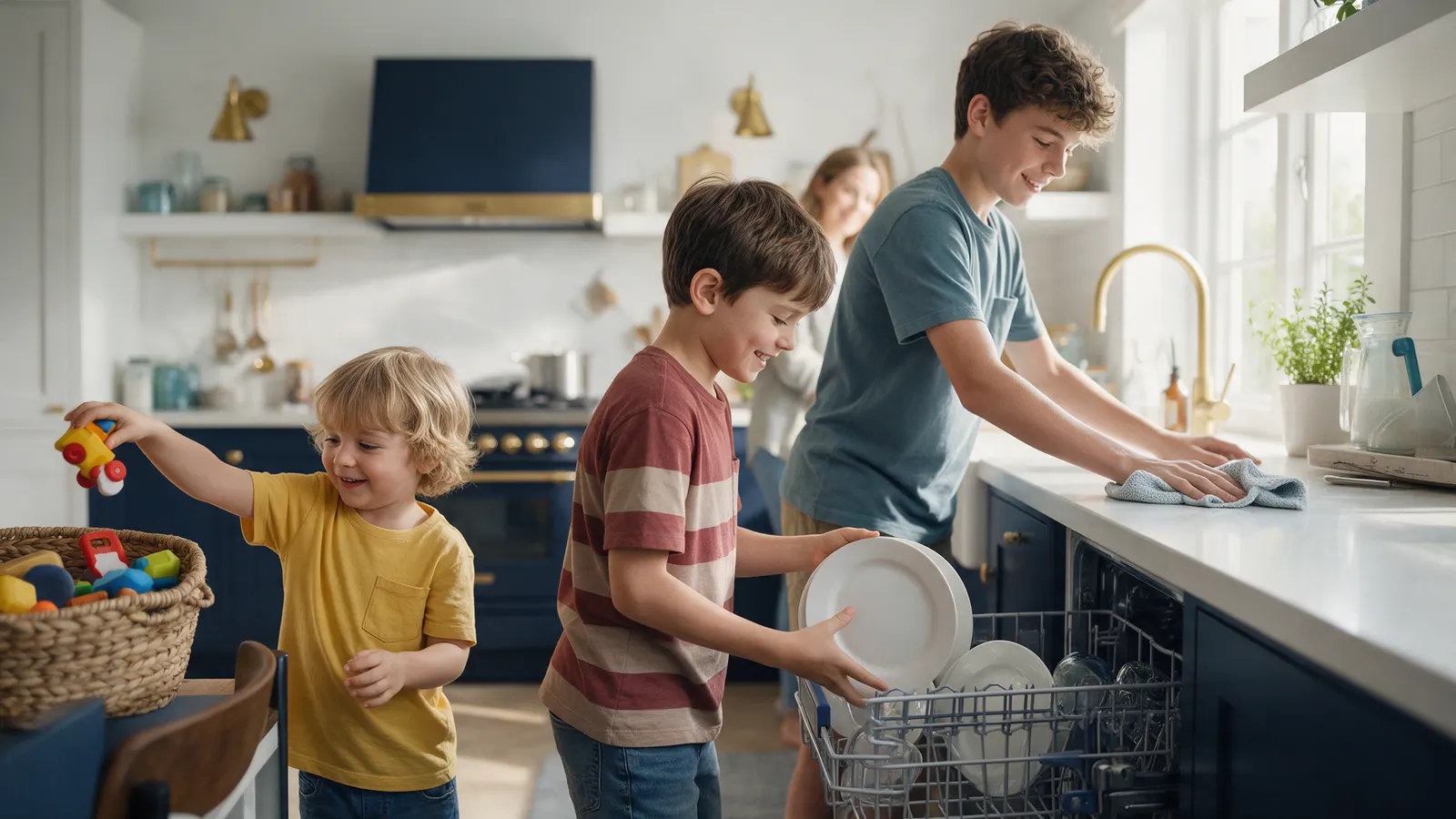
Somewhere between "she's too little" and "he's too busy," a lot of kids never get a real job at home. The research on chores by age is unusually clear: the earlier kids start, the better they tend to do later, and the starting line is younger than most of us guess.
Here's what kids can actually handle at 3, 5, 8, 12 and 15, what's safe, which chores stay unpaid, and what US families pay for the extras. Every number comes from a named source at the bottom.
Why "start at 3" isn't a joke
The most-cited finding is Marty Rossmann's at the University of Minnesota. She analyzed data on 84 people tracked from preschool into their mid-20s in Diana Baumrind's longitudinal study and found that the best predictor of success in the mid-20s was having helped with household tasks at age 3 or 4. Kids who didn't start until 15 or 16 did worse, not better. Rossmann also flagged how tasks are presented: not overwhelming, kids involved in choosing them, and not done for an allowance.
A much larger, more recent study points the same way. Researchers followed 9,971 US children from kindergarten to third grade and found that doing chores in kindergarten was linked to stronger self-competence, prosocial behavior and better math scores by third grade, after adjusting for family income and parent education.
And if you've heard about the "Harvard study on chores," that's Julie Lythcott-Haims, author of How to Raise an Adult, citing the Harvard Grant Study in her TED talk: professional success tracks with having done chores as a kid, "and the earlier you started, the better."
None of this means a 3-year-old should scrub toilets. It means a 3-year-old who carries her plate to the sink is doing something that matters.
Required vs. paid: the rule that keeps chores from becoming a negotiation
Required chores are the price of living in a house with other people: your room, your dishes, your laundry, your share of the common spaces. Nobody gets paid for these. Ron Lieber, the New York Times money columnist and author of The Opposite of Spoiled, doesn't tie allowance to chores at all, because kids should contribute to the family whether or not money is involved. He treats allowance as a separate tool for learning to handle money.
Paid chores are the extras: washing the car, clearing out the garage, the jobs you might otherwise pay a neighbor's kid to do. They're optional, priced in advance, and open to anyone in the house who wants them.
Most American families do connect money and chores somehow. In a 2019 Harris Poll for the AICPA, 80% of parents who give an allowance said their kids have to earn it. The trick is being precise about which chores earn and which don't, so "I'll skip my room, keep your money" is never on the table. In Chorevia, every chore is tagged Required or Paid when you create it, so the line is visible to the kid, not just in your head.
The big age-by-age table
Every child develops at a different pace. The backbone here is the University of Arkansas Cooperative Extension's Appropriate Chores by Age list by family life specialist Dr. Brittney Schrick, whose bands (2+, 4+, 6+, 8+, 10+, 12+) each include the ages before. Dollar figures are each report's all-ages US average for that chore (RoosterMoney 2019 in the 8 and 12 rows, GoHenry 2021 in the 15 row), placed at the age the chore usually becomes appropriate; neither report breaks pay out by age.
| Age | Readiness | Required (unpaid) | Paid extras | Safety notes |
|---|---|---|---|---|
| 3 | One-step instructions, imitating you | Toys in the bin, clothes in the hamper, plate to the sink, trash in the can | None yet. A sticker chart and your attention do the job. | Always supervised. No chemicals, no small parts, nothing near the stove. |
| 5 | Two- and three-step routines, simple sorting | Make the bed, feed pets, set and clear the table, put away flatware, water plants | Tiny ones: pulling weeds, matching socks, wiping baseboards | Butter knife only. You measure the pet food. Damp cloth, not the spray bottle. |
| 8 | Multi-step jobs with a checklist, basic appliances | Put away own laundry, load and unload the dishwasher, take out trash, sweep, pack school lunch | Vacuuming ($1.75), dog walking ($1.70), mopping ($1.68), dusting ($1.44), helping with dinner ($1.40) | Knives point down in the dishwasher. Microwave and toaster yes; stovetop only with you in the room. |
| 12 | Full routines without reminders, planning | Own laundry start to finish, change bed linens, clean a bathroom, cook a simple dinner once a week | Washing the car ($5.76), gardening ($2.55), window cleaning ($2.42), push-mowing (AAP minimum age 12) | Mowing: long pants, sturdy shoes, adult present at first. Stove and oven after you've watched them do it. |
| 15 | Adult-level competence, needs adult-level respect | Cook a complete meal, shop from a list, own a whole zone (kitchen night, yard, bathrooms) | Mowing ($9.26), babysitting ($8.57), gardening ($5.32), car washing ($4.57), painting and simple repairs with guidance | No riding mower until 16 (AAP). Power tools only after hands-on training. Babysitting after a course. |
Age 3: the imitation years
Three-year-olds want to do what you do. They're bad at it, and that's fine. The point at 3 isn't output; it's the habit of being someone who helps. Keep every job under two minutes, do it alongside them, and let them see you notice.
Safety: everything supervised, no chemicals, nothing near a hot stove or an open dishwasher with knives in it.
Age 5: the routine years
By 5, a kid can run a short routine alone: make the bed, feed the dog, set the table, clear it after, fix a simple snack. It's a fine age for a first taste of paid work; keep it tiny and optional. A quarter for a basket of matched socks isn't about the money; it's about learning that extra work and expected work are different things.
Safety: butter knife, no stove, and you measure the pet food. A spray bottle of plain water and a rag gives the wiping experience without the cleanser.
Age 8: the checklist years
Eight is where chores get real: dishwasher, trash, mopping, groceries, their own school lunch, chopping and mixing for family meals. It's also where the required-vs-paid split starts to matter, because kids now understand money well enough to bargain. Keep the big three unpaid: their room, their laundry, their dishes. Then open a short menu of paid extras. In RoosterMoney's 2019 Kids Allowance Report, based on 20,000 US families, the going rates were $1.75 for vacuuming, $1.70 for walking the dog, $1.68 for mopping, $1.44 for dusting and $1.40 for helping with dinner. Not riches. Enough to learn from.
Safety: knives point down in the dishwasher basket. Toaster and microwave are fine; stovetop only with an adult in the kitchen. Trash bags they can lift without dragging.
Age 12: the independence years
By 10, the Arkansas list already includes laundry, changing bed linens, cleaning the kitchen and bathroom, and using the oven and stove. At 12 it adds grocery shopping from a list, washing and vacuuming the car, cooking a complete meal, and simple home repairs with guidance.
Twelve is also the American Academy of Pediatrics' minimum age for a push mower. UPMC Children's Hospital of Pittsburgh summarizes the AAP guidance: 12 for a walk-behind power mower, 16 for a riding mower, kids under 5 indoors while anyone is mowing, and no cutting wet grass. Some chore lists, including Arkansas's, put mowing at 10+. Go with the pediatricians.
This is the right age for the big lesson, too. Chorevia's founder frames it as the rent-and-groceries question: if you had to pay for your room and the food you eat, what would that cost? Most kids meet that lesson at 22; the app's premise is teaching it at 8. A 12-year-old can grasp that a household has costs, and a pretend version of those costs, worked off with chores, is a safe place to learn it. Keep it a game with pretend numbers, not a bill they owe you. Keep it a game with pretend numbers, not a bill they owe you.
Safety: long pants, sturdy closed-toe shoes, and you standing there for the first several mows. Stove and oven only after you've watched them do it, twice.
Age 15: the roommate years
A 15-year-old can do most of what an adult can do around a house. The question is no longer ability; it's ownership. Hand over a whole zone: one dinner a week from planning to cleanup, the yard, the bathrooms. A zone can't be half-done or handed back.
Paid chores at 15 look like a first job. GoHenry's 2021 US Youth Economy Report, built on transaction data from 57,000 US kids aged 6 to 18, put average pay at $9.26 for mowing the lawn, $8.57 for babysitting, $5.32 for gardening and $4.57 for washing the car. If you're paying a teenager two dollars to mow the lawn, you're well below what other families pay, and they probably know it.
Safety: still no riding mower until 16 per the AAP. Power tools only after hands-on training. Babysitting after a real course, and never a first solo job with an infant.
What US families actually pay, side by side
Three sources, three methods, and they don't agree. That's useful.
- RoosterMoney (2019, 20,000 US families): average weekly allowance $8.24; top-paid chore is washing the car at $5.76.
- GoHenry (2021, 57,000 US kids ages 6 to 18): average weekly allowance $9.15, with mowing and babysitting close to $9 a job.
- AICPA / Harris Poll (2019, 1,002 US adults): average weekly allowance $30, about 5.1 hours of chores a week, and 66% of parents giving an allowance at all.
The gap between $8 and $30 is partly method: the app figures are recorded transactions, the AICPA figure is what parents told a pollster. Use the app figures to price individual chores and the AICPA figure as a reality check for the teen years.
How to set your own prices: a five-step checklist
- Sort every chore into Required or Paid before you talk money. If a kid could reasonably be expected to do it just because they live there, it's Required.
- Price paid chores in advance and in writing. A posted price ends the haggling. Start near the national averages above and adjust for your area.
- Pay per job, not per hour. Kids don't control the clock, and hourly pay rewards slowness.
- Keep the money small and the pride large. Rossmann's research points to responsibility and competence as the mechanism, not the cash.
- Review the proof, then pay promptly. A photo of the clean car and a same-week payout closes the loop. If you'd rather not do the math, Chorevia can suggest a fair price per chore from these same national averages and keeps an earnings ledger of what was earned and paid.
The short version
Start at 3 with two-minute jobs done next to you. By 5, a routine. By 8, a checklist and a small menu of paid extras. By 12, real independence and the family-costs lesson. By 15, whole zones and paid work near the going rate. Keep living-in-the-house chores unpaid, price the extras clearly, and let the pride do most of the work.
If you want one place to hold the Required/Paid line, the point goals and the earnings ledger, Chorevia is free to use on the web, with an iPhone app in development. Adults still make every call; the app just keeps score.
This article is general parenting information, not financial advice for your specific household.
Sources
- Marty Rossmann, University of Minnesota, "Involving Children in Household Tasks: Is It Worth the Effort?" (September 2002; PDF reproduced by Good Housekeeping): https://ghk.h-cdn.co/assets/cm/15/12/55071e0298a05_-_Involving-children-in-household-tasks-U-of-M.pdf
- White EM, DeBoer MD, Scharf RJ, "Associations Between Household Chores and Childhood Self-Competency," Journal of Developmental & Behavioral Pediatrics 40(3):176–182 (April 2019): https://pubmed.ncbi.nlm.nih.gov/30507727/
- Julie Lythcott-Haims, "How to raise successful kids — without over-parenting," TED (November 2015): https://www.ted.com/talks/julie_lythcott_haims_how_to_raise_successful_kids_without_over_parenting
- Brittney Schrick, "Appropriate Chores by Age: 2 – Teen," University of Arkansas System Division of Agriculture, Cooperative Extension Service: https://www.uaex.uada.edu/life-skills-wellness/personal-family-well-being/family-life-fridays-blog/posts/images/Appropriate%20Chores%20by%20Age.pdf
- UPMC Children's Hospital of Pittsburgh, "Lawn Mower Safety Tips" (summarizing American Academy of Pediatrics age guidance): https://www.chp.edu/injury-prevention/safety/home-and-yard/lawnmowers
- RoosterMoney, "Top 10 Most Lucrative Kids Chores This Summer, Revealed by RoosterMoney" (Kids Allowance Report), PR Newswire (July 30, 2019): https://www.prnewswire.com/news-releases/top-10-most-lucrative-kids-chores-this-summer-revealed-by-roostermoney-300893045.html
- GoHenry, "Report Reveals U.S. Kids Contributed $24.3B to the Economy During COVID-19" (US Youth Economy Report), PRWeb (April 27, 2021): https://www.prweb.com/releases/report_reveals_u_s_kids_contributed_24_3b_to_the_economy_during_covid_19/prweb17891580.htm
- AICPA / The Harris Poll, reported by FOX6 Milwaukee, "Survey: 66% of parents give their children an allowance; kids are raking in $30/week on average" (October 7, 2019): https://www.fox6now.com/news/survey-66-of-parents-give-their-children-an-allowance-kids-are-raking-in-30-week-on-average
- Ron Lieber, "How to Raise Kids Who Aren't Spoiled," DailyGood (on The Opposite of Spoiled): https://www.dailygood.org/story/999/how-to-raise-kids-who-aren-t-spoiled-ron-lieber/
Run it at home with Chorevia
Chores with points and proof, a reward ladder you design, and a family economy where kids work off monthly costs. Adults always make the call. Free for families.
Create your household