How to Stop Nagging Kids About Chores: A 2-Week Reset Plan
The Chorevia Team · September 21, 2026 · 8 min read
Nagging is the chore strategy most of us fall back on, and the research explains why it backfires. Here is how to replace it with a visible routine, a "show me" proof step, and consequences that run themselves, plus a two-week reset plan.
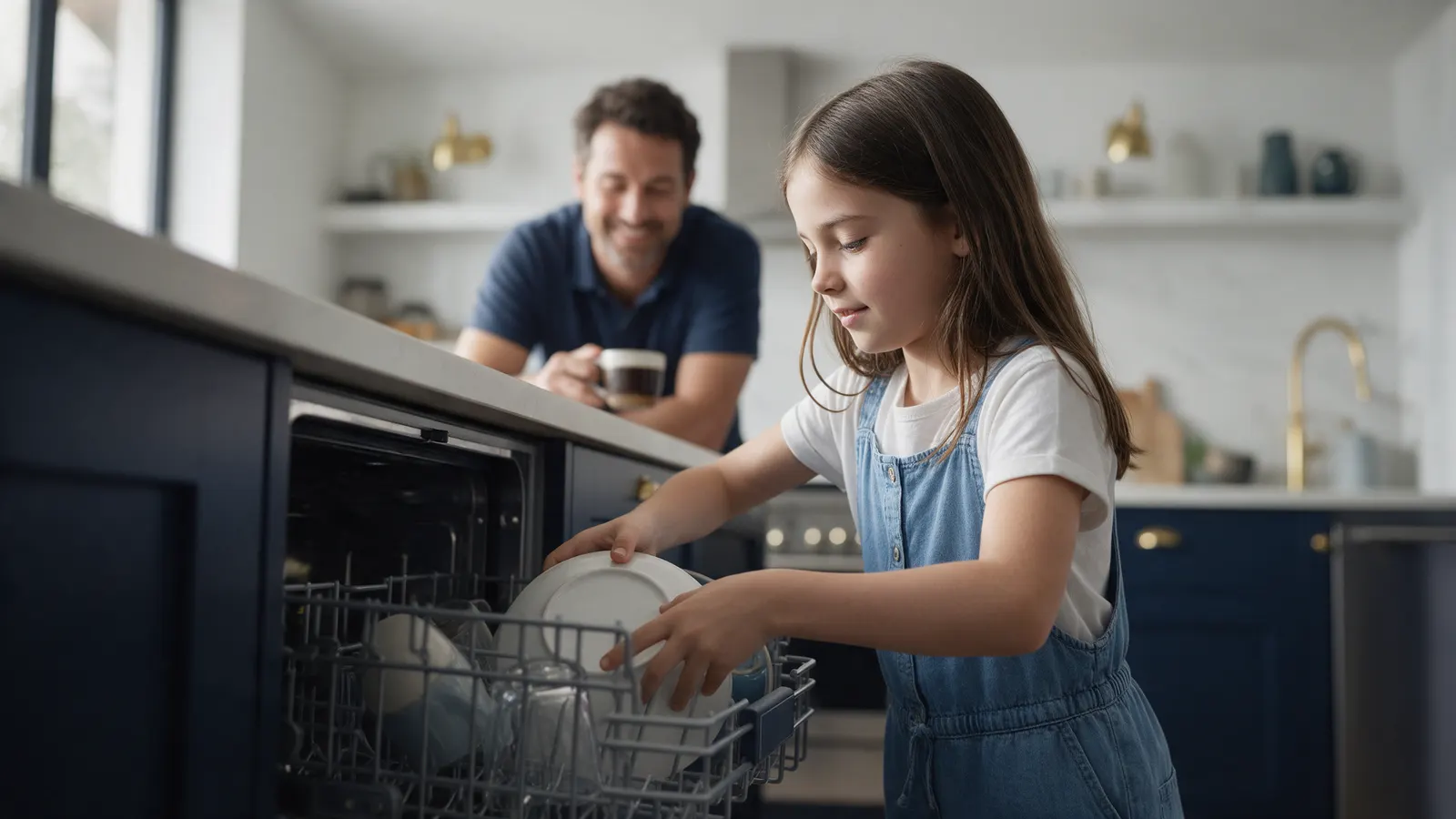
You have said "Did you empty the dishwasher?" four times since dinner. The dishwasher is still full. Your kid is somehow still on the couch, and you are somehow the one who feels bad.
You are in good company. In a Braun Research poll of 1,001 parents reported by the Boston Globe, 82 percent said they did chores growing up, but only 28 percent regularly assign them to their own kids. The gap between those two numbers is a lot of parents who tried, nagged, and quietly gave up.
Nagging fails for predictable reasons, and none of them is a character flaw in you or your kid. The fix is mostly structural: make the routine visible, replace "did you do it?" with "show me," and let earned privileges and natural consequences carry the weight your voice has been carrying. Here is how to set that up, with a two-week plan at the end.
Why nagging fails (it is the reminder, not you)
Three findings explain the couch situation.
Reminders create pushback, not compliance. Psychologists call it reactance: when people feel their freedom being squeezed, they push to get it back, sometimes by doing the opposite of what was asked. A four-study project in Child Development with 1,472 adolescents ages 12 to 21 found that a pressuring, controlling parenting style went with kids feeling pushed, which went with reactance, which went with more acting out and more inner distress. Nagging is the everyday, low-grade version of that pressure. By the fourth "empty the dishwasher," your kid cannot empty it without feeling like they lost.
Pressure drains the motivation you actually want. Decades of self-determination research by Edward Deci and Richard Ryan show that threats, deadlines, directives, and pressured evaluations reliably lower intrinsic motivation, and that autonomy-supportive parents have more intrinsically motivated kids than controlling parents do (Ryan and Deci, 2000). A nag is a directive with a deadline, delivered as an evaluation. It hits the whole list.
Repetition wears your words out. Yale psychologist Alan Kazdin, author of The Kazdin Method for Parenting the Defiant Child, notes that studies show "saying something fifty times is usually less effective than saying it once or twice" (quoted in Psychology Today). Every reminder that does not produce the chore teaches your kid that reminders are background noise. Past a point, Kazdin adds, reminders become unpleasant in their own right, the same way punishment does.
And every reminder you give is one they do not have to give themselves. The goal is not a better reminder. It is a system in which the reminder is not you.
Build a routine the house can see
Habits form by repeating a behavior in the same context until it runs on its own. In the best-known study of real-world habit formation, 96 volunteers each picked one daily behavior and tied it to a cue like "after breakfast." Automaticity climbed for an average of 66 days before it plateaued, with a range from 18 days to a projected 254. Missing a single day had little effect. A string of missed days did.
Two lessons for chores. First, the cue matters more than the chore: "dishwasher after dinner" beats "dishwasher sometime tonight" every time. Second, plan for two months, not two weeks, and do not treat one missed day as proof the system failed.
Then make it visible. A chart on the fridge or a shared app both work; the point is that the plan lives somewhere other than your mouth. Marty Rossmann's University of Minnesota research, which followed 84 people from ages three and four into their mid-20s, found that doing household tasks at three or four was the best predictor of success in young adulthood. Kids who did not start until 15 or 16 actually did worse. Rossmann also recommends involving kids in choosing their tasks, through a family meeting or a weekly chore chart, and presenting tasks in a way that fits the child rather than overwhelms them. Start early, and let them pick.
What "done" looks like by age
| Age | Good starter chores | Cue | What proof looks like |
|---|---|---|---|
| 4 to 6 | Toys in the bin, plate to the sink, matching socks | Right after dinner | You take the photo together; it is a game |
| 7 to 9 | Make the bed, feed the pet, empty small trash cans | Before screen time | Kid snaps the photo |
| 10 to 12 | Unload the dishwasher, fold own laundry, vacuum one room | After the after-school snack | Before-and-after photo |
| 13 to 17 | Cook one dinner a week, own laundry start to finish, clean a bathroom | A weekly deadline they choose | 15-second video walkthrough |
Adjust for your kid. The table is a starting point, not a standard.
The "show me" principle
"Did you do it?" is a yes-or-no question that invites a yes. "Show me" is a handoff.
Swap the interrogation for a quick proof step: a photo of the empty dishwasher, a before-and-after of the bathroom, a 15-second video walkthrough of the bedroom. The kid decides when the loop closes, you review when it is convenient, and nobody stands in a doorway with their arms crossed.
One caveat. Deci and Ryan's review of autonomy support versus control found that being watched and expecting to be evaluated both tend to undermine intrinsic motivation, even when the evaluation turns out to be positive. So proof has to feel like closing a ticket, not passing inspection:
- The standard is written down in advance. Three bullets per chore is plenty.
- The review is binary. Done, or not yet. Nobody scores the photo.
- The evidence stays in the family. Your kid's bathroom is not a group-chat exhibit.
- The kid submits on their own schedule inside the cue window. You are not watching them work.
This is how Chorevia handles it: kids sign in with their own username and PIN, submit photo or short-video proof, and an adult marks it complete. There is an optional AI photo review, off by default, and it never makes the call. Adults do.
Nobody grades their own work
Fairness is the thing kids litigate hardest, so remove the ambiguity before it starts.
- One standard, written down. "Clean bathroom" means: counter wiped, toilet cleaned, floor swept, trash out. If it is not on the list, it is not the standard.
- The doer never reviews. A kid submits; a parent, the other parent, or a roommate reviews. Adults too: if you cook, someone else signs off on the kitchen.
- Same process across siblings. Different chores by age, same review, same consequences.
- Required is separate from paid. Some chores are simply part of living in the house and are never paid. Others are extra, and those can carry a price. Rossmann cautions against making kids do household tasks for an allowance, which is exactly why the split matters: the baseline is unpaid; only the extras earn. Chorevia builds this into the structure. Every chore is either required or a paid special chore, and each carries points and a dollar value, so the difference is visible instead of argued about.
Write these down once and the 9 p.m. debate about what "clean" means mostly disappears.
Let consequences and privileges do the talking
A consequence you have to deliver in the moment is a nag in a costume. A consequence that was set up in advance, in daylight, when everyone was calm, runs itself.
Natural consequences. If the laundry is not done, the jersey is not clean on game day. You do not need to add a speech. The jersey is the speech.
Earned privileges. Tie the good stuff to the work and let the ladder talk. Kazdin's advice, summarized in the same Psychology Today piece, is that punishment changes behavior only briefly, while specific praise for the behavior you want is one of the most reliable ways to change it. A reward ladder does this on autopilot: internet access at 50 points, pick-the-menu dinner at 100, movie night at 150. When the points are not there, the privilege is not either, and nobody has to play the bad guy. In Chorevia the family builds the ladder, each kid can have a monthly point goal, the app announces when a rung unlocks, and a parent grants the reward.
Praise the process, specifically. When you do say something, make it about what they did, not who they are. Carol Dweck's classic experiments with fifth graders found that kids praised for effort persisted longer, enjoyed the task more, and performed better after a setback than kids praised for being smart. "You got the whole floor, corners included" beats "you are so responsible."
One quick note: this is general parenting guidance, not therapy. If chore refusal comes wrapped in bigger struggles, that is a conversation with a pediatrician or family therapist, not a chore chart.
The 2-week reset plan
Announce it once, then follow the plan instead of your instincts.
Days 1 to 2: The family meeting
- Explain the change in one sentence: "Fewer reminders, clearer rules, real rewards."
- Let each kid pick two or three chores from a list you have pre-approved.
- Agree on the cue for each one ("after dinner," "before screens").
- Write the three-bullet "done" definition for each chore, together.
Days 3 to 7: Run it quiet
- One cue, not five. The cue is the reminder. You are not.
- Say "show me," never "did you."
- Review proof as done or not yet. No commentary on the photo.
- Praise one specific thing per completed chore.
- When a chore is skipped, let the natural consequence land without narration.
Day 8: Check-in
- Ask what was annoying. Fix the cue or the standard, not the kid.
- Drop any chore that was too big. Add one that was too small.
Days 9 to 13: Add the ladder
- Post the reward ladder where everyone can see it.
- Grant the first rung the day it unlocks. Speed matters more than size.
Day 14: Retro
- Count the reminders you gave this week versus two weeks ago. Write the number down.
- Ask your kid what they would change. Then change one thing.
What to expect
Expect week one to be louder, not quieter; the pushback does not stop the day the reminders do. Week two is usually where the dishwasher starts emptying itself while you are somewhere else, which is the whole point.
Give it the two months the habit research says it takes. A missed day is not a failed plan. A missed cue, a vague standard, or a privilege that never quite arrives usually is, and all three are fixable at the next family meeting.
If you would rather keep the routine, the proof step, and the reward ladder in one place instead of on the fridge and in your head, Chorevia is free and built for exactly this. Responsibilities completed. Rewards earned. Families aligned. And a lot fewer evenings saying "dishwasher."
Sources
- Van Petegem, S., Soenens, B., Vansteenkiste, M., & Beyers, W. (2015). Rebels With a Cause? Adolescent Defiance From the Perspective of Reactance Theory and Self-Determination Theory. Child Development, 86(3), 903–918. https://selfdeterminationtheory.org/wp-content/uploads/2019/07/2015_VanPetegemSoenensVansteenkisteBeyers_CD.pdf
- Ryan, R. M., & Deci, E. L. (2000). Self-Determination Theory and the Facilitation of Intrinsic Motivation, Social Development, and Well-Being. American Psychologist, 55(1), 68–78. https://selfdeterminationtheory.org/SDT/documents/2000_RyanDeci_SDT.pdf
- Deci, E. L., & Ryan, R. M. (1987). The Support of Autonomy and the Control of Behavior. Journal of Personality and Social Psychology, 53(6), 1024–1037. https://selfdeterminationtheory.org/SDT/documents/1987_DeciRyan_JPSP.pdf
- Turner, E. A. (2013, January 2). 4 Parenting Myths: Tips on Managing Behavior Problems (quoting Alan Kazdin, The Kazdin Method for Parenting the Defiant Child). Psychology Today. https://www.psychologytoday.com/us/blog/the-race-good-health/201301/4-parenting-myths-tips-managing-behavior-problems
- Lally, P., van Jaarsveld, C. H. M., Potts, H. W. W., & Wardle, J. (2010). How are habits formed: Modelling habit formation in the real world. European Journal of Social Psychology, 40(6), 998–1009. https://onlinelibrary.wiley.com/doi/10.1002/ejsp.674
- University of Minnesota (2002, September). Involving Children in Household Tasks: Is It Worth the Effort? Research summary of Marty Rossmann's analysis of Diana Baumrind's longitudinal data (PDF copy hosted by Good Housekeeping). https://ghk.h-cdn.co/assets/cm/15/12/55071e0298a05_-_Involving-children-in-household-tasks-U-of-M.pdf
- Mueller, C. M., & Dweck, C. S. (1998). Praise for Intelligence Can Undermine Children's Motivation and Performance. Journal of Personality and Social Psychology, 75(1), 33–52. https://www.columbia.edu/cu/psychology/courses/3615/Readings/Mueller_Dweck.pdf
- Albernaz, A. (2015, December 8). Sparing chores spoils children and their future selves, study says. The Boston Globe (reporting the Braun Research poll commissioned by Whirlpool). https://www.bostonglobe.com/lifestyle/2015/12/08/research-indicates-sparing-chores-spoils-children-and-their-future-selves/ZLvMznpC5btmHtNRXXhNFJ/story.html
Run it at home with Chorevia
Chores with points and proof, a reward ladder you design, and a family economy where kids work off monthly costs. Adults always make the call. Free for families.
Create your household