How to Teach Kids Financial Skills That Last (Age-by-Age Plan)
The Chorevia Team · September 21, 2026 · 8 min read
The foundations of money behavior are usually in place by age seven. Here is what the research says about chores, allowance, and a family economy, with a concrete plan for every age from 5 to 18.
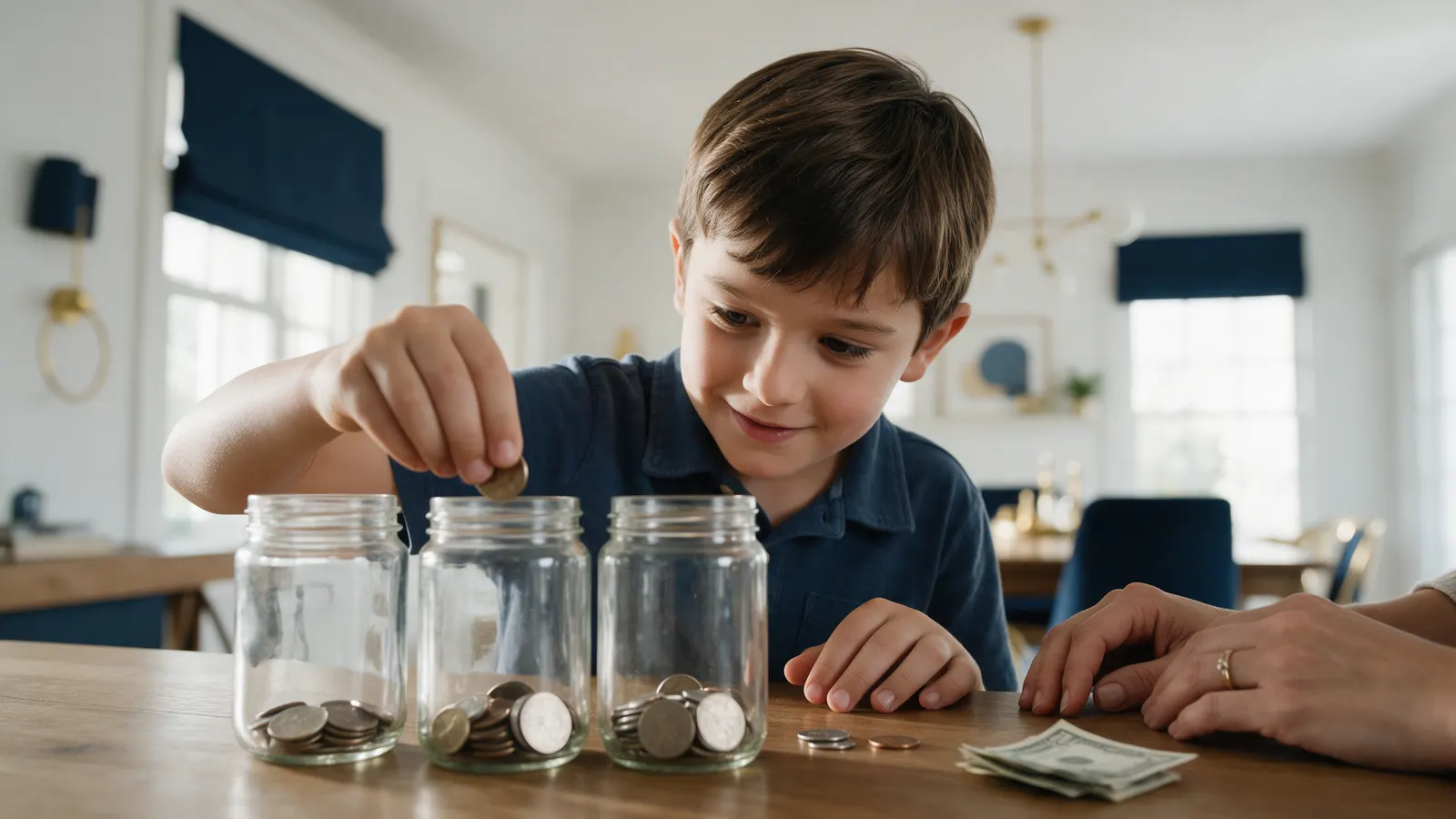
If you had to pay rent for your room and the food you eat, you would learn fast what money is for. Most kids meet that lesson at 22, usually the same month they discover security deposits. It does not have to wait that long. The research points one way: start early, keep it concrete, and let kids practice while the stakes are small.
Here is how to teach kids financial skills that stick, from kindergarten to the last summer before they leave home.
Why money habits form so early
In 2013 the UK's Money Advice Service published a review by University of Cambridge researchers David Whitebread and Sue Bingham on how young children learn and form habits. Their report, Habit Formation and Learning in Young Children, found that by about age seven, several basic concepts behind later financial behavior have typically developed. A seven-year-old can hold the idea of value in mind, understands that money is exchanged for goods, and knows that change comes back when you hand over more than something costs.
You will see this quoted online as "money habits are set by age 7," which overstates it. The window does not slam shut at seven; the foundation is poured by then, and what gets built on it depends on what happens next.
The Consumer Financial Protection Bureau's Building Blocks framework describes that "next" in three interconnected building blocks:
- Executive function (ages 3 to 5): planning, focus, memory, self-control. The raw material for saving.
- Financial habits and norms (ages 6 to 12): the routines and rules of thumb kids absorb by watching adults and practicing.
- Financial knowledge and decision-making (ages 13 to 21): comparing options, researching, planning purchases.
Both reports land on the same point: children learn about money by observation, instruction, and hands-on practice. Talking about money helps. Letting kids handle it helps more.
Chores come first, money comes second
Before money, there is work. The most-cited study is Marty Rossmann's University of Minnesota analysis of 84 people followed from preschool into their mid-20s, using data from Diana Baumrind's long-running parenting study. Rossmann found that the best predictor of success in the mid-20s, measured by things like finishing school, starting a career, solid relationships, and staying off drugs, was whether the person had helped with household tasks at age three or four. Starting at 15 or 16 did not help; in that sample it appeared to backfire.
The takeaway is not that toddlers should vacuum. It is that a four-year-old who puts toys away learns something a teenager cannot be lectured into: I am someone who contributes here. Money skills grow well in that soil. Without it, an allowance is just a subsidy.
Rossmann adds three notes: keep tasks manageable, let kids help choose their tasks (a family meeting or a weekly chart both work), and never make chores something children do only for an allowance.
The allowance debate, honestly
Three camps, each with a point.
Camp one: pay for chores. This is what most allowance-giving American families do. In a 2019 Harris Poll survey for the AICPA, 80% of parents who give an allowance require chores in exchange, the average allowance works out to about $120 a month, and kids put in roughly five hours of chores a week to earn it. The logic: money comes from work, so tie them together from day one.
Camp two: allowance is a teaching tool, not a wage. Ron Lieber, the New York Times personal-finance columnist and author of The Opposite of Spoiled, argues against linking the two. As the AFCPE's review of his book puts it, paying for chores "puts the focus on the work, not the money." Chores are what everyone does because they live in the house; the allowance exists so children can practice spending, saving, and giving while the amounts are small. Lieber suggests three jars: roughly 10% to give, 20% to save, the rest to spend.
Camp three: some of both. Required chores stay unpaid. Extra jobs beyond the baseline (washing the car, weeding, clearing the garage) can be paid. A small allowance can sit alongside, purely for practice.
What does the research say? Two things.
First, allowances appear to help. In T. Rowe Price's 2015 Parents, Kids & Money Survey of 1,000 parents and 881 kids aged 8 to 14, kids with an allowance were twice as likely to call themselves knowledgeable about managing personal finances (32% vs. 16%) and more likely to feel smart about money (40% vs. 25%). A survey cannot prove cause, but it fits the Cambridge finding: kids learn by handling money.
Second, paying for everything carries a cost. A 1999 meta-analysis of 128 experiments by Edward Deci, Richard Koestner, and Richard Ryan found that expected, tangible rewards reliably reduced intrinsic motivation, and the effect was stronger in children than in college students. Positive feedback increased it. One catch: that effect showed up for activities people already found interesting; for dull tasks, rewards did not hurt and sometimes helped. In kitchen terms: a price on the garage clean-out is fine, but do not put one on the things you want your kid to do because they live here, or the reason shrinks to the dollar and vanishes the week they already have $20.
Our reading: camp three is the sturdiest. Keep a floor of required, unpaid chores that define what it means to live in your home. Put real money on the extras. Praise specifically and often. That is the structure Chorevia is built around: every chore is either required (part of living here, never paid) or a paid special job, and an optional AI helper suggests a fair price per chore from published US averages.
An age-by-age plan
| Age | Core lesson | Practices that work | Watch for |
|---|---|---|---|
| 5 to 7 | Money is finite and it is exchanged for things | Cash they can touch; three jars; one required chore; small purchases they pay for | Tantrums at the register are data, not failure |
| 8 to 11 | Choices have trade-offs; waiting pays | Weekly allowance; a pictured savings goal; paid extra jobs; a points target with a reward ladder | Spending everything the first week (let it happen once) |
| 12 to 14 | Budgets, bills, and the gap between want and need | A category budget they own; a simulated rent-and-food statement; price comparison before buying | Borrowing from parents becoming a habit |
| 15 to 18 | Earning, banking, and the cost of a real life | Checking account and debit card; a part-time job or bigger paid projects; one real bill they are responsible for paying; a look at your real budget | Overconfidence right before independence |
Ages 5 to 7: make money physical
Kids this age cannot reason about numbers on a screen, but they can count coins. Give a small allowance in cash, split across spend, save, and give jars. Assign one or two required chores that are clearly theirs. When they want a $6 toy and have $4, let the gap do the teaching.
Ages 8 to 11: introduce trade-offs and goals
This is the sweet spot for habits. Move to a weekly allowance, add paid extra jobs, and set a savings goal they chose. A reward ladder works well here. In Chorevia, each kid can have a monthly point goal and the family builds a ladder such as Internet access at 50 points, a free dinner at 100, movie night at 150; the app announces the unlock and you grant the reward. Effort accumulates into things you want, which is what a paycheck teaches.
Ages 12 to 14: show them the bills
Middle schoolers are ready to see how a household runs. Give them a category budget (a season's clothes, say) and let them own it, including the consequences of blowing it in week one. Name fixed costs out loud: rent or mortgage, food, phone, internet. This is the age where a simulated family economy earns its keep.
Ages 15 to 18: practice on real rails
Open a checking account. Let them handle one real bill; their phone line is the classic. If they have a job, walk through the first pay stub together and explain why the number is smaller than expected. Show them your real budget, or at least its shape. The goal at 18 is not a kid who never makes a money mistake. It is one who has already made the small ones.
The family economy: rent, food, and a monthly statement
This is the approach behind the line at the top. Give each kid a set of simulated monthly costs: room rent, food, internet, maybe a phone line. Chores earn against those costs. At month's end they get a statement, like an adult does: earned, owed, what is left.
Two rules keep this healthy. First, the money is simulated and kept deliberately separate from real cash; nobody is literally charging a nine-year-old rent. Second, adults set the numbers and adults make every call; software only does the bookkeeping. In Chorevia, a kid snaps a photo or short video when a chore is done, a parent reviews it (a person, not software, makes the call), and the Family Economy keeps the bills and the monthly statement. Kids are not employees and they are not assets. They are apprentices in a household they already belong to, learning that costs arrive whether or not you feel like working, and that a statement is a story about your month, not a verdict on your worth.
Common mistakes
- Paying for everything. See the Deci findings above. Keep a floor of unpaid, required chores.
- Paying for nothing. Kids who never handle money never get to practice. The T. Rowe Price numbers are hard to ignore.
- Rescuing too fast. The week they blow the whole allowance on stickers is the best lesson of the year. Do not top it up. The same T. Rowe Price survey found kids whose parents let them make money mistakes were more likely to call themselves knowledgeable (36% vs. 16%).
- Vague chores. "Clean your room" invites negotiation. "Clothes in the hamper, floor clear, bed made" invites completion.
- Using money as punishment. Docking pay for attitude turns the system into a fight. Consequences for behavior belong elsewhere.
- Keeping money secret. Kids who never see a bill paid learn that money is magic. Narrate the grocery total, the electric bill, the impulse buy you skipped.
A checklist you can start this week
- Pick one or two required, unpaid chores per kid, matched to age.
- Decide on a small allowance, a family-economy model, or both. Write the rules down.
- Set up three jars (or three named buckets) for spend, save, and give.
- Post two or three paid extra jobs with prices.
- Choose a savings goal with each kid and post a picture of it.
- Set a fixed review time (after dinner works) so finished chores get acknowledged daily.
- Schedule one money conversation a month: a bill, a purchase decision, a statement.
- Praise the process ("you saved for three weeks") more than the outcome.
None of this is financial advice for your specific household; amounts and rules should fit your budget and your kids. But the research pattern is consistent: early, concrete, and hands-on beats late, abstract, and occasional.
If you would rather not run the bookkeeping on a whiteboard, Chorevia is a free web app that keeps required and paid chores separate, tracks points and a reward ladder, and produces a monthly statement your kid can read. Every decision stays with you.
Sources
- Whitebread, D. and Bingham, S. (2013). Habit Formation and Learning in Young Children. University of Cambridge, published by the Money Advice Service. https://web.archive.org/web/20220127085521/https://www.maps.org.uk/wp-content/uploads/2021/03/the-money-advice-service-habit-formation-and-learning-in-young-children-may-2013.pdf
- Consumer Financial Protection Bureau. Building Blocks to Help Youth Achieve Financial Capability. https://www.consumerfinance.gov/consumer-tools/educator-tools/youth-financial-education/learn/
- University of Minnesota (2002, September). Involving Children in Household Tasks: Is It Worth the Effort? Research summary of Marty Rossmann's analysis of Diana Baumrind's longitudinal data (PDF copy hosted by Good Housekeeping). https://ghk.h-cdn.co/assets/cm/15/12/55071e0298a05_-_Involving-children-in-household-tasks-U-of-M.pdf
- Journal of Accountancy / AICPA (2019). Children's average allowance in 2019: $120 a month (Harris Poll survey for the AICPA). https://www.journalofaccountancy.com/news/2019/oct/average-child-allowance-2019-201922088/
- T. Rowe Price (2015). Kids Who Get an Allowance Are More Money Savvy Than Those Who Do Not (7th annual Parents, Kids & Money Survey, via PR Newswire). https://www.prnewswire.com/news-releases/t-rowe-price-kids-who-get-an-allowance-are-more-money-savvy-than-those-who-do-not-300134202.html
- Deci, E. L., Koestner, R. and Ryan, R. M. (1999). A meta-analytic review of experiments examining the effects of extrinsic rewards on intrinsic motivation. Psychological Bulletin, 125(6), 627-668. https://home.ubalt.edu/tmitch/642/articles%20syllabus/Deci%20Koestner%20Ryan%20meta%20IM%20psy%20bull%2099.pdf
- AFCPE (2016). Review of The Opposite of Spoiled by Ron Lieber. https://www.afcpe.org/news-and-publications/the-standard/2016-1/the-opposite-of-spoiled-raising-kids-who-are-grounded-generous-and-smart-about-money/
Run it at home with Chorevia
Chores with points and proof, a reward ladder you design, and a family economy where kids work off monthly costs. Adults always make the call. Free for families.
Create your household