The first year · 1 to 2 months
1 to 2 Months: Development, Research, and What Helps
Last reviewed · 14 min read · 14 activities · 12 common questions · 91 sources · Plain-text version
Month two brings real smiles, new sounds, and for many families the hardest stretch of crying. Here's what's developing, what the research shows about colic and sleep, and what actually helps.
At a glance
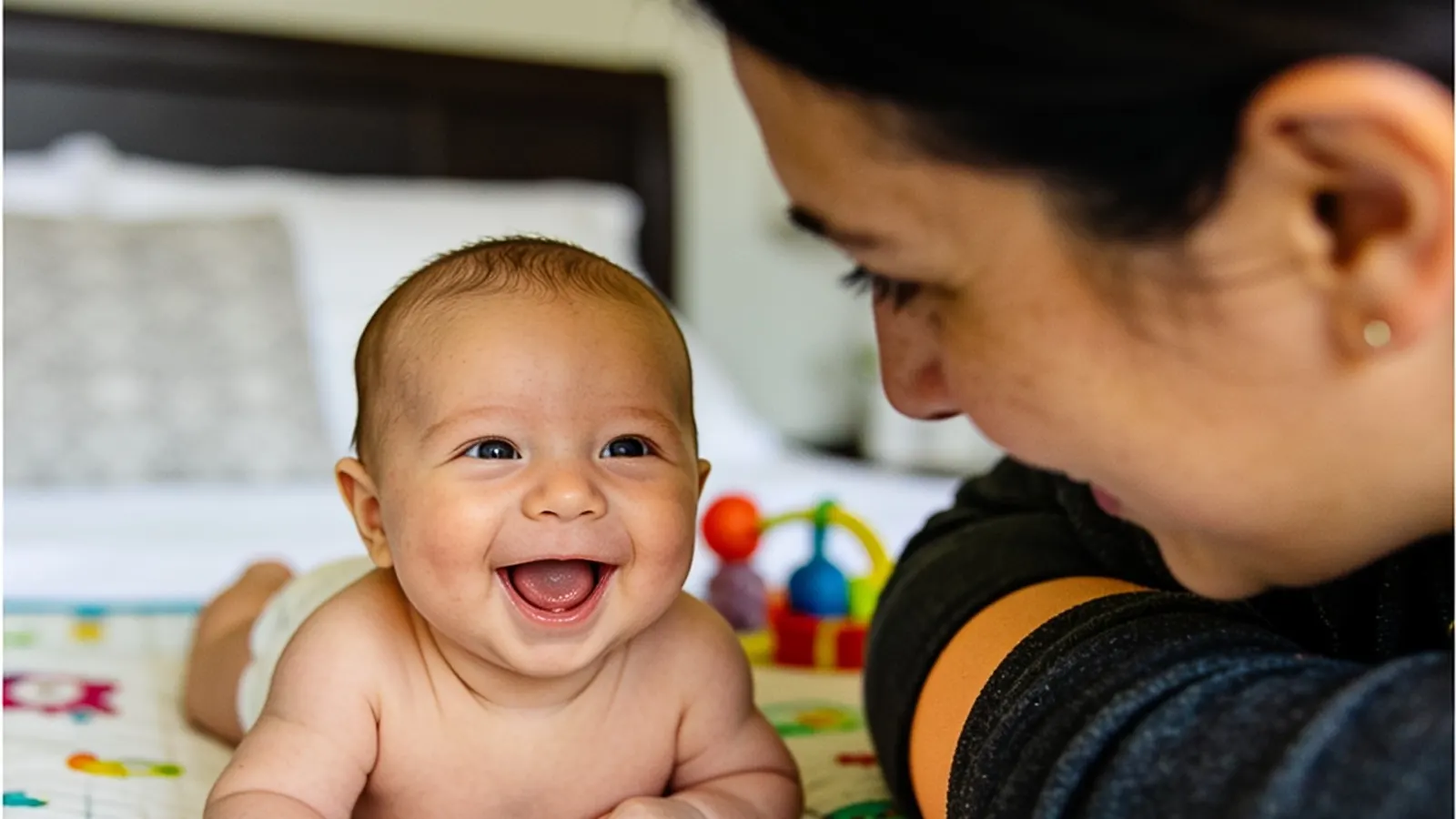
- Real social smiles usually arrive by 2 months. Smile and talk back; those little conversations matter.
- Crying averages about 2 hours a day through 6 weeks, then usually eases. It's normal, temporary, and not your fault.
- Gas drops haven't helped colic in studies. One probiotic strain may help breastfed babies with colic; ask your pediatrician before trying it.
- Hold off on sleep training. Frequent night waking is still normal, and the research on sleep training involves older babies.
- Tummy time builds strength and helps prevent flat spots. Work up to 15 to 30 minutes a day in short sessions.
- Before 3 months, a rectal temperature of 100.4°F (38°C) or higher means call your pediatrician right away.
- US vaccine guidance shifted in 2026. Ask your pediatrician which schedule they follow at the 2-month visit.
Your month-two checklist
0 of 12 done
Month two is when many babies give their first real smiles, and when crying often hits its high point. This guide covers what's new from 1 to 2 months; for safe sleep and other basics that haven't changed, see the newborn guide.
What's developing#
CDC's milestone checklists list skills that at least 75% of babies show by each age, so a missed milestone is a reason to check in, not to wait and see (Zubler et al., 2022).
Milestones by 2 months
By 2 months, most babies (CDC):
- Social: calm down when spoken to or picked up, look at your face, seem happy to see you, and smile when you talk to or smile at them.
- Communication: make sounds other than crying and react to loud sounds.
- Thinking: watch you as you move and look at a toy for several seconds.
- Movement: hold their head up when on their tummy, move both arms and both legs, and open their hands briefly.
Born early? Use your baby's corrected age (age in weeks minus the weeks they were born early) for milestones until age 2 (AAP).
First real smiles
The AAP says that by the second month, early expressions begin to turn into genuine signals of pleasure and friendliness. A smile gives your baby a new way, besides crying, to tell you what they need (AAP).
Coos and early conversations
Expect sounds other than crying. Long "oooo" and "aahh" coos are a 4-month milestone, so they may still be coming (AAP). Even so, many babies this age already trade sounds with you (see the research below).
Eyes and tracking
Your baby's eyes are starting to follow moving objects (AAP), and by about 8 weeks babies focus more easily on nearby faces (AOA). Wandering or crossing eyes should fade by 2 to 3 months, and color vision improves by about 4 months (AAP). Lab studies show 2-month-olds can already tell some colors apart (Teller, 1998).
Head, hands, and growth
Most babies this age can lift their head on their tummy. Fists are still common, but hands start to catch your baby's attention, and some reach the mouth (AAP). Babies typically gain 1.5 to 2 pounds a month now (AAP). Baby acne is common, can last until 4 to 6 months, and needs no treatment; call your pediatrician right away about tiny blisters, purple or blood-colored spots, or a rash with a fever (AAP).
The crying peak
Across 28 diary studies of 8,690 babies, fussing and crying averaged about 2 hours a day for the first 6 weeks, then fell to about 1 hour a day by 10 to 12 weeks (Wolke et al., 2017). Colic, usually defined as crying 3 or more hours a day, at least 3 days a week, for at least 3 weeks (Gordon et al., 2018), affected 17% to 25% of babies in the first 6 weeks (Wolke et al., 2017). PURPLE crying materials describe the most crying in month 2, often in the evening (Seattle Children's).
Sleep at 1 to 2 months
WHO guidelines say babies up to 3 months need 14 to 17 hours of sleep a day, naps included (WHO). Regular sleep cycles don't arrive until about 4 months, so night waking is expected (AAP).
Feeding and diapers
By the end of the first month, formula-fed babies usually take at least 3 to 4 ounces per feed (AAP). Evening cluster feeding and fewer poops in breastfed babies are common too; see the common questions below.
What the research says#
Some findings for this month are solid. Several rest on small studies.
1. Milestones were rewritten to end "wait and see." In 2022, an AAP expert group revised CDC's checklists to use only milestones that at least 75% of children reach by each age. The list shrank by about a quarter, and most milestones that changed ages moved later. Social and thinking milestones had the least data behind them (Zubler et al., 2022). Takeaway: If your baby misses one, ask now.
2. Crying plateaus, then falls. The 2017 meta-analysis found no single crying peak at 6 weeks across studies, just a steady average of about 2 hours a day, then a drop. By 10 to 12 weeks, only 0.6% of babies met the definition of colic (Wolke et al., 2017). Takeaway: For most families, things ease noticeably by about 3 months.
3. Most colic remedies have weak evidence. Reviews find that gas drops don't help, that the evidence for diet and formula changes is very low quality, and that one probiotic strain in breastfed babies has the best support (Ellwood et al., 2020; Gordon et al., 2018). European experts advise against special "colic" formulas (Haiden et al., 2024). Takeaway: Ask your pediatrician before buying anything for colic.
4. Babies notice when you stop responding. In the "still-face" experiment, a parent briefly goes expressionless. A review of more than 80 still-face studies found that babies smile less, look away more, and get more upset, and that the effect shows up from about 1 month of age (Mesman et al., 2009). Takeaway: Your face and responses are what your baby is tuned to.
5. Babies take turns early. In recordings of 51 mother-baby pairs, babies 8 to 21 weeks old joined in and often started vocal "protoconversations" (Gratier et al., 2015). In a study of 48 Japanese babies, 3- and 4-month-olds paused after making a sound, as if listening for a reply (Masataka, 1993). Takeaway: Talk, then pause. Leave room for your baby's turn.
6. Flat spots are common and usually mild. Nearly half of 440 healthy babies checked at 7 to 12 weeks in Calgary had some head flattening, mostly mild (Mawji et al., 2013). The AAP says positional flattening doesn't affect brain growth or intellectual development (AAP). Takeaway: Tummy time and position changes now are the easy fix.
Parenting techniques#
Turn smiles into conversations
When your baby smiles or coos, respond quickly and with enthusiasm. The AAP says this tells your baby they're important, they can trust you, and they have some control over their world (AAP). Researchers call this back-and-forth "serve and return," and it helps build connections in the brain (Harvard Center on the Developing Child).
Script: "Oh, you're smiling at me! Hi there." (Pause.) "Are you telling me something?"
Getting through the crying peak
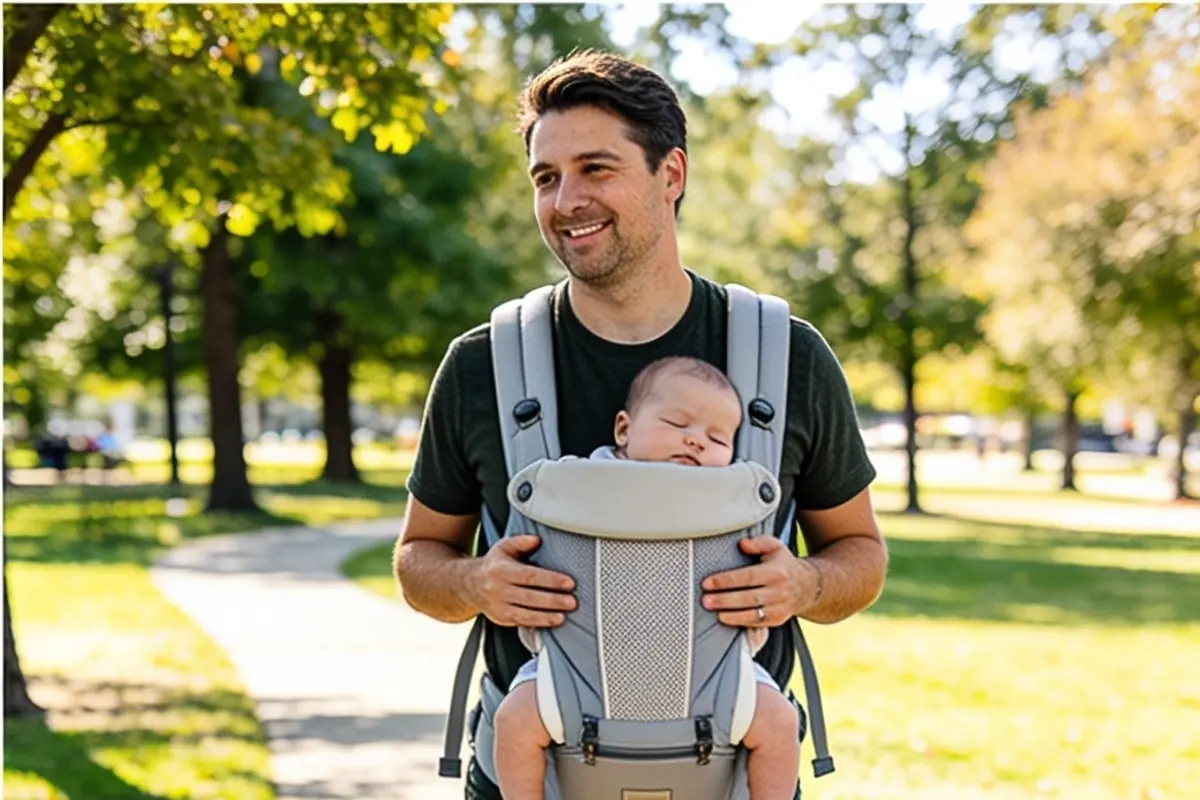
You can't spoil a young baby with attention, and babies whose cries are answered cry less overall (AAP). Once your pediatrician has checked your baby, try the AAP's colic tips: walk with your baby in a carrier, rock, add steady sound like a fan, offer a pacifier, or lay your baby tummy-down across your knees and rub their back (AAP).
Ask your pediatrician before switching formulas or cutting foods from your diet (AAP). Experts advise against moving a breastfed baby to formula because of colic (Haiden et al., 2024).
Some crying resists everything. If you're at your limit, put your baby down in a safe place, walk away, and calm down before you go back (Seattle Children's). The newborn guide has a walk-away plan to share with every caregiver.
Better nights without sleep training
- Make days lively and nights boring. Keep nights calm and quiet and save play for daytime (AAP). By day, open the curtains; at night, keep the lights low (NHS).
- Don't wake a thriving baby to feed. Healthy, growing babies usually don't need waking to eat (AAP). Check with your pediatrician first.
- Split the night so each adult gets one longer stretch, and follow the safe sleep rules for every sleep.
Tummy time and head shape
Start with 3 to 5 minutes, 2 to 3 times a day, and work up to 15 to 30 minutes a day by 7 weeks (AAP). Flattening most often develops in the first 4 to 12 weeks, so also alternate the arm you hold and feed with, and limit time in car seats, bouncers, and swings (AAP).
Watch for torticollis (tight neck muscles), often noticed in the first 6 to 8 weeks: your baby tilts their head toward one shoulder or always turns the same way. Early stretching, sometimes with a physical therapist, matters (AAP).
Feeding on cues
Watch your baby, not the bottle. Stop when your baby turns away or seems full, even if the bottle isn't empty, and never prop a bottle (CDC). If your baby gets any breast milk, keep giving 400 IU of vitamin D a day (AAP).
Going back to work and choosing child care
- Pumping rights. The federal PUMP Act requires employers to give reasonable break time to pump for a year after birth, in a private space that isn't a bathroom. Before you go back, practice pumping and let your baby practice bottles (CDC).
- Paced bottle feeding. Hold the baby close and semi-upright (AAP), angle the bottle so milk flows only when the baby sucks, allow breaks, and stop at fullness cues (CDC). It's widely taught but lightly tested: in one small study of 29 mothers, paced feeding slowed feeds without changing how much babies drank (Ventura et al., 2025).
- Child care basics. Ask whether the program is licensed. For babies 12 months and younger, the AAP recommends no more than 3 babies per caregiver and no more than 6 in a group (AAP). Ask for a written safe sleep policy (AAP).
- Back to sleep, every caregiver. In 1990s data from 11 states, 20.4% of SIDS deaths happened in child care, and babies who died there were more likely than others to have been put down on their stomachs when they usually slept on their backs or sides (Moon et al., 2000).
Your own checkup and mental health
ACOG recommends contact with your obstetric provider within 3 weeks of birth and a full postpartum visit no later than 12 weeks, covering mood, sleep, recovery, contraception, and chronic conditions (ACOG, 2018). Your pediatrician should screen the birthing parent for depression at the 2-month visit (Earls et al., 2019). Partners count: about 10% of fathers have depression around a birth, with higher rates 3 to 6 months after (Paulson & Bazemore, 2010).
Help now: call or text the National Maternal Mental Health Hotline at 1-833-TLC-MAMA (1-833-852-6262), or call or text 988. In an emergency, call 911 (CDC).
What to teach#
Still no lessons. But your baby is learning fast, mostly from how you respond:
- My signals work. When smiles and coos get answers, your baby learns they can trust you (AAP).
- Conversations take turns. You talk, you pause, your baby "answers."
- Day and night are different. Light and play by day; dim and quiet at night.
Screens: video chat only
The AAP calls TV and apps a bad idea before 18 months, with video chats with faraway family as the exception (Hill, AAP). Background TV or your phone can crowd out the face-to-face time babies learn from (AAP).
Later guides in this series get into chores and raising capable kids. For now, the lesson plan is simple: notice, respond, and wait for your baby's turn.
Activities to try#
Every activity here is for an awake, alert baby with an adult watching. Stop when your baby looks away, fusses, or arches. If your baby gets sleepy, lay them on their back in their own sleep space (AAP).
How we rate the evidence
- Strong evidence
- Randomized trials or systematic reviews show a consistent benefit.
- Moderate evidence
- Consistent observational research, or a major guideline (AAP, WHO) built on research.
- Emerging evidence
- Small or early studies. Plausible, not yet proven.
- Mixed evidence
- Studies disagree, or reviews rate the evidence as weak.
Too tired to choose? Let us pick one.
Tummy time, four ways
Moderate evidence- Time
- 3 to 5 minutes, several times a day
- Builds
- Neck, shoulder, and arm strength; a rounder head
- Chest: while you're awake and reclined, lay your baby tummy-down on you and talk so they lift their head.
- Lap: lay your baby tummy-down across your thighs and rub their back.
- Floor: on a firm, flat surface, get face to face or put a toy just out of reach.
- Side: if your baby protests, lay them on their side with a rolled towel behind their back.
Make it work: Several short sessions count toward the daily total.
Evidence: Moderate. A systematic review of mostly observational studies linked tummy time to better gross motor development and less flattening at the back of the head (Hewitt et al., 2020); the AAP and WHO both recommend it (AAP; WHO).
Smile conversations
Emerging evidence- Time
- A few minutes, whenever your baby is alert
- Builds
- Trust, connection, early communication
- Hold your baby face to face, close enough to see you clearly.
- Smile, raise your eyebrows, and say hello.
- When your baby smiles, smile bigger, say a few words, then pause.
Evidence: Emerging. Still-face studies show babies from about 1 month notice and get upset when a parent stops responding (Mesman et al., 2009), and the AAP encourages answering smiles quickly and warmly (AAP). Whether extra smile play changes later development hasn't been tested.
Picture talk and reading
Moderate evidence- Time
- About 5 minutes, once or twice a day
- Builds
- Language exposure, a shared routine
- Pick a board book with faces or bold, bright pictures.
- Hold it where your baby can see, point, and name what's there.
- Read in a sing-song voice and follow your baby's gaze.
Evidence: Moderate. The AAP recommends shared reading from birth, based on research with young children (Klass et al., 2024); CDC suggests looking at bright pictures or faces together and talking about them (CDC).
Cooing back and forth
Emerging evidence- Time
- 2 to 5 minutes, during calm, alert times
- Builds
- Turn-taking, early speech sounds
- Wait for your baby to make a sound.
- Copy it back softly, with a smile.
- Pause and see if your baby "answers."
Evidence: Emerging. Small studies show babies 2 to 5 months old take part in vocal turn-taking (Gratier et al., 2015; Masataka, 1993), and CDC suggests copying your baby's sounds (CDC). Long-term benefits haven't been tested.
Daylight walk
Emerging evidence- Time
- Once a day, any length
- Builds
- Day-night rhythm, a change of scene for you
- Head out before 10 a.m. or after 4 p.m., when the sun is weaker.
- Keep your baby in the shade or under a stroller canopy, in a wide-brimmed hat and light long sleeves and pants.
- Narrate what you see and hear.
Make it work: The AAP advises keeping babies under 6 months out of direct and indirect sun and avoiding outings from 10 a.m. to 4 p.m. (AAP). In the middle of the day, open the curtains and play near a window instead (NHS).
Evidence: Emerging. In one study of 56 babies 6 to 12 weeks old, those who slept better at night got more daytime light, especially in the early afternoon, a link that doesn't prove cause (Harrison, 2004).
Singing and gentle swaying
Emerging evidence- Time
- A song or two, any time
- Builds
- Calm, closeness
- Hold your baby securely, with head and neck supported.
- Sing anything, slowly, and sway or rock in rhythm.
Make it work: Keep movement smooth and gentle. Never shake a baby.
Evidence: Emerging. The AAP lists singing, rocking, and walking among ways to soothe (AAP); one non-randomized study of about 170 mothers linked singing lullabies to stronger bonding at 3 months (Persico et al., 2017).
Bedtime wind-down
Emerging evidence- Time
- A few minutes before the night's first long sleep
- Builds
- Predictable cues for nighttime
- Pick 2 or 3 steps you can repeat: a fresh diaper, a feed, a song.
- Dim the lights and keep your voice low.
- Lay your baby on their back in their own sleep space.
Evidence: Emerging. A survey of more than 10,000 mothers of children up to age 5 linked consistent bedtime routines with better sleep, but it can't prove cause (Mindell et al., 2015). The NHS suggests steps like a bath, a story, dim lights, and a lullaby (NHS).
Video chat with family
Emerging evidence- Time
- A few minutes
- Builds
- Connection with faraway family
- Hold your baby on your lap, close to the screen.
- Ask the caller to talk slowly, smile, and pause for your baby's sounds.
- End before fussing starts.
Evidence: Emerging. The AAP makes video chat the exception to avoiding screens before 18 months (Hill, AAP); research showing learning from live video chat involved 12- to 25-month-olds, not young babies (Myers et al., 2017).
Follow the face
Emerging evidence- Time
- 1 to 2 minutes
- Builds
- Visual tracking, attention
- With your baby on their back, lean in until they lock eyes with you.
- Slowly move your face, or a bright toy, to one side, then back across.
- Stop when your baby looks away.
Evidence: Emerging. Watching you move and following moving objects are 2-month milestones (CDC; AAP), but no studies show that practice speeds them up.
Rattle sound hunt
Emerging evidence- Time
- 1 to 2 minutes
- Builds
- Listening, linking sound and sight
- Hold a sturdy rattle off to one side of your baby's head, out of view.
- Shake it gently and watch for a glance or a pause.
- Switch sides.
Evidence: Emerging. CDC suggests shaking a rattle to one side and watching whether your baby looks for the sound (CDC); the game itself hasn't been studied.
Hand discovery
Emerging evidence- Time
- A minute or two, during changes or play
- Builds
- Body awareness, early grasp
- Gently open your baby's palm and place your finger or a soft toy in it.
- Bring both hands together over their chest so they can feel them touch.
- Let your baby look at and suck on their hands.
Evidence: Emerging. Opening hands briefly is a 2-month milestone, and CDC suggests letting babies suck on their fingers to self-soothe (CDC); this activity hasn't been studied.

Bath-time chat
Emerging evidence- Time
- 5 to 10 minutes, a few times a week
- Builds
- Body awareness, language, a calming ritual
- Use about 2 inches of warm, not hot, water; test it with your wrist or elbow.
- Keep one hand on your baby the whole time.
- Name body parts as you wash: "Here's your hand. Here are your toes."
Make it work: Never leave your baby alone in the bath, even for an instant.
Evidence: Emerging. The AAP lists a warm bath among ways to soothe (AAP); bath play itself hasn't been studied, but the safety rules are firm (AAP).
Babywearing walk
Mixed evidence- Time
- As long as you're both comfortable, up to about an hour at a stretch
- Builds
- Closeness, calm, hands-free time for you
- Follow T.I.C.K.S.: Tight, In view at all times, Close enough to kiss, Keep chin off chest, Supported back (Mankato Clinic).
- Check often that you can see your baby's face and nothing blocks their nose and mouth (CPSC).
Make it work: CPSC urges extra care with slings for babies under 4 months, preemies, low-birthweight babies, and babies with colds (CPSC). WHO advises not keeping babies strapped in a carrier or stroller more than 1 hour at a time (WHO). If your baby falls asleep, move them to their back on a firm, flat surface when you can (AAP).
Evidence: Mixed. In a 1986 trial of 99 families, extra daily carrying cut fussing and crying by 43% at 6 weeks (Hunziker & Barr, 1986), but later trials didn't repeat that in a general group of babies (St James-Roberts et al., 1995) or in babies with colic (Barr et al., 1991). In a small lab study of 12 babies 1 to 6 months old, babies cried and moved less and their heart rates slowed when their mother walked while carrying them, compared with holding them while sitting (Esposito et al., 2013).
Bicycle legs and tummy rub
Mixed evidence- Time
- 1 to 3 minutes, between feeds
- Builds
- Comfort, body awareness
- Lay your baby on their back and gently move their legs in a slow pedaling motion.
- With warm hands, rub their tummy in slow circles.
Make it work: Stop if your baby fusses or turns away.
Evidence: Mixed. An AAP article suggests bicycling your baby's legs, a form of baby massage, to help move gas (Jana & Shu, AAP), but a Cochrane review of 34 studies found mostly poor-quality evidence and didn't support routine massage for healthy babies under 6 months (Bennett et al., 2013).
Common questions#
When do babies start smiling at people?
Most babies smile when you talk to or smile at them by 2 months; it's on CDC's 2-month milestone list (CDC). The AAP says genuine social smiles usually appear during the second month (AAP). If your baby was born early, count from the due date (AAP). If your baby isn't smiling at people by the 2-month checkup, bring it up.
Is it normal for a 6-week-old to cry this much?
Yes, lots of crying at 6 weeks is common. In a meta-analysis of 28 diary studies, fussing and crying averaged about 2 hours a day through 6 weeks, then dropped to about 1 hour a day by 10 to 12 weeks (Wolke et al., 2017). The AAP says colic usually stops by 3 to 4 months (AAP). Call your pediatrician right away if your baby has a fever, vomits, cries when touched or moved, or cries nonstop for more than 2 hours. Go to the ER if your baby isn't alert when awake, and call 911 if they aren't moving or are very weak (AAP).
Do gas drops or probiotics help colic?
Gas drops probably don't, and one probiotic may help breastfed babies. A review of reviews found simethicone, the ingredient in most gas drops, showed no benefit (Ellwood et al., 2020), and the AAP says studies suggest it doesn't help colic (AAP). Pooling 4 trials of 345 babies, the probiotic L. reuteri DSM 17938 reduced crying in breastfed babies with colic; the effect in formula-fed babies wasn't significant (Sung et al., 2018). That result applies to that strain only. Ask your pediatrician before giving any drops or supplements.
Can I sleep train my 2-month-old?
It's too early for formal sleep training. Babies don't have regular sleep cycles until about 4 months, and the AAP's advice about putting babies down drowsy and not rushing in to soothe is written for babies 4 months and older (AAP). The AAP doesn't name a starting age for sleep training. A well-known trial taught sleep techniques at 8 to 10 months and found no lasting harms or benefits by age 6 (Price et al., 2012), and one children's hospital says pediatricians generally give the okay at 3 or 4 months (Lurie Children's).
How much should my 2-month-old eat?
Formula-fed babies usually take at least 3 to 4 ounces per feed, about every 3 to 4 hours, by the end of the first month. A rough daily guide is 2.5 ounces per pound of body weight, usually topping out around 32 ounces (AAP). Breastfed babies don't have a set amount: feed on cue, watching for early signs like lip smacking and rooting (AAP). Weight checks at each visit show whether intake is on track.
Why does my baby want to eat constantly in the evening?
It's probably cluster feeding, which is normal. Many breastfed babies bunch feeds together in the evening, sometimes every 30 minutes to an hour, and it doesn't mean your milk supply is low (USDA WIC). Growth spurts often get the blame, but a 2024 review found little solid evidence that they happen on a fixed schedule (Davanzo & Baldassarre, 2024). Call your pediatrician within a day if your baby isn't gaining weight or always seems hungry (AAP).
How do I prevent a flat spot on my baby's head?
Tummy time and changing positions are the main fixes. Do supervised tummy time several times a day, alternate the arm you hold and feed with, and limit time in car seats, swings, and bouncers (AAP). Some flattening is common: nearly half of 7- to 12-week-olds in one study had some, mostly mild (Mawji et al., 2013). Mention a flat spot or a head tilt at the checkup; early treatment of a tight neck matters (AAP).
What vaccines does my baby get at 2 months?
The AAP recommends vaccines at 2 months against diphtheria, tetanus, and whooping cough (DTaP), Hib, polio, pneumococcal disease, and rotavirus, plus a second hepatitis B dose between 1 and 2 months (AAP). For the 2026-2027 season, it also recommends RSV protection for babies under 8 months in their first RSV season, unless the birthing parent got an RSV vaccine during pregnancy (AAP). US guidance has been changing. The AAP and CDC schedules have differed in 2026 (AAP), and federal vaccine changes have been challenged in court (STAT, 2026). Ask your pediatrician which schedule they follow.
Is a fever an emergency in a 2-month-old?
Yes, treat it as urgent. If your baby is 3 months or younger and has a rectal temperature of 100.4°F (38°C) or higher, call your pediatrician immediately, even if your baby seems fine. A rectal reading is the most reliable at this age (AAP). Don't give fever medicine before your baby is seen (AAP). If your baby is limp, can't be woken, or is struggling to breathe, call 911 (see the safety section).
My breastfed baby hasn't pooped in days. Is that normal?
It can be, after the first month. Some breastfed babies go several days or even a week between bowel movements, though in the first month, fewer than one stool a day can mean a baby isn't getting enough milk (AAP). Normal grunting and straining are fine. Under 2 months, call within a day if stools are hard or your baby strains more than 10 minutes without success. Call right away for any blood in the poop (AAP), vomiting 2 or more times with a swollen belly, or a new weak suck or weak muscles. Green vomit means go to the ER now (AAP).
Can my 2-month-old watch TV or videos?
It's best to skip TV and videos for now, but video chats with family are fine. The AAP says TV and apps are a bad idea before 18 months, with video chatting as the exception (Hill, AAP), and that babies this young learn best from real-world interactions (Munzer, AAP). Your face and voice are the best "screen" your baby has.
What if my baby isn't smiling or holding their head up by 2 months?
Tell your pediatrician now rather than waiting. CDC milestones reflect skills that at least 75% of babies show by that age, so a missed one is a signal to check, not a diagnosis (Zubler et al., 2022). You can also call your state's early intervention program for a free evaluation; you don't need a doctor's referral or a diagnosis to call (CDC). If your baby was born early, use corrected age (AAP).
Safety and when to call your pediatrician#
Safe sleep still applies
Every rule in the newborn guide still applies: on the back for every sleep, on a firm, flat surface with nothing else in the crib, and in your room for at least the first 6 months but never in your bed. Skip inclined sleepers; anything tilted more than 10 degrees isn't safe for sleep. If your baby falls asleep in a car seat, stroller, swing, or carrier, move them to a firm, flat surface on their back as soon as you can (AAP).
Rolling can start early
Some babies start working on rolling at 2 months. Stop swaddling at the first signs, and skip weighted swaddles (AAP). Don't leave your baby alone on a bed, sofa, or changing table, even for a second (NHS). A changing-table strap isn't enough on its own (AAP).
Car seats and travel
Rear-facing, in the back seat, with a snug harness, the chest clip at armpit level, and no bulky coat under the straps. Car seats are for travel, not for sleeping at home (AAP).
Never shake a baby
Shaking often happens in response to crying (Barr et al., 2009), and month 2 is when crying tends to be heaviest. It is never safe to shake, throw, hit, slam, or jerk a baby. If you feel yourself losing control, put your baby on their back in the crib, leave the room for 10 to 15 minutes, and call someone (AAP). If you're afraid someone might hurt or shake your baby, call your pediatrician now (AAP).
Call 911 if your baby
- Has bluish lips or face (AAP)
- Is struggling for each breath, has stopped breathing, or has new grunting, wheezing, or whistling sounds (AAP; Nationwide Children's)
- Is not moving, or is very weak or floppy (AAP)
- Can't be woken up (AAP)
Go to the ER now if your baby
- Has any trouble breathing: more than 60 breaths a minute, pauses longer than about 10 seconds, or ribs pulling in with each breath. The AAP advises the ER for babies under 1 year with trouble breathing (AAP; Nationwide Children's).
- Isn't alert when awake, or seems "out of it" (AAP)
- Vomits green (bile), even once, or vomits blood (AAP)
- Passes a lot of blood in their poop, or blood with no poop (AAP)
Call your pediatrician right away if your baby
- Has a rectal temperature of 100.4°F (38°C) or higher, even if they seem well (AAP)
- Vomits 2 or more times (not just spit-up), or spit-up turns into forceful or projectile vomiting (AAP; AAP)
- Has a bulging or swollen soft spot, cries when touched or moved, or cries nonstop for more than 2 hours (AAP)
- Drinks very little or nothing for more than 8 hours, or has had no wet diaper in more than 8 hours (AAP; AAP)
- Is feeding poorly or has a new weak suck (Nationwide Children's; AAP)
- Has any blood in their poop, or black, tarry poop (AAP)
- Has tiny blisters, purple or blood-colored spots, or skin that looks infected (AAP)
- Looks or acts very sick, or you think they need to be seen urgently (AAP)
Call within a day if your baby isn't gaining weight or always seems hungry, or if you're worn out from the crying (AAP).
Don't wait on development worries
CDC's advice is not to wait: if your baby isn't meeting milestones, has lost skills, or you have other concerns, talk with your pediatrician and ask about developmental screening (CDC). Bring it up if your baby:
- Doesn't smile when you talk to or smile at them
- Doesn't look at your face or watch you as you move
- Doesn't react to loud sounds, or makes no sounds other than crying
- Can't hold their head up when on their tummy
- Doesn't move both arms and both legs, or uses only one side (AAP)
- Doesn't calm down when spoken to or picked up
- Has lost skills they used to have
- Has eyes that often cross or wander (AAP), a flat spot, or always tilts their head one way (AAP)
The 2-month checkup
Expect measurements, a full exam, vaccines, and questions about development, feeding, sleep, and safety (AAP), plus a depression screen for the birthing parent (AAP, 2025). For the AAP's vaccine list and how to talk about schedules, see What vaccines does my baby get at 2 months? above. Bring your questions in writing.
Sources#
- Centers for Disease Control and Prevention. "Milestones by 2 Months." Learn the Signs. Act Early. program, updated 2026. https://www.cdc.gov/act-early/milestones/2-months.html
- Centers for Disease Control and Prevention. "Concerned About Your Child's Development?" 2026. https://www.cdc.gov/act-early/families/concerned.html
- Centers for Disease Control and Prevention. "About Feeding From a Bottle." 2026. https://www.cdc.gov/infant-toddler-nutrition/bottle-feeding/index.html
- Centers for Disease Control and Prevention. "Breastfeeding and Returning to Your Workplace." 2026. https://www.cdc.gov/infant-toddler-nutrition/breastfeeding/returning-to-your-workplace.html
- Centers for Disease Control and Prevention. "Symptoms of Depression Among Women." 2024. https://www.cdc.gov/reproductive-health/depression/index.html
- American Academy of Pediatrics. "Developmental Milestones: 1-4 Months Old." HealthyChildren.org, updated 2026. https://www.healthychildren.org/English/ages-stages/baby/Pages/Developmental-Milestones-3-Months.aspx
- American Academy of Pediatrics. "Emotional & Social Development: Birth Through 3 Months." HealthyChildren.org, updated 2026. https://www.healthychildren.org/English/ages-stages/baby/Pages/Emotional-and-Social-Development-Birth-to-3-Months.aspx
- American Academy of Pediatrics. "Movement Milestones: Birth to 3 Months." HealthyChildren.org, updated 2020. https://www.healthychildren.org/English/ages-stages/baby/Pages/Movement-Birth-to-Three-Months.aspx
- American Academy of Pediatrics. "Infant Vision Development: What Can Babies See?" HealthyChildren.org, updated 2024. https://www.healthychildren.org/English/ages-stages/baby/Pages/Babys-Vision-Development.aspx
- American Academy of Pediatrics. "Your Baby's Growth & Physical Development: 1 to 4 Months Old." HealthyChildren.org, updated 2026. https://www.healthychildren.org/English/ages-stages/baby/Pages/Physical-Appearance-and-Growth-1-To-3-Months.aspx
- American Academy of Pediatrics. "Corrected Age For Preemies." HealthyChildren.org, updated 2018. https://www.healthychildren.org/English/ages-stages/baby/preemie/Pages/Corrected-Age-For-Preemies.aspx
- American Academy of Pediatrics. "Newborn Rashes and Birthmarks" (symptom checker). HealthyChildren.org, accessed 2026. https://www.healthychildren.org/English/tips-tools/symptom-checker/Pages/symptomviewer.aspx?symptom=Newborn+Rashes+and+Birthmarks
- American Academy of Pediatrics. "Colic Relief Tips for Parents." HealthyChildren.org, updated 2024. https://www.healthychildren.org/English/ages-stages/baby/crying-colic/Pages/Colic.aspx
- Jana LA, Shu J. "Gas Relief for Babies." HealthyChildren.org, updated 2025. https://www.healthychildren.org/English/ages-stages/baby/diapers-clothing/Pages/Breaking-Up-Gas.aspx
- American Academy of Pediatrics. "Responding to Your Baby's Cries." HealthyChildren.org, updated 2025. https://www.healthychildren.org/English/ages-stages/baby/crying-colic/Pages/Responding-to-Your-Babys-Cries.aspx
- American Academy of Pediatrics. "Crying Baby - Before 3 Months Old" (symptom checker). HealthyChildren.org, accessed 2026. https://www.healthychildren.org/English/tips-tools/symptom-checker/Pages/symptomviewer.aspx?symptom=Crying+Baby+-+Before+3+Months+Old
- American Academy of Pediatrics. "Breathing Trouble" (symptom checker). HealthyChildren.org, accessed 2026. https://www.healthychildren.org/English/tips-tools/symptom-checker/Pages/symptomviewer.aspx?symptom=Breathing+Trouble
- American Academy of Pediatrics. "Vomiting Without Diarrhea" (symptom checker). HealthyChildren.org, accessed 2026. https://www.healthychildren.org/English/tips-tools/symptom-checker/Pages/symptomviewer.aspx?symptom=Vomiting+Without+Diarrhea
- American Academy of Pediatrics. "Reflux (Spitting Up)" (symptom checker). HealthyChildren.org, accessed 2026. https://www.healthychildren.org/English/tips-tools/symptom-checker/Pages/symptomviewer.aspx?symptom=Reflux+%28Spitting+Up%29
- American Academy of Pediatrics. "Constipation" (symptom checker). HealthyChildren.org, accessed 2026. https://www.healthychildren.org/English/tips-tools/symptom-checker/Pages/symptomviewer.aspx?symptom=Constipation
- American Academy of Pediatrics. "Stools - Blood In" (symptom checker). HealthyChildren.org, accessed 2026. https://www.healthychildren.org/English/tips-tools/symptom-checker/Pages/symptomviewer.aspx?symptom=Stools+-+Blood+In
- American Academy of Pediatrics. "Fever and Your Baby." HealthyChildren.org, updated 2025. https://www.healthychildren.org/English/health-issues/conditions/fever/Pages/Fever-and-Your-Baby.aspx
- American Academy of Pediatrics. "Getting Your Baby to Sleep." HealthyChildren.org, updated 2024. https://www.healthychildren.org/English/ages-stages/baby/sleep/Pages/getting-your-baby-to-sleep.aspx
- American Academy of Pediatrics. "Sleeping Through the Night." HealthyChildren.org, updated 2013. https://www.healthychildren.org/English/ages-stages/baby/sleep/Pages/Sleeping-Through-the-Night.aspx
- Moon RY. "How to Keep Your Sleeping Baby Safe: AAP Policy Explained." HealthyChildren.org, updated 2026. https://www.healthychildren.org/English/ages-stages/baby/sleep/Pages/a-parents-guide-to-safe-sleep.aspx
- American Academy of Pediatrics. "Swaddling: Is it Safe for Your Baby?" HealthyChildren.org, updated 2022. https://www.healthychildren.org/English/ages-stages/baby/diapers-clothing/Pages/Swaddling-Is-it-Safe.aspx
- American Academy of Pediatrics. "Back to Sleep, Tummy to Play." HealthyChildren.org, updated 2026. https://www.healthychildren.org/English/ages-stages/baby/sleep/Pages/back-to-sleep-tummy-to-play.aspx
- American Academy of Pediatrics. "3 Tummy Time Activities to Try With Your Baby." HealthyChildren.org, updated 2023. https://www.healthychildren.org/English/ages-stages/baby/sleep/Pages/The-Importance-of-Tummy-Time.aspx
- American Academy of Pediatrics. "When a Baby's Head is Misshapen: Positional Skull Deformities." HealthyChildren.org, updated 2022. https://www.healthychildren.org/English/health-issues/conditions/Cleft-Craniofacial/Pages/Positional-Skull-Deformities-and-Torticollis.aspx
- American Academy of Pediatrics. "Head Tilt (Torticollis)." HealthyChildren.org, updated 2020. https://www.healthychildren.org/English/health-issues/conditions/Cleft-Craniofacial/Pages/Head-Tilt.aspx
- American Academy of Pediatrics. "Amount and Schedule of Baby Formula Feedings." HealthyChildren.org, updated 2022. https://www.healthychildren.org/English/ages-stages/baby/formula-feeding/Pages/amount-and-schedule-of-formula-feedings.aspx
- American Academy of Pediatrics. "How Often to Breastfeed." HealthyChildren.org, updated 2015. https://www.healthychildren.org/English/ages-stages/baby/breastfeeding/Pages/How-Often-to-Breastfeed.aspx
- American Academy of Pediatrics. "Bottle Feeding Basics." HealthyChildren.org, updated 2012. https://www.healthychildren.org/English/ages-stages/baby/feeding-nutrition/Pages/Bottle-Feeding-How-Its-Done.aspx
- American Academy of Pediatrics. "How Can I Tell If My Baby is Constipated?" HealthyChildren.org, updated 2022. https://www.healthychildren.org/English/ages-stages/baby/diapers-clothing/Pages/Infant-Constipation.aspx
- American Academy of Pediatrics Section on Gastroenterology, Hepatology and Nutrition. "Vitamin D for Babies, Children & Adolescents." HealthyChildren.org, updated 2022. https://www.healthychildren.org/English/healthy-living/nutrition/Pages/vitamin-d-on-the-double.aspx
- American Academy of Pediatrics. "Choosing a Child Care Center." HealthyChildren.org, updated 2022. https://www.healthychildren.org/English/family-life/work-and-child-care/Pages/choosing-a-child-care-center.aspx
- American Academy of Pediatrics. "Bathing Your Baby." HealthyChildren.org, updated 2025. https://www.healthychildren.org/English/ages-stages/baby/bathing-skin-care/Pages/Bathing-Your-Newborn.aspx
- Gupta D, Mahoney M. "Baby Sunburn Prevention Tips." HealthyChildren.org, updated 2026. https://www.healthychildren.org/English/ages-stages/baby/bathing-skin-care/Pages/Baby-Sunburn-Prevention.aspx
- American Academy of Pediatrics. "Changing Table Safety." HealthyChildren.org, updated 2009. https://www.healthychildren.org/English/safety-prevention/at-home/Pages/Changing-Table-Safety.aspx
- American Academy of Pediatrics. "Shaken Baby Syndrome: Protect Your Infant from Abusive Head Trauma." HealthyChildren.org, updated 2025. https://www.healthychildren.org/English/safety-prevention/at-home/Pages/Abusive-Head-Trauma-Shaken-Baby-Syndrome.aspx
- American Academy of Pediatrics. "Car Seats: Information for Families." HealthyChildren.org, updated 2026. https://www.healthychildren.org/English/safety-prevention/on-the-go/Pages/Car-Safety-Seats-Information-for-Families.aspx
- American Academy of Pediatrics. "Checkup Checklist: 2 Months Old." HealthyChildren.org, updated 2021. https://www.healthychildren.org/English/ages-stages/Your-Childs-Checkups/Pages/Your-Checkup-Checklist-2-Months-Old.aspx
- American Academy of Pediatrics and Bright Futures. "Recommendations for Preventive Pediatric Health Care" (Periodicity Schedule). 2025. https://downloads.aap.org/AAP/PDF/periodicity_schedule.pdf
- Bracho-Sánchez E. "AAP Guide: Vaccines Your Child Needs by Age 6." HealthyChildren.org, updated 2026. https://www.healthychildren.org/English/safety-prevention/immunizations/Pages/Your-Babys-First-Vaccines.aspx
- American Academy of Pediatrics. "AAP Releases Recommended Childhood and Adolescent Immunization Schedule for 2026." HealthyChildren.org, 2026. https://www.healthychildren.org/English/news/Pages/AAPs-recommended-childhood-and-adolescent-immunization-schedule-for-2026.aspx
- American Academy of Pediatrics. "AAP Releases RSV Immunization Recommendations for 2026-2027 Season." HealthyChildren.org, 2026. https://www.healthychildren.org/English/news/Pages/aap-updates-rsv-immunization-recommendations-for-2026-2027-season.aspx
- Hill DL. "Why to Avoid TV for Infants & Toddlers." HealthyChildren.org, updated 2016. https://www.healthychildren.org/English/family-life/Media/Pages/Why-to-Avoid-TV-Before-Age-2.aspx
- Munzer T. "Helping Kids Thrive in a Digital World: AAP Policy Explained." HealthyChildren.org, updated 2026. https://www.healthychildren.org/English/family-life/Media/Pages/helping-kids-thrive-in-a-digital-world-AAP-policy-explained.aspx
- AAP Center of Excellence on Social Media and Youth Mental Health. "Kids & Screen Time: The 5 C's Questions to Ask for Infants." HealthyChildren.org, updated 2024. https://www.healthychildren.org/English/family-life/Media/Pages/infants-and-screen-time-5-cs-questions-to-ask.aspx
- World Health Organization. "To grow up healthy, children need to sit less and play more." 2019. https://www.who.int/news/item/24-04-2019-to-grow-up-healthy-children-need-to-sit-less-and-play-more
- National Health Service (UK). "Helping your baby to sleep." Accessed 2026. https://www.nhs.uk/baby/caring-for-a-newborn/helping-your-baby-to-sleep/
- National Health Service (UK). "Baby and toddler safety." 2026. https://www.nhs.uk/baby/first-aid-and-safety/safety/baby-and-toddler-safety/
- US Department of Agriculture WIC Breastfeeding Support. "Cluster Feeding and Growth Spurts." Accessed 2026. https://wicbreastfeeding.fna.usda.gov/cluster-feeding-and-growth-spurts
- US Consumer Product Safety Commission. "CPSC Educates New Parents on Safe Babywearing." 2010. https://www.cpsc.gov/Newsroom/News-Releases/2011/CPSC-Educates-New-Parents-on-Safe-BabywearingInfant-suffocation-deaths-in-slings-prompt-renewed-effort-to-warn-moms-and-dads
- Mankato Clinic. "The T.I.C.K.S. Rule for Safe Babywearing." 2017. https://www.mankatoclinic.com/wp-content/uploads/TICKS-Rule-for-Safe-Babywearing-MC2188.pdf
- Seattle Children's Hospital. "Period of PURPLE Crying." Accessed 2026. https://www.seattlechildrens.org/health-safety/parenting/purple-education-crying/
- Nationwide Children's Hospital. "Newborn Warning Signs." 2023. https://www.nationwidechildrens.org/conditions/health-library/newborn-warning-signs
- Freeman I. "How to Sleep Train Your Baby." Lurie Children's Hospital of Chicago, 2022. https://www.luriechildrens.org/en/blog/sleep-training-for-babies/
- American Optometric Association. "Infant Vision: Birth to 24 Months of Age." Accessed 2026. https://www.aoa.org/healthy-eyes/eye-health-for-life/infant-vision
- Center on the Developing Child at Harvard University. "Serve and Return." Accessed 2026. https://developingchild.harvard.edu/key-concept/serve-and-return/
- STAT. "HHS appeals ruling that stalled many of Kennedy's vaccine policy changes." 2026. https://www.statnews.com/2026/04/29/hhs-appealing-acip-vaccine-policy-lawsuit-ruling/
- American College of Obstetricians and Gynecologists. "ACOG Committee Opinion No. 736: Optimizing Postpartum Care." Obstetrics & Gynecology, 2018. https://pubmed.ncbi.nlm.nih.gov/29683911/
- Zubler JM, Wiggins LD, Macias MM, et al. "Evidence-Informed Milestones for Developmental Surveillance Tools." Pediatrics, 2022. https://pubmed.ncbi.nlm.nih.gov/35132439/
- Wolke D, Bilgin A, Samara M. "Systematic Review and Meta-Analysis: Fussing and Crying Durations and Prevalence of Colic in Infants." Journal of Pediatrics, 2017. https://pubmed.ncbi.nlm.nih.gov/28385295/
- Gordon M, Biagioli E, Sorrenti M, et al. "Dietary modifications for infantile colic." Cochrane Database of Systematic Reviews, 2018. https://pubmed.ncbi.nlm.nih.gov/30306546/
- Ellwood J, Draper-Rodi J, Carnes D. "Comparison of common interventions for the treatment of infantile colic: a systematic review of reviews and guidelines." BMJ Open, 2020. https://pubmed.ncbi.nlm.nih.gov/32102827/
- Sung V, D'Amico F, Cabana MD, et al. "Lactobacillus reuteri to Treat Infant Colic: A Meta-analysis." Pediatrics, 2018. https://pubmed.ncbi.nlm.nih.gov/29279326/
- Haiden N, Savino F, Hill S, et al. "Infant formulas for the treatment of functional gastrointestinal disorders: A position paper of the ESPGHAN Nutrition Committee." Journal of Pediatric Gastroenterology and Nutrition, 2024. https://pubmed.ncbi.nlm.nih.gov/38766683/
- Hunziker UA, Barr RG. "Increased carrying reduces infant crying: a randomized controlled trial." Pediatrics, 1986. https://pubmed.ncbi.nlm.nih.gov/3517799/
- Barr RG, McMullan SJ, Spiess H, et al. "Carrying as colic 'therapy': a randomized controlled trial." Pediatrics, 1991. https://pubmed.ncbi.nlm.nih.gov/2020506/
- St James-Roberts I, Hurry J, Bowyer J, Barr RG. "Supplementary carrying compared with advice to increase responsive parenting as interventions to prevent persistent infant crying." Pediatrics, 1995. https://pubmed.ncbi.nlm.nih.gov/7862477/
- Esposito G, Yoshida S, Ohnishi R, et al. "Infant calming responses during maternal carrying in humans and mice." Current Biology, 2013. https://pubmed.ncbi.nlm.nih.gov/23602481/
- Barr RG, Barr M, Fujiwara T, et al. "Do educational materials change knowledge and behaviour about crying and shaken baby syndrome? A randomized controlled trial." CMAJ, 2009. https://pubmed.ncbi.nlm.nih.gov/19255065/
- Mesman J, van IJzendoorn MH, Bakermans-Kranenburg MJ. "The many faces of the Still-Face Paradigm: A review and meta-analysis." Developmental Review, 2009. https://doi.org/10.1016/j.dr.2009.02.001
- Gratier M, Devouche E, Guellai B, et al. "Early development of turn-taking in vocal interaction between mothers and infants." Frontiers in Psychology, 2015. https://pubmed.ncbi.nlm.nih.gov/26388790/
- Masataka N. "Effects of contingent and noncontingent maternal stimulation on the vocal behaviour of three- to four-month-old Japanese infants." Journal of Child Language, 1993. https://pubmed.ncbi.nlm.nih.gov/8376471/
- Teller DY. "Spatial and temporal aspects of infant color vision." Vision Research, 1998. https://pubmed.ncbi.nlm.nih.gov/9893838/
- Mawji A, Vollman AR, Hatfield J, et al. "The incidence of positional plagiocephaly: a cohort study." Pediatrics, 2013. https://pubmed.ncbi.nlm.nih.gov/23837184/
- Hewitt L, Kerr E, Stanley RM, Okely AD. "Tummy Time and Infant Health Outcomes: A Systematic Review." Pediatrics, 2020. https://pubmed.ncbi.nlm.nih.gov/32371428/
- Harrison Y. "The relationship between daytime exposure to light and night-time sleep in 6-12-week-old infants." Journal of Sleep Research, 2004. https://pubmed.ncbi.nlm.nih.gov/15560769/
- Price AMH, Wake M, Ukoumunne OC, Hiscock H. "Five-year follow-up of harms and benefits of behavioral infant sleep intervention: randomized trial." Pediatrics, 2012. https://pubmed.ncbi.nlm.nih.gov/22966034/
- Ventura AK, Drewelow VM, Richardson TN. "Does paced bottle-feeding improve the quality and outcome of bottle-feeding interactions?" Early Human Development, 2025. https://pubmed.ncbi.nlm.nih.gov/39693774/
- Mindell JA, Li AM, Sadeh A, et al. "Bedtime routines for young children: a dose-dependent association with sleep outcomes." Sleep, 2015. https://pubmed.ncbi.nlm.nih.gov/25325483/
- Davanzo R, Baldassarre ME. "Infant Growth Spurts in the Context of Perceived Insufficient Milk Supply." Nutrients, 2024. https://pmc.ncbi.nlm.nih.gov/articles/PMC11547328/
- Klass P, Miller-Fitzwater A, High PC; AAP Council on Early Childhood. "Literacy Promotion: An Essential Component of Primary Care Pediatric Practice: Policy Statement." Pediatrics, 2024. https://pubmed.ncbi.nlm.nih.gov/39342414/
- Persico G, Antolini L, Vergani P, et al. "Maternal singing of lullabies during pregnancy and after birth: Effects on mother-infant bonding and on newborns' behaviour. Concurrent Cohort Study." Women and Birth, 2017. https://pubmed.ncbi.nlm.nih.gov/28169158/
- Myers LJ, LeWitt RB, Gallo RE, Maselli NM. "Baby FaceTime: can toddlers learn from online video chat?" Developmental Science, 2017. https://pubmed.ncbi.nlm.nih.gov/27417537/
- Bennett C, Underdown A, Barlow J. "Massage for promoting mental and physical health in typically developing infants under the age of six months." Cochrane Database of Systematic Reviews, 2013. https://pubmed.ncbi.nlm.nih.gov/23633323/
- Moon RY, Patel KM, Shaefer SJ. "Sudden infant death syndrome in child care settings." Pediatrics, 2000. https://pubmed.ncbi.nlm.nih.gov/10920154/
- Earls MF, Yogman MW, Mattson G, Rafferty J; AAP Committee on Psychosocial Aspects of Child and Family Health. "Incorporating Recognition and Management of Perinatal Depression Into Pediatric Practice." Pediatrics, 2019. https://pubmed.ncbi.nlm.nih.gov/30559120/
- Paulson JF, Bazemore SD. "Prenatal and postpartum depression in fathers and its association with maternal depression: a meta-analysis." JAMA, 2010. https://pubmed.ncbi.nlm.nih.gov/20483973/
This guide is general education that summarizes published research and guidance from groups like the American Academy of Pediatrics, the CDC, and the WHO. It isn’t medical advice, and every child develops on their own timeline. Your pediatrician knows your child; if something feels wrong, call them. In an emergency, call 911.
Raising capable kids with Chorevia
When your kids are ready for responsibility, Chorevia turns chores into a family economy, with points, proof, a reward ladder you design, and monthly costs kids work off. Adults always make the call. Free for families.
Create your household