The first year · Birth to 1 month
Newborn to 1 Month: Development, Research, and What Helps
Last reviewed · 16 min read · 16 activities · 18 common questions · 106 sources · Plain-text version
The first month is about feeding, sleep, and getting to know each other. Here's what's developing, what the research actually shows, 16 simple activities, and answers to the questions new parents ask most.
At a glance
- Back to sleep for every sleep, on a firm, flat, bare surface, in your room but not your bed.
- A rectal temperature of 100.4°F (38°C) or higher in a newborn means call your pediatrician right away.
- Feed on cues. Breastfed newborns usually eat 8 to 12 times in 24 hours.
- You cannot spoil a newborn. Responding to cries builds trust.
- Lots of crying in the early weeks is normal and temporary. It is not your fault.
- Your mental health matters. Low moods that are severe or last past 2 weeks deserve a call.
- Tummy time can start the day you come home: a few minutes, a few times a day, while your baby is awake and watched.
- Sneezes, hiccups, spit-up, and baby acne are usually normal. Green vomit means go to the ER now. White or pale poop or a bulging soft spot means call your pediatrician right away.
Your first-month checklist
0 of 12 done
Your baby's first month is mostly about the basics: eating, sleeping, staying warm, and getting to know you. If it feels like survival mode, that's normal.
This guide is general education, not medical advice. Your pediatrician knows your baby, so call them with any concern.
What's developing#
A lot is happening under the surface. The Harvard Center on the Developing Child estimates that in the first few years of life, more than 1 million new neural connections form every second (Harvard Center on the Developing Child), and everyday back-and-forth moments with you help build them (Harvard Center on the Developing Child).
Senses. Your newborn sees best at 8 to 12 inches, about the distance to your face during a feed. Eyes may wander or cross at times; that should fade by 2 to 3 months (AAP). Newborns prefer high-contrast patterns and human faces. Hearing is fully developed, and babies react to loud sounds. They prefer sweet smells and soft touch (AAP). Breastfed babies quickly learn their mother's unique scent (Porter & Winberg, 1999).
Reflexes (AAP):
- Rooting: turns toward a touch on the cheek to find the nipple. Fades around 4 months.
- Sucking: starts automatically when a nipple is deep in the mouth.
- Moro (startle): flings out arms and legs at a loud sound or sudden movement, then pulls them in. Fades around 2 months.
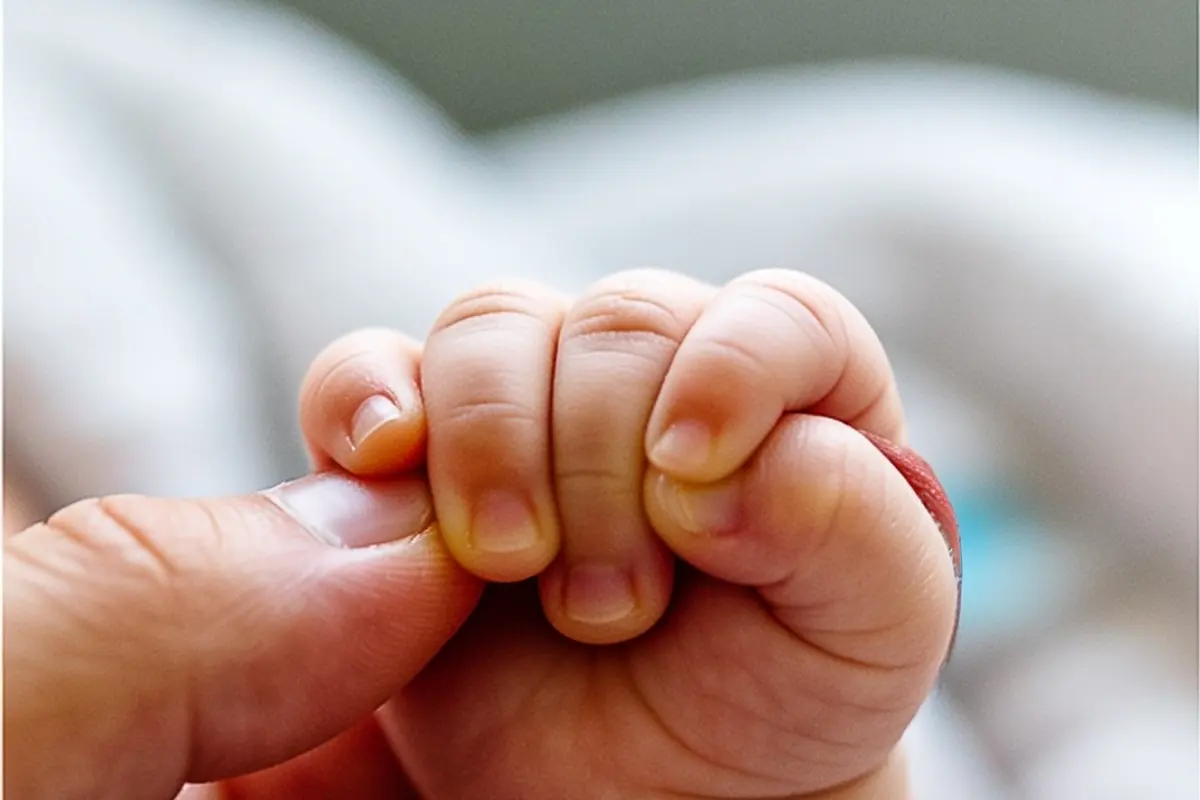
- Grasp: grips a finger placed in the palm. Fades around 5 to 6 months.
- Stepping: "steps" when held upright with feet on a flat surface. Fades around 2 months.
Movement. Expect jerky arm movements, tight fists, hands drifting to the mouth, and a head that flops without support. On the tummy, your baby may turn their head side to side (AAP).
Sleep. Newborns sleep about 16 to 17 hours a day, often just 1 or 2 hours at a time. Regular sleep cycles don't arrive until about 4 months (AAP). Night waking is expected.
Feeding. Breastfed newborns usually feed 8 to 12 times in 24 hours, going no more than about 2 to 3 hours by day or 4 at night (AAP). Formula-fed babies take about 1 to 2 ounces per feed in week one, working up to 3 to 4 ounces every 3 to 4 hours by month's end (AAP).
Most babies lose some weight in the first few days; the AAP says it should be no more than 8 to 10% of birth weight (AAP). In a study of more than 140,000 newborns, half were back to birth weight by day 9 or 10, but 14% born vaginally and 24% born by cesarean weren't back at 2 weeks (Paul et al., 2016). Your pediatrician tracks this.
Crying. The AAP notes that newborns routinely cry 1 to 4 hours a day (AAP). Across 28 diary studies, fussing and crying averaged about 2 hours a day for the first 6 weeks, then fell to about 1 hour a day by 10 to 12 weeks (Wolke et al., 2017).
Social signals. Your baby already prefers faces and familiar voices. True social smiles usually arrive in the second month (AAP), so don't worry if they haven't yet.
What's typical, week by week
| Week 1 | Week 2 | Weeks 3 to 4 | |
|---|---|---|---|
| Feeding | Breastfed: 8 to 12 feeds in 24 hours. Formula: about 1 to 2 oz per feed | Same frequency; intake slowly grows | Formula: working up to 3 to 4 oz every 3 to 4 hours |
| Weight | Some loss is normal; no more than 8 to 10% | About half are back to birth weight by day 9 or 10 | Some take longer, especially after a cesarean |
| Diapers (breastfed) | Days 1 to 2: black, tarry stools. Days 3 to 4: greenish-yellow stools. By days 5 to 7: 6+ wet diapers and at least 3 to 4 loose yellow stools a day | Same pattern continues | Steady wet diapers |
| Sleep | About 16 to 17 hours a day, 1 to 2 hours at a time | Short stretches around the clock | Still no regular sleep cycles |
| Crying | Your baby's main way to communicate | Common; about 2 hours a day on average in the early weeks | About 2 hours a day on average; 1 to 4 hours is routine |
| Skin | Yellow tint (jaundice) is common after day 1; yellow in the first 24 hours needs a check right away | Call if yellow deepens or spreads to belly, arms, or legs | Can last a month if breastfed; usually gone by 2 weeks with formula. Tell your pediatrician if it lasts past 2 weeks (formula) or 4 weeks (breastfed) |
Table sources: AAP, AAP, Seattle Children's, and the sources above. Every baby is different; your pediatrician's read beats any chart.
What the research says#
Some landmark findings have held up well. One famous one is still being argued about.
1. Newborns prefer their mother's voice. Ten newborns under 3 days old learned to suck in a rhythm that played their own mother, rather than another woman, reading Dr. Seuss. The authors suggested hearing her voice before birth may play a role (DeCasper & Fifer, Science, 1980). A tiny study, but an influential one. Takeaway: Your voice is already familiar and comforting. Use it.
2. Babies are born ready to look at patterns. Infants under 5 days old consistently looked longer at black-and-white patterns than at plain colored surfaces (Fantz, Science, 1963). Takeaway: That's a preference, not proof that special products make babies smarter.
3. Faces matter from the first hour. Within an hour of birth, newborns followed a moving face-like pattern farther than scrambled versions. The preference faded during the second month (Johnson et al., Cognition, 1991). Takeaway: Your face is the best thing to look at this month.
4. Newborn imitation is contested. Meltzoff and Moore reported that babies 12 to 21 days old imitated gestures like sticking out the tongue (Meltzoff & Moore, Science, 1977). A 2016 study testing 106 infants at 1, 3, 6, and 9 weeks found no imitation (Oostenbroek et al., Current Biology, 2016). Meltzoff's team reanalyzed that raw data and reported tongue-protrusion imitation at every age (Meltzoff et al., Developmental Science, 2018). It isn't settled. Takeaway: Make faces for fun. If your baby doesn't copy you, nothing is wrong.
5. Skin-to-skin after birth helps. A 2025 Cochrane review of 69 trials (7,290 mother-baby pairs) found that immediate or early skin-to-skin contact probably increases exclusive breastfeeding and raises babies' blood sugar. Certainty was moderate (Moore et al., Cochrane, 2025). Takeaway: A free, well-supported tool, with the strongest evidence for the hours after birth.
6. The "crying curve," revisited. Brazelton's 1962 diaries from 80 mothers described crying that peaked at about 2.75 hours a day at 6 weeks (Brazelton, Pediatrics, 1962, as described by Vermillet et al., 2022). A 2017 meta-analysis of 8,690 infants found no universal 6-week peak, just a steady 2 hours or so a day for 6 weeks, then a drop (Wolke et al., 2017). In two randomized trials, the Period of PURPLE Crying program improved parents' knowledge of normal crying and some protective behaviors, like walking away when frustrated (Barr et al., Pediatrics, 2009; Barr et al., CMAJ, 2009). Takeaway: Early crying is normal and temporary. Plan ahead for frustration.
7. Back to sleep: a big drop, then a plateau. After the Back to Sleep campaign began in 1994 and back-sleeping became the norm, US SIDS rates dropped by about half (NICHD, 2012). Sudden unexpected infant deaths fell 44.6% from 1990 to 1998, then barely declined after 1999 (Erck Lambert et al., Pediatrics, 2018). Current AAP guidance, noting that stall, covers the whole sleep environment (Moon et al., Pediatrics, 2022). Takeaway: Back to sleep, every sleep, in a bare, flat space.
8. Serve and return builds brains. When a baby coos, cries, or gazes and an adult responds with eye contact, words, or a hug, those exchanges help build neural connections. Consistently missing responses can disrupt development (Harvard Center on the Developing Child). Much of the underlying research involves older babies and children. Takeaway: Responding to your baby is the activity. No special gear needed.
Parenting techniques#
Read your baby's cues
- Hungry: lip smacking, sucking motions, rooting, squirming. Crying is a late hunger sign (AAP).
- Full (bottle): getting fidgety or easily distracted during a feed (AAP).
- Tired: yawning, droopy eyelids, staring into the distance, fussiness (Cleveland Clinic).
- Had enough: looking away or starting to fuss (Harvard Center on the Developing Child).
Example: Your baby turns away mid-chat and squirms. Try, "Okay, you're done. Let's rest," and hold them quietly.
Respond to crying. You can't spoil a newborn.
The AAP is clear: you cannot spoil a young baby with attention, and babies whose calls for help are answered cry less overall (AAP). Responding quickly to your baby's signals lets them know they can trust you (AAP).
AAP soothing ideas: rocking, stroking or patting, safe swaddling, singing, soft music, walking, rhythmic noise or vibration, burping, and a warm bath (AAP).
An honest note on evidence: research on specific soothing methods is limited. In a 1990 trial of 40 newborns, 80% fell asleep within 5 minutes with white noise, versus 25% without (Spencer et al., 1990). In 230 babies getting 2- and 4-month shots, the "5 S's" (swaddling, side or stomach position, shushing, swinging, sucking) lowered pain scores and crying (Harrington et al., 2012). Side and stomach positions are only for a baby you're holding, never for sleep. Keep sound machines quiet and away from the crib; at full volume, some exceed safe noise levels (Hugh et al., 2014).
Some crying "resists soothing," the R in PURPLE, no matter what you try (Seattle Children's). That isn't your failure.
If you feel yourself losing control: lay your baby on their back in the crib, leave the room for 10 to 15 minutes, and call someone. Pick your baby up again once you're calm (AAP). A script for your own head: "My baby is safe in the crib. I can take a break."
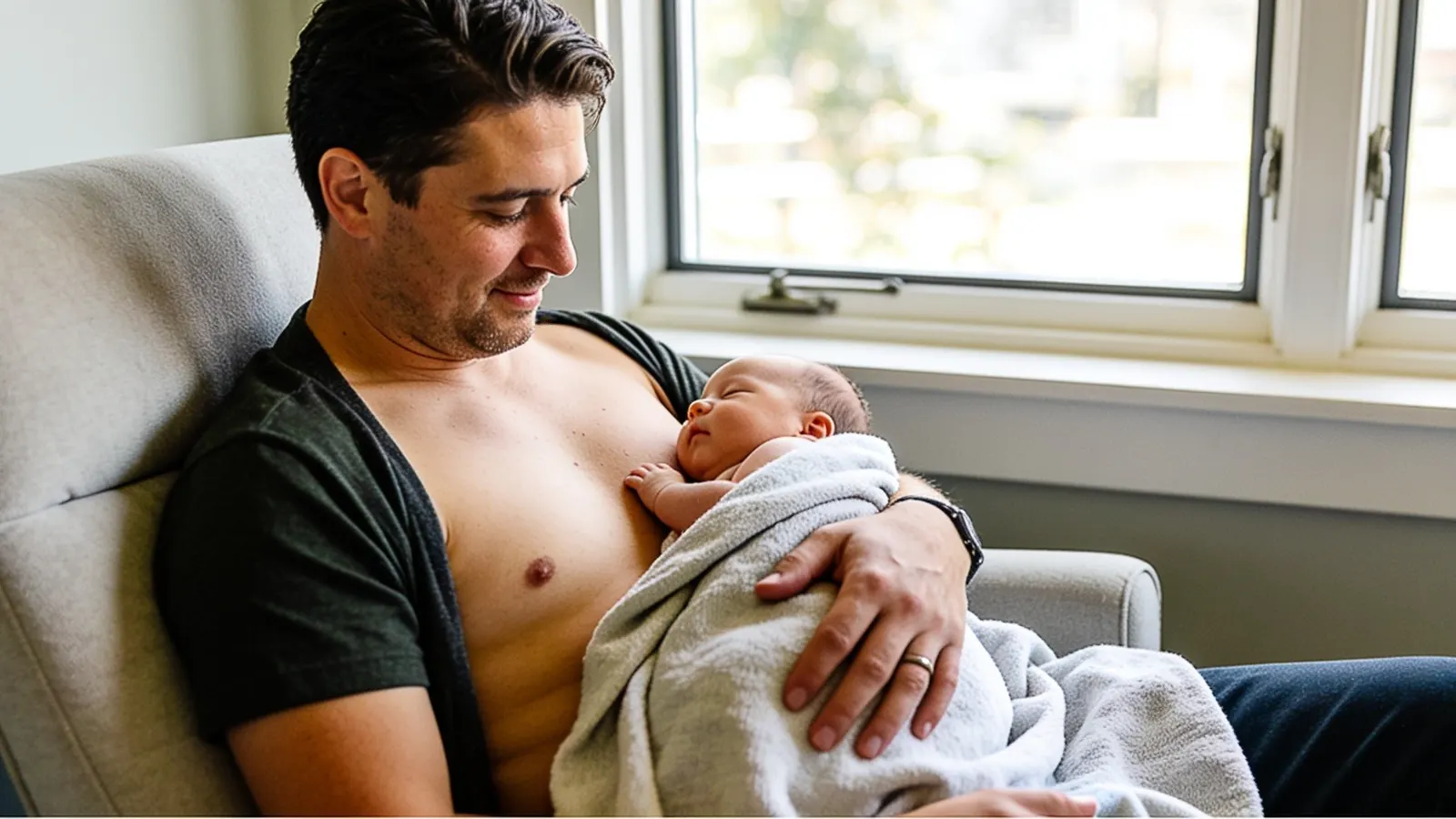
Skin-to-skin, at home too
Lay your diaper-only baby on your bare chest under a blanket. Keep your baby's face visible and nose and mouth uncovered, head turned to one side, with the blanket below the ears (Feldman-Winter & Goldsmith, 2016). Partners count: in a small trial of 29 fathers after cesarean births, babies held skin-to-skin cried less and calmed sooner than babies in a cot (Erlandsson et al., 2007). Do it while awake; if you get drowsy, move your baby to their back in their own sleep space.
Feed on cues, however you feed
The AAP recommends exclusive breastfeeding for about 6 months when possible (Meek & Noble, 2022). Many families use formula or a mix, for good reasons. Either way: watch for early hunger cues, let your baby set the pace, and stop at signs of fullness. If feeding hurts or worries you, ask your pediatrician early.
Share the load
The AAP urges pediatricians to support fathers' involvement (Yogman & Garfield, 2016). In practice:
- Split the night so each adult gets one longer stretch of sleep.
- The non-feeding partner owns diapers, burping, and settling.
- Accept specific help: meals, laundry, a stroller walk while you nap.
Script: "I've got everything until 2 a.m. You sleep. Then we switch."
Protect your own mental health
The AAP says 50% to 80% of people who give birth experience the "baby blues" (AAP), mild, short-lived mood changes in the first 2 weeks. Feelings that are severe or last longer than 2 weeks may be postpartum depression (NIMH). About 1 in 8 women report symptoms of postpartum depression after a birth (CDC). Partners too: in a meta-analysis of 43 studies, about 10% of fathers had depression during pregnancy or the year after birth, with higher rates 3 to 6 months after birth (Paulson & Bazemore, 2010).
Perinatal depression can be treated effectively, and the AAP recommends pediatricians screen mothers at the 1-, 2-, 4-, and 6-month visits (Earls et al., 2019). Answer honestly. You might say, "I'm not sleeping even when the baby sleeps, and I feel numb. Is that normal?"
Help now: call or text the National Maternal Mental Health Hotline at 1-833-TLC-MAMA (1-833-852-6262), or call or text 988. In an emergency, call 911 (CDC).
What to teach#
Honestly, you don't teach a newborn anything formally. No flashcards, no lessons. But your baby is learning constantly, mostly from how you respond.
What your baby learns from you this month:
- Needs get met. Through feeding and comfort, your baby learns who helps them feel safe (AAP).
- Your voice and face. Every feed and diaper change adds familiarity.
- Rhythms. Feed, awake, sleep, repeat. Loose patterns are fine.
- Day versus night. In the day, open the curtains and let normal household noise carry on. At night, keep lights low, voices quiet, and play to a minimum (NHS).
What you can deliberately model. Harvard's five serve-and-return steps (Harvard Center on the Developing Child), adapted for a newborn:
- Notice the serve: a gaze, a coo, a cry, a wiggle.
- Return it: a smile, a touch, a soft "I see you."
- Name it: "You're looking at the window. That's the light."
- Take turns and wait: pause. Newborns respond slowly.
- Notice endings: looking away or fussing can mean "done for now."
Narrate your day. "Now we're changing your diaper. Cold wipe! Okay, warm again." It may feel silly, but your baby hears language and warmth.
Later stages of this Chorevia guide get into chores, responsibility, and raising capable kids. For now, the curriculum is simpler: show up, respond, repeat.
Activities to try#
Every activity here is for an awake baby with an attentive adult. Pick one or two that fit your day, and let your baby's cues tell you when to stop.
How we rate the evidence
- Strong evidence
- Randomized trials or systematic reviews show a consistent benefit.
- Moderate evidence
- Consistent observational research, or a major guideline (AAP, WHO) built on research.
- Emerging evidence
- Small or early studies. Plausible, not yet proven.
- Mixed evidence
- Studies disagree, or reviews rate the evidence as weak.
Too tired to choose? Let us pick one.
Chest-to-chest tummy time
Moderate evidence- Time
- 3 to 5 minutes, 2 to 3 times a day
- Builds
- Neck and shoulder strength, early motor skills
- Choose a moment when your baby is awake and content, like after a diaper change or a nap (AAP).
- Recline with your back propped up, wide awake, and lay your baby tummy-down on your chest.
- Talk and smile so they try to lift and turn their head toward your face.
- Stop after 3 to 5 minutes, or sooner if they fuss. Try again later.
- Mix in short sessions on a blanket on the floor, working up to 15 to 30 minutes a day in total by 7 weeks (AAP).
Make it work: If your baby protests, try lap time: lay them tummy-down across your lap and support their head (AAP). Never leave a baby on their tummy unwatched. If they fall asleep, move them to their back in their own sleep space (AAP).
Evidence: Moderate. A systematic review of 16 mostly observational studies linked tummy time to better gross motor development (Hewitt et al., 2020), and the AAP says you can start the day your baby comes home from the hospital (AAP).
Skin-to-skin snuggles
Moderate evidence- Time
- As long as you're both comfortable and you're wide awake
- Builds
- Calm, closeness, breastfeeding
- Undress your baby down to the diaper.
- Lay them tummy-down on your bare chest, head turned to one side.
- Cover their back with a blanket, kept below their ears.
- Keep their face visible and their nose and mouth uncovered (Feldman-Winter & Goldsmith, 2016).
- Rest, breathe slowly, or hum.
Make it work: Partners count too. In a small trial of 29 fathers after cesarean births, babies held skin-to-skin cried less and calmed sooner than babies in a cot (Erlandsson et al., 2007). If you start to feel drowsy, move your baby to their back in their own sleep space.
Evidence: Moderate. The best evidence is for the hours after birth: a 2025 Cochrane review of 69 trials found that early skin-to-skin contact probably increases exclusive breastfeeding and raises babies' blood sugar, with moderate-certainty evidence (Moore et al., 2025). Skin-to-skin at home in the weeks after is much less studied.
Side-lying play
Emerging evidence- Time
- A few minutes at a time during awake play
- Builds
- A change of position, a new view of hands and faces
- Lay your baby on their side on a blanket on the floor while they're awake.
- If they roll onto their back, tuck a rolled-up towel behind them for support.
- Lie down facing them, or set a book or toy where they can see it.
- After a few minutes, switch to the other side.
Make it work: This is a good option when tummy time ends in tears. The AAP suggests changing your baby's position every 10 to 15 minutes during playtime, and staying with your baby the whole time (AAP). Side-lying is for awake play only. For sleep, always place your baby on their back on a bare, flat surface, with the towel put away.
Evidence: Emerging. There's little direct research on side-lying play. The AAP suggests it, with a rolled-up towel for support if needed, as one of the positions to rotate through during supervised play (AAP).
Hold and carry more
Mixed evidence- Time
- Extra holding through the day, beyond feeds and crying spells
- Builds
- Closeness, possibly less fussing
- Pick a few calm, awake times each day to hold your baby, not only when they cry or feed.
- Hold them upright against your chest, or walk around the house and describe what you see.
- If you use a sling or carrier, keep their face visible, nose and mouth clear, and chin off their chest (AAP).
- Check on your baby often, and bend at the knees, not the waist, to pick things up (AAP).
- Share the holding with partners, grandparents, and friends.
Make it work: Holding your baby won't spoil them (see "Respond to crying" above). The CPSC urges extra care with slings for babies under 4 months, preemies, and babies with colds, and says to reposition your baby after nursing so their face is at or above the rim of the sling (CPSC). If your baby falls asleep in a carrier, move them to their back on a firm, flat surface as soon as you can.
Evidence: Mixed. In a 1986 randomized trial of 99 families, babies who got extra carrying through the day cried and fussed 43% less at 6 weeks (Hunziker & Barr, 1986). Later trials did not repeat that result, either in a general group of babies (St James-Roberts et al., 1995) or in babies with colic (Barr et al., 1991).
The narrated diaper change
Emerging evidence- Time
- Every diaper change, and any time you're caring for your baby
- Builds
- Familiarity with your voice, early language exposure
- Look at your baby's face and say what you're doing: "Tabs open. Here comes the cool wipe."
- Name body parts as you go: "Here's your knee. Here's your other knee."
- Pause after you speak, as if waiting for a reply. Newborns respond slowly.
- If they coo, squeak, or stare, answer back.
Make it work: It may feel silly at first. That's normal. If your baby turns away or fusses, they're saying "done for now" (see "Read your baby's cues" above).
Evidence: Emerging. Back-and-forth talk is at the heart of serve-and-return brain building (Harvard Center on the Developing Child), and observational studies of older babies tie it to later language, most strongly at 18 to 24 months (Gilkerson et al., 2018). For newborns, the benefit is inferred.
Talk in parentese
Emerging evidence- Time
- A few minutes at a time, whenever your baby is alert
- Builds
- Attention to speech, early language
- Get face to face, about 8 to 12 inches away.
- Raise your pitch, slow down, and stretch out your words: "Hiii, sweeet baaaby" (AAP).
- Widen your eyes and smile as you talk.
- Pause to give your baby a "turn," then respond to whatever they do.
Make it work: Use real words, just in a warmer, slower, sing-song voice. The AAP notes that babies like high-pitched voices in general (AAP). If your baby looks away or fusses, take a break.
Evidence: Emerging. In a small lab study, 16 babies just 2 days old preferred infant-directed speech (parentese) to adult-style speech (Cooper & Aslin, 1990). The outcome research is with older babies: in a randomized trial, coaching parents on parentese and back-and-forth talk at 6 and 10 months led to more babbling and more words at 14 months (Ferjan Ramírez et al., 2019). For newborns, the benefit is inferred.
Read anything aloud
Moderate evidence- Time
- A few minutes a day
- Builds
- Language exposure, a calm routine
- Pick anything: a board book, a novel, a recipe, the news.
- Settle in a quiet spot with your baby in your arms.
- Read slowly, with lots of expression, for a few minutes.
- For picture books, hold the page about 8 to 12 inches from your baby's face, where they see best (AAP).
Make it work: Your baby won't follow the story, and that's fine. Stop when they fuss or turn away.
Evidence: Moderate. The AAP recommends shared reading beginning at birth, based on research with young children (Klass et al., 2024).
Face-to-face chats
Emerging evidence- Time
- A few minutes during quiet, alert moments
- Builds
- Social attention, connection
- Wait for a quiet, alert moment: eyes open, body calm.
- Hold your baby 8 to 12 inches from your face (AAP).
- Smile, talk softly, and make slow expressions, like opening your mouth wide or sticking out your tongue.
- Pause and watch. Give your baby time to respond.
Make it work: If your baby doesn't copy you, nothing is wrong. Newborn imitation is still debated (see "What the research says"). Looking away means "break, please."
Evidence: Emerging. Lab studies show newborns favor faces, even in the first hour after birth (Johnson et al., 1991). Long-term benefits are inferred.
Follow my face
Emerging evidence- Time
- A minute or two when your baby is alert
- Builds
- Visual attention, early eye control
- Hold your baby facing you, about 8 to 12 inches away.
- Catch their gaze, then slowly move your face a little to one side.
- Pause and watch whether their eyes or head follow.
- Come back to center, then try the other side.
Make it work: Go slowly and stop after a few tries. Wandering or crossed eyes should fade by 2 to 3 months, and babies should follow a moving object by 3 months (AAP). If yours doesn't, tell your pediatrician.
Evidence: Emerging. In lab studies, newborns in their first hour followed a slowly moving face-like pattern with their head and eyes farther than scrambled patterns (Johnson et al., 1991). The AAP expects babies to follow a moving object by about 3 months, so don't expect much yet (AAP).
Find the sound
Emerging evidence- Time
- A few tries when your baby is alert
- Builds
- Listening, linking sounds to places
- Hold your baby upright with their head well supported.
- From one side, call their name softly or shake a quiet rattle.
- Wait. The turn can take several seconds.
- When they find you, smile and talk. Then try the other side.
Make it work: Keep sounds gentle, since loud noises make newborns startle (AAP). If your baby never seems to react to sounds, or didn't pass the newborn hearing screen, tell your pediatrician (see the hearing question below).
Evidence: Emerging. In a small lab study, most of 21 alert newborns turned their heads toward a sound played to one side, but slowly: the turn took a median of 2.5 seconds to start (Muir & Field, 1979). The AAP lists looking or turning toward familiar sounds and voices as something a 1-month-old may do (AAP).
Sing to your baby
Emerging evidence- Time
- A song or two, any time
- Builds
- Soothing, closeness
- Pick any song: a lullaby, a pop song, or one you make up.
- Sing softly while rocking, feeding, or changing diapers.
- Repeat the same song at the same times of day, like before sleep.
- Watch how your baby responds, and get quieter if they seem overwhelmed.
Make it work: You don't need a good voice. Babies can recognize a parent's voice within the first month (AAP). Singing is also on the AAP's list of ways to soothe a crying baby (AAP).
Evidence: Emerging. One non-randomized study of about 170 mothers linked singing lullabies, during pregnancy and after birth, to stronger bonding at 3 months (Persico et al., 2017).
High-contrast looking
Emerging evidence- Time
- A minute or two
- Builds
- Visual attention
- Find something bold: a striped shirt, a black-and-white book, a checkered cloth.
- Hold it 8 to 12 inches from your baby's face while they're alert.
- Move it slowly, or swap in a new pattern.
- Stop when they look away.
Make it work: No special cards or screens needed. The AAP notes newborns prefer the human face to other patterns, so your face counts too (AAP). Keep pictures and toys out of the crib.
Evidence: Emerging. Newborns look longer at bold black-and-white patterns than at plain surfaces (Fantz, 1963), but there's no evidence that looking at them boosts development.
Gentle baby massage
Mixed evidence- Time
- A few minutes when your baby is calm and alert
- Builds
- Calm, connection
- Warm your hands and the room, and lay your baby on their back on a soft towel.
- Use slow, gentle strokes down the legs, then the arms.
- Gently open their palm and let them grip your finger, a reflex newborns are born with (AAP).
- Stop if your baby fusses or turns away.
Make it work: Try it after a bath or a diaper change. If your baby gets sleepy, move them to their back in their own sleep space.
Evidence: Mixed. A Cochrane review of 34 studies found mostly poor-quality evidence and did not support routine massage for healthy, low-risk babies (Bennett et al., 2013). Think of it as a way to connect, not a treatment.
A calm sponge bath
Emerging evidence- Time
- A few minutes, about 3 times a week
- Builds
- Clean skin, calm connection
- Warm the room and gather everything first: towel, washcloth, a basin of warm water, a clean diaper.
- Wrap your baby in a towel and uncover only the part you're washing.
- Wash the face first with a damp cloth, then the body, and the diaper area last.
- Talk or sing as you go, slowly.
- Pat dry and dress right away.
Make it work: Test the water with the inside of your wrist or elbow; it should feel warm, not hot. Use soap sparingly, since it can dry out the skin. Never leave your baby alone in the bath, even for an instant (AAP).
Evidence: Emerging. There's little research on bath time as an activity. The AAP lists a warm bath among ways to soothe a crying baby (AAP), says bathing should be relaxing, and advises sponge baths until the cord stump falls off (AAP).
Bright days, dim nights
Emerging evidence- Time
- All day, plus a short walk outside when you're up to it
- Builds
- Day-night rhythm
- In the daytime, open the curtains and let normal household noise carry on.
- If the weather is nice, take a short stroll outside in the early morning or late afternoon whenever you feel up to it (KidsHealth).
- Keep your baby out of the sun: use a stroller sunshade, dress them in lightweight long sleeves and pants, and skip outings from 10 a.m. to 4 p.m. (AAP).
- At night, keep lights low and voices soft (NHS), and try not to rouse your baby during feeds and changes (AAP).
Make it work: Expect slow change. Babies don't have regular sleep cycles until about 4 months (AAP). On walks, just be sure your baby is dressed for the weather (KidsHealth).
Evidence: Emerging. In a study of 56 babies at 6 to 12 weeks old, those who slept better at night were exposed to more light in the early afternoon (Harrison, 2004). That shows a link, not proof, in babies older than newborns. The NHS recommends light, normal daytimes and dim, quiet nights (NHS).
A short wind-down routine
Emerging evidence- Time
- A few minutes before night sleep
- Builds
- Sleep cues, a calmer evening
- Pick 2 or 3 calm steps you can repeat, such as a fresh diaper, a feed, and a quiet song.
- Dim the lights and lower your voice.
- Do the steps in the same order each night.
- Lay your baby on their back in their own sleep space, ideally drowsy but still awake (AAP).
Make it work: Keep expectations loose for now; this is about building a habit, not a schedule. If you swaddle, keep your baby on their back with hips loose, stop as soon as they show signs of trying to roll, and keep the sleep space bare: no pillows, blankets, bumpers, or toys (see "Safe sleep, every sleep" below).
Evidence: Emerging. In a 3-week randomized trial with babies and toddlers 7 to 36 months old, a consistent bedtime routine reduced night wakings and improved mothers' mood (Mindell et al., 2009). A survey of more than 10,000 children up to age 5 linked more consistent routines, started earlier, to better sleep, but there's little research in newborns (Mindell et al., 2015).
Common questions#
Quick answers to the questions new parents ask most in the first month, including when each one is worth a call to your pediatrician.
Is it normal for my newborn to sneeze and hiccup so much?
Yes, frequent sneezing and hiccups are normal in newborns. Sneezing is how babies clear their noses of dust, fuzz, smoke, or strong smells, and it isn't caused by an allergy (AAP). Hiccups often come from overeating or a little stomach acid (AAP), and they usually bother parents more than babies (AAP). If hiccups start during a feed, change your baby's position, try a burp, or help them relax. If they don't stop in 5 to 10 minutes, try feeding again for a few minutes (AAP). Sneezing along with fever, trouble breathing, or poor feeding is different; see the lists below.
Why does my newborn breathe fast and then pause?
Irregular breathing with short pauses is normal for newborns. Pauses of less than 10 seconds, called periodic breathing, are expected, and the breathing rate should stay below 60 breaths a minute (AAP). Squeaks and sighs are common too (AAP). Go to the ER now if pauses last more than 10 seconds, breathing stays faster than 60 breaths a minute, breathing looks hard, or the ribs pull in with each breath (AAP). Call 911 for blue or gray lips or a baby struggling for each breath (see the lists below).
How can I tell normal spit-up from vomiting?
Spit-up flows out easily, often with a burp, and doesn't upset your baby, while vomiting is forceful and usually uncomfortable (AAP). Spitting up is common. The AAP says about half of babies are "happy spitters" who aren't bothered by it, and many are better by 7 months, once they sit well (AAP). Call your pediatrician right away if spit-up turns forceful or projectile or has blood in it (AAP), and call during office hours if your baby isn't gaining weight well. Green spit-up or vomit means go to the ER now (AAP).
What color should my newborn's poop be?
After the first few days, mustard yellow is typical for breastfed babies, and yellow-tan with hints of green is typical for formula-fed babies (AAP). The first stools are black and tarry, then turn greenish-yellow around days 3 to 4 (see the week-by-week table above). Green stools on their own aren't a cause for alarm (AAP). Call your pediatrician as soon as possible about white or very pale poop, which can be a sign of a liver problem. Red poop, or black poop after the first few days, can mean blood, so call about that too (AAP).
How often should my newborn poop?
How often a newborn poops varies a lot, and the pattern often changes after the first few weeks. By 5 to 7 days old, breastfed babies should have at least 3 to 4 loose, yellow stools a day (AAP). By 3 to 6 weeks, some breastfed babies poop only once a week and are still healthy, as long as the stools are soft and your baby is feeding well and gaining weight steadily. Formula-fed babies should have at least one bowel movement a day (AAP). If fewer stools come with poor feeding or fewer wet diapers, call your pediatrician right away (see the list below).
How do I take care of the umbilical cord stump?
Just keep the umbilical cord stump clean; you don't need rubbing alcohol (AAP). Fold the diaper below the stump so urine doesn't soak it, and stick to sponge baths until it falls off (AAP). It should dry and fall off by 3 weeks, and a few drops of blood on the diaper when it does are normal. Call your pediatrician the same day for yellowish, foul-smelling discharge, red skin around the base, or crying when you touch it, and book a visit if the stump is still there after 3 weeks (AAP). Call right away if it actively bleeds, redness spreads out from the base, or your baby has a fever (AAP; AAP).
When can I give my newborn a real bath?
You can give a tub bath once the umbilical cord stump has fallen off and the area has healed. Until then, stick to sponge baths (AAP). The stump usually falls off by 1 to 2 weeks of age. For tub baths, use about 2 inches of water that feels warm, not hot, on the inside of your wrist or elbow, and never leave your baby alone in the bath, even for an instant. Three baths a week may be enough, since bathing more often can dry out your baby's skin (AAP).
Are the bumps, pimples, and peeling on my baby's skin normal?
Most newborn bumps, pimples, and peeling are normal and clear up on their own. Tiny white bumps on the nose and cheeks (milia) appear in about 40% of newborns and go away by 1 to 2 months. Baby acne shows up in more than 30% of babies at 2 to 4 weeks and can last until 4 to 6 months. Neither needs treatment, and oils or creams can make them worse (AAP). Peeling skin is normal too (AAP). Cradle cap, a scaly scalp rash, usually starts between 3 weeks and 2 months; washing every other day with a mild baby shampoo helps (AAP). Call your pediatrician right away about tiny blisters, purple or blood-colored spots, infected-looking skin, or a rash with a fever (AAP).
Why are my newborn's breasts or genitals swollen?
Swollen breasts and genitals are common in newborns and usually harmless, often caused by the birthing parent's estrogen crossing the placenta. Both boys and girls can have swollen breasts, sometimes leaking a few drops of milk (AAP). The swelling often lasts 2 to 4 weeks. Don't squeeze them, which can cause a serious infection (AAP). Girls may have white vaginal mucus, sometimes with a little blood (AAP), and blood-tinged discharge shouldn't last more than 3 or 4 days. Call your pediatrician right away if a swollen breast turns red, streaky, or tender (AAP).
How do I trim my newborn's nails without cutting them?
Trim or file your newborn's nails while they're asleep, using baby nail clippers, blunt-tipped scissors, or a nail file (AAP). Push the fingertip skin down, away from the nail, so you can get around the nail without nicking your baby's finger. Smooth any sharp edges with an emery board. Expect to trim or file at least once a week. Don't bite or peel your baby's nails off, which can lead to infection (AAP).
How do I know my baby is eating enough?
Your baby is likely eating enough if they have plenty of wet and dirty diapers and are gaining weight steadily. By 5 to 7 days old, a breastfed baby should have 6 or more wet diapers a day with pale urine, plus at least 3 to 4 yellow, loose stools, and should seem satisfied for 1 to 3 hours between feeds (AAP). Newborns lose some weight at first. Most are back to birth weight by about 2 weeks, almost all by 3 weeks, and then the average baby gains almost an ounce a day (AAP). Your pediatrician checks weight at the early visits.
Why does my baby want to feed nonstop in the evening?
Frequent evening feeds are usually cluster feeding, a normal pattern of several short feeds spaced closer together than usual (Cleveland Clinic). It often happens in the evening, when levels of prolactin, a milk-making hormone, are usually lowest. Growth spurts, around 7 to 10 days and again at 3 to 6 weeks, can bring extra-hungry stretches too (AAP). Keep feeding on cues, and let a partner cover burping, diapers, and dinner. Call your pediatrician if your baby is more than a week old and feeding constantly, or if you're worried about latch or milk supply (Cleveland Clinic).
Can I take my newborn outside or have visitors?
Yes, you can take your newborn outside and have visitors, with a few precautions. If the weather is nice, a stroll is fine whenever you feel up to it, though some doctors suggest waiting a few months before crowded places like malls and airplanes (KidsHealth). Ask anyone who holds your baby to wash their hands first and to stay away while they're sick (KidsHealth; AAP). The AAP also suggests that relatives be up to date on vaccines, with Tdap finished at least 2 weeks before visiting (AAP). Keep babies under 6 months out of the sun, with shade and lightweight clothing, and skip outings from 10 a.m. to 4 p.m. (AAP).
Can I give my breastfed baby a pacifier?
Yes, you can offer your breastfed baby a pacifier once breastfeeding is going well, which usually takes about 3 to 4 weeks (AAP). Offering one at naps and bedtime helps lower the risk of SIDS. Give it when you're sure your baby isn't hungry, and don't force it if they don't want it. Choose a one-piece pacifier with a soft nipple, and never tie it to the crib or around your baby's neck or hand (AAP).
Is it safe to touch my baby's soft spot?
Yes, gently touching your baby's soft spots is safe, because a thick, durable membrane protects the brain underneath (AAP). Babies have two: a diamond-shaped one on top that usually closes between 12 and 18 months, and a smaller one at the back that closes between 2 and 3 months. The front soft spot normally looks flat or a little sunken and may pulse with each heartbeat. A bulging (swollen-looking) soft spot isn't normal, and neither is a deeply sunken one in a baby who isn't acting well, which can mean dehydration. Call your pediatrician right away for either (AAP).
How warm should my baby's room be?
The UK's NHS suggests keeping a baby's room between about 61 and 68°F (16 to 20°C) (NHS). The AAP's rule is to dress your baby in only one more layer than you'd wear to be comfortable in the same room. Watch for signs of overheating, like sweating, a hot chest, or flushed skin, and skip hats indoors (AAP). To check, feel your baby's chest or the back of their neck (NHS). If you're worried your baby is cold at night, use layers or a wearable blanket, not loose blankets (AAP).
What happens if my baby doesn't pass the newborn hearing screen?
If your baby doesn't pass the newborn hearing screen, they need a full hearing test by an audiologist to find out whether there is hearing loss (CDC). The CDC says that test should happen before 3 months of age, so book it as soon as you can. If hearing loss is found, starting support services before 6 months helps babies communicate better (CDC). Hearing loss can also show up later in childhood, so mention any worries about your baby's hearing at checkups (CDC).
Which vaccines does my newborn need in the first month?
The AAP recommends that newborns get a first dose of hepatitis B vaccine within 24 hours of birth, with different timing for some very small preterm babies (AAP). It also recommends an RSV antibody shot (nirsevimab or clesrovimab) for babies under 8 months during RSV season, generally October through March, unless the birthing parent got an RSV vaccine during pregnancy at least 14 days before birth (AAP; AAP). US guidance has been changing. In January 2026, the AAP published a schedule that differs from a revised one the CDC issued that month (AAP), and federal vaccine changes made in 2025 and 2026 have been challenged in court (STAT, 2026). Ask your pediatrician which shots your baby needs.
Safety and when to call your pediatrician#

Safe sleep, every sleep
From the AAP's 2022 policy (Moon et al., 2022; AAP parent summary):
- Back to sleep for every nap and every night.
- Firm, flat surface. Anything inclined more than 10 degrees isn't safe for sleep, so skip inclined sleepers.
- Room-share without bed-sharing for at least the first 6 months. The AAP advises against bed-sharing under any circumstances.
- Bare crib: a fitted sheet only. No bumpers, pillows, blankets, toys, or weighted sleep products.
- Move sleeping babies from car seats, swings, strollers, or carriers to a firm, flat surface on their back as soon as you can.
- Offer a pacifier at sleep times. If breastfeeding, wait until it's well established.
- Avoid overheating: dress your baby in only one layer more than you're wearing.
- No smoke or nicotine exposure, and avoid alcohol, marijuana, opioids, and illicit drugs.
- Swaddle safely: always on the back, hips loose, and stop as soon as your baby shows signs of trying to roll (AAP).
- Don't attach a pacifier to clothing or a string.
- No hat indoors once you're home.
- Don't rely on home monitors. There's no evidence they lower SIDS risk.
- Avoid feeding on a couch or armchair. If you doze off while feeding, put your baby on their back in their own space as soon as you wake (AAP).
Car seat
Rear-facing from the first ride home, as long as possible up to the seat's limits. Back seat only, never in front of an active airbag. Snug harness, chest clip at armpit level, no bulky coats under straps (AAP).
Never shake a baby
It is never safe to shake, throw, hit, slam, or jerk a child (AAP). Shaking often happens in response to crying (Barr et al., 2009). Make your walk-away plan now and share it with every caregiver.
Fever: call right away
If your baby is 3 months or younger and has a rectal temperature of 100.4°F (38°C) or higher, call your pediatrician immediately, even if they seem fine. Rectal readings are the most accurate at this age (AAP).
Call 911 if your baby
- Has blue or gray lips or tongue
- Can't be woken enough to feed
- Is limp, floppy, or not moving
- Is struggling to breathe, or has new grunting, wheezing, or whistling sounds
Go to the ER now if your baby
- Has any trouble breathing: more than 60 breaths a minute, pauses longer than about 10 seconds, or ribs pulling in with each breath. The AAP advises the ER for babies under 1 year with trouble breathing (AAP; Nationwide Children's).
- Vomits green (bile), even once (AAP).
Call your pediatrician right away if your baby
- Is feeding poorly, has a weak suck, or vomits more than once (not just spit-up) (Nationwide Children's)
- Has a rectal temperature below 96.8°F (36.0°C) that doesn't go up with warming (Seattle Children's)
- Has fewer wet diapers than expected; 6 or more a day by days 5 to 7 is the goal for breastfed babies (AAP)
- Has yellow skin that's deepening or spreading to the belly, arms, or legs, yellow whites of the eyes, or is hard to wake (AAP)
- Cries and can't be comforted in a way that's new or worries you (Nationwide Children's)
- Just doesn't seem right to you. Trust your instincts (Lurie Children's).
Vitamin D
Breastfed and partially breastfed babies need 400 IU of vitamin D a day, starting in the first few days. Babies who drink less than 32 ounces of formula a day also need a 400 IU supplement (AAP).
Checkups in the first month
Per the AAP and Bright Futures schedule (AAP, 2025):
- Newborn, in the hospital: exam, newborn blood screen, jaundice check, a pulse-oximetry heart screen, and a hearing screen, which every baby should have by 1 month (CDC).
- 3 to 5 days old, within 48 to 72 hours of going home (within 48 hours if your baby left the hospital before 48 hours old): weight, feeding, and jaundice check, plus breastfeeding support.
- By 1 month: growth, feeding, development, and a depression screen for the birthing parent.
Immunizations are reviewed at each visit. Keep a running list of questions; the 3 a.m. ones count.
Sources#
- American Academy of Pediatrics. "Back to Sleep, Tummy to Play." HealthyChildren.org, updated 2026. https://www.healthychildren.org/English/ages-stages/baby/sleep/Pages/back-to-sleep-tummy-to-play.aspx
- American Academy of Pediatrics. "Fever and Your Baby." HealthyChildren.org, updated 2025. https://www.healthychildren.org/English/health-issues/conditions/fever/Pages/Fever-and-Your-Baby.aspx
- American Academy of Pediatrics Section on Gastroenterology, Hepatology and Nutrition. "Vitamin D for Babies, Children & Adolescents." HealthyChildren.org, updated 2022. https://www.healthychildren.org/English/healthy-living/nutrition/Pages/vitamin-d-on-the-double.aspx
- Moon RY. "How to Keep Your Sleeping Baby Safe: AAP Policy Explained." HealthyChildren.org, updated 2026. https://www.healthychildren.org/English/ages-stages/baby/sleep/Pages/a-parents-guide-to-safe-sleep.aspx
- Moon RY. "Safe Sleep Tips for Sleep-Deprived New Parents." HealthyChildren.org, updated 2026. https://www.healthychildren.org/English/ages-stages/baby/sleep/Pages/safe-sleep-tips-for-sleep-deprived-parents.aspx
- American Academy of Pediatrics. "Swaddling: Is it Safe?" HealthyChildren.org, updated 2022. https://www.healthychildren.org/English/ages-stages/baby/diapers-clothing/Pages/Swaddling-Is-it-Safe.aspx
- American Academy of Pediatrics. "Newborn Reflexes." HealthyChildren.org, updated 2022. https://www.healthychildren.org/English/ages-stages/baby/Pages/newborn-reflexes.aspx
- American Academy of Pediatrics. "Infant Vision Development: What Can Babies See?" HealthyChildren.org, updated 2024. https://www.healthychildren.org/English/ages-stages/baby/Pages/Babys-Vision-Development.aspx
- American Academy of Pediatrics. "Developmental Milestones at 1 Month Old." HealthyChildren.org, updated 2026. https://www.healthychildren.org/English/ages-stages/baby/Pages/Developmental-Milestones-1-Month.aspx
- American Academy of Pediatrics. "Emotional & Social Development in Babies: Birth Through 3 Months." HealthyChildren.org, updated 2026. https://www.healthychildren.org/English/ages-stages/baby/Pages/Emotional-and-Social-Development-Birth-to-3-Months.aspx
- American Academy of Pediatrics. "Getting Your Baby to Sleep." HealthyChildren.org, updated 2024. https://www.healthychildren.org/English/ages-stages/baby/sleep/Pages/getting-your-baby-to-sleep.aspx
- American Academy of Pediatrics. "How Often to Breastfeed." HealthyChildren.org, updated 2015. https://www.healthychildren.org/English/ages-stages/baby/breastfeeding/Pages/How-Often-to-Breastfeed.aspx
- American Academy of Pediatrics Section on Breastfeeding. "How to Tell if Your Breastfed Baby is Getting Enough Milk." HealthyChildren.org, updated 2025. https://www.healthychildren.org/English/ages-stages/baby/breastfeeding/Pages/How-to-Tell-if-Baby-is-Getting-Enough-Milk.aspx
- American Academy of Pediatrics. "Amount and Schedule of Baby Formula Feedings." HealthyChildren.org, updated 2022. https://www.healthychildren.org/English/ages-stages/baby/formula-feeding/Pages/amount-and-schedule-of-formula-feedings.aspx
- American Academy of Pediatrics. "Responding to Your Baby's Cries." HealthyChildren.org, updated 2025. https://www.healthychildren.org/English/ages-stages/baby/crying-colic/Pages/Responding-to-Your-Babys-Cries.aspx
- American Academy of Pediatrics. "Shaken Baby Syndrome: Protect Your Infant from Abusive Head Trauma." HealthyChildren.org, updated 2025. https://www.healthychildren.org/English/safety-prevention/at-home/Pages/Abusive-Head-Trauma-Shaken-Baby-Syndrome.aspx
- Sriraman NK. "Depression During & After Pregnancy: You Are Not Alone." HealthyChildren.org, updated 2022. https://www.healthychildren.org/English/ages-stages/prenatal/delivery-beyond/Pages/understanding-motherhood-and-mood-baby-blues-and-beyond.aspx
- American Academy of Pediatrics. "Car Seats: Information for Families." HealthyChildren.org, updated 2026. https://www.healthychildren.org/English/safety-prevention/on-the-go/Pages/Car-Safety-Seats-Information-for-Families.aspx
- American Academy of Pediatrics Committee on Fetus and Newborn. "Jaundice in Newborns." HealthyChildren.org, updated 2024. https://www.healthychildren.org/English/ages-stages/baby/Pages/jaundice.aspx
- American Academy of Pediatrics. "Breathing Trouble" (symptom checker). HealthyChildren.org, accessed 2026. https://www.healthychildren.org/English/tips-tools/symptom-checker/Pages/symptomviewer.aspx?symptom=Breathing+Trouble
- American Academy of Pediatrics. "Newborn Reflexes and Behavior" (symptom checker). HealthyChildren.org, accessed 2026. https://www.healthychildren.org/English/tips-tools/symptom-checker/Pages/symptomviewer.aspx?symptom=Newborn+Reflexes+and+Behavior
- American Academy of Pediatrics. "Newborn Appearance Questions" (symptom checker). HealthyChildren.org, accessed 2026. https://www.healthychildren.org/English/tips-tools/symptom-checker/Pages/symptomviewer.aspx?symptom=Newborn+Appearance+Questions
- American Academy of Pediatrics. "Newborn Rashes and Birthmarks" (symptom checker). HealthyChildren.org, accessed 2026. https://www.healthychildren.org/English/tips-tools/symptom-checker/Pages/symptomviewer.aspx?symptom=Newborn+Rashes+and+Birthmarks
- American Academy of Pediatrics. "Reflux (Spitting Up)" (symptom checker). HealthyChildren.org, accessed 2026. https://www.healthychildren.org/English/tips-tools/symptom-checker/Pages/symptomviewer.aspx?symptom=Reflux+%28Spitting+Up%29
- American Academy of Pediatrics. "Umbilical Cord Symptoms" (symptom checker). HealthyChildren.org, accessed 2026. https://www.healthychildren.org/English/tips-tools/symptom-checker/Pages/symptomviewer.aspx?symptom=Umbilical+Cord+Symptoms
- American Academy of Pediatrics. "How Your Newborn Behaves." HealthyChildren.org, updated 2021. https://www.healthychildren.org/English/ages-stages/baby/Pages/How-Your-Newborn-Behaves.aspx
- American Academy of Pediatrics. "How Your Newborn Looks." HealthyChildren.org, updated 2021. https://www.healthychildren.org/English/ages-stages/baby/Pages/How-Your-Newborn-Looks.aspx
- American Academy of Pediatrics. "Your Baby's First Month: Growth & Physical Appearance." HealthyChildren.org, updated 2026. https://www.healthychildren.org/English/ages-stages/baby/Pages/First-Month-Physical-Appearance-and-Growth.aspx
- American Academy of Pediatrics. "Hearing & Making Sounds: Your Baby's Milestones." HealthyChildren.org, updated 2021. https://www.healthychildren.org/English/ages-stages/baby/pages/Hearing-and-Making-Sounds.aspx
- American Academy of Pediatrics. "3 Tummy Time Activities to Try With Your Baby." HealthyChildren.org, updated 2023. https://www.healthychildren.org/English/ages-stages/baby/sleep/Pages/The-Importance-of-Tummy-Time.aspx
- American Academy of Pediatrics. "Baby Carriers: Backpacks, Front Packs & Slings." HealthyChildren.org, updated 2025. https://www.healthychildren.org/English/safety-prevention/on-the-go/Pages/Baby-Carriers.aspx
- American Academy of Pediatrics. "Baby Burping, Hiccups & Spit-Up." HealthyChildren.org, updated 2024. https://www.healthychildren.org/English/ages-stages/baby/feeding-nutrition/Pages/baby-burping-hiccups-and-spit-up.aspx
- Velez A, Waasdorp Hurtado C. "Why Babies Spit Up." HealthyChildren.org, updated 2025. https://www.healthychildren.org/English/ages-stages/baby/feeding-nutrition/Pages/Why-Babies-Spit-Up.aspx
- Jana L, Shu J. "The Many Colors of Baby Poop." HealthyChildren.org, updated 2024. https://www.healthychildren.org/English/ages-stages/baby/Pages/The-Many-Colors-of-Poop.aspx
- American Academy of Pediatrics. "Baby's First Days: Bowel Movements & Urination." HealthyChildren.org, updated 2024. https://www.healthychildren.org/English/ages-stages/baby/Pages/babys-first-days-bowel-movements-and-urination.aspx
- American Academy of Pediatrics. "Umbilical Cord Care in Newborns." HealthyChildren.org, updated 2025. https://www.healthychildren.org/English/ages-stages/baby/bathing-skin-care/Pages/Umbilical-Cord-Care.aspx
- Navsaria D. "Bathing Your Baby." HealthyChildren.org, updated 2025. https://www.healthychildren.org/English/ages-stages/baby/bathing-skin-care/Pages/Bathing-Your-Newborn.aspx
- Stein S. "What is Cradle Cap?" HealthyChildren.org, updated 2023. https://www.healthychildren.org/English/ages-stages/baby/bathing-skin-care/Pages/Cradle-Cap.aspx
- Jana L, Shu J. "Nailing It: How to Trim Your Baby's Fingernails." HealthyChildren.org, updated 2020. https://www.healthychildren.org/English/ages-stages/baby/bathing-skin-care/Pages/Nails-Nails-Everywhere.aspx
- Gupta D, Mahoney M. "Baby Sunburn Prevention Tips." HealthyChildren.org, updated 2026. https://www.healthychildren.org/English/ages-stages/baby/bathing-skin-care/Pages/Baby-Sunburn-Prevention.aspx
- American Academy of Pediatrics. "Baby Pacifiers & Thumb Sucking: What Parents Need to Know." HealthyChildren.org, updated 2026. https://www.healthychildren.org/English/ages-stages/baby/crying-colic/Pages/Pacifiers-and-Thumb-Sucking.aspx
- American Academy of Pediatrics Section on Infectious Diseases. "How to Cocoon a Newborn: Family & Friends Can Protect Baby From Germs." HealthyChildren.org, updated 2025. https://www.healthychildren.org/English/safety-prevention/immunizations/Pages/How-to-Cocoon-a-Newborn-Only-an-E-Mail-Away.aspx
- American Academy of Pediatrics. "AAP Immunization FAQs." AAP.org, updated 2026. https://www.aap.org/en/patient-care/immunizations/aap-immunization-faq/
- American Academy of Pediatrics. "AAP Releases Recommended Childhood and Adolescent Immunization Schedule for 2026." HealthyChildren.org, January 2026. https://www.healthychildren.org/English/news/Pages/AAPs-recommended-childhood-and-adolescent-immunization-schedule-for-2026.aspx
- American Academy of Pediatrics. "AAP Releases RSV Immunization Recommendations for 2026-2027 Season." HealthyChildren.org, September 2026. https://www.healthychildren.org/English/news/Pages/aap-updates-rsv-immunization-recommendations-for-2026-2027-season.aspx
- American Academy of Pediatrics. "RSV Immunizations: 2 Ways to Protect Babies." HealthyChildren.org, updated 2026. https://www.healthychildren.org/English/safety-prevention/immunizations/Pages/RSV-immunizations-new-ways-to-protect-babies.aspx
- American Academy of Pediatrics and Bright Futures. "Recommendations for Preventive Pediatric Health Care" (Periodicity Schedule). 2025. https://downloads.aap.org/AAP/PDF/periodicity_schedule.pdf
- Moon RY, Carlin RF, Hand I; AAP Task Force on SIDS and Committee on Fetus and Newborn. "Sleep-Related Infant Deaths: Updated 2022 Recommendations for Reducing Infant Deaths in the Sleep Environment." Pediatrics, 2022. https://pubmed.ncbi.nlm.nih.gov/35726558/
- Meek JY, Noble L; AAP Section on Breastfeeding. "Policy Statement: Breastfeeding and the Use of Human Milk." Pediatrics, 2022. https://pubmed.ncbi.nlm.nih.gov/35921640/
- Klass P, Miller-Fitzwater A, High PC; AAP Council on Early Childhood. "Literacy Promotion: An Essential Component of Primary Care Pediatric Practice: Policy Statement." Pediatrics, 2024. https://pubmed.ncbi.nlm.nih.gov/39342414/
- Earls MF, Yogman MW, Mattson G, Rafferty J; AAP Committee on Psychosocial Aspects of Child and Family Health. "Incorporating Recognition and Management of Perinatal Depression Into Pediatric Practice." Pediatrics, 2019. https://pubmed.ncbi.nlm.nih.gov/30559120/
- Yogman M, Garfield CF; AAP Committee on Psychosocial Aspects of Child and Family Health. "Fathers' Roles in the Care and Development of Their Children: The Role of Pediatricians." Pediatrics, 2016. https://pubmed.ncbi.nlm.nih.gov/27296867/
- Centers for Disease Control and Prevention. "Symptoms of Depression Among Women." 2024. https://www.cdc.gov/reproductive-health/depression/index.html
- Centers for Disease Control and Prevention. "Hearing Loss in Children: Screening." 2024. https://www.cdc.gov/hearing-loss-children/screening/index.html
- National Institute of Mental Health. "Perinatal Depression." 2023. https://www.nimh.nih.gov/health/publications/perinatal-depression
- Eunice Kennedy Shriver National Institute of Child Health and Human Development (NICHD). "Safe to Sleep" spotlight. 2012. https://www.nichd.nih.gov/newsroom/resources/spotlight/100312-safe-to-sleep
- Center on the Developing Child at Harvard University. "InBrief: The Science of Early Childhood Development." https://developingchild.harvard.edu/wp-content/uploads/2024/10/InBrief-The-Science-of-Early-Childhood-Development2.pdf
- Center on the Developing Child at Harvard University. "Serve and Return." https://developingchild.harvard.edu/key-concept/serve-and-return/
- Center on the Developing Child at Harvard University. "5 Steps for Brain-Building Serve and Return." 2019. https://developingchild.harvard.edu/wp-content/uploads/2024/10/HCDC_ServeReturn_for_Parents_Caregivers_2019.pdf
- National Health Service (UK). "Helping your baby to sleep." 2025. https://www.nhs.uk/baby/caring-for-a-newborn/helping-your-baby-to-sleep/
- Seattle Children's Hospital. "Period of PURPLE Crying." https://www.seattlechildrens.org/health-safety/parenting/purple-education-crying/
- Seattle Children's Hospital. "Newborn Illness - How to Recognize." https://www.seattlechildrens.org/conditions/a-z/newborn-illness---how-to-recognize/
- American Academy of Pediatrics. "Vomiting Without Diarrhea" symptom checker. HealthyChildren.org. https://www.healthychildren.org/English/tips-tools/symptom-checker/Pages/symptomviewer.aspx?symptom=Vomiting+Without+Diarrhea
- Feldman-Winter L, Goldsmith JP; AAP Committee on Fetus and Newborn, Task Force on Sudden Infant Death Syndrome. "Safe Sleep and Skin-to-Skin Care in the Neonatal Period for Healthy Term Newborns." Pediatrics, 2016. https://pubmed.ncbi.nlm.nih.gov/27550975/
- Nationwide Children's Hospital. "Newborn Warning Signs." 2023. https://www.nationwidechildrens.org/conditions/health-library/newborn-warning-signs
- Latimer T. "When to Call the Pediatrician for Your Newborn." Lurie Children's Hospital of Chicago, 2022. https://www.luriechildrens.org/en/blog/when-to-call-the-pediatrician-for-your-newborn/
- Cleveland Clinic. "How Can I Tell When My Baby Is Tired?" 2024. https://health.clevelandclinic.org/how-can-i-tell-when-my-baby-is-tired
- Cleveland Clinic. "Cluster Feeding." 2024. https://my.clevelandclinic.org/health/articles/cluster-feeding
- Nemours KidsHealth. "When Can I Take My Newborn Out in Public?" Reviewed 2024. https://kidshealth.org/en/parents/newborn-out.html
- National Health Service (UK). "Sudden infant death syndrome (SIDS)." 2025. https://www.nhs.uk/conditions/sudden-infant-death-syndrome-sids/
- Centers for Disease Control and Prevention. "Newborn Hearing Screening." 2024. https://www.cdc.gov/hearing-loss-children-guide/parents-guide/newborn-hearing-screening.html
- US Consumer Product Safety Commission. "CPSC Educates New Parents on Safe Babywearing." 2010. https://www.cpsc.gov/Newsroom/News-Releases/2011/CPSC-Educates-New-Parents-on-Safe-BabywearingInfant-suffocation-deaths-in-slings-prompt-renewed-effort-to-warn-moms-and-dads
- Oza A. "HHS appeals ruling that stalled many of Kennedy's vaccine policy changes." STAT News, April 29, 2026. https://www.statnews.com/2026/04/29/hhs-appealing-acip-vaccine-policy-lawsuit-ruling/
- DeCasper AJ, Fifer WP. "Of human bonding: newborns prefer their mothers' voices." Science, 1980. https://pubmed.ncbi.nlm.nih.gov/7375928/
- Fantz RL. "Pattern Vision in Newborn Infants." Science, 1963. https://pubmed.ncbi.nlm.nih.gov/17788054/
- Johnson MH, Dziurawiec S, Ellis H, Morton J. "Newborns' preferential tracking of face-like stimuli and its subsequent decline." Cognition, 1991. https://pubmed.ncbi.nlm.nih.gov/1786670/
- Meltzoff AN, Moore MK. "Imitation of facial and manual gestures by human neonates." Science, 1977. https://pubmed.ncbi.nlm.nih.gov/17741897/
- Oostenbroek J, Suddendorf T, Nielsen M, et al. "Comprehensive Longitudinal Study Challenges the Existence of Neonatal Imitation in Humans." Current Biology, 2016. https://pubmed.ncbi.nlm.nih.gov/27161497/
- Meltzoff AN, Murray L, Simpson E, et al. "Re-examination of Oostenbroek et al. (2016): evidence for neonatal imitation of tongue protrusion." Developmental Science, 2018. https://pubmed.ncbi.nlm.nih.gov/28952202/
- Moore ER, Brimdyr K, Blair A, et al. "Immediate or early skin-to-skin contact for mothers and their healthy newborn infants." Cochrane Database of Systematic Reviews, 2025. https://pubmed.ncbi.nlm.nih.gov/41120189/
- Erlandsson K, Dsilna A, Fagerberg I, Christensson K. "Skin-to-skin care with the father after cesarean birth and its effect on newborn crying and prefeeding behavior." Birth, 2007. https://pubmed.ncbi.nlm.nih.gov/17542814/
- Brazelton TB. "Crying in infancy." Pediatrics, 1962. https://pubmed.ncbi.nlm.nih.gov/13872677/
- Vermillet AQ, Tølbøll K, Litsis Mizan S, Skewes JC, Parsons CE. "Crying in the first 12 months of life: A systematic review and meta-analysis of cross-country parent-reported data and modeling of the 'cry curve'." Child Development, 2022. https://pubmed.ncbi.nlm.nih.gov/35438798/
- Wolke D, Bilgin A, Samara M. "Systematic Review and Meta-Analysis: Fussing and Crying Durations and Prevalence of Colic in Infants." Journal of Pediatrics, 2017. https://pubmed.ncbi.nlm.nih.gov/28385295/
- Barr RG, Rivara FP, Barr M, et al. "Effectiveness of educational materials designed to change knowledge and behaviors regarding crying and shaken-baby syndrome in mothers of newborns: a randomized, controlled trial." Pediatrics, 2009. https://pubmed.ncbi.nlm.nih.gov/19255028/
- Barr RG, Barr M, Fujiwara T, et al. "Do educational materials change knowledge and behaviour about crying and shaken baby syndrome? A randomized controlled trial." CMAJ, 2009. https://pubmed.ncbi.nlm.nih.gov/19255065/
- Erck Lambert AB, Parks SE, Shapiro-Mendoza CK. "National and State Trends in Sudden Unexpected Infant Death: 1990-2015." Pediatrics, 2018. https://pubmed.ncbi.nlm.nih.gov/29440504/
- Paul IM, Schaefer EW, Miller JR, et al. "Weight Change Nomograms for the First Month After Birth." Pediatrics, 2016. https://pubmed.ncbi.nlm.nih.gov/27940721/
- Porter RH, Winberg J. "Unique salience of maternal breast odors for newborn infants." Neuroscience & Biobehavioral Reviews, 1999. https://pubmed.ncbi.nlm.nih.gov/9989430/
- Spencer JA, Moran DJ, Lee A, Talbert D. "White noise and sleep induction." Archives of Disease in Childhood, 1990. https://pubmed.ncbi.nlm.nih.gov/2405784/
- Harrington JW, Logan S, Harwell C, et al. "Effective analgesia using physical interventions for infant immunizations." Pediatrics, 2012. https://pubmed.ncbi.nlm.nih.gov/22508924/
- Hugh SC, Wolter NE, Propst EJ, et al. "Infant sleep machines and hazardous sound pressure levels." Pediatrics, 2014. https://pubmed.ncbi.nlm.nih.gov/24590753/
- Paulson JF, Bazemore SD. "Prenatal and postpartum depression in fathers and its association with maternal depression: a meta-analysis." JAMA, 2010. https://pubmed.ncbi.nlm.nih.gov/20483973/
- Hewitt L, Kerr E, Stanley RM, Okely AD. "Tummy Time and Infant Health Outcomes: A Systematic Review." Pediatrics, 2020. https://pubmed.ncbi.nlm.nih.gov/32371428/
- Gilkerson J, Richards JA, Warren SF, et al. "Language Experience in the Second Year of Life and Language Outcomes in Late Childhood." Pediatrics, 2018. https://pubmed.ncbi.nlm.nih.gov/30201624/
- Persico G, Antolini L, Vergani P, et al. "Maternal singing of lullabies during pregnancy and after birth: Effects on mother-infant bonding and on newborns' behaviour. Concurrent Cohort Study." Women and Birth, 2017. https://pubmed.ncbi.nlm.nih.gov/28169158/
- Bennett C, Underdown A, Barlow J. "Massage for promoting mental and physical health in typically developing infants under the age of six months." Cochrane Database of Systematic Reviews, 2013. https://pubmed.ncbi.nlm.nih.gov/23633323/
- Hunziker UA, Barr RG. "Increased carrying reduces infant crying: a randomized controlled trial." Pediatrics, 1986. https://pubmed.ncbi.nlm.nih.gov/3517799/
- Barr RG, McMullan SJ, Spiess H, et al. "Carrying as colic 'therapy': a randomized controlled trial." Pediatrics, 1991. https://pubmed.ncbi.nlm.nih.gov/2020506/
- St James-Roberts I, Hurry J, Bowyer J, Barr RG. "Supplementary carrying compared with advice to increase responsive parenting as interventions to prevent persistent infant crying." Pediatrics, 1995. https://pubmed.ncbi.nlm.nih.gov/7862477/
- Cooper RP, Aslin RN. "Preference for infant-directed speech in the first month after birth." Child Development, 1990. https://pubmed.ncbi.nlm.nih.gov/2245748/
- Ferjan Ramírez N, Lytle SR, Fish M, Kuhl PK. "Parent coaching at 6 and 10 months improves language outcomes at 14 months: A randomized controlled trial." Developmental Science, 2019. https://pubmed.ncbi.nlm.nih.gov/30318708/
- Muir D, Field J. "Newborn infants orient to sounds." Child Development, 1979. https://pubmed.ncbi.nlm.nih.gov/487883/
- Harrison Y. "The relationship between daytime exposure to light and night-time sleep in 6-12-week-old infants." Journal of Sleep Research, 2004. https://pubmed.ncbi.nlm.nih.gov/15560769/
- Mindell JA, Telofski LS, Wiegand B, Kurtz ES. "A nightly bedtime routine: impact on sleep in young children and maternal mood." Sleep, 2009. https://pubmed.ncbi.nlm.nih.gov/19480226/
- Mindell JA, Li AM, Sadeh A, Kwon R, Goh DY. "Bedtime routines for young children: a dose-dependent association with sleep outcomes." Sleep, 2015. https://pubmed.ncbi.nlm.nih.gov/25325483/
This guide is general education that summarizes published research and guidance from groups like the American Academy of Pediatrics, the CDC, and the WHO. It isn’t medical advice, and every child develops on their own timeline. Your pediatrician knows your child; if something feels wrong, call them. In an emergency, call 911.
Raising capable kids with Chorevia
When your kids are ready for responsibility, Chorevia turns chores into a family economy, with points, proof, a reward ladder you design, and monthly costs kids work off. Adults always make the call. Free for families.
Create your household