The first year · 3 to 4 months
3 to 4 Months: Development, Research, and What Helps
Last reviewed · 18 min read · 13 activities · 12 common questions · 74 sources · Plain-text version
Month four brings chuckles, hands that finally grab, and for some babies a first roll. Here's what's developing, what research actually says about the '4-month sleep regression,' and how to get everyone more rest.
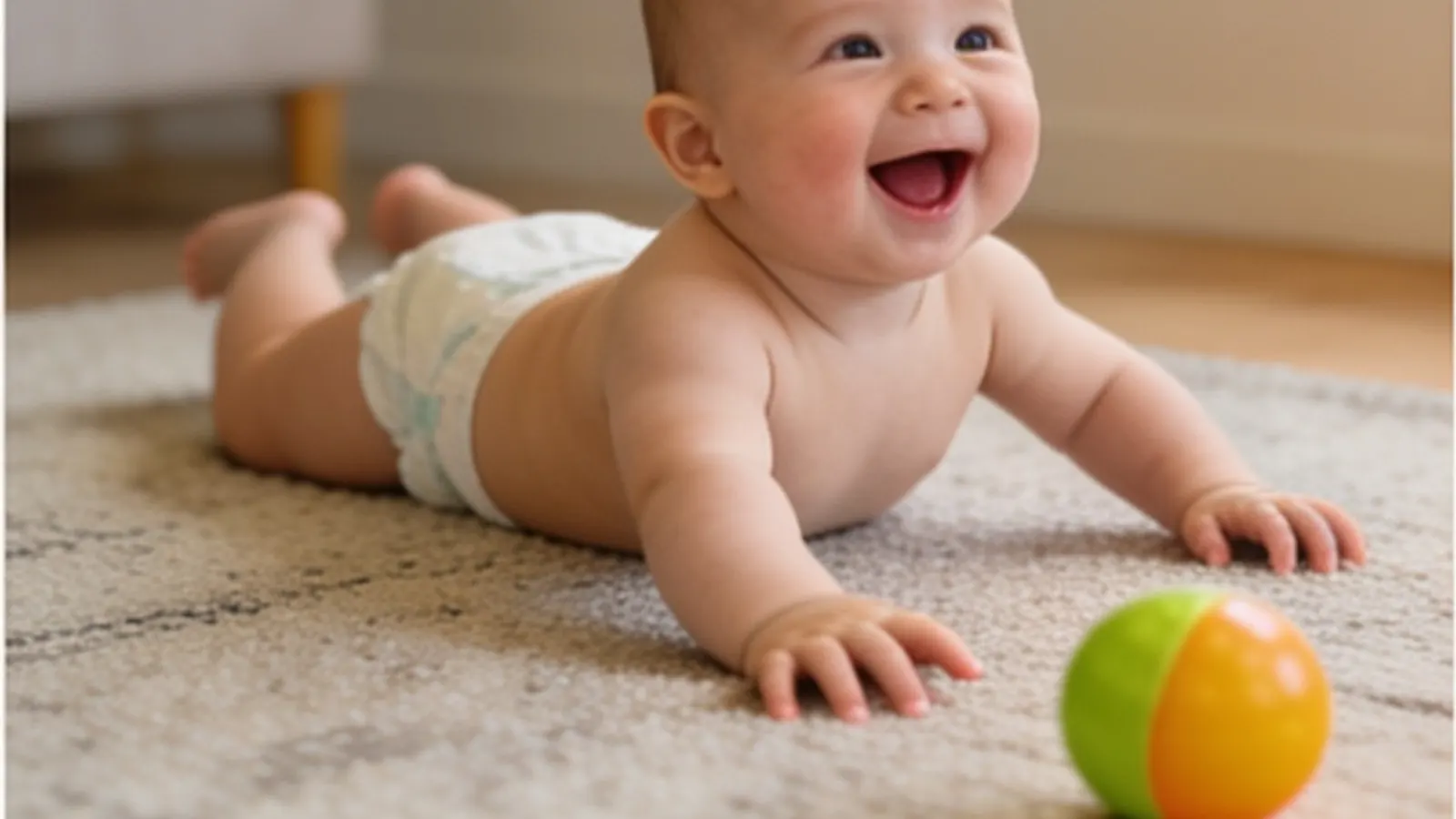
At a glance
- Chuckles usually arrive by 4 months and full laughs by about 6. Your own laughter helps teach your baby what's funny.
- Batting turns into grabbing now. Offer safe toys, and expect everything to go straight to the mouth.
- Rolling usually starts around 3 to 4 months, often tummy to back first. Never leave your baby on a bed, couch, or changing table, even for a second.
- The '4-month sleep regression' isn't a research term. Sleep is maturing, night waking is still normal, and the range is wide.
- A short bedtime routine, done the same way each night, is linked to better sleep. Starting one now is reasonable.
- Skip baby walkers. They don't help babies walk, and they send thousands of children to hospitals every year, mostly from falls down stairs.
- Shorter, distracted feeds are common now. A quiet room helps, and growth checks show whether your baby is getting enough.
- Share the nights if you can. Parents' sleep hits its low point in the first 3 months after birth and recovers slowly.
Your month-four checklist
0 of 11 done
Between 3 and 4 months, many babies start to feel like real playmates: chuckles, grabs, and maybe a first roll. For coos, the 2-month shots, and moving on from the swaddle, see the 2-month guide. The 4-month checkup and readiness for solid foods are in the 4-month guide.
What's developing#
Milestones by 4 months
CDC's milestone checklists list skills that at least 75% of babies show by each age, so a missed milestone is a reason to ask, not to wait and see (Zubler et al., 2022). By 4 months, most babies (CDC):
- Social: smile on their own to get your attention, chuckle (not yet a full laugh) when you try to make them laugh, and look at you, move, or make sounds to get or keep your attention.
- Communication: coo ("oooo," "aahh"), make sounds back when you talk, and turn their head toward your voice.
- Thinking: open their mouth at the sight of the breast or bottle when hungry, and look at their hands with interest.
- Movement: hold their head steady without support when you hold them, hold a toy you put in their hand, swing an arm at toys, bring hands to mouth, and push up onto elbows or forearms on their tummy.
Laughing, raspberries, grabbing on purpose, and rolling tummy to back come next, on the 6-month list (CDC). Born early? Use your baby's corrected age for milestones during the first 2 years (AAP).
Laughs and social play
Chuckles are a 4-month milestone and full laughs a 6-month one, so the window is wide (CDC; CDC). Laughter first appears at about 4 months on average, and in the second half of the first year babies start laughing at silly surprises, like a parent putting a book on their head (Mireault et al., 2015). Looking away mid-game is normal; it keeps your baby from getting overwhelmed (AAP).
From batting to grabbing
Babies typically start reaching for things at around 3 months (AOA), and by 4 months they often reach for and grasp nearby objects they see (AAP). Early grabs use a mitten-like grip, and most of what they catch goes straight to the mouth; the pincer grasp waits until about 9 months (AAP).
First rolls
Rolling usually starts around 3 to 4 months, sometimes earlier (Moon, AAP). Most babies roll tummy to back first, though the reverse is normal too, and many roll both ways by about 7 months (AAP). In a 1998 study, back sleepers rolled tummy to back a little later than stomach sleepers, still within the normal range (Davis et al., 1998).
A steadier head
By 4 months, most babies hold their head steady without support when you hold them (CDC). Between 4 and 7 months, the AAP lists a head that still flops back when your baby is pulled up to sitting as a sign to raise with your pediatrician (AAP).
Seeing depth and color
By 4 months, babies see colors and shades better and often love circular patterns, like faces (AAP). Depth vision is coming online too: lab tests first detect it at about 16 weeks on average (Held et al., 1980), and by around 5 months the eyes work together to see in depth. If an eye seems to turn in or out all the time, ask about an eye exam (AOA).
Sounds on the way to babble
By 4 months, many babies amuse themselves making strange new sounds and grow more sensitive to your tone of voice (AAP). Squeals and raspberries are 6-month milestones (CDC). True babbling, with syllables like "bababa," comes later; nearly all babies with typical hearing start by 10 months (Oller et al., 1999).
Sleep is reorganizing
Newborns often fall asleep straight into active, REM-like sleep, a pattern that fades by 2 to 3 months (Grigg-Damberger, 2016). Daily sleep and hormone rhythms develop after 2 months (Rivkees, 2003), and light and deep non-REM stages become distinct after 4 to 6 months (Ednick et al., 2009). Longer night stretches are becoming common, not universal: in a London video study of 101 babies, 45% slept at least 5 hours straight by 3 months (St James-Roberts et al., 2015).
Feeding and growth
Babies get far more aware of the world around 4 to 6 months, so a phone, a pet, or a voice can pull them off mid-feed (Australian Breastfeeding Association). From 1 to 4 months, babies typically gain 1.5 to 2 pounds a month (AAP). The growth charts CDC recommends for babies under 2 use breastfed babies as the standard, and slower growth among breastfed babies from 3 months on is normal (Grummer-Strawn et al., 2010). No water, other drinks, or solids yet (CDC).
Drool, and the teething question
Drool glands kick into high gear at 2 to 3 months (Shu, AAP). First teeth usually appear between 6 and 10 months, though some babies feel discomfort as early as 3 months, and teething doesn't cause fever, diarrhea, or extra crying (AAP).
What the research says#
Some popular ideas about this age have little research behind them. Here's what studies show.
1. The "4-month sleep regression" hasn't really been studied. It isn't a medical diagnosis, and we couldn't find studies that test it directly. What is documented is that sleep is maturing and that babies vary enormously. In two Finnish birth cohorts (1,427 babies at 3 months, 2,002 at 6 months), sleep varied widely, night sleep began to consolidate during the second year, and parents often reported sleep problems throughout (Paavonen et al., 2020). Takeaway: A rough patch now is common, and it doesn't mean you did something wrong.
2. Bedtime routines: one trial and many surveys. In a randomized trial of 405 mothers, a nightly bath, massage, and quiet time cut night wakings in 7- to 18-month-olds from 1.6 to 1.0 a night, and mothers' moods improved; a baby-products company funded it (Mindell et al., 2009). A survey of mothers of 10,085 children up to age 5 linked more consistent routines with better sleep, which can't prove cause (Mindell et al., 2015). In an industry-funded survey of 135 families with babies 1 to 15 weeks old, babies with a routine slept longer stretches (Mindell et al., 2025). Takeaway: A simple routine costs nothing and may help.
3. Sleep programs before 6 months have modest effects. A meta-analysis of 9 randomized trials (1,656 families) found sleep programs for new parents slightly increased reported night sleep but didn't reduce how often babies woke (Kempler et al., 2016). A 2013 review found no proof that behavioral sleep interventions before 6 months reduce crying, prevent later sleep problems, or protect against postnatal depression, and flagged risks like early weaning (Douglas & Hill, 2013). Takeaway: Gentle habits are fine now. Formal sleep training is a later decision; see the 4-month guide.
4. Reaching is guided by feel, not just sight. Researchers tested 7 babies repeatedly from 6 to 25 weeks with objects in the light and glowing or sounding objects in total darkness. Babies first touched objects at about 12 weeks either way, and first grasped them at 16.0 weeks in the light and 14.7 weeks in the dark (Clifton et al., 1993). Takeaway: Babies learn to reach by reaching. Give them plenty of chances.
5. Seeing depth isn't the same as fearing heights. Babies can see depth within a few months (Held et al., 1980). But babies with little or no crawling experience show no wariness of heights; that comes from moving around on their own (Dahl et al., 2013). Takeaway: Your baby can't protect themselves from an edge. You have to.
6. Babies take cues from your laugh and your songs. In a study of 37 babies tested at 5 to 7 months, babies smiled longer, or sooner and more often, at a parent's raspberries when the parent laughed too (Mireault et al., 2015). And 5-month-olds whose parent sang them a new song for 1 to 2 weeks paid more attention to a stranger who sang it; hearing it from a toy didn't do that (Mehr et al., 2016). Takeaway: Laugh along and sing your songs. To your baby, they're social signals.
7. Flat spots peak around now, then usually improve. In a New Zealand study of 200 babies, head flattening affected 16.0% at 6 weeks, 19.7% at 4 months, 9.2% at 8 months, and 3.3% at 2 years (Hutchison et al., 2004). In a Dutch trial of 65 babies who strongly preferred turning one way, physical therapy cut the risk of severe flattening at 6 months by 46% (van Vlimmeren et al., 2008). Flattening doesn't affect brain growth (AAP). Takeaway: Mention a flat spot or a favorite side now. Caught early, simple changes help.
8. Baby walkers carry real risk and no benefit. An estimated 230,676 children under 15 months were treated in US emergency rooms for walker injuries from 1990 to 2014; 90.6% had head or neck injuries, and 74.1% fell down stairs (Sims et al., 2018). In an observational study of 109 babies, walker users sat, crawled, and walked later (Siegel & Burton, 1999). The AAP has called for a ban (AAP, 2001). Takeaway: Skip the walker. The floor is the best gym.
Parenting techniques#
Play that fits new skills
- Get down on the floor. Lay your baby on a blanket with safe toys to reach for and kick at, and avoid long stretches in swings, strollers, and bouncy seats (CDC). WHO advises at least 30 minutes of tummy time a day, spread out, and no more than 1 hour at a time strapped into a seat or carrier (WHO).
- Put toys within reach. Let your baby swipe, grab, and mouth safe things that aren't sharp, hot, or small enough to choke on (CDC).
- Give rolling a reason. On the tummy, use an interesting toy to coax your baby to lift their head and look around (AAP).
Script: "Do you want the rattle? Reach, reach. You got it!"
Laugh together
Try peekaboo, and pay close attention to how your baby reacts to different things (CDC). Laugh along; your reaction is part of the game (Mireault et al., 2015).
Talk, read, and sing
The AAP recommends shared reading from birth (Klass et al., 2024). In a randomized trial at a New York public hospital clinic, coaching parents to read and play with children from birth to age 3 led to fewer behavior problems at age 4½ (Mendelsohn et al., 2018). Copy your baby's sounds, then add simple words with that sound (AAP), and sing the same songs often (Mehr et al., 2016).
Script: "Bah! You said bah. Bah, ball. Here's your ball."
A short bedtime routine
Do the same few things, in the same order, at naptime and bedtime, with steps you and your partner can both do (Moon, AAP): a feed, pajamas, a book or song, then the crib. Any calm steps work; what research links to better sleep is doing them consistently (Mindell et al., 2015).
Script: "Pajamas, book, song, bed. Goodnight, sweet pea."
Drowsy but awake, and a pause before you go in
From 4 months, the AAP suggests putting babies to bed drowsy rather than asleep, since babies rocked to sleep may struggle to resettle at night (AAP). Practicing now is fine.
Self-soothing doesn't mean crying it out. For a fussy baby who is fed, changed, and rested, the AAP suggests stepping up slowly: look, talk softly, rest a hand on their belly, and only then pick up, rock, or feed (Ideran & Fishbein, AAP). A brief pause may help too: about a quarter of 3-month-olds in one video study resettled on their own after waking (St James-Roberts et al., 2015).
Script: (Your baby stirs and fusses.) Watch for a moment. If it builds: "I'm here. Shh, shh." Try a hand on the belly before you pick them up.
Getting through a rough patch
Keep days bright and playful and nights calm and boring (AAP), and stick with your routine. Don't let exhaustion move sleep somewhere unsafe: sleeping with a baby on a couch or armchair raises the risk of sleep-related death up to 67 times, and bed sharing is 5 to 10 times riskier before 4 months (Moon, AAP).
Feeding a distracted baby
Feed in a quiet room, mask sudden noises with a fan, and give your baby something soft to hold (Australian Breastfeeding Association). With bottles, offer a little less and pause; you can always give more. Plenty of wet diapers and steady growth on the chart are good signs your baby is getting enough (Jain & Bunik, AAP).
Head shape check-in
After a bath, check that the back of the head is evenly round and the ears line up. Alternate the arm you feed with and the end of the crib you lay your baby at, limit time in seats and swings, and work up to an hour of tummy time a day if you see a flat spot. Skip head-shaping pillows (AAP). If your baby always turns one way, ask about physical therapy (van Vlimmeren et al., 2008). Helmets are covered in the 2-month guide.
Sharing the nights
In a German study of 2,541 mothers and 2,118 fathers, sleep hit its low point in the first 3 months after birth: mothers slept 62 minutes less a night than before pregnancy, fathers 13 minutes less (Richter et al., 2019). New mothers' sleep is more broken than short, and it gets less fragmented over the first 4 months (Montgomery-Downs et al., 2010).
- Take shifts so each adult gets one longer stretch (see Tag-team nights).
- Bank sleep. Nap when your baby naps, and go to bed right after the last feed (Moon, AAP).
- Plan for drowsy feeds. Skip the couch and armchair, clear bedding, set an alarm, and if you nod off, move your baby to their own sleep space as soon as you wake (Moon, AAP).
Your pediatrician will ask how you're doing at the 4-month visit (AAP). If you're struggling, call or text the National Maternal Mental Health Hotline at 1-833-TLC-MAMA (1-833-852-6262) (Moon, AAP).
What to teach#
No lessons yet; your baby learns from everyday play with you. This month, they're ready to learn:
- My actions make things happen. A kick shakes the crib; a wave makes the rattle sound (AAP).
- Hidden things come back. Sometime after 4 months, babies start to grasp that things exist out of sight, and peekaboo helps (AAP).
- Fun is shared. Your laughter helps your baby figure out what's funny (Mireault et al., 2015).
- Bedtime has a pattern. A consistent nightly routine is linked to better sleep (Mindell et al., 2015).
Screens: video calls only
CDC advises keeping screens to video calls with loved ones (CDC). Babies under 18 months learn best from real-world interactions (Munzer, AAP), and WHO recommends no screen time for babies (WHO).
Big siblings as helpers
The AAP suggests inviting older siblings to play with the baby, with clear rules such as never picking the baby up without permission (AAP). Babies this age are intrigued by other children (AAP), so a preschooler who picks the bedtime book has a real job. For how family jobs grow with age, see how to raise independent kids with chores.
Activities to try#
Every activity here is for an awake, alert baby with an adult right there. Stop when your baby looks away, fusses, or arches. If your baby gets sleepy, lay them on their back in their own sleep space (Moon, AAP).
How we rate the evidence
- Strong evidence
- Randomized trials or systematic reviews show a consistent benefit.
- Moderate evidence
- Consistent observational research, or a major guideline (AAP, WHO) built on research.
- Emerging evidence
- Small or early studies. Plausible, not yet proven.
- Mixed evidence
- Studies disagree, or reviews rate the evidence as weak.
Too tired to choose? Let us pick one.
Reach-and-grab
Emerging evidence- Time
- 3 to 5 minutes, once or twice a day
- Builds
- Reaching, grasping, hand-eye coordination
- Lay your baby on their back and hold a light, easy-to-grip toy over their chest, within arm's reach.
- Wait for a swipe, then let them close their hand around it.
- Offer it from the left, the right, and the middle.
Make it work: Choose toys too big to choke on, like a rattle or a cloth book (CDC).
Evidence: Emerging. Lab studies show babies begin touching and grasping objects at about 12 to 16 weeks (Clifton et al., 1993), and CDC suggests giving babies safe chances to reach (CDC). Whether extra practice speeds reaching hasn't been tested at this age.
Tummy-time look-around
Moderate evidence- Time
- 3 to 10 minutes, several times a day
- Builds
- Neck, shoulder, and arm strength; the push-ups that lead to rolling
- Lay your baby tummy-down on a firm, flat surface with their arms forward.
- Hold a bright toy in front of them, then slowly raise it so they lift their head and chest.
- Move it a little to each side so they turn and shift their weight.
Make it work: Several short sessions count. Stay with your baby the whole time.
Evidence: Moderate. A systematic review of 16 mostly observational studies linked tummy time to better gross motor development and to rolling and moving on the tummy (Hewitt et al., 2020); WHO recommends at least 30 minutes a day for babies who aren't mobile yet (WHO).
Roll-over helper
Emerging evidence- Time
- 2 to 3 minutes during floor play
- Builds
- Rolling, body awareness
- With your baby on their back, show a toy, then move it slowly to one side and down to the floor.
- If they turn toward it, gently guide their hips over so they end up on their side or tummy.
- Cheer, then try the other side.
Make it work: Only on the floor, never on a bed or sofa.
Evidence: Emerging. In a study of 100 four-month-olds, those who spent more awake time on their tummies had reached more motor milestones, an association rather than proof (Dudek-Shriber & Zelazny, 2007). Helping babies roll hasn't been studied as its own activity.
Peekaboo
Emerging evidence- Time
- 1 to 3 minutes
- Builds
- Shared fun, early object permanence
- Cover your face with your hands or a light cloth.
- Pause, then pop out with a big smile: "Peekaboo!"
- Repeat while your baby is smiling, and stop when they look away.
Evidence: Emerging. CDC suggests peekaboo at 4 months (CDC), and the AAP says hiding games help babies learn that things still exist out of sight (AAP). The game itself hasn't been studied at this age.
Raspberry laugh game
Emerging evidence- Time
- A few minutes, when your baby is happy and alert
- Builds
- Shared joy, social cues
- Blow a gentle raspberry on your baby's tummy or your own hand.
- Laugh, then pause and watch your baby's face.
- Repeat what gets a smile or chuckle, and stop while it's still fun.
Make it work: Keep it gentle, and take a break when your baby looks away.
Evidence: Emerging. In a study of 37 babies aged 5 to 7 months, babies smiled longer at a parent's raspberries when the parent smiled and laughed too (Mireault et al., 2015). Laugh games haven't been tested at 3 to 4 months.
Sound copycat
Emerging evidence- Time
- 2 to 5 minutes, several times a day
- Builds
- Turn-taking, early speech sounds
- Wait for your baby to coo, squeal, or gurgle.
- Copy the sound back, face to face.
- Pause for a reply, then say a simple word with that sound.
Evidence: Emerging. CDC suggests copying your baby's sounds and seeing how long you can keep the "conversation" going (CDC), and the AAP suggests repeating your baby's syllables and adding words (AAP).
Your family song
Emerging evidence- Time
- A song or two, every day
- Builds
- Connection, listening, a calming cue
- Pick a song or two you like, in any language.
- Sing them at the same times each day, like bath time and bedtime.
- Add gentle movement, like rocking or moving your baby's arms in rhythm.
Make it work: Singing counts even if you think you can't sing.
Evidence: Emerging. In a lab study, 5-month-olds who heard a parent sing a new song at home for 1 to 2 weeks later paid more attention to a stranger who sang that melody (Mehr et al., 2016).
Board-book time
Moderate evidence- Time
- About 5 minutes, once or twice a day
- Builds
- Language, a shared routine, closeness
- Hold your baby on your lap with a board, cloth, or vinyl book.
- Point to pictures, name them, and pause for coos.
- Let your baby touch, grab, and mouth the book.
Make it work: Any book works. It's the time together that counts (AAP).
Evidence: Moderate. The AAP recommends shared reading from birth (Klass et al., 2024), and a randomized trial that coached parents to read and play from birth found fewer behavior problems by age 4½ (Mendelsohn et al., 2018).
Three-step bedtime
Moderate evidence- Time
- 15 to 30 minutes before the first long sleep of the night
- Builds
- Predictable sleep cues, calm for everyone
- Pick three steps, like a feed, pajamas, and a song.
- Do them in the same order, with lights low and voices soft.
- Lay your baby on their back in their crib or bassinet, drowsy if possible.
Make it work: Use the same steps, in the same order, for naps (Moon, AAP).
Evidence: Moderate. A randomized trial in 7- to 18-month-olds found fewer night wakings with a nightly routine (Mindell et al., 2009), and large surveys link consistent routines with better sleep in young children (Mindell et al., 2015). Studies in babies this young are surveys only (Mindell et al., 2025).
Toe discovery
Emerging evidence- Time
- 1 to 2 minutes, during diaper changes
- Builds
- Body awareness, reaching across the body
- With your baby on their back, gently lift their feet toward their hands.
- Name what they touch: "Those are your toes!"
- Let go and see if they hold on.
Evidence: Emerging. The AAP describes babies grabbing their feet and toes and bringing them to the mouth as coordination improves between 4 and 7 months (AAP). This game hasn't been studied.
Color and pattern look
Emerging evidence- Time
- 1 to 3 minutes
- Builds
- Visual attention, color vision
- Show a brightly colored toy or book page about a foot away.
- Name the color and move it slowly side to side.
- Switch to a new color and watch if your baby looks longer.
Evidence: Emerging. By 4 months, babies see colors better and often love circular patterns (AAP), and a lab study found 4- to 6-month-olds sort colors into categories like red, yellow, green, blue, and purple (Skelton et al., 2017). Looking games haven't been tested for benefits.
Quiet-corner feeds
Emerging evidence- Time
- Daytime feeds that keep getting interrupted
- Builds
- Calmer, fuller feeds
- Pick a quiet room, and turn on a fan or soft music to mask sudden noises.
- Sit facing a plain wall and give your baby something soft to hold.
- Keep your phone away and your attention on your baby.
Make it work: If your baby pulls off and won't go back, try again in a little while.
Evidence: Emerging. These are practical tips from the Australian Breastfeeding Association for babies who are newly distractible (Australian Breastfeeding Association); they haven't been tested in trials.
Tag-team nights
Emerging evidence- Time
- One shift each, every night
- Builds
- Longer sleep stretches for the adults
- Agree on shifts, such as one adult from bedtime to 2 a.m. and the other from 2 a.m. on.
- The off-duty adult sleeps in another room with earplugs if needed.
- If you're breastfeeding, your partner handles diapers, settling, and bringing the baby to you.
Make it work: Whoever is on duty follows the same safe sleep rules (Moon, AAP).
Evidence: Emerging. Parents' sleep is shortest in the first 3 months after birth (Richter et al., 2019), and fathers' involvement in baby care was linked to fewer infant night wakings in a small study (Tikotzky et al., 2011). Splitting nights hasn't been tested directly.
Common questions#
Is the 4-month sleep regression real?
There's no research that proves a 4-month sleep regression exists, though parents commonly report sleep problems at this age and well beyond it. Sleep is maturing at this age: regular sleep cycles arrive at about 4 months (AAP), and the stages of non-REM sleep become distinct after 4 to 6 months (Ednick et al., 2009). In a large Finnish study, infant sleep varied widely, and night sleep began to consolidate during the second year (Paavonen et al., 2020). Keep your routine steady, and call your pediatrician if your baby seems sick or in pain.
Should I put my baby down drowsy but awake?
Yes, it's worth trying, but it's not a test you can fail. The AAP suggests putting babies 4 months and older to bed drowsy rather than asleep, so they learn to fall asleep in their own bed (AAP), and its safe sleep tips for new parents suggest laying babies down while still a little awake (Moon, AAP). In a study of 80 babies, those whose parents responded a bit more slowly to night wakings at 3 months were more likely to soothe themselves at 12 months, though that link doesn't prove cause (Burnham et al., 2002). If your baby cries, pick them up, soothe them, and try again another night.
How much should a 3- to 4-month-old sleep?
WHO recommends 14 to 17 hours a day, including naps, up to 3 months, and 12 to 16 hours from 4 months (WHO). The American Academy of Sleep Medicine, with AAP endorsement, recommends 12 to 16 hours for babies 4 to 12 months and gives no number for younger babies because normal sleep varies so much (Paruthi et al., 2016). Many babies still wake at night; in one London study, fewer than half slept 5 hours straight at 3 months (St James-Roberts et al., 2015).
My baby rolls onto their tummy during sleep. Should I flip them back?
Always lay your baby down on their back, but once they can roll both ways, you don't need to keep turning them over. Keep the crib bare, with no blankets, pillows, toys, or bumpers (Moon, AAP). Stop swaddling as soon as your baby looks like they're trying to roll, because rolling onto the stomach while swaddled raises the risk of suffocation, and never use weighted swaddles or sleep sacks (Moon, AAP). If your baby rolls one way but can't roll back yet, turn them onto their back and ask your pediatrician what to do next.
When do babies start rolling over?
Most babies start rolling around 3 to 4 months, though some start earlier (Moon, AAP). Tummy to back usually comes first, and rolling both ways often follows by about 7 months (AAP). Rolling from tummy to back is on CDC's 6-month milestone list (CDC). The AAP suggests talking with your pediatrician if your baby doesn't roll in either direction by 5 months (AAP). Use corrected age if your baby was born early (AAP).
When do babies start grabbing toys?
Most babies hold a toy you put in their hand and swing at toys by 4 months, and reach to grab a toy they want by 6 months (CDC; CDC). In lab studies, babies first grasped objects at about 15 to 16 weeks (Clifton et al., 1993). Early grabs use the whole hand; the pincer grasp comes at about 9 months (AAP). Tell your pediatrician if your baby reaches with only one hand (AAP).
Why does my baby keep pulling off during feeds?
Your baby is probably distracted, which is common around 4 to 6 months as babies notice more of the world. Feeding in a quiet room, masking sudden noises with a fan or soft music, and giving your baby something to hold can help, and most babies learn to feed through distractions as they get older (Australian Breastfeeding Association). Call your pediatrician if your baby seems unwell, has fewer wet diapers, or isn't growing as expected (Jain & Bunik, AAP).
Can a 3-month-old be teething?
Some babies feel teething discomfort as early as 3 months, though first teeth usually appear between 6 and 10 months (AAP). Drooling alone isn't a sure sign, since saliva production ramps up at 2 to 3 months for every baby (Shu, AAP). In a study that followed 125 babies from the 4-month visit to age 1, symptoms clustered in the 8 days around a tooth's arrival, and none reliably predicted it (Macknin et al., 2000). Teething doesn't cause fever, diarrhea, or extra crying, and the AAP warns against benzocaine or lidocaine gels, homeopathic teething tablets, and teething necklaces (AAP).
Are baby walkers safe?
No, the AAP says baby walkers are never safe, even with an adult close by, and has called for a ban on walkers with wheels. A child in a walker can move more than 3 feet in 1 second, most walker injuries happen while adults are watching, and walkers can delay walking. Canada has banned them (AAP). Stationary activity centers without wheels are a safer alternative (AAP, 2001), but keep any seat time short and save most playtime for the floor (WHO).
My baby fell off the bed. What should I do?
Call your pediatrician now for any head injury in a baby under 1 year, even if your baby seems fine. Call 911 if your baby has a seizure, was knocked out for more than a minute, is hard to wake, or has bleeding you can't stop. Go to the ER now if your baby vomits 2 or more times, cries nonstop, or seems "out of it" (AAP). Falls from furniture are a common cause of injury hospitalizations in young children, and beds top the list (Pomerantz et al., 2012).
When is a fever an emergency for a 3- or 4-month-old?
Any fever, meaning a rectal temperature of 100.4°F (38°C) or higher, in a baby younger than 12 weeks (about 3 months) needs a call to your pediatrician right away, even if your baby seems fine; from 3 to 6 months, call about any fever, and get care right away if there are warning signs. Before 12 weeks, don't give fever medicine before your baby is seen (AAP; AAP). From 3 to 6 months, the AAP's symptom guide says to contact your doctor within 24 hours about any fever (AAP), and its fever article singles out 101°F (38.3°C) or higher as a reason to call (AAP). At any age, get care now for a fever over 104°F (40°C), nonstop crying, signs of dehydration, or a baby who looks very sick, and go to the ER for a bulging soft spot, a stiff neck, or a baby who is hard to wake (AAP). Skip ear thermometers before 6 months (AAP).
Will giving formula at night help me sleep more?
Not necessarily; the studies disagree. In one study of 133 first-time parents at 3 months, parents whose babies were breastfed at night slept 40 to 45 minutes more than parents who gave formula at night (Doan et al., 2007). A much larger German study found breastfeeding was linked to slightly less maternal sleep, about 14 minutes (Richter et al., 2019). If you're breastfeeding and thinking about adding formula, talk with your pediatrician first.
Safety and when to call your pediatrician#
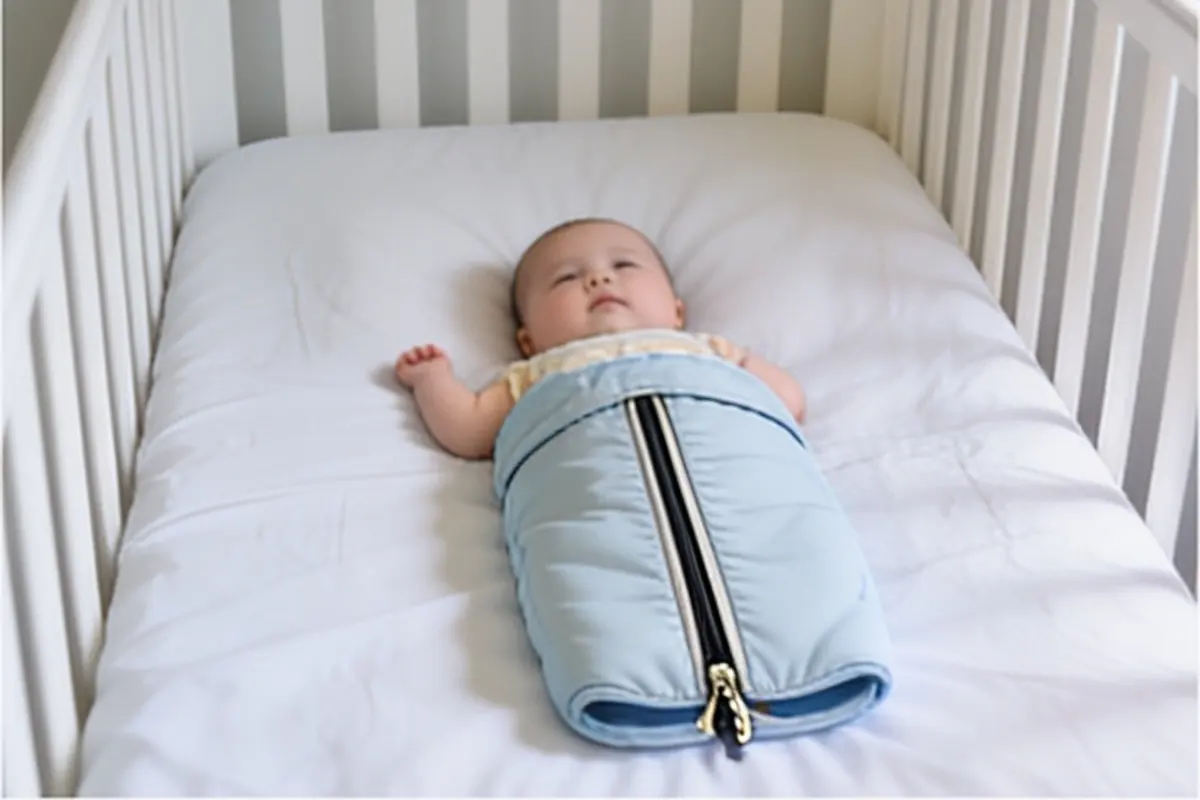
Safe sleep as rolling begins
Every rule in the newborn guide still applies: on the back for every sleep, on a firm, flat surface with nothing else in the crib, in your room but not your bed for at least 6 months. Stop swaddling at the first sign of rolling (Moon, AAP). Take bibs off before sleep (Shu, AAP).
Falls: no safe second
Rolling can start without warning, and babies this age don't fear edges (Dahl et al., 2013).
- Changing tables: never step away, even for a moment, even with the strap buckled (AAP).
- Beds and couches: don't leave your baby on adult furniture. Among young children hospitalized for furniture falls in one study, a third fell from beds (Pomerantz et al., 2012).
- Car seats: keep them on the floor. From 2003 to 2007, an estimated 43,562 babies were treated in US ERs for car seat injuries outside the car, mostly from falls (Parikh & Wilson, 2010).
- Walkers: skip any walker with wheels, at home and at child care (AAP).
Everything goes in the mouth
Remove anything your baby could choke on or get hurt by (AAP). Skip teething necklaces, liquid-filled teethers, and numbing gels (AAP).
Car seats are for the car
Rear-facing in the back seat, harness snug enough that you can't pinch slack, chest clip at armpit level, no bulky coats under the straps. Car seats are for travel, not for sleeping or feeding outside the car (AAP).
Call 911 if your baby
- Is struggling to breathe, has stopped breathing, or has bluish lips or face (AAP)
- Choked on a small object that could be stuck in the throat (AAP)
- Can't be woken up, or is not moving or very weak (AAP)
- Has a seizure or was knocked out for more than a minute after a fall (AAP)
Go to the ER now if your baby
- Has any trouble breathing, including ribs pulling in with each breath or wheezing; the AAP advises the ER for babies under 1 with trouble breathing (AAP)
- Has a fever with a bulging soft spot or stiff neck, or isn't alert when awake (AAP)
- Vomits 2 or more times or cries nonstop after a head injury (AAP)
Call your pediatrician right away if your baby
- Has any fever (a rectal temperature of 100.4°F, or 38°C, or higher) before 12 weeks; give no fever medicine before your baby is seen (AAP)
- Is 3 to 6 months old with a rectal temperature of 101°F (38.3°C) or higher (AAP)
- Has had any head injury, such as a fall from a bed (AAP)
- Has a fever and cries nonstop, cries when touched, has had no urine in more than 8 hours, or looks very sick (AAP)
For any other fever between 3 and 6 months, call within 24 hours (AAP).
Don't wait on development worries
If your baby isn't meeting milestones, has lost skills, or you're concerned, ask your pediatrician about developmental screening (CDC), or call your state's early intervention program for a free evaluation, no referral needed (CDC). The AAP suggests raising it if your baby (AAP):
- Seems very stiff, or very floppy
- Has a head that still flops back when pulled up to sitting
- Doesn't turn toward sounds by 4 months
- Struggles to get objects to their mouth, or reaches with only one hand
- Has an eye that consistently turns in or out
- Doesn't smile on their own or roll either way by 5 months
If your baby didn't pass the newborn hearing screen, follow-up testing should happen by 3 months (Hecht, AAP).
Looking ahead to the 4-month checkup
Expect measurements, an exam, and questions about sleep, feeding, and safety. Under the AAP schedule, babies may get second doses of rotavirus, DTaP, Hib, pneumococcal, and polio vaccines at this visit (AAP). US guidance has been in flux: the AAP's 2026 schedule differs from CDC's (AAP), and in March 2026 a federal judge paused the CDC's January 2026 schedule changes while the court fight continues (KFF, 2026). Ask your pediatrician which schedule they follow. The 4-month guide covers the visit in detail.
Sources#
- Centers for Disease Control and Prevention. "Milestones by 4 Months." Learn the Signs. Act Early. program, updated 2026. https://www.cdc.gov/act-early/milestones/4-months.html
- Centers for Disease Control and Prevention. "Milestones by 6 Months." Learn the Signs. Act Early. program, updated 2026. https://www.cdc.gov/act-early/milestones/6-months.html
- Centers for Disease Control and Prevention. "Concerned About Your Child's Development?" 2026. https://www.cdc.gov/act-early/families/concerned.html
- American Academy of Pediatrics. "Developmental Milestones: 1-4 Months Old." HealthyChildren.org, updated 2026. https://www.healthychildren.org/English/ages-stages/baby/Pages/Developmental-Milestones-3-Months.aspx
- American Academy of Pediatrics. "Developmental Milestones: 7 Months." HealthyChildren.org, updated 2009. https://www.healthychildren.org/English/ages-stages/baby/Pages/Developmental-Milestones-7-Months.aspx
- American Academy of Pediatrics. "Movement Milestones: Babies 4 to 7 Months." HealthyChildren.org, updated 2021. https://www.healthychildren.org/English/ages-stages/baby/Pages/Movement-4-to-7-Months.aspx
- American Academy of Pediatrics. "Emotional & Social Development in Babies: Birth Through 3 Months." HealthyChildren.org, updated 2026. https://www.healthychildren.org/English/ages-stages/baby/Pages/Emotional-and-Social-Development-Birth-to-3-Months.aspx
- American Academy of Pediatrics. "Cognitive Development in Infants: 4 to 7 Months." HealthyChildren.org, updated 2023. https://www.healthychildren.org/English/ages-stages/baby/Pages/Cognitive-Development-4-to-7-Months.aspx
- American Academy of Pediatrics. "Language Development: 4 to 7 Months." HealthyChildren.org, updated 2009. https://www.healthychildren.org/English/ages-stages/baby/Pages/Language-Development-4-to-7-Months.aspx
- American Academy of Pediatrics. "Hearing & Making Sounds: Your Baby's Milestones." HealthyChildren.org, updated 2021. https://www.healthychildren.org/English/ages-stages/baby/Pages/Hearing-and-Making-Sounds.aspx
- American Academy of Pediatrics. "Infant Vision Development: What Can Babies See?" HealthyChildren.org, updated 2024. https://www.healthychildren.org/English/ages-stages/baby/Pages/Babys-Vision-Development.aspx
- American Academy of Pediatrics. "Your Baby's Growth & Physical Development: 1 to 4 Months Old." HealthyChildren.org, updated 2026. https://www.healthychildren.org/English/ages-stages/baby/Pages/Physical-Appearance-and-Growth-1-To-3-Months.aspx
- American Academy of Pediatrics. "Corrected Age For Preemies." HealthyChildren.org, updated 2018. https://www.healthychildren.org/English/ages-stages/baby/preemie/Pages/Corrected-Age-For-Preemies.aspx
- American Academy of Pediatrics. "Getting Your Baby to Sleep." HealthyChildren.org, updated 2024. https://www.healthychildren.org/English/ages-stages/baby/sleep/Pages/getting-your-baby-to-sleep.aspx
- Ideran P, Fishbein M. "Self-Soothing: Help Your Baby Learn This Life Skill." HealthyChildren.org, updated 2024. https://www.healthychildren.org/English/ages-stages/baby/crying-colic/Pages/Self-Soothing-Helping-Your-Baby-Learn-This-Life-Skill.aspx
- Moon RY. "Safe Sleep Tips for Sleep-Deprived New Parents." HealthyChildren.org, updated 2026. https://www.healthychildren.org/English/ages-stages/baby/sleep/Pages/safe-sleep-tips-for-sleep-deprived-parents.aspx
- Moon RY. "How to Keep Your Sleeping Baby Safe: AAP Policy Explained." HealthyChildren.org, updated 2026. https://www.healthychildren.org/English/ages-stages/baby/sleep/Pages/a-parents-guide-to-safe-sleep.aspx
- Jain S, Bunik M. "How Often and How Much Should Your Baby Eat?" HealthyChildren.org, updated 2024. https://www.healthychildren.org/English/ages-stages/baby/feeding-nutrition/Pages/How-Often-and-How-Much-Should-Your-Baby-Eat.aspx
- Shu J. "Drooling Baby? Here's Why Spit Happens." HealthyChildren.org, updated 2026. https://www.healthychildren.org/English/ages-stages/baby/teething-tooth-care/Pages/Drooling-and-Your-Baby.aspx
- American Academy of Pediatrics. "Teething Pain Relief: How to Soothe Your Baby's Discomfort." HealthyChildren.org, updated 2025. https://www.healthychildren.org/English/ages-stages/baby/teething-tooth-care/Pages/Teething-Pain.aspx
- American Academy of Pediatrics. "When a Baby's Head is Misshapen: Positional Skull Deformities." HealthyChildren.org, updated 2022. https://www.healthychildren.org/English/health-issues/conditions/Cleft-Craniofacial/Pages/Positional-Skull-Deformities-and-Torticollis.aspx
- American Academy of Pediatrics. "Baby Walkers: A Dangerous Choice." HealthyChildren.org, updated 2022. https://www.healthychildren.org/English/safety-prevention/at-home/Pages/Baby-Walkers-A-Dangerous-Choice.aspx
- American Academy of Pediatrics. "Changing Table Safety." HealthyChildren.org, updated 2009. https://www.healthychildren.org/English/safety-prevention/at-home/Pages/Changing-Table-Safety.aspx
- American Academy of Pediatrics. "Car Seats: Information for Families." HealthyChildren.org, updated 2026. https://www.healthychildren.org/English/safety-prevention/on-the-go/Pages/Car-Safety-Seats-Information-for-Families.aspx
- American Academy of Pediatrics. "Fever and Your Baby." HealthyChildren.org, updated 2025. https://www.healthychildren.org/English/health-issues/conditions/fever/Pages/Fever-and-Your-Baby.aspx
- American Academy of Pediatrics. "Fever" (symptom checker). HealthyChildren.org, accessed 2026. https://www.healthychildren.org/English/tips-tools/symptom-checker/Pages/symptomviewer.aspx?symptom=Fever
- American Academy of Pediatrics. "Head Injury" (symptom checker). HealthyChildren.org, accessed 2026. https://www.healthychildren.org/English/tips-tools/symptom-checker/Pages/symptomviewer.aspx?symptom=Head+Injury
- American Academy of Pediatrics. "Breathing Trouble" (symptom checker). HealthyChildren.org, accessed 2026. https://www.healthychildren.org/English/tips-tools/symptom-checker/Pages/symptomviewer.aspx?symptom=Breathing+Trouble
- Hecht JL. "Hearing Screening for Newborns, Children & Adolescents: AAP Policy Explained." HealthyChildren.org, updated 2023. https://www.healthychildren.org/English/ages-stages/baby/Pages/Purpose-of-Newborn-Hearing-Screening.aspx
- American Academy of Pediatrics. "Checkup Checklist: 4 Months Old." HealthyChildren.org, updated 2023. https://www.healthychildren.org/English/ages-stages/Your-Childs-Checkups/Pages/Your-Checkup-Checklist-4-Months-Old.aspx
- American Academy of Pediatrics. "AAP Releases Recommended Childhood and Adolescent Immunization Schedule for 2026." HealthyChildren.org, 2026. https://www.healthychildren.org/English/news/Pages/AAPs-recommended-childhood-and-adolescent-immunization-schedule-for-2026.aspx
- Kates J. "The Court's Opening Shot on Federal Vaccine Policy Changes." KFF, 2026. https://www.kff.org/quick-insights/the-courts-opening-shot-on-federal-vaccine-policy-changes/
- Munzer T. "Helping Kids Thrive in a Digital World: AAP Policy Explained." HealthyChildren.org, updated 2026. https://www.healthychildren.org/English/family-life/Media/Pages/helping-kids-thrive-in-a-digital-world-AAP-policy-explained.aspx
- American Academy of Pediatrics Committee on Injury and Poison Prevention. "Injuries associated with infant walkers." Pediatrics, 2001. https://pubmed.ncbi.nlm.nih.gov/11533353/
- World Health Organization. "To grow up healthy, children need to sit less and play more." 2019. https://www.who.int/news/item/24-04-2019-to-grow-up-healthy-children-need-to-sit-less-and-play-more
- American Optometric Association. "Infant Vision: Birth to 24 Months of Age." Accessed 2026. https://www.aoa.org/healthy-eyes/eye-health-for-life/infant-vision
- Australian Breastfeeding Association. "Feeding your distractible baby." 2025. https://www.breastfeeding.asn.au/resources/distractible-baby
- Zubler JM, Wiggins LD, Macias MM, et al. "Evidence-Informed Milestones for Developmental Surveillance Tools." Pediatrics, 2022. https://pubmed.ncbi.nlm.nih.gov/35132439/
- Paruthi S, Brooks LJ, D'Ambrosio C, et al. "Recommended Amount of Sleep for Pediatric Populations: A Consensus Statement of the American Academy of Sleep Medicine." Journal of Clinical Sleep Medicine, 2016. https://pubmed.ncbi.nlm.nih.gov/27250809/
- Grigg-Damberger MM. "The Visual Scoring of Sleep in Infants 0 to 2 Months of Age." Journal of Clinical Sleep Medicine, 2016. https://pubmed.ncbi.nlm.nih.gov/26951412/
- Ednick M, Cohen AP, McPhail GL, et al. "A review of the effects of sleep during the first year of life on cognitive, psychomotor, and temperament development." Sleep, 2009. https://pubmed.ncbi.nlm.nih.gov/19928384/
- Rivkees SA. "Developing circadian rhythmicity in infants." Pediatrics, 2003. https://pubmed.ncbi.nlm.nih.gov/12897290/
- Paavonen EJ, Saarenpää-Heikkilä O, Morales-Munoz I, et al. "Normal sleep development in infants: findings from two large birth cohorts." Sleep Medicine, 2020. https://pubmed.ncbi.nlm.nih.gov/32087408/
- St James-Roberts I, Roberts M, Hovish K, Owen C. "Video Evidence That London Infants Can Resettle Themselves Back to Sleep After Waking in the Night, as well as Sleep for Long Periods, by 3 Months of Age." Journal of Developmental and Behavioral Pediatrics, 2015. https://pubmed.ncbi.nlm.nih.gov/26035139/
- Burnham MM, Goodlin-Jones BL, Gaylor EE, Anders TF. "Nighttime sleep-wake patterns and self-soothing from birth to one year of age: a longitudinal intervention study." Journal of Child Psychology and Psychiatry, 2002. https://pubmed.ncbi.nlm.nih.gov/12236607/
- Mindell JA, Telofski LS, Wiegand B, Kurtz ES. "A nightly bedtime routine: impact on sleep in young children and maternal mood." Sleep, 2009. https://pubmed.ncbi.nlm.nih.gov/19480226/
- Mindell JA, Li AM, Sadeh A, Kwon R, Goh DY. "Bedtime routines for young children: a dose-dependent association with sleep outcomes." Sleep, 2015. https://pubmed.ncbi.nlm.nih.gov/25325483/
- Mindell JA, Leichman ES, Carson M, Mack MC. "Bedtime and naptime routines for young infants: Associations with family sleep outcomes." Sleep Health, 2025. https://pubmed.ncbi.nlm.nih.gov/40461397/
- Kempler L, Sharpe L, Miller CB, Bartlett DJ. "Do psychosocial sleep interventions improve infant sleep or maternal mood in the postnatal period? A systematic review and meta-analysis of randomised controlled trials." Sleep Medicine Reviews, 2016. https://pubmed.ncbi.nlm.nih.gov/26555938/
- Douglas PS, Hill PS. "Behavioral sleep interventions in the first six months of life do not improve outcomes for mothers or infants: a systematic review." Journal of Developmental and Behavioral Pediatrics, 2013. https://pubmed.ncbi.nlm.nih.gov/24042081/
- Clifton RK, Muir DW, Ashmead DH, Clarkson MG. "Is visually guided reaching in early infancy a myth?" Child Development, 1993. https://pubmed.ncbi.nlm.nih.gov/8404258/
- Held R, Birch E, Gwiazda J. "Stereoacuity of human infants." Proceedings of the National Academy of Sciences, 1980. https://pubmed.ncbi.nlm.nih.gov/6933571/
- Dahl A, Campos JJ, Anderson DI, et al. "The epigenesis of wariness of heights." Psychological Science, 2013. https://pubmed.ncbi.nlm.nih.gov/23722981/
- Skelton AE, Catchpole G, Abbott JT, Bosten JM, Franklin A. "Biological origins of color categorization." Proceedings of the National Academy of Sciences, 2017. https://pubmed.ncbi.nlm.nih.gov/28484022/
- Mireault GC, Crockenberg SC, Sparrow JE, et al. "Laughing matters: Infant humor in the context of parental affect." Journal of Experimental Child Psychology, 2015. https://pubmed.ncbi.nlm.nih.gov/25897958/
- Mehr SA, Song LA, Spelke ES. "For 5-Month-Old Infants, Melodies Are Social." Psychological Science, 2016. https://pubmed.ncbi.nlm.nih.gov/26917211/
- Oller DK, Eilers RE, Neal AR, Schwartz HK. "Precursors to speech in infancy: the prediction of speech and language disorders." Journal of Communication Disorders, 1999. https://pubmed.ncbi.nlm.nih.gov/10466095/
- Klass P, Miller-Fitzwater A, High PC; AAP Council on Early Childhood. "Literacy Promotion: An Essential Component of Primary Care Pediatric Practice: Policy Statement." Pediatrics, 2024. https://pubmed.ncbi.nlm.nih.gov/39342414/
- Mendelsohn AL, Cates CB, Weisleder A, et al. "Reading Aloud, Play, and Social-Emotional Development." Pediatrics, 2018. https://pubmed.ncbi.nlm.nih.gov/29632254/
- Hewitt L, Kerr E, Stanley RM, Okely AD. "Tummy Time and Infant Health Outcomes: A Systematic Review." Pediatrics, 2020. https://pubmed.ncbi.nlm.nih.gov/32371428/
- Dudek-Shriber L, Zelazny S. "The effects of prone positioning on the quality and acquisition of developmental milestones in four-month-old infants." Pediatric Physical Therapy, 2007. https://pubmed.ncbi.nlm.nih.gov/17304097/
- Davis BE, Moon RY, Sachs HC, Ottolini MC. "Effects of sleep position on infant motor development." Pediatrics, 1998. https://pubmed.ncbi.nlm.nih.gov/9794945/
- Hutchison BL, Hutchison LA, Thompson JM, Mitchell EA. "Plagiocephaly and brachycephaly in the first two years of life: a prospective cohort study." Pediatrics, 2004. https://pubmed.ncbi.nlm.nih.gov/15466093/
- van Vlimmeren LA, van der Graaf Y, Boere-Boonekamp MM, et al. "Effect of pediatric physical therapy on deformational plagiocephaly in children with positional preference: a randomized controlled trial." Archives of Pediatrics & Adolescent Medicine, 2008. https://pubmed.ncbi.nlm.nih.gov/18678802/
- Sims A, Chounthirath T, Yang J, Hodges NL, Smith GA. "Infant Walker-Related Injuries in the United States." Pediatrics, 2018. https://pubmed.ncbi.nlm.nih.gov/30224365/
- Siegel AC, Burton RV. "Effects of baby walkers on motor and mental development in human infants." Journal of Developmental and Behavioral Pediatrics, 1999. https://pubmed.ncbi.nlm.nih.gov/10533994/
- Pomerantz WJ, Gittelman MA, Hornung R, Husseinzadeh H. "Falls in children birth to 5 years: different mechanisms lead to different injuries." Journal of Trauma and Acute Care Surgery, 2012. https://pubmed.ncbi.nlm.nih.gov/23026963/
- Parikh SN, Wilson L. "Hazardous use of car seats outside the car in the United States, 2003-2007." Pediatrics, 2010. https://pubmed.ncbi.nlm.nih.gov/20603257/
- Macknin ML, Piedmonte M, Jacobs J, Skibinski C. "Symptoms associated with infant teething: a prospective study." Pediatrics, 2000. https://pubmed.ncbi.nlm.nih.gov/10742315/
- Grummer-Strawn LM, Reinold C, Krebs NF; CDC. "Use of World Health Organization and CDC growth charts for children aged 0-59 months in the United States." MMWR Recommendations and Reports, 2010. https://pubmed.ncbi.nlm.nih.gov/20829749/
- Richter D, Krämer MD, Tang NKY, Montgomery-Downs HE, Lemola S. "Long-term effects of pregnancy and childbirth on sleep satisfaction and duration of first-time and experienced mothers and fathers." Sleep, 2019. https://pubmed.ncbi.nlm.nih.gov/30649536/
- Montgomery-Downs HE, Insana SP, Clegg-Kraynok MM, Mancini LM. "Normative longitudinal maternal sleep: the first 4 postpartum months." American Journal of Obstetrics and Gynecology, 2010. https://pubmed.ncbi.nlm.nih.gov/20719289/
- Doan T, Gardiner A, Gay CL, Lee KA. "Breast-feeding increases sleep duration of new parents." Journal of Perinatal and Neonatal Nursing, 2007. https://pubmed.ncbi.nlm.nih.gov/17700096/
- Tikotzky L, Sadeh A, Glickman-Gavrieli T. "Infant sleep and paternal involvement in infant caregiving during the first 6 months of life." Journal of Pediatric Psychology, 2011. https://pubmed.ncbi.nlm.nih.gov/20444853/
This guide is general education that summarizes published research and guidance from groups like the American Academy of Pediatrics, the CDC, and the WHO. It isn’t medical advice, and every child develops on their own timeline. Your pediatrician knows your child; if something feels wrong, call them. In an emergency, call 911.
Raising capable kids with Chorevia
When your kids are ready for responsibility, Chorevia turns chores into a family economy, with points, proof, a reward ladder you design, and monthly costs kids work off. Adults always make the call. Free for families.
Create your household