Toddlers · 2 to 3 years
Age 2: Development, Research, and What Helps
Last reviewed · 19 min read · 14 activities · 12 common questions · 88 sources · Plain-text version
Two is the year toddlers start talking in sentences, insist on doing it themselves, and want in on everything you do. Here's what's developing, what research says about tantrums, potty training, and stuttering, and what actually helps.
At a glance
- Words take off. Most 2-year-olds put two words together, and by 30 months most say about 50 words and use action words, like "Doggie run."
- Tantrums are common, but daily ones aren't. Stay calm, stay close, and hold the limit. Spanking doesn't help and is linked to worse behavior.
- There's no prize for early potty training. Most children show readiness after their second birthday, and starting intensive training before 27 months didn't help kids finish sooner.
- Repeating words and getting stuck is common. Most children who stutter outgrow it, but ask for an evaluation if it worries you or bothers your child.
- You decide what food to offer; your toddler decides how much. Small daily tastes help, and pressure backfires. Offer up to 2 cups of milk a day.
- Toddlers need 11 to 14 hours of sleep a day, naps included. Move to a bed once your child climbs out of the crib or reaches 35 inches tall.
- Let your toddler help with real family jobs, like putting toys away and wiping spills. Thank them, and skip the rewards.
- Drowning kills more children ages 1 to 4 than any other cause. Fence pools on all 4 sides, empty buckets, and stay within arm's reach near water.
Your age-2 checklist
0 of 12 done
Two is the year toddlers start talking in sentences, insist on doing it themselves, and want in on everything you do. For the year before, see the 12 to 24 months guide; for the year ahead, see the age 3 guide.
What's developing#
CDC's milestone checklists list skills that at least 75% of children show by each age, so a missed milestone is a reason to check in, not to wait and see. The 2022 revision added a checklist for 30 months (Zubler et al., 2022).
Milestones by 2 years
By 2, most children (CDC):
- Social: notice when others are hurt or upset, and look at your face to see how to react to something new.
- Communication: say at least two words together, like "More milk"; point to things in a book when you ask; and point to at least two body parts.
- Thinking: try switches and buttons on toys, and play with more than one toy at a time, like putting toy food on a toy plate.
- Movement: kick a ball, run, walk up a few stairs, and eat with a spoon.
Milestones by 30 months
By 2½, most children (CDC):
- Social: play next to other children and sometimes with them, say "Look at me!", and follow simple routines, like helping pick up toys at "clean-up time."
- Communication: say about 50 words, put two or more words together with an action word ("Doggie run"), name things in a book, and say "I," "me," or "we."
- Thinking: use things to pretend, like feeding a block to a doll; solve simple problems, like standing on a stool to reach; follow two-step instructions; and know at least one color.
- Movement: twist doorknobs and lids, take off loose clothes, jump with both feet, and turn book pages one at a time.
Body, growth, and appetite
Growth slows after the second birthday. Preschoolers grow about 2½ inches and gain about 4 pounds a year, so many 2-year-olds eat less than parents expect (AAP).
The language explosion
Over this year, sentences often grow from two or three words to four, five, or six, and pronouns like "I" and "you" arrive (AAP). The AAP's rough guide for age 2 is 50 to 100 words and some two-word phrases. About 1 in 5 children start talking later than their peers (AAP). Learning two languages doesn't cause speech or language problems, and mixing them in one sentence is normal (AAP and ASHA).
Bumpy speech
Repeating whole words or phrases ("I want, I want the cup") is common, especially when a child is excited, tired, or rushed. Stretching out a first sound ("Ssssometimes"), repeating sounds ("b-b-baby"), or tension like eye blinking point more toward stuttering (AAP).
Pretend play, side-by-side play, and "mine"
Pretend is a favorite game, and much of it is copying you. Two-year-olds often play next to other children more than with them, and many won't hand over a toy they want (AAP). They're still working out what "mine" and "yours" mean; in one study, toddlers who better understood ownership shared more (Brownell, Iesue, et al., 2013).
Big feelings and tantrums
Mood swings, testing limits, and anger at being stopped are part of this age (AAP). Tantrums happen most between ages 1 and 3 and tend to get better after 3 (Swanson, AAP).
Sleep and naps
Children 1 to 2 need 11 to 14 hours of sleep in 24 hours, naps included, and children 3 to 5 need 10 to 13 (Paruthi et al., 2016).
What the research says#
Some of this age's best-known advice rests on solid studies. Some rests on less than you'd think.
1. Almost every toddler has tantrums. Daily tantrums are less common. Among 1,490 preschoolers, 83.7% had tantrums sometimes, but only 8.6% had them daily. Tantrums that were unpredictable, long, or destructive were more often tied to other emotional or behavioral problems (Wakschlag et al., 2012). Takeaway: Expect tantrums. Mention them if they're daily, very long, destructive, or seem to come from nowhere.
2. Hitting peaks early, and most children learn other ways. In 572 Quebec families, mothers rated aggression at 17, 30, and 42 months: about 28% of children showed little or none, 58% modest aggression, and 14% high aggression. The authors concluded that most children learn alternatives before school (Tremblay et al., 2004). Across 8 trials, group parenting programs improved the behavior of children up to about age 3, though long-term data were thin (Barlow et al., 2010). Takeaway: Hitting at 2 is common and usually fades. Teach calmly, and ask for help if it's frequent or wearing you down.
3. Starting potty training early doesn't mean finishing early. In a study following 378 children, intensive training (asking a child to use the potty more than 3 times a day) that began before 27 months didn't lead to earlier completion, and younger starters took longer (Blum et al., 2003). In 267 children, the median age for staying dry by day was 32.5 months for girls and 35 months for boys (Schum et al., 2002). No method has proven best (Baird et al., 2019), and norms differ by country: the UK's NHS says almost all children can be trained between 18 months and 2½ years, and that parents don't need to wait for readiness signs (NHS). Takeaway: Start when your child shows readiness and life is calm. Earlier isn't faster.
4. Most stuttering resolves, but often slowly. In an Australian community study of 1,619 children, 11.2% had started stuttering by age 4, and only 6.3% of them recovered within a year. On average, children who stuttered had slightly stronger language skills (Reilly et al., 2013). By age 7, 65% had recovered (Kefalianos et al., 2017). An older US study estimated about 74% recover (Yairi & Ambrose, 1999). Takeaway: Stuttering isn't caused by anything you did. Listen patiently, and get an evaluation if it lasts or bothers your child.
5. Strangers understand toddlers less than old rules of thumb say. In a study of 538 typically developing children, unfamiliar adults wrote down what children said. The typical child reached 50% intelligibility at about 31 months for single words and 34 months for sentences; some took until nearly 4. The authors say children should be at least 50% intelligible to strangers by 48 months (Hustad et al., 2021). Takeaway: It's common for you to understand your 2-year-old when others can't. Raise any worry at a checkup anyway.
6. Reading together, with questions, builds language. Across 19 randomized trials with 2,594 children ages 1 to 6, teaching parents to share picture books interactively had small positive effects on language; programs with lower doses had minimal impact (Dowdall et al., 2020). A federal review found that dialogic reading, where the adult asks questions and the child becomes the storyteller, improved preschoolers' oral language (What Works Clearinghouse, 2007). Takeaway: Read most days, ask questions, and wait for answers.
7. Pressure at meals backfires; repetition helps. In a trial with 156 families of 2- to 6-year-olds, a tiny daily taste of a disliked vegetable for 14 days increased how much children liked and ate it (Wardle et al., 2003). In a lab study of 27 preschoolers, children ate more soup when they weren't pressured to finish it, and made 30 negative comments compared with 157 under pressure (Galloway et al., 2006). Takeaway: Offer, repeat, and let it go.
8. Pretend play is great fun, but its benefits are oversold. A major review found the evidence doesn't support claims that pretend play is crucial to development. Results for creativity and intelligence were inconsistent, and some links may come from things that go along with play, like attentive adults (Lillard et al., 2013). Takeaway: Pretend because your toddler loves it. You don't need special toys or classes.
Parenting techniques#
Calm first, then help them calm
- Head off triggers. Protect naps, pack snacks, and offer small choices (Swanson, AAP).
- Calm yourself, then co-regulate. Get to your child's height or lower, use a soothing voice, and take slow, long breaths (Gilgoff & Bhushan, AAP). Some families call staying close like this "time-in."
- Hold the limit. Day-to-day consistency is key to reducing tantrums. If your child might run into the street, hold them tightly (Swanson, AAP).
- Name it afterward. Notice the feeling, name it, then deal with the need (Shah, AAP).
Script: "You're so mad the tower fell. I'm right here." (Wait.) "When you're ready, we can build it again."
Hitting and biting
Stop it right away, separate the children until they calm down, and teach what to do instead, like saying "no" firmly or turning away. Until about age 3, children don't really understand punishment, and the AAP calls time-outs a last resort (AAP). Skip spanking: the AAP says physical punishment and yelling work poorly short term and not at all long term (Sege & Siegel, 2018), and meta-analyses of 160,927 children linked spanking to worse outcomes (Gershoff & Grogan-Kaylor, 2016).
Script: "Stop. I won't let you bite. Biting hurts." (To the other child:) "Are you OK?" (Later:) "If you want a turn, say 'My turn, please.'"
Time-outs, if you use them
Warn first, name the behavior, and use a quiet spot that isn't the bedroom, for about 1 minute per year of age, the same way every time and not too often (AAP). Fears that calm time-outs harm children aren't backed by evidence so far: in Early Head Start data, children whose parents used time-out at 36 months did no worse through fifth grade (Knight et al., 2020).
Potty training without a power struggle
Wait for readiness signs (see When should I start potty training my toddler?) and a calm stretch at home.
- Go in small steps. In the child-led approach, your child first sits on the potty fully clothed, and diapers come off only once they're comfortable (Choby & George, 2008).
- Stay calm. The AAP advises against treats and punishments (AAP). In a review of 8 studies, punishment during toilet training was among the stresses linked to soiling problems (Philips et al., 2015).
- Expect bumps. Up to 20% of children refuse to poop in the potty for a while, and 40% still wet the bed after they're dry by day (Baird et al., 2019). Call your pediatrician if your child holds in poop or seems constipated.
Moving to a big-kid bed
Move your child once they can climb out of the crib (Moon, AAP) or reach 35 inches tall (AAP). Keep the same bedtime routine, gate the top of the stairs, and latch or anchor dressers. When your child gets up, keep it "brief and boring," and praise staying in bed the next morning (Moon, AAP). Try not to go back in each time your child calls out (AAP).
You decide what, they decide how much
- Split the jobs. Your job is to offer healthy foods; your child's job is to decide whether and how much to eat (CDC). This "division of responsibility" is widely taught. In one interview study of 71 parents of 2- to 5-year-olds, those whose children had a healthy weight more often described feeding this way, which supports the idea but doesn't prove it works (de Brito et al., 2022).
- One meal for everyone. Serve 3 meals and 1 or 2 snacks, and don't cook a second dinner (AAP; AAP).
- Cut choking risks. Skip whole grapes, nuts, popcorn, and hard candy, and quarter hot dogs lengthwise (AAP).
- Water and plain milk. See How much milk should a 2-year-old drink?
Screens: quality, company, and a cap
The AAP's 2026 policy moves beyond simple time limits. It asks families to choose quality content, watch and play alongside their kids, and keep screen-free times like meals and the hour before bed (Munzer, AAP; AAP). For families who want a number, it suggests less than 1 hour a day for toddlers and preschoolers (Munzer et al., 2026). CDC and WHO also suggest no more than 1 hour a day at this age (CDC; WHO). Turn off background TV: in lab studies, an adult show playing in the background shortened toddlers' play and cut parent-child interaction (Schmidt et al., 2008; Kirkorian et al., 2009).
Choosing child care
For children 13 to 35 months old, the AAP recommends no more than 4 children per caregiver and 8 per room. Ask whether the program is licensed and whether its discipline policy matches yours (AAP). In a federal study of 1,364 children, parenting predicted development more strongly than child care did; higher-quality care predicted slightly larger vocabularies, and more center time slightly more behavior problems (Belsky et al., 2007). Preschool is in the age 3 guide.
What to teach#
Your 2-year-old is ready to learn (CDC):
- Words for feelings: mad, sad, scared, excited (Shah, AAP).
- Turn-taking, with words instead of grabbing.
- Two-step directions: "Shoes off, then wash hands."
- Small choices: "Banana or apple?"
- Safety rules, with you as the backup. Toddlers can learn "hold hands in the parking lot" but can't be counted on to follow it. Even at 3, CDC's milestone is avoiding a hot stove when warned (CDC).
Family jobs for 2-year-olds
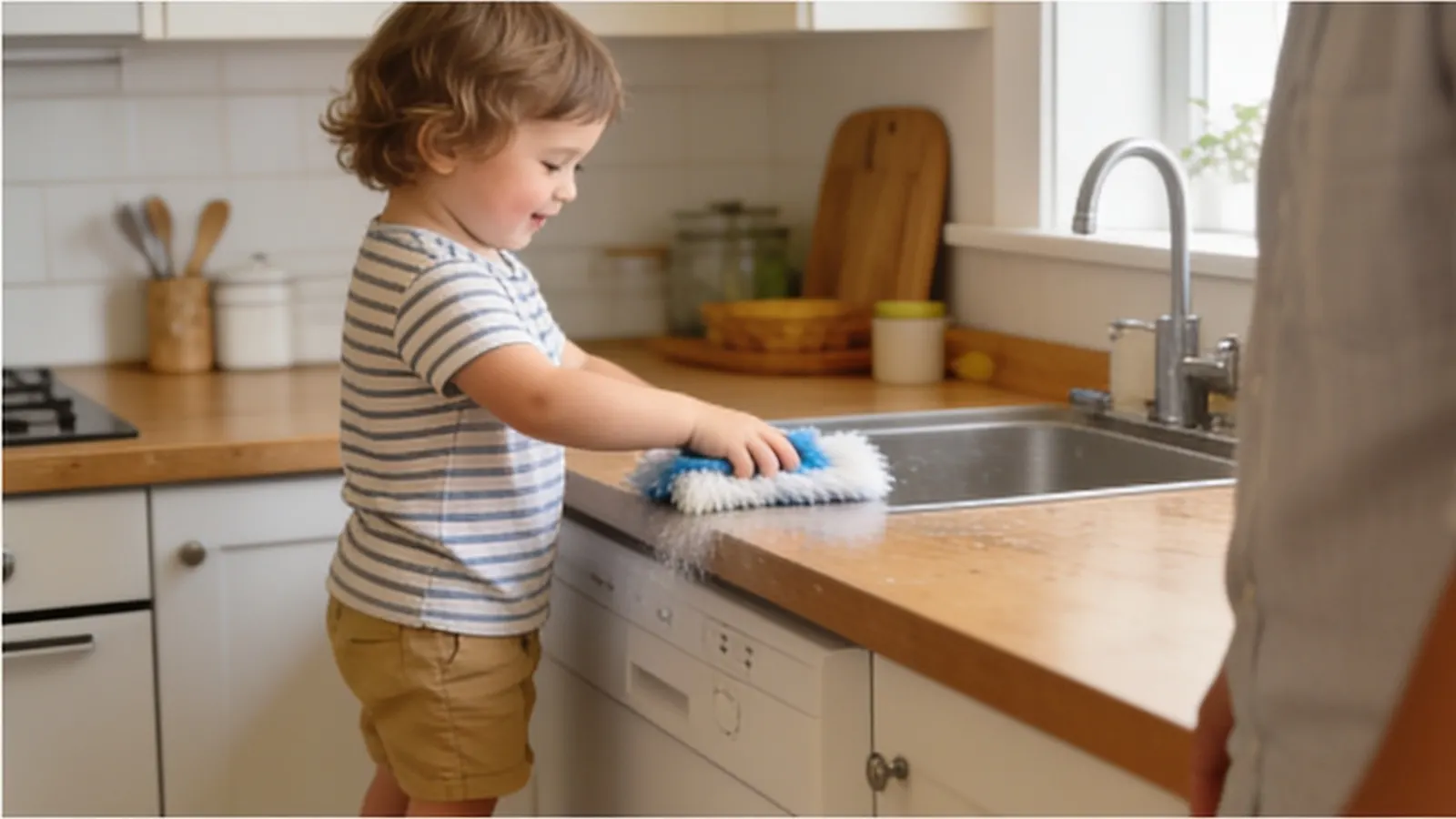
CDC suggests letting 2-year-olds help get ready for meals and do simple chores, like putting toys or laundry in a basket, and thanking them for it (CDC).
Jobs that fit this age:
- Toys into bins at clean-up time
- Dirty clothes into the hamper
- Napkins, spoons, and unbreakable cups to the table
- Wiping a spill with a cloth
- Scooping pet food you've measured into the bowl
- Watering a plant from a small cup
How to make it work:
- Do it with them. Toddlers learn by copying.
- Accept slow and messy. In a survey of more than 500 families of 1- to 4-year-olds, most parents said their child's help was sometimes unhelpful (Hammond & Brownell, 2018). Letting them help now builds the habit.
- Thank them; don't pay them. In a lab study, 20-month-olds given a toy for helping later helped less than those who got praise or nothing (Warneken & Tomasello, 2008). Keep these as unpaid family jobs. Research on paying children for chores is limited and mixed; first money lessons, like a save jar, come up in the age 3 guide (see also rewarding effort without bribery).
- Play the long game. Among 9,971 US children, those who did chores more often in kindergarten rated their own social and academic skills higher in third grade, a correlation, not proof (White et al., 2019). More in chores that raise independent kids.
Safety note: Keep helpers away from the stove, cleaners, and buckets of water (AAP; AAP).
Activities to try#
Short, playful, and repeated beats long and perfect. Follow your toddler's lead, and stop while it's still fun.
How we rate the evidence
- Strong evidence
- Randomized trials or systematic reviews show a consistent benefit.
- Moderate evidence
- Consistent observational research, or a major guideline (AAP, WHO) built on research.
- Emerging evidence
- Small or early studies. Plausible, not yet proven.
- Mixed evidence
- Studies disagree, or reviews rate the evidence as weak.
Too tired to choose? Let us pick one.
Ask-and-wait book time
Strong evidence- Time
- About 10 minutes, once or twice a day
- Builds
- Vocabulary, longer sentences, conversation
- Pick a picture book with lots to point at.
- Ask a "what" or "where" question about a picture, then wait.
- Repeat your child's answer and add a word or two: "Dog. A big, brown dog."
- Reread favorites and pause so your child can fill in familiar words.
Make it work: The AAP suggests starting a conversation by repeating an important word your child just said and responding with enthusiasm to their questions (AAP).
Evidence: Strong. Across 19 randomized trials, teaching parents interactive book-sharing improved children's language, with small effects that depended on doing it regularly (Dowdall et al., 2020); a federal review found dialogic reading improved preschoolers' oral language (What Works Clearinghouse, 2007).
Feelings detective
Emerging evidence- Time
- A few minutes during story time
- Builds
- Emotion words, empathy, early sharing and helping
- Point to a character's face and ask, "How does she feel?"
- Ask why: "Why is she sad?"
- Connect it to your child: "You felt sad when your ball rolled away."
Evidence: Emerging. In two small studies, toddlers whose parents asked them to name and explain characters' feelings shared and helped more, a link that doesn't prove cause (Brownell, Svetlova, et al., 2013); the AAP recommends naming emotions with children (Shah, AAP).
Clean-up song
Moderate evidence- Time
- 2 to 5 minutes, before meals or bed
- Builds
- Following routines, sorting, pitching in
- Sing the same short song each time clean-up starts.
- Give one clear job: "Blocks go in the red bin."
- Work alongside your child, then thank them for what they did.
Make it work: Fewer toys out means a job your toddler can actually finish.
Evidence: Moderate. Following a clean-up routine is a 30-month milestone, and CDC suggests letting 2-year-olds put toys in a basket and praising the help (CDC; CDC); in a large observational study, kindergartners who did more chores rated their own skills higher later (White et al., 2019).
Table helper
Moderate evidence- Time
- 2 to 3 minutes before meals
- Builds
- Belonging, counting, two-step directions
- Hand over one napkin and one spoon per person.
- Give a two-step direction: "Napkins first, then spoons."
- Count the places together and say thank you.
Evidence: Moderate. CDC suggests letting 2-year-olds help get ready for meals by carrying cups or napkins, and thanking them (CDC); in a lab study, toy rewards made 20-month-olds less likely to help again (Warneken & Tomasello, 2008).
Spill patrol
Emerging evidence- Time
- A minute, whenever something spills
- Builds
- Problem-solving, responsibility without blame
- Keep a small cloth where your toddler can reach it.
- When something spills, say "Uh-oh, let's wipe it," not "Look what you did."
- Let your child wipe first, then you finish.
Make it work: Use this for water and milk. You handle anything hot, broken, or made with cleaning products.
Evidence: Emerging. Toddlers often jump into everyday chores on their own, even when their help slows things down (Hammond & Brownell, 2018); cleaning up spills hasn't been studied as an activity.
Pet-feeding partner
Emerging evidence- Time
- 2 minutes, once a day
- Builds
- Caring for others, routines, hand control
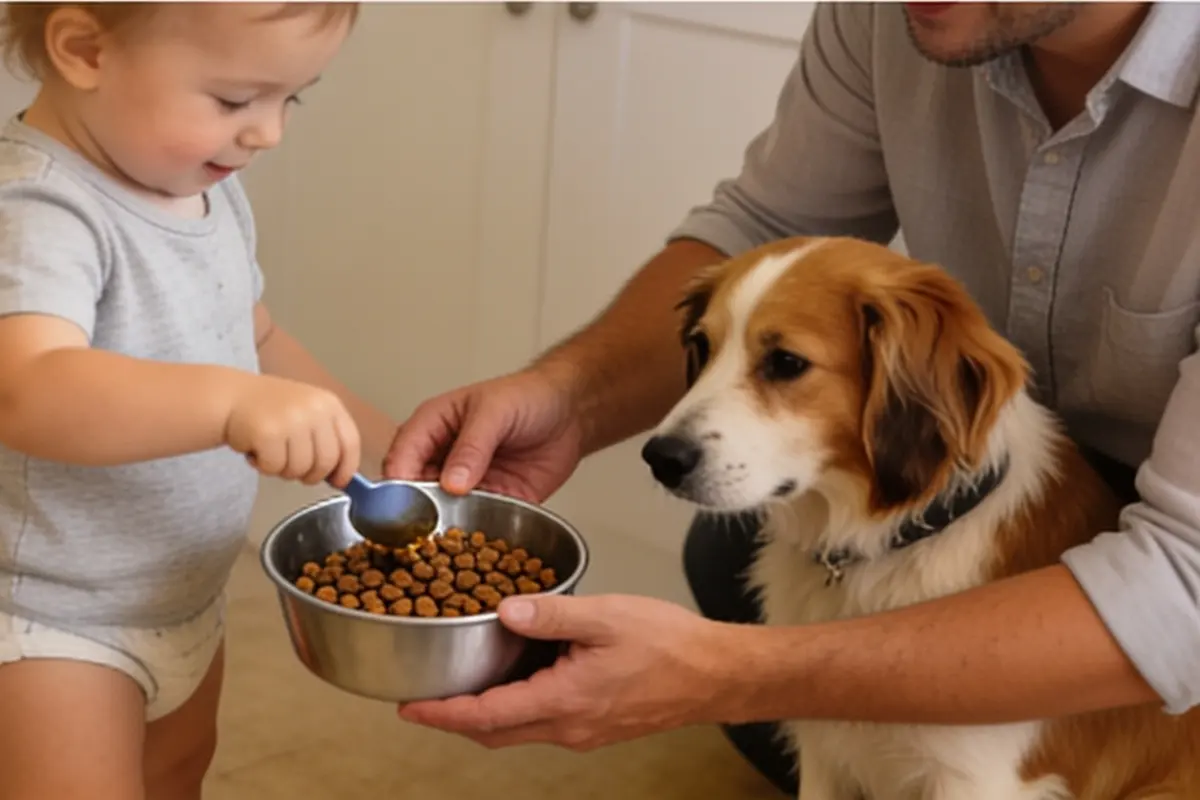
- Measure the food yourself and let your child scoop or pour it into the bowl.
- Have them tell the pet, "Dinner time!"
- Wash hands together afterward.
Make it work: Stay with your toddler around the animal, and store pet food out of reach between meals.
Evidence: Emerging. Simple, repeated chores fit CDC's tips for this age (CDC); feeding pets hasn't been studied in toddlers.
Pretend kitchen
Mixed evidence- Time
- 10 to 20 minutes
- Builds
- Imagination, language, copying everyday life
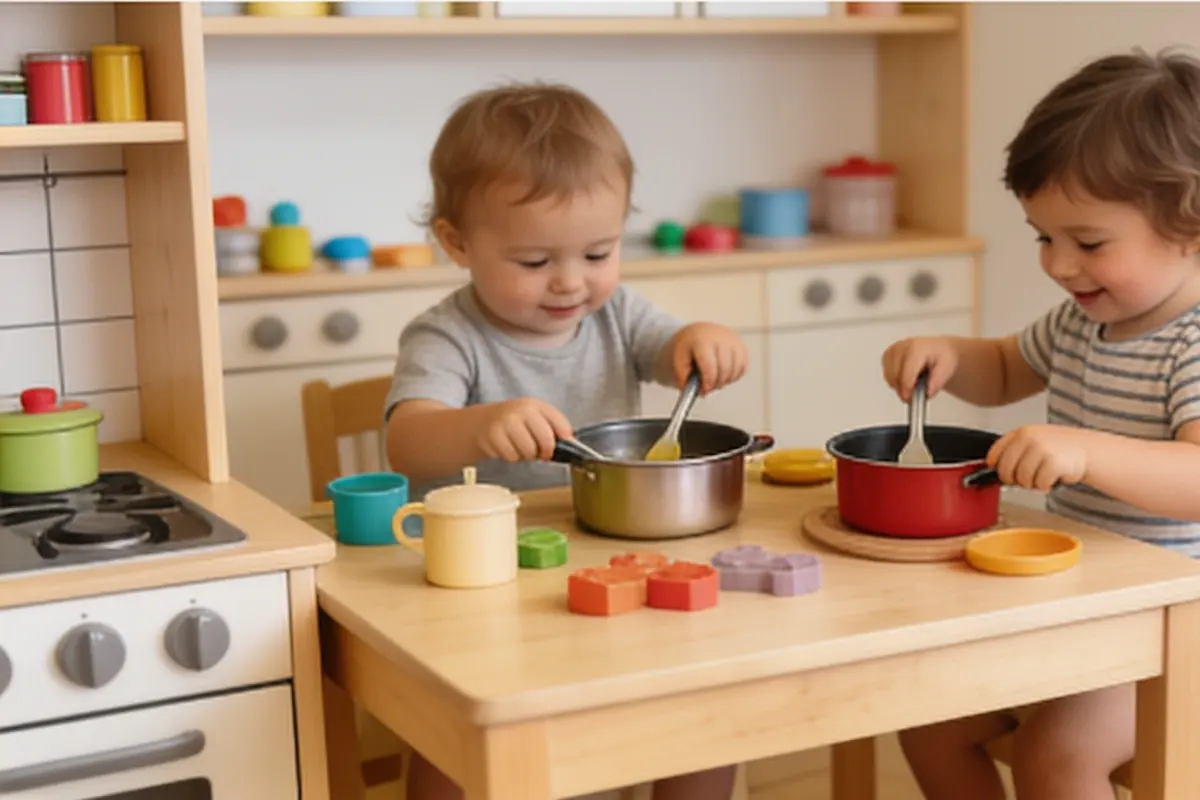
- Offer plastic bowls, wooden spoons, and a pot.
- Order a meal: "One soup, please!"
- Swap roles and let your child be the customer.
Evidence: Mixed. Using objects to pretend is a 30-month milestone, and CDC suggests letting toddlers pretend to cook with safe kitchen things (CDC), but a major review found little evidence that pretend play itself causes developmental gains (Lillard et al., 2013).
Ready, set... go!
Emerging evidence- Time
- A few minutes at the swing or with a ball
- Builds
- Waiting, listening, turn-taking
- Pull the swing back and say "Ready, set..."
- Wait for your child to say "Go!" before you push.
- Stretch the pause a little as they get the hang of it.
Evidence: Emerging. CDC suggests playing "ready, set, go" at the swing at this age (CDC); waiting for your child to say "Go!" hasn't been studied on its own.
Kick, chase, and freeze
Moderate evidence- Time
- 10 to 15 minutes, outdoors if you can
- Builds
- Running, kicking, balance, stopping on cue
- Kick a soft ball back and forth.
- Run after it together, and call "Freeze!" now and then.
- Take turns being the one who calls it.
Evidence: Moderate. WHO recommends at least 180 minutes of physical activity a day for children 1 to 4 (WHO); kicking a ball and running are 2-year milestones (CDC).
Follow the leader
Emerging evidence- Time
- About 5 minutes
- Builds
- Balance, body control, copying
- March, turn, and tiptoe while your child copies you.
- Add a silly move, like walking backward.
- Switch, and copy your child.
Evidence: Emerging. CDC suggests walking in a line, turning, walking backward, and tiptoeing for your child to copy, then letting them lead (CDC); the game hasn't been studied.
Copy my line
Emerging evidence- Time
- 5 to 10 minutes
- Builds
- Hand control, early drawing
- Offer chunky crayons, sidewalk chalk, or shaving cream on a tray.
- Draw a line and say, "Your turn."
- When lines are easy, try a circle.
Evidence: Emerging. CDC suggests drawing a straight line for your child to copy, then a circle once lines are easy (CDC); drawing a circle when shown is a 3-year milestone (CDC).
Teddy goes potty
Emerging evidence- Time
- About 5 minutes
- Builds
- Comfort with the potty, body words
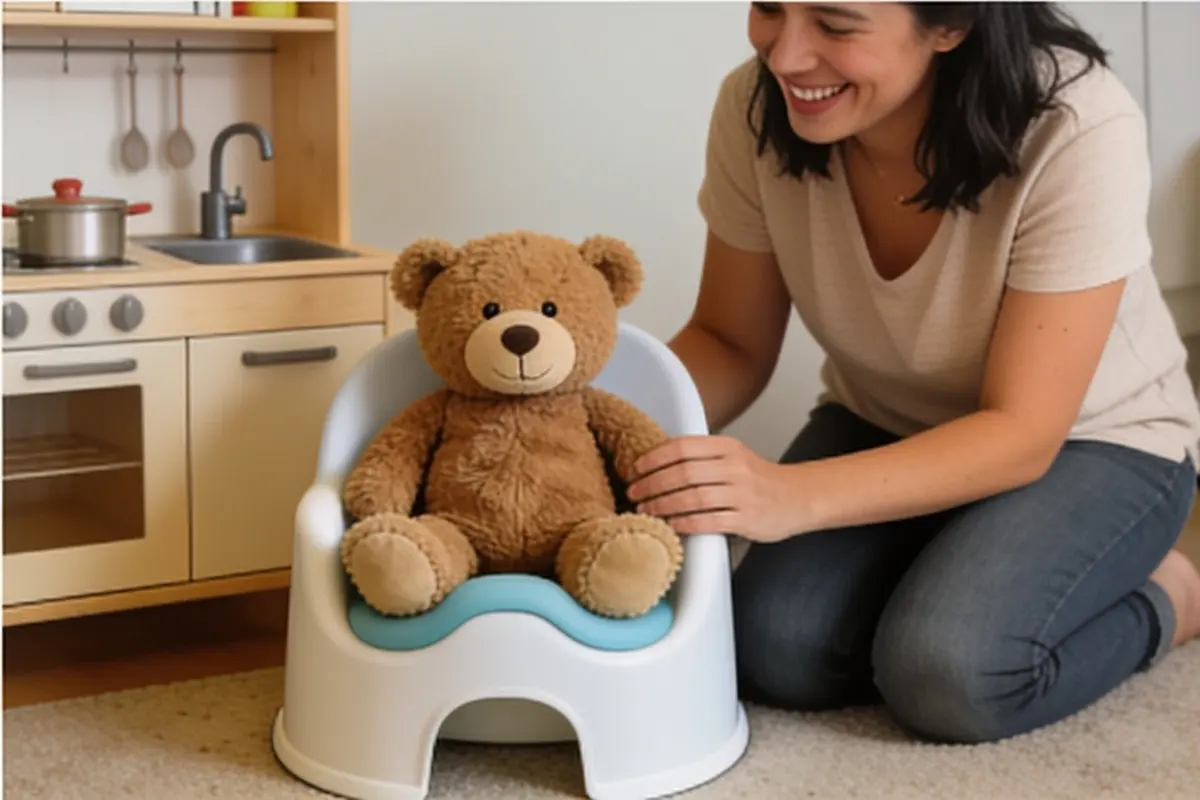
- Let a doll or teddy "use" the potty, then wash hands together.
- Invite your child to sit on the potty in their clothes, just for practice.
- Read a short book or sing while they sit for a minute.
Make it work: Keep it light. The AAP says power struggles, rewards, and punishments keep children from managing their own toileting (AAP).
Evidence: Emerging. Doll demonstrations are part of the structured Azrin and Foxx method, and the child-led method starts with sitting on the potty fully clothed (Choby & George, 2008); a federal review found no studies comparing the two directly (Klassen et al., 2006).
Taste-a-day
Moderate evidence- Time
- 1 minute at one meal a day, for 2 weeks
- Builds
- Acceptance of new foods
- Pick one vegetable your child has refused.
- Offer one small taste each day next to foods they like.
- Say "Thanks for trying," whether they eat it or not.
Make it work: No bribes or pressure. In one study, pressure made preschoolers eat less and complain more (Galloway et al., 2006).
Evidence: Moderate. In a randomized trial with 2- to 6-year-olds, a tiny daily taste of a disliked vegetable for 14 days increased liking and intake (Wardle et al., 2003); the AAP says acceptance can take 10 or more tastes (AAP).
Brush, book, bed
Moderate evidence- Time
- 20 to 30 minutes each night
- Builds
- Healthy teeth, sleep, a calm end to the day
- Brush with a rice-grain smear of fluoride toothpaste (AAP).
- Read 1 or 2 books (CDC).
- Lights out at the same time each night, with a favorite stuffed animal or blanket.
Evidence: Moderate. In a 3-week randomized trial with 199 toddlers, a consistent bedtime routine cut night waking and time to fall asleep; a baby-products company funded it (Mindell et al., 2009). The AAP recommends a quiet routine at the same time each night (AAP).
Common questions#
How long do the terrible twos last?
Tantrums usually ease after age 3, though they don't stop overnight. The AAP says tantrums happen most between ages 1 and 3 and tend to get better after 3 (Swanson, AAP). In a study of 1,490 preschoolers, 83.7% had tantrums sometimes and 8.6% had them daily (Wakschlag et al., 2012). Talk to your pediatrician if tantrums are daily, very long, or destructive, or if your child is unusually aggressive for longer than a few weeks (AAP).
What if my 2-year-old isn't talking much yet?
Tell your pediatrician now rather than waiting. By 2, most children put at least two words together (CDC), and the AAP's rough guide is 50 to 100 words. About 1 in 5 children start talking later than their peers. Your pediatrician may order a hearing test and a speech evaluation, since late talking is sometimes linked to hearing loss or autism (AAP). Before age 3, you can also call your state's early intervention program for a free evaluation, with no referral needed (CDC).
Is it normal for my 2-year-old to repeat words or get stuck?
Often, yes. Repeating whole words or phrases is common while language grows fast. Stretching out sounds, repeating parts of words ("b-b-ball"), or visible tension point more toward stuttering (AAP). In one Australian study, 11.2% of children started stuttering by age 4 (Reilly et al., 2013), and 65% of them had recovered by 7 (Kefalianos et al., 2017). Give your child time to finish, and don't say "slow down." If you're concerned, ask your pediatrician about a speech-language evaluation; early help offers the best chance of reducing stuttering (AAP).
When should I start potty training my toddler?
Start when your child shows readiness signs, which for most children come after their second birthday (Schum et al., 2002). US families usually start between 2 and 3, and most children are trained by 4. Signs include staying dry for 2 hours, showing they're about to go, and disliking wet diapers (AAP). In one study, intensive training started before 27 months didn't lead to finishing earlier (Blum et al., 2003). No method has proven best, so choose a calm approach that fits your family (Baird et al., 2019).
Why won't my 2-year-old share?
Sharing is a skill toddlers are just starting to learn, along with what "mine" and "yours" mean. The AAP notes that 2-year-olds often refuse to share things they care about, and other children their age act the same way (AAP). In studies, toddlers shared more when the other person said what they wanted (Brownell et al., 2009) and when they understood ownership better (Brownell, Iesue, et al., 2013). Help your child share, take turns, and use words (CDC).
My toddler bites other kids at day care. What should I do?
Respond the same calm way every time: stop it, check on the child who was bitten, and say, "No biting. Biting hurts." The AAP advises separating the children until they calm down and teaching other ways to handle frustration, like saying "no" firmly or turning away (AAP). Notice when it happens, like when your child is tired or hungry, and agree on one plan with the teachers. Most children learn alternatives to physical aggression before school (Tremblay et al., 2004). Talk to your pediatrician if your child is unusually aggressive for more than a few weeks or attacks adults (AAP).
When should my toddler move from a crib to a bed?
Move your toddler once they can climb out of the crib or reach 35 inches tall. The AAP gives both signs (Moon, AAP; AAP). Until then, keep the crib mattress at its lowest setting (AAP). The AAP doesn't set an age, so there's no need to rush a child who sleeps well in a crib. See Moving to a big-kid bed for how to make the switch.
How much milk should a 2-year-old drink?
Up to about 2 cups (16 ounces) of low-fat or nonfat milk a day. The AAP's beverage guidance says up to 2 cups a day for ages 2 and 3, and up to 2½ cups for ages 4 and 5 (AAP; AAP). Make water the main drink, and keep 100% juice, if you serve it, to no more than 4 ounces a day for 2- and 3-year-olds (Muth, AAP). The AAP calls toddler milks unnecessary and advises skipping flavored milk because of added sugar. If your toddler fills up on milk and skips meals, ask your pediatrician.
How much screen time is OK for a 2-year-old?
No more than about 1 hour a day, and what your toddler watches and who watches with them matter as much as the minutes. The AAP's 2026 policy focuses on quality content, watching together, and screen-free times like meals and the hour before bed, and for families who want a limit it suggests less than 1 hour a day for toddlers and preschoolers (Munzer et al., 2026; Munzer, AAP). CDC suggests no more than 1 hour a day of a children's program with an adult present (CDC), and WHO says no more than 1 hour for 2-year-olds, with less being better (WHO). Keep background TV off while your toddler plays (Schmidt et al., 2008).
How do I get my 2-year-old to eat vegetables?
Keep offering small tastes without pressure; repetition works better than persuasion. In a trial with 2- to 6-year-olds, a tiny daily taste of a disliked vegetable for 14 days raised liking and intake (Wardle et al., 2003). The AAP says it can take 10 or more tastes and warns that pressuring or punishing can make children dislike foods. Serve vegetables alongside foods your child likes, and let your toddler help with simple cooking tasks, closely supervised (AAP).
Does learning two languages delay talking?
No. Learning more than one language doesn't cause speech or language problems, and children learning two languages know about as many words in total as children learning one (AAP and ASHA). Mixing languages in a sentence is normal, and around age 3 most children start using the right language for each person. Speak the language you're most comfortable with. A true language problem shows up in every language a child uses, so raise concerns the same way you would for any child.
What happens at the 2-year and 30-month checkups?
Expect growth checks, a physical exam, questions about development, feeding, and safety, and a few screenings. At 24 months, the AAP recommends autism screening and a lead check (Hyman et al., 2020; AAP). At 30 months, it recommends a general developmental screen (AAP, 2025). Most toddlers are caught up on early vaccines by now; missed doses and a flu vaccine may be given (AAP). See the checkups section for details.
Safety and when to get help#

Injuries are the leading cause of death for US children younger than 4 (AAP), and more children ages 1 to 4 die from drowning than from any other cause (CDC).
Water and drowning
The biggest threat is unexpected access: 69% of drownings in children 4 and younger happened during non-swim times. Fence home pools on all 4 sides with a self-closing, self-latching gate; fencing can prevent more than half of young children's pool drownings. Stay within arm's reach in the bath and around water, name a "water watcher" at gatherings, and empty buckets and wading pools after use. Swim lessons can start after the first birthday, depending on readiness (AAP).
Car seats and driveways
Keep your child rear-facing until they reach the seat's highest weight or height limit; most convertible seats allow this for 2 years or more. Then use a forward-facing seat with a harness as long as possible, at least to age 4. Never leave your child alone in or around a car (AAP), and walk behind your car before backing out (AAP).
Poisons, batteries, and magnets
Keep medicines and cleaners capped and out of sight and reach. If your child puts something poisonous in their mouth, call Poison Help at 1-800-222-1222 right away, and don't make them vomit (AAP). The line is free, confidential, and open 24 hours a day (America's Poison Centers). Swallowed button batteries can cause swift, life-threatening damage (AAP); see the ER list below.
Falls, windows, and tip-overs
Install window guards above the first floor, open windows from the top if you can, and keep furniture away from windows; a screen won't stop a fall (AAP; AAP). In window falls, children under 5 were more likely than older children to have head injuries (Harris et al., 2011). Anchor TVs, dressers, and bookcases: of 217 tip-over deaths reported from 2013 to mid-2023, 71% were children ages 1 to 3 (CPSC, 2026).
Burns and hot drinks
Never carry your child and a hot drink at the same time (AAP), and turn pot handles toward the back of the stove (AAP). Set the water heater so tap water is no hotter than 120°F. For a burn, run cold water over it, cover it loosely, and call your doctor (AAP).
Guns in the home
The AAP says the safest home for a child has no guns. If you keep one, store it unloaded and locked, with ammunition locked separately and keys or combinations out of reach. Even young toddlers can find unlocked guns and are strong enough to pull the trigger. Before playdates, ask, "Is there an unlocked gun in your house?" (Schaechter, AAP)
Call 911 if your child
- Is struggling for each breath, has bluish lips or face, or has stopped breathing (AAP)
- Choked on a small object that could be stuck in their throat (AAP)
- Isn't moving, is too weak to stand, or can't be woken (AAP)
- Has purple or blood-colored spots on the skin with a fever (AAP)
- After a head injury, has a seizure, was knocked out for more than a minute, or is confused or unsteady (AAP)
Go to the ER now if your child
- Might have swallowed a button battery or magnet, or drools, gags, or can't swallow after swallowing something (AAP)
- Has ribs pulling in with each breath, or trouble breathing with loud wheezing or a harsh sound when breathing in (AAP)
- Had a seizure with a fever, has a stiff neck, is hard to wake, or acts confused (AAP)
Call your pediatrician right away if your child
- Has a fever over 104°F (40°C) or seems dehydrated: no urine in more than 8 hours, dark urine, a very dry mouth, and no tears (AAP)
- Won't move an arm or leg normally, or cries when touched or moved (AAP)
- Has a head injury with swelling larger than 1 inch, a cut that may need stitches, or a fall from a dangerous height (AAP)
- Has any burn (AAP)
- Looks or acts very sick (AAP)
Call within a day for a fever that lasts more than 3 days or comes back after being gone more than 24 hours (AAP).
Don't wait on development worries
If your child isn't meeting milestones, has lost skills, or you're worried, talk with your pediatrician. Before age 3, you can also call your state's early intervention program, with no referral needed. After 3, call your local public elementary school and ask for a preschool special education evaluation (CDC). Bring it up if your child:
- Isn't putting two words together by 2, or saying about 50 words by 30 months (CDC; CDC)
- Isn't pretending with objects by 30 months, or doesn't notice when others are upset (CDC; CDC)
- Has lost skills they once had (CDC)
- Stutters with visible tension (AAP)
- Seems very withdrawn, always sad, or highly demanding most of the time (AAP)
- Snores or breathes heavily in their sleep (AAP)
The 2-year and 30-month checkups
The AAP recommends well visits at 24 and 30 months (AAP, 2025). Expect:
- Autism screening at 24 months, as at 18 months (Hyman et al., 2020). A positive screen isn't a diagnosis; it's a reason for a closer look.
- A developmental screen at 30 months, plus questions about pretend play, colors, and the potty (AAP).
- Lead and teeth. Lead risk is checked at 24 months, with testing based on risk or Medicaid rules (AAP, 2025). The AAP recommends fluoride varnish 2 to 4 times a year until age 5, and a pea-sized amount of toothpaste once your child turns 3 (AAP).
- Vaccines. Missed doses are caught up, and a flu vaccine is given during flu season (AAP); the AAP recommends it for all children 6 months and older (AAP). US guidance has been changing: a January 2026 CDC schedule stopped routinely recommending flu and hepatitis A vaccines for all children, and a federal court stayed it in March 2026; the government has appealed (Congressional Research Service, 2026). Ask your pediatrician which schedule they follow.
Sources#
- Centers for Disease Control and Prevention. "Milestones by 2 Years." Learn the Signs. Act Early., updated 2026. https://www.cdc.gov/act-early/milestones/2-years.html
- Centers for Disease Control and Prevention. "Milestones by 30 Months." Learn the Signs. Act Early., updated 2026. https://www.cdc.gov/act-early/milestones/30-months.html
- Centers for Disease Control and Prevention. "Milestones by 3 Years." Learn the Signs. Act Early., updated 2026. https://www.cdc.gov/act-early/milestones/3-years.html
- Centers for Disease Control and Prevention. "Concerned About Your Child's Development?" Updated 2026. https://www.cdc.gov/act-early/families/concerned.html
- Centers for Disease Control and Prevention. "Drowning Facts." Updated 2026. https://www.cdc.gov/drowning/data-research/facts/index.html
- American Academy of Pediatrics. "Physical Appearance and Growth: Your 2 Year Old." HealthyChildren.org, updated 2009. https://www.healthychildren.org/English/ages-stages/toddler/Pages/Physical-Appearance-and-Growth-Your-2-Year-Od.aspx
- American Academy of Pediatrics. "Language Development: 2 Year Olds." HealthyChildren.org, updated 2009. https://www.healthychildren.org/English/ages-stages/toddler/Pages/Language-Development-2-Year-Olds.aspx
- American Academy of Pediatrics. "Language Delays in Toddlers: Information for Parents." HealthyChildren.org, updated 2021. https://www.healthychildren.org/English/ages-stages/toddler/Pages/language-delay.aspx
- American Academy of Pediatrics and American Speech-Language-Hearing Association. "Young Children Learning Multiple Languages: Parent FAQs." HealthyChildren.org, updated 2025. https://www.healthychildren.org/English/ages-stages/gradeschool/school/Pages/7-Myths-Facts-Bilingual-Children-Learning-Language.aspx
- Coleman C. "Stuttering in Toddlers & Preschoolers: What's Typical, What's Not?" HealthyChildren.org, updated 2016. https://www.healthychildren.org/English/ages-stages/toddler/Pages/Stuttering-in-Toddlers-Preschoolers.aspx
- American Academy of Pediatrics. "Social Development: 2 Year Olds." HealthyChildren.org, updated 2022. https://www.healthychildren.org/English/ages-stages/toddler/Pages/social-development-2-year-olds.aspx
- American Academy of Pediatrics. "Emotional Development: 2 Year Olds." HealthyChildren.org, updated 2022. https://www.healthychildren.org/English/ages-stages/toddler/Pages/emotional-development-2-year-olds.aspx
- Swanson WS. "Top Tips for Surviving Tantrums." HealthyChildren.org, updated 2021. https://www.healthychildren.org/English/family-life/family-dynamics/communication-discipline/Pages/Temper-Tantrums.aspx
- American Academy of Pediatrics. "10 Tips to Prevent Aggressive Behavior in Young Children." HealthyChildren.org, updated 2023. https://www.healthychildren.org/English/ages-stages/toddler/Pages/Aggressive-Behavior.aspx
- American Academy of Pediatrics. "How to Give a Time-Out." HealthyChildren.org, updated 2018. https://www.healthychildren.org/English/family-life/family-dynamics/communication-discipline/Pages/Time-Outs-101.aspx
- Gilgoff R, Bhushan D. "Why Kids Act Out: Tips to Help Your Child Cope With Stress." HealthyChildren.org, updated 2024. https://www.healthychildren.org/English/healthy-living/emotional-wellness/Building-Resilience/Pages/why-kids-act-out-tips-to-help-your-child-cope-with-stress.aspx
- Shah P. "Helping Little People Manage Big Feelings." HealthyChildren.org, updated 2024. https://www.healthychildren.org/English/family-life/family-dynamics/Pages/helping-little-people-manage-big-feelings.aspx
- American Academy of Pediatrics. "The Right Age to Potty Train." HealthyChildren.org, updated 2022. https://www.healthychildren.org/English/ages-stages/toddler/toilet-training/Pages/The-Right-Age-to-Toilet-Train.aspx
- Moon RY. "Big Kid Beds: When to Switch From a Crib." HealthyChildren.org, updated 2022. https://www.healthychildren.org/English/healthy-living/sleep/Pages/Big-Kid-Beds-When-To-Make-the-Switch.aspx
- American Academy of Pediatrics. "Make Baby's Room Safe: Parent Checklist." HealthyChildren.org, updated 2020. https://www.healthychildren.org/English/safety-prevention/at-home/Pages/Make-Babys-Room-Safe.aspx
- American Academy of Pediatrics. "Toddler Won't Go to Sleep? 7 Tips to Help End Bedtime Battles." HealthyChildren.org, updated 2026. https://www.healthychildren.org/English/healthy-living/sleep/Pages/bedtime-trouble.aspx
- American Academy of Pediatrics. "Healthy Sleep Habits: How Many Hours Does Your Child Need?" HealthyChildren.org, updated 2026. https://www.healthychildren.org/English/healthy-living/sleep/Pages/healthy-sleep-habits-how-many-hours-does-your-child-need.aspx
- AAP Committee on Nutrition. "10 Tips for Parents of Picky Eaters." HealthyChildren.org, updated 2018. https://www.healthychildren.org/English/ages-stages/toddler/nutrition/Pages/Picky-Eaters.aspx
- AAP Section on Obesity. "Feeding & Nutrition Tips: Your 2-Year-Old." HealthyChildren.org, updated 2022. https://www.healthychildren.org/English/ages-stages/toddler/nutrition/Pages/feeding-and-nutrition-your-two-year-old.aspx
- Muth ND. "Recommended Drinks for Children Age 5 & Younger." HealthyChildren.org, updated 2023. https://www.healthychildren.org/English/healthy-living/nutrition/Pages/recommended-drinks-for-young-children-ages-0-5.aspx
- American Academy of Pediatrics Institute for Healthy Childhood Weight. "Healthy Beverage Quick Reference Guide." 2021. https://downloads.aap.org/AAP/PDF/HealthyBeverageQuickReferenceGuideDownload.pdf
- Munzer T. "Helping Kids Thrive in a Digital World: AAP Policy Explained." HealthyChildren.org, updated 2026. https://www.healthychildren.org/English/family-life/Media/Pages/helping-kids-thrive-in-a-digital-world-AAP-policy-explained.aspx
- American Academy of Pediatrics. "A Child-Friendly Digital World: AAP Releases New Media Recommendations." HealthyChildren.org, 2026. https://www.healthychildren.org/English/news/Pages/creating-a-child-friendly-digital-world-AAP-releases-new-media-recommendations.aspx
- American Academy of Pediatrics. "How to Share Books with Children 2 and 3 Years Old." HealthyChildren.org, updated 2021. https://www.healthychildren.org/English/ages-stages/toddler/Pages/How-to-Share-Books-with-2-and-3-Year-Olds.aspx
- American Academy of Pediatrics. "Choosing a Child Care Center." HealthyChildren.org, updated 2022. https://www.healthychildren.org/English/family-life/work-and-child-care/Pages/choosing-a-child-care-center.aspx
- American Academy of Pediatrics. "Your Checkup Checklist: 24 Months (2 Years) Old." HealthyChildren.org, updated 2022. https://www.healthychildren.org/English/ages-stages/Your-Childs-Checkups/Pages/your-checkup-checklist-24-months-2-Years-Old.aspx
- American Academy of Pediatrics. "Your Checkup Checklist: 2½ Years Old (30 Months)." HealthyChildren.org, updated 2022. https://www.healthychildren.org/English/ages-stages/Your-Childs-Checkups/Pages/your-checkup-checklist-30-months-old.aspx
- American Academy of Pediatrics and Bright Futures. "Recommendations for Preventive Pediatric Health Care" (Periodicity Schedule). 2025. https://downloads.aap.org/AAP/PDF/periodicity_schedule.pdf
- AAP Section on Oral Health. "Fluoride for Children: Parent FAQs." HealthyChildren.org, updated 2025. https://www.healthychildren.org/English/healthy-living/oral-health/Pages/FAQ-Fluoride-and-Children.aspx
- American Academy of Pediatrics. "AAP Releases Recommended Childhood and Adolescent Immunization Schedule for 2026." HealthyChildren.org, 2026. https://www.healthychildren.org/English/news/Pages/AAPs-recommended-childhood-and-adolescent-immunization-schedule-for-2026.aspx
- Congressional Research Service. "The 2026 Childhood Immunization Schedule" (R48982). 2026. https://www.everycrsreport.com/reports/R48982.html
- American Academy of Pediatrics. "Safety for Your Child: 2 to 4 Years Old." HealthyChildren.org, updated 2022. https://www.healthychildren.org/English/ages-stages/toddler/Pages/Safety-for-Your-Child-2-to-4-Years.aspx
- AAP Council on Injury, Violence & Poison Prevention. "Drowning Prevention for Curious Toddlers: What Parents Need to Know." HealthyChildren.org, updated 2026. https://www.healthychildren.org/English/safety-prevention/at-play/Pages/Water-Safety-And-Young-Children.aspx
- American Academy of Pediatrics. "Car Seats: Information for Families." HealthyChildren.org, updated 2026. https://www.healthychildren.org/English/safety-prevention/on-the-go/Pages/Car-Safety-Seats-Information-for-Families.aspx
- American Academy of Pediatrics. "Home Safety: Tips for Families With Young Children." HealthyChildren.org, updated 2022. https://www.healthychildren.org/English/safety-prevention/at-home/Pages/home-safety-heres-how.aspx
- AAP Council on Injury, Violence & Poison Prevention. "Burn Treatment & Prevention Tips for Families." HealthyChildren.org, updated 2023. https://www.healthychildren.org/English/health-issues/injuries-emergencies/Pages/Treating-and-Preventing-Burns.aspx
- AAP Council on Injury, Violence & Poison Prevention. "Kitchen Safety: 10 Tips for Families With Young Children." HealthyChildren.org, updated 2023. https://www.healthychildren.org/English/safety-prevention/at-home/Pages/Kitchen-Safety.aspx
- Schaechter J. "Guns in the Home: How to Keep Kids Safe." HealthyChildren.org, updated 2026. https://www.healthychildren.org/English/safety-prevention/at-home/Pages/Handguns-in-the-Home.aspx
- American Academy of Pediatrics. "Fever" (symptom checker). HealthyChildren.org, accessed 2026. https://www.healthychildren.org/English/tips-tools/symptom-checker/Pages/symptomviewer.aspx?symptom=Fever
- American Academy of Pediatrics. "Breathing Trouble" (symptom checker). HealthyChildren.org, accessed 2026. https://www.healthychildren.org/English/tips-tools/symptom-checker/Pages/symptomviewer.aspx?symptom=Breathing+Trouble
- American Academy of Pediatrics. "Head Injury" (symptom checker). HealthyChildren.org, accessed 2026. https://www.healthychildren.org/English/tips-tools/symptom-checker/Pages/symptomviewer.aspx?symptom=Head+Injury
- American Academy of Pediatrics. "Swallowed Foreign Object" (symptom checker). HealthyChildren.org, accessed 2026. https://www.healthychildren.org/English/tips-tools/symptom-checker/Pages/symptomviewer.aspx?symptom=Swallowed+Foreign+Object
- America's Poison Centers. "Get Poison Help." Accessed 2026. https://poisoncenters.org/get-poison-help
- US Consumer Product Safety Commission. "CPSC Urges Fans: Anchor TVs and Furniture Before Super Bowl LX." 2026. https://www.cpsc.gov/Newsroom/News-Releases/2026/CPSC-Urges-Fans-Anchor-TVs-and-Furniture-Before-Super-Bowl-LX
- World Health Organization. "To grow up healthy, children need to sit less and play more." 2019. https://www.who.int/news/item/24-04-2019-to-grow-up-healthy-children-need-to-sit-less-and-play-more
- National Health Service (UK). "Potty training your child." Best Start in Life, accessed 2026. https://www.nhs.uk/best-start-in-life/toddler/potty-training-your-child/
- What Works Clearinghouse, US Department of Education. "Dialogic Reading" (intervention report). 2007. https://ies.ed.gov/ncee/wwc/Docs/InterventionReports/WWC_Dialogic_Reading_020807.pdf
- Baird DC, Bybel M, Kowalski AW. "Toilet Training: Common Questions and Answers." American Family Physician, 2019. https://www.aafp.org/pubs/afp/issues/2019/1015/p468.html
- Choby BA, George S. "Toilet Training." American Family Physician, 2008. https://www.aafp.org/pubs/afp/issues/2008/1101/p1059.html
- Zubler JM, Wiggins LD, Macias MM, et al. "Evidence-Informed Milestones for Developmental Surveillance Tools." Pediatrics, 2022. https://pubmed.ncbi.nlm.nih.gov/35132439/
- Wakschlag LS, Choi SW, Carter AS, et al. "Defining the developmental parameters of temper loss in early childhood: implications for developmental psychopathology." Journal of Child Psychology and Psychiatry, 2012. https://pubmed.ncbi.nlm.nih.gov/22928674/
- Tremblay RE, Nagin DS, Séguin JR, et al. "Physical aggression during early childhood: trajectories and predictors." Pediatrics, 2004. https://pubmed.ncbi.nlm.nih.gov/15231972/
- Barlow J, Smailagic N, Ferriter M, Bennett C, Jones H. "Group-based parent-training programmes for improving emotional and behavioural adjustment in children from birth to three years old." Cochrane Database of Systematic Reviews, 2010. https://pubmed.ncbi.nlm.nih.gov/20238324/
- Blum NJ, Taubman B, Nemeth N. "Relationship between age at initiation of toilet training and duration of training: a prospective study." Pediatrics, 2003. https://pubmed.ncbi.nlm.nih.gov/12671117/
- Schum TR, Kolb TM, McAuliffe TL, et al. "Sequential acquisition of toilet-training skills: a descriptive study of gender and age differences in normal children." Pediatrics, 2002. https://pubmed.ncbi.nlm.nih.gov/11875176/
- Klassen TP, Kiddoo D, Lang ME, et al. "The effectiveness of different methods of toilet training for bowel and bladder control." Evidence Report/Technology Assessment (AHRQ), 2006. https://pubmed.ncbi.nlm.nih.gov/17764212/
- Philips EM, Peeters B, Teeuw AH, et al. "Stressful Life Events in Children With Functional Defecation Disorders." Journal of Pediatric Gastroenterology and Nutrition, 2015. https://pubmed.ncbi.nlm.nih.gov/26192701/
- Reilly S, Onslow M, Packman A, et al. "Natural history of stuttering to 4 years of age: a prospective community-based study." Pediatrics, 2013. https://pubmed.ncbi.nlm.nih.gov/23979093/
- Kefalianos E, Onslow M, Packman A, et al. "The History of Stuttering by 7 Years of Age: Follow-Up of a Prospective Community Cohort." Journal of Speech, Language, and Hearing Research, 2017. https://pubmed.ncbi.nlm.nih.gov/28979988/
- Yairi E, Ambrose NG. "Early childhood stuttering I: persistency and recovery rates." Journal of Speech, Language, and Hearing Research, 1999. https://pubmed.ncbi.nlm.nih.gov/10515508/
- Hustad KC, Mahr TJ, Natzke P, Rathouz PJ. "Speech Development Between 30 and 119 Months in Typical Children I: Intelligibility Growth Curves for Single-Word and Multiword Productions." Journal of Speech, Language, and Hearing Research, 2021. https://pubmed.ncbi.nlm.nih.gov/34491793/
- Dowdall N, Melendez-Torres GJ, Murray L, et al. "Shared Picture Book Reading Interventions for Child Language Development: A Systematic Review and Meta-Analysis." Child Development, 2020. https://pubmed.ncbi.nlm.nih.gov/30737957/
- Brownell CA, Svetlova M, Anderson R, Nichols SR, Drummond J. "Socialization of Early Prosocial Behavior: Parents' Talk about Emotions is Associated with Sharing and Helping in Toddlers." Infancy, 2013. https://pubmed.ncbi.nlm.nih.gov/23264753/
- Brownell CA, Iesue SS, Nichols SR, Svetlova M. "Mine or yours? Development of sharing in toddlers in relation to ownership understanding." Child Development, 2013. https://pubmed.ncbi.nlm.nih.gov/23145536/
- Brownell CA, Svetlova M, Nichols S. "To share or not to share: When do toddlers respond to another's needs?" Infancy, 2009. https://pubmed.ncbi.nlm.nih.gov/22639549/
- Wardle J, Cooke LJ, Gibson EL, et al. "Increasing children's acceptance of vegetables; a randomized trial of parent-led exposure." Appetite, 2003. https://pubmed.ncbi.nlm.nih.gov/12781165/
- Galloway AT, Fiorito LM, Francis LA, Birch LL. "'Finish your soup': counterproductive effects of pressuring children to eat on intake and affect." Appetite, 2006. https://pubmed.ncbi.nlm.nih.gov/16626838/
- de Brito JN, Matsumoto M, Bonilla Z, et al. "Identification of positive parenting practices among parents of young children living in low-income and racially, ethnically, and culturally diverse households." Appetite, 2022. https://pubmed.ncbi.nlm.nih.gov/35988800/
- Lillard AS, Lerner MD, Hopkins EJ, et al. "The impact of pretend play on children's development: a review of the evidence." Psychological Bulletin, 2013. https://pubmed.ncbi.nlm.nih.gov/22905949/
- Knight RM, Albright J, Deling L, et al. "Longitudinal Relationship Between Time-Out and Child Emotional and Behavioral Functioning." Journal of Developmental and Behavioral Pediatrics, 2020. https://pubmed.ncbi.nlm.nih.gov/31513092/
- Sege RD, Siegel BS; AAP Council on Child Abuse and Neglect. "Effective Discipline to Raise Healthy Children." Pediatrics, 2018. https://pubmed.ncbi.nlm.nih.gov/30397164/
- Gershoff ET, Grogan-Kaylor A. "Spanking and child outcomes: Old controversies and new meta-analyses." Journal of Family Psychology, 2016. https://pubmed.ncbi.nlm.nih.gov/27055181/
- Paruthi S, Brooks LJ, D'Ambrosio C, et al. "Recommended Amount of Sleep for Pediatric Populations: A Consensus Statement of the American Academy of Sleep Medicine." Journal of Clinical Sleep Medicine, 2016. https://pubmed.ncbi.nlm.nih.gov/27250809/
- Mindell JA, Telofski LS, Wiegand B, Kurtz ES. "A nightly bedtime routine: impact on sleep in young children and maternal mood." Sleep, 2009. https://pubmed.ncbi.nlm.nih.gov/19480226/
- Munzer T, Parga-Belinkie J, Milkovich LM, et al.; AAP Council on Communications and Media. "Digital Ecosystems, Children, and Adolescents: Policy Statement." Pediatrics, 2026. https://pubmed.ncbi.nlm.nih.gov/41556917/
- Schmidt ME, Pempek TA, Kirkorian HL, et al. "The effects of background television on the toy play behavior of very young children." Child Development, 2008. https://pubmed.ncbi.nlm.nih.gov/18717911/
- Kirkorian HL, Pempek TA, Murphy LA, et al. "The impact of background television on parent-child interaction." Child Development, 2009. https://pubmed.ncbi.nlm.nih.gov/19765004/
- Belsky J, Vandell DL, Burchinal M, et al. "Are there long-term effects of early child care?" Child Development, 2007. https://pubmed.ncbi.nlm.nih.gov/17381797/
- Hammond SI, Brownell CA. "Happily Unhelpful: Infants' Everyday Helping and its Connections to Early Prosocial Development." Frontiers in Psychology, 2018. https://pubmed.ncbi.nlm.nih.gov/30298039/
- Warneken F, Tomasello M. "Extrinsic rewards undermine altruistic tendencies in 20-month-olds." Developmental Psychology, 2008. https://pubmed.ncbi.nlm.nih.gov/18999339/
- White EM, DeBoer MD, Scharf RJ. "Associations Between Household Chores and Childhood Self-Competency." Journal of Developmental and Behavioral Pediatrics, 2019. https://pubmed.ncbi.nlm.nih.gov/30507727/
- Harris VA, Rochette LM, Smith GA. "Pediatric injuries attributable to falls from windows in the United States in 1990-2008." Pediatrics, 2011. https://pubmed.ncbi.nlm.nih.gov/21859909/
- Hyman SL, Levy SE, Myers SM; AAP Council on Children With Disabilities. "Identification, Evaluation, and Management of Children With Autism Spectrum Disorder." Pediatrics, 2020. https://pubmed.ncbi.nlm.nih.gov/31843864/
This guide is general education that summarizes published research and guidance from groups like the American Academy of Pediatrics, the CDC, and the WHO. It isn’t medical advice, and every child develops on their own timeline. Your pediatrician knows your child; if something feels wrong, call them. In an emergency, call 911.
Raising capable kids with Chorevia
When your kids are ready for responsibility, Chorevia turns chores into a family economy, with points, proof, a reward ladder you design, and monthly costs kids work off. Adults always make the call. Free for families.
Create your household