Preschool · 3 to 4 years
Age 3: Development, Research, and What Helps
Last reviewed · 27 min read · 13 activities · 12 common questions · 86 sources · Plain-text version
Three-year-olds hold real conversations, ask why about everything, and start making friends. Here's what's developing, what the research really says about preschool, pretend play, and the marshmallow test, and what helps at home.
At a glance
- Most 3-year-olds hold short conversations, ask why constantly, and join other kids in play. A missed milestone is a reason to ask now, not wait.
- Imaginary friends, monster fears, and nightmares are common at 3 and usually a normal part of a busy imagination.
- Plan on 10 to 13 hours of sleep a day, naps included. Many 3-year-olds still nap; nearly all stop by 5.
- Wetting at night is common at 3 and isn't a toilet-training failure. Night dryness can come months or years after day training.
- Preschool quality matters more than the label. Big public programs have shown mixed long-term results.
- The marshmallow test predicts far less than its legend. Practice waiting, and keep your promises so waiting pays off.
- Small unpaid family jobs and a clear save jar are the right size for chores and money at 3.
- Drowning kills more children ages 1 to 4 than any other cause. Fence pools on all 4 sides and give water your full attention.
Your age-3 checklist
0 of 12 done
Three is when many children shift from toddler to preschooler. They hold short conversations, play with other kids, and want to do things "all by myself" (AAP). This guide covers ages 3 to 4. For the toddler years that led here, see the 2-year guide.
What's developing#
CDC's milestone checklists list skills that at least 75% of children show by each age, so a missed milestone is a reason to check in now, not to wait and see (Zubler et al., 2022).
Milestones by 3 years
By 3 years, most children (CDC):
- Social and emotional: calm down within 10 minutes after you leave, like at a child care drop-off, and notice other children and join them to play.
- Language: hold a conversation with at least two back-and-forth exchanges; ask "who," "what," "where," or "why" questions; say what's happening in a picture or book when asked; say their first name when asked; and talk well enough for others to understand most of the time.
- Thinking: draw a circle when you show them how, and avoid touching hot objects, like a stove, when you warn them.
- Movement: string items together, like large beads or macaroni; put on some clothes by themselves, like loose pants or a jacket; and use a fork.
Over the coming year, your child works toward the 4-year list: pretending to be something else in play, comforting a friend who is sad, liking to be a "helper," talking in sentences of four or more words, naming a few colors, and catching a large ball most of the time (CDC). The 4-year guide picks up from there.
Body and movement
The AAP describes 3- to 4-year-olds who hop and stand on one foot for up to 5 seconds, go up and down stairs without support, and dress and undress themselves with things like a coat, jacket, or shirt (AAP). At the 3-year checkup, your pediatrician may ask whether your child can pedal a tricycle, use scissors and a fork, and put on a jacket or shirt (AAP).
Appetite often drops at this age because growth slows down. Offer healthy foods and let your child decide how much to eat. Making special substitutes to tempt a reluctant eater can encourage picky eating (AAP).
Talking, and the "why" years
Language takes off. By 3 to 4, most children understand ideas like "same" and "different" and "on" and "under," and strangers can understand about 75% of their words (AAP). Questions arrive in floods. The AAP notes there may be hundreds of "why" questions a day, and some have no answers (AAP). Those questions are real learning, not just stalling (see the research).
Repeating sounds or words is common now. Stuttering happens most often between ages 2 and 6, while language is building, and about 75% of children who stutter recover. Experts generally suggest an evaluation if stuttering has lasted 3 to 6 months (NIDCD).
Thinking: monsters, magic, and other minds
Three-year-olds often can't tell fantasy from reality, and many imagine that unfamiliar images may be "monsters" (AAP). Their reasoning is still one-sided. Pour equal amounts of water into a short, wide cup and a tall, thin one, and your child will probably say the tall one holds more, even after watching you pour (AAP). Their sense of time is getting clearer: they know their own daily routine, but a year is still a mystery (AAP).
Children also start to grasp that other people can believe things that aren't true: across 178 studies, performance on these "false belief" tasks rose from below chance to above chance over the preschool years (Wellman et al., 2001).
Pretend play and imaginary friends
Pretend play blooms at 3. Children take on roles, give feelings to objects like the moon or a truck, and move back and forth between make-believe and real life (AAP). By 3, many create detailed stories involving playmates, family, pets, and imaginary friends (AAP). Imaginary companions are common: in a study that followed 100 children, 65% had one at some point by age 7 (Taylor et al., 2004). The AAP says an imaginary friend doesn't mean your child is lonely (AAP).
Feelings, fears, and self-control
Tantrums happen most between ages 1 and 3 and tend to get better after 3, though they don't disappear (AAP). In a study of 1,490 preschoolers, 83.7% had tantrums sometimes, but only 8.6% had them daily (Wakschlag et al., 2012). Words help. In a study that followed 120 children from 18 to 48 months, toddlers with stronger language skills looked less angry at 48 months, partly because they sought support and used distraction (Roben et al., 2013).
Fears are common too: the dark, big barking dogs, storms, high places. Most are mild and fade with reassurance and support (AAP). Nightmares tend to peak between 3 and 12 years old (AAP).
Friends, sharing, and fairness
At 3, children start playing with other kids rather than just next to them, and drift toward particular friends (AAP). They can take turns and share toys in small groups, but at first they need your encouragement (AAP). Don't expect natural generosity yet. In sharing experiments, the overwhelming majority of 3- and 4-year-olds made selfish choices, while most 7- and 8-year-olds preferred equal splits (Fehr et al., 2008).
Toilet training and dry nights
Most children are toilet trained between 2 and 4, and staying dry at night can take longer (AAP). Night bladder control often comes months or even years after day training. The AAP says many children under 6 aren't yet physically able to stay dry at night, and bedwetting stays common through age 5 (AAP).
Around 3, children also start to feel shame after doing something they know is wrong, so some hide accidents. A new baby, a move, or other stress can bring setbacks (AAP).
Sleep and naps
Children 3 to 5 need 10 to 13 hours of sleep in 24 hours, naps included, according to the American Academy of Sleep Medicine (Paruthi et al., 2016), whose guidelines the AAP supports (AAP). WHO's guideline for 3- and 4-year-olds also says 10 to 13 hours of good-quality sleep, which may include a nap, with regular sleep and wake-up times (WHO).
Naps fade on no fixed schedule. In a cohort of 172 children, most still napped in their third and fourth years, at decreasing rates (Weissbluth, 1995). A 2020 meta-analysis called the preschool years a particularly variable stretch and found that 94% of children stop napping by age 5 (Staton et al., 2020).
What the research says#
Several famous findings about this age are weaker, or more complicated, than their reputations.
1. Preschool helps when it's good, and "pre-K" isn't one thing. In Tennessee, 2,990 low-income children who applied to the state's pre-K program for 4-year-olds were randomly offered a seat or waitlisted. Those offered pre-K had lower state test scores in third through sixth grades, and the program had negative effects on discipline, attendance, and special education placement (Durkin et al., 2022). The federal Head Start Impact Study randomly assigned nearly 5,000 3- and 4-year-olds. Head Start improved outcomes during preschool but had few impacts from kindergarten through third grade (ACF, 2012). Boston's public preschool, studied through admissions lotteries, had no detectable effect on state test scores but raised high school graduation and college attendance and reduced discipline problems, including juvenile incarceration (Gray-Lobe et al., 2021). The AAP says the quality of care matters more than the type of arrangement (AAP). Takeaway: Judge a program by its relationships, group sizes, and play, not its label.
2. The marshmallow test predicts less than its legend. In Walter Mischel's studies, 4-year-olds who waited longer for a bigger treat grew into teens with stronger school performance and coping skills (Mischel et al., 1989). But the famous follow-up reached only 185 of the original 653 children. A 2018 team revisited the question with 918 children from a large US study, focusing on children whose mothers hadn't finished college. The link between waiting at age 4 and achievement at 15 was about half the original size, and it shrank by two thirds after accounting for family background, early ability, and the home environment. Links to teen behavior were much smaller and rarely statistically significant (Watts et al., 2018). Waiting also depends on trust: in a study of 28 children, those who had just seen an adult act unreliably waited much less than those who had seen the adult keep their word (Kidd et al., 2013). Self-control still matters: in a study that followed 1,000 children to age 32, childhood self-control predicted health, finances, and criminal offending, separate from intelligence and social class (Moffitt et al., 2011). Takeaway: Help your child practice waiting, and keep your promises, but don't read their future in one snack.
3. Pretend play is good, but not magic. Pretend play is often called crucial for development. A major 2013 review found the evidence doesn't support strong claims that it's uniquely important. For some skills, like language and emotion regulation, the research was too thin to say; for others, like creativity, intelligence, and understanding other minds, results were inconsistent and may reflect the adults and settings that come with play (Lillard et al., 2013). The AAP still urges plenty of play, which supports relationships and skills like self-regulation (Yogman et al., 2018). Takeaway: Make room for pretend play because children love it and learn through it, not as a shortcut to a higher IQ.
4. "Why?" is real learning. In a set of four studies, including diaries from 68 parents and zoo visits with 112 families, preschoolers asked many questions aimed at getting information, and they kept asking when they didn't get a real answer (Chouinard, 2007). In an experiment with 42 children ages 3 to 5, kids were more likely to agree and ask follow-ups after a real explanation, and more likely to repeat their question after a non-answer (Frazier et al., 2009). Takeaway: A short, true answer, or "I don't know, let's find out," beats "because I said so."
5. Screen time has small, measurable links. In a study of 2,441 children in Calgary, Canada, kids averaged about 25 hours of screens a week at 36 months. More screen time at 24 and 36 months predicted slightly lower developmental screening scores at 36 and 60 months, and the reverse pattern wasn't seen (Madigan et al., 2019). The effects were small, and mothers reported both screen time and development. In 2026, the AAP replaced its earlier media guidance with a policy that focuses less on simple time limits and more on content quality, watching together, and apps designed to keep kids hooked (AAP; Munzer, AAP). Takeaway: What screens crowd out (sleep, play, and talk) matters as much as the minutes.
6. Young children help on their own, and rewards can backfire. In a lab study, 20-month-olds who got a material reward for helping later helped less than toddlers who got praise or nothing (Warneken & Tomasello, 2008). Word choice findings are mixed. Asking 3- to 6-year-olds to "be a helper" rather than "to help" increased helping in experiments with 149 children (Bryan et al., 2014), but in later studies of 139 4- and 5-year-olds, the "helper" wording backfired after kids hit a setback, like spilling (Foster-Hanson et al., 2020). Over the longer run, in a study of 9,971 US children, kindergartners who did chores more often rated their social and academic competence higher in third grade, a link that can't prove cause (White et al., 2019). A widely shared University of Minnesota summary of 84 people found that helping at home at 3 or 4 was the best predictor of success in their mid-20s, but it's a small, correlational analysis (Rossmann). Takeaway: Invite your child into real family work, keep prizes out of it, and treat spills as part of learning.
7. Spanking backfires; calm, consistent limits work better. Meta-analyses covering 160,927 children linked spanking with more harmful child outcomes, with effects similar in size to those of physical abuse (Gershoff & Grogan-Kaylor, 2016). The AAP says physical punishment, yelling, and shaming are minimally effective in the short term and not effective in the long term (Sege & Siegel, 2018). Coaching emotions can help. In a trial of 216 parents of 4- and 5-year-olds, a 6-session emotion-coaching program improved children's understanding of emotions, and parents and teachers reported fewer behavior problems (Havighurst et al., 2010). Takeaway: Name feelings, hold limits, and skip physical punishment.
Parenting techniques#
Answer "why" briefly and honestly
Keep answers simple and to the point. The AAP notes that 3-year-olds can't follow long explanations of rules, and "so you don't get hurt" makes more sense to them than a lecture. For big questions, it's fine to say you don't know and look it up together; taking the questions seriously feeds curiosity (AAP).
Script: "Why is the moon following us?" "It sure looks like it! The moon is so far away that it seems to move with us. Want to find a moon book tonight?"
Name the feeling, then hold the limit
CDC suggests naming emotions for your child, teaching calming steps like deep breaths, hugging a toy, or going to a quiet place, and setting a few simple, clear rules: redirect when a rule is broken and praise when it's followed (CDC). Help your child find words for what they feel and want, and show by example how to handle conflict calmly (AAP).
Script: "You're mad it's time to leave the park. You wanted more slides. It's still time to go. Do you want to hop to the car or stomp like a dinosaur?"
Tantrums, hitting, and time-outs
- Prevent what you can. Pack a snack if hunger sets off meltdowns, protect naps, and "catch them being good" with specific praise (AAP).
- During a tantrum, offer small choices instead of yes-or-no questions, try a distraction, and stay consistent from day to day, which helps reduce how often and how hard tantrums hit (AAP).
- Never ignore hitting, kicking, biting, or throwing. Stop it right away (AAP). Your pediatrician may suggest time-outs for hitting or biting (AAP).
- How to give a time-out: warn first, name the behavior ("no hitting"), move your child to a quiet spot, and set a timer for about 1 minute per year of age, so 3 minutes at 3. From age 3, you can also try "come back when you feel ready," which lets your child practice calming down. If you're losing your cool, put your child somewhere safe and take a time-out yourself (AAP).
- Skip spanking and yelling. They don't work in the long run (Sege & Siegel, 2018).
Fears, monsters, and bad dreams
Talk with your child about their fears and be sympathetic. Don't belittle them or pressure your child to be brave, and keep scary media out of the mix (AAP). Never joke about leaving your child behind or locking them up. At this age, they may believe you (AAP).
- After a nightmare, go to your child quickly, reassure them, let them tell you about it, remind them dreams aren't real, and leave a light on if it helps. Check for scary shadows (AAP).
- Night terrors are different. They happen in deep sleep early in the night: your child may scream, thrash, and not recognize you, then won't remember it. Stay calm, keep them from getting hurt, and tell babysitters what to expect. Talk with your pediatrician if they keep happening (AAP).
Script: "That was a scary dream. You're safe, and I'm right here. Dreams are pictures our brains make while we sleep."
Short, sweet drop-offs
The CDC milestone is calming down within about 10 minutes after you leave (CDC). To get there, the AAP suggests a quick goodbye ritual, the same routine each day, full attention and affection before you go, and then a prompt exit. Don't come back because of pleas. Describe your return in your child's terms ("after nap and before snack"), keep your promise, and practice short separations before preschool starts (AAP).
Choosing a preschool (or not)
- Small groups. The AAP lists small groups, fewer children per caregiver, and low staff turnover as signs of quality (AAP). National health and safety standards call for no more than 7 three-year-olds per adult in centers, with no more than 14 in a group (Caring for Our Children).
- Licensing and ratings. Ask whether the program is licensed, and check your state's quality rating system and any accreditation, though only a small share of programs are accredited (AAP).
- Play, not drills. As preschools face pressure to add more lecture-style lessons, the AAP urges a balanced curriculum with plenty of playful learning (Yogman et al., 2018). There's no advantage to rushing academic concepts, and pressure can make children resist learning later (AAP).
- Home is fine too. If you don't enroll your child in preschool, your pediatrician can suggest other ways to build school readiness (AAP).
Finishing toilet training without a fight
- Stay calm about the hard parts. Resisting bowel training is a normal phase that usually passes if you don't react with big emotions. Letting your child flush can help (AAP).
- Downplay nights. Use training pants or a diaper at night for as long as your child is comfortable, and respond calmly to wet nights (AAP).
- Hidden accidents: gently say you know about the accident, that it's OK, and that they'll do better next time. Then clean up together. During a setback, try compromises like training pants under underwear or walking your child to the preschool bathroom, rather than going back to diapers (AAP).
- Never blame or punish for wet beds. Protect the mattress, set a no-teasing rule for siblings, and let your child help change the sheets if they don't see it as punishment (AAP).
Sleep when the nap fades
- Keep the clock steady. The AAP recommends the same wake-up time on weekdays and weekends (AAP) and a predictable "brush, book, bed" routine. Don't wait for eye rubbing; moving bedtime 15 to 20 minutes earlier can make a big difference (AAP).
- Screens out of the bedroom, and off at least an hour before bed (AAP).
- On days without a nap, a quiet rest time with books gives everyone a break, and an earlier bedtime can cover the gap.
Screens: a plan, not just a number
WHO advises no more than 1 hour a day of sedentary screen time for 3- and 4-year-olds, and says less is better (WHO). CDC's tips for this age suggest no more than 1 hour a day of children's programming, with an adult present, and no screens in the bedroom (CDC).
The AAP's 2026 guidance adds how to make the time count: make a family media plan, watch together, choose quality content, use a shared family device rather than a personal tablet, keep meals and bedrooms screen-free, and model the habits you want to see (Munzer, AAP). The AAP notes that nonprofits like PBS Kids and Sesame Workshop design content around children and have the strongest evidence of benefit (AAP).
What to teach#
At 3, your child is ready for small, real responsibilities and simple ideas about money, bodies, and safety. Keep lessons short, hands-on, and repeated.
Family jobs: chores for 3-year-olds
Young children are natural helpers. The AAP says most preschoolers can start pitching in with simple household tasks, which teaches life skills and cooperation and boosts self-esteem. Don't expect perfection, and praise the effort, not the result (AAP). Liking to be a "helper" is on CDC's list for age 4 (CDC).
Good jobs at 3, done next to you:
- Toys back in their bins, clothes in the hamper
- Carrying their own plate or cup to the counter
- Washing fruit and vegetables, or stirring, as CDC suggests (CDC)
- Wiping up their own spills with a damp cloth
- Helping feed a pet while you measure the food
Give two- or three-step instructions ("Put your cup on the counter, then wash your hands"), which CDC suggests practicing at this age (CDC). Keep cleaning products and medicines up high in their original containers, and keep your child away from the stove while you cook (AAP).
Keep family jobs unpaid. They're what everyone does because they live here. Research on paying children for chores is limited and mixed: the AAP mentions allowances and stickers as possible rewards (AAP), while lab studies show material rewards can reduce very young children's natural helping (Warneken & Tomasello, 2008). Optional paid extra jobs can come later, once your child understands money. For what that looks like at older ages, see chores by age and rewards without bribery.
First money ideas
CFPB says children 3 to 5 are usually too young for abstract money concepts, but they're building the foundation: focus, persistence, and noticing trade-offs with things they care about, like time, treats, and toys (CFPB). A 2016 CFPB report explains that executive function, the brain skills behind planning and waiting, develops rapidly from 3 to 5 and later supports saving and sticking to a budget (CFPB, 2016).
CFPB suggests four ideas to talk about (CFPB):
- You need money to buy things, and you earn money by working.
- You may have to wait and save before you can buy something you want.
- For big events and everyday plans, think ahead about what you'll need.
- Every time you spend money, you make a choice, and needs are different from wants.
Think out loud while you shop, so your child can follow your choices (CFPB). A clear save jar makes saving visible. Coins are a choking hazard, so keep coin play supervised and put them away after (AAP). You don't need an allowance at 3. For the age-by-age plan that follows, see teaching kids financial skills.
Body names, body rules, and safe secrets
- Use the real words. The AAP recommends teaching proper names for all body parts, including penis, vagina, breasts, and buttocks. Made-up names can suggest those parts are bad or secret (AAP).
- Private means private. Parts covered by a swimsuit shouldn't be looked at or touched without your child's permission. Don't force hugs or kisses, even for grandparents; offer a high-five or a wave instead (AAP).
- Surprises versus secrets. Some secrets, like a surprise party, are fine to keep. Others should always be told to a trusted adult. Tell your child you'll believe them and they won't be in trouble for telling. Abusers are usually someone the child knows (AAP).
- Curiosity is normal. Touching their own genitals is common from about 2 to 6. Stay calm and redirect: "It's OK to touch your own body, but do that in a private place" (AAP).
Safety rules, with you as the backup
Three-year-olds can start learning rules, but they don't yet understand danger or remember "no" while playing (AAP). Teach the rules and keep supervising:
- "Hot! Don't touch." Avoiding a hot stove when warned is a 3-year milestone (CDC).
- "Hold my hand in parking lots and near streets." No riding tricycles in the street (AAP).
- "If you see a gun, don't touch it. Tell a grown-up." But the AAP is clear that teaching kids about gun safety isn't enough; locked storage is what protects them (AAP).
Early reading and numbers, through play
Read together every day. The AAP calls shared reading a foundation for language, social-emotional growth, and school readiness (Klass et al., 2024), and suggests even just 15 minutes a day (AAP). Count stairs, toes, and crackers (CDC). Letters and numbers will come; the AAP says there's no advantage to pushing them early (AAP).
Activities to try#
Pick a few that fit your week; most need nothing more than you and household odds and ends. The evidence ratings show how well each idea has been tested. Most everyday activities haven't been studied directly, and that's fine.
How we rate the evidence
- Strong evidence
- Randomized trials or systematic reviews show a consistent benefit.
- Moderate evidence
- Consistent observational research, or a major guideline (AAP, WHO) built on research.
- Emerging evidence
- Small or early studies. Plausible, not yet proven.
- Mixed evidence
- Studies disagree, or reviews rate the evidence as weak.
Too tired to choose? Let us pick one.
Ask-and-wait picture book reading
Moderate evidence- Time
- 10 to 15 minutes, daily
- Builds
- Vocabulary, storytelling, back-and-forth talk
- Let your child pick the book and hold it.
- Pause on a page and ask an open question: "What's happening here?"
- Repeat their answer and add a little: "Yes, the dog is running. He's running to the gate!"
- Before you turn the page, ask what might happen next.
Make it work: CDC suggests asking about the pictures and what might happen next (CDC). Rereading favorites counts.
Evidence: Moderate. A meta-analysis of 16 studies found that interactive "dialogic" reading, where the child does more of the talking, built expressive vocabulary more than ordinary reading aloud, with a moderate effect that was smaller for 4- and 5-year-olds and for children at risk of language problems (Mol et al., 2008). The AAP recommends shared reading from infancy (Klass et al., 2024).
Number path board game
Emerging evidence- Time
- 15 minutes, a few times a week
- Builds
- Counting, number sense, taking turns
- Draw a straight path of 10 squares on paper and number them 1 to 10.
- Take turns spinning a 1 or a 2 and moving a token.
- Say the numbers out loud as you move: "I'm on 4. Five!"
- First to 10 wins. Play again.
Make it work: Use a big token, like a toy car. Marbles, small balls, and small toy pieces are still choking hazards at this age (AAP).
Evidence: Emerging. In a study of low-income preschoolers (average age about 5), roughly an hour of playing a simple numbered board game improved counting, number comparison, and number recognition, with gains lasting 9 weeks; classmates who played the same game with colors instead of numbers didn't improve (Ramani & Siegler, 2008).
Feelings faces in the mirror
Emerging evidence- Time
- 5 minutes, once a day
- Builds
- Emotion words, reading faces, empathy
- Make faces in a mirror together: happy, sad, mad, scared, surprised.
- Name each one and guess what might make someone feel that way.
- Ask, "Which face are you today?" and share yours too.
Make it work: Practice when everyone is calm. The middle of a meltdown isn't the time to learn new words.
Evidence: Emerging. CDC suggests naming emotions at this age (CDC); stronger language skills in toddlers were linked with less anger by 48 months (Roben et al., 2013), and a program teaching parents to coach emotions improved preschoolers' emotional understanding (Havighurst et al., 2010). This game itself hasn't been studied.

Freeze dance and red light, green light
Emerging evidence- Time
- 5 to 10 minutes
- Builds
- Self-control, listening, movement
- Play music and dance; when it stops, everyone freezes.
- Switch to red light (stop) and green light (go).
- Once it's easy, flip the rules: red means go and green means stop.
Make it work: The silly rule switch is the point. It makes kids stop and think before they move.
Evidence: Emerging. In a preschool trial with 157 children from low-income families, circle-time music-and-movement games designed to build self-regulation produced self-regulation gains that weren't statistically significant, along with significant gains in math (McClelland et al., 2019).
Pretend rehearsal for something new
Mixed evidence- Time
- 10 minutes, in the days before a new experience
- Builds
- Confidence, coping, language
- Set the scene with toys: a doctor's office, a classroom, a haircut.
- Let your child hand out the roles; take whatever part they give you.
- Act out the tricky moment, like the shot or the goodbye at the door.
- Let your child decide how it ends.
Make it work: The AAP suggests keeping your part low-key so pretend stays the one place your child runs the show (AAP).
Evidence: Mixed. CDC suggests preparing children for new places and people through stories or pretend play (CDC), and the AAP suggests play like "sending a doll to school" to explore feelings (AAP), but a major review found little solid evidence that pretend play itself causes developmental gains (Lillard et al., 2013).
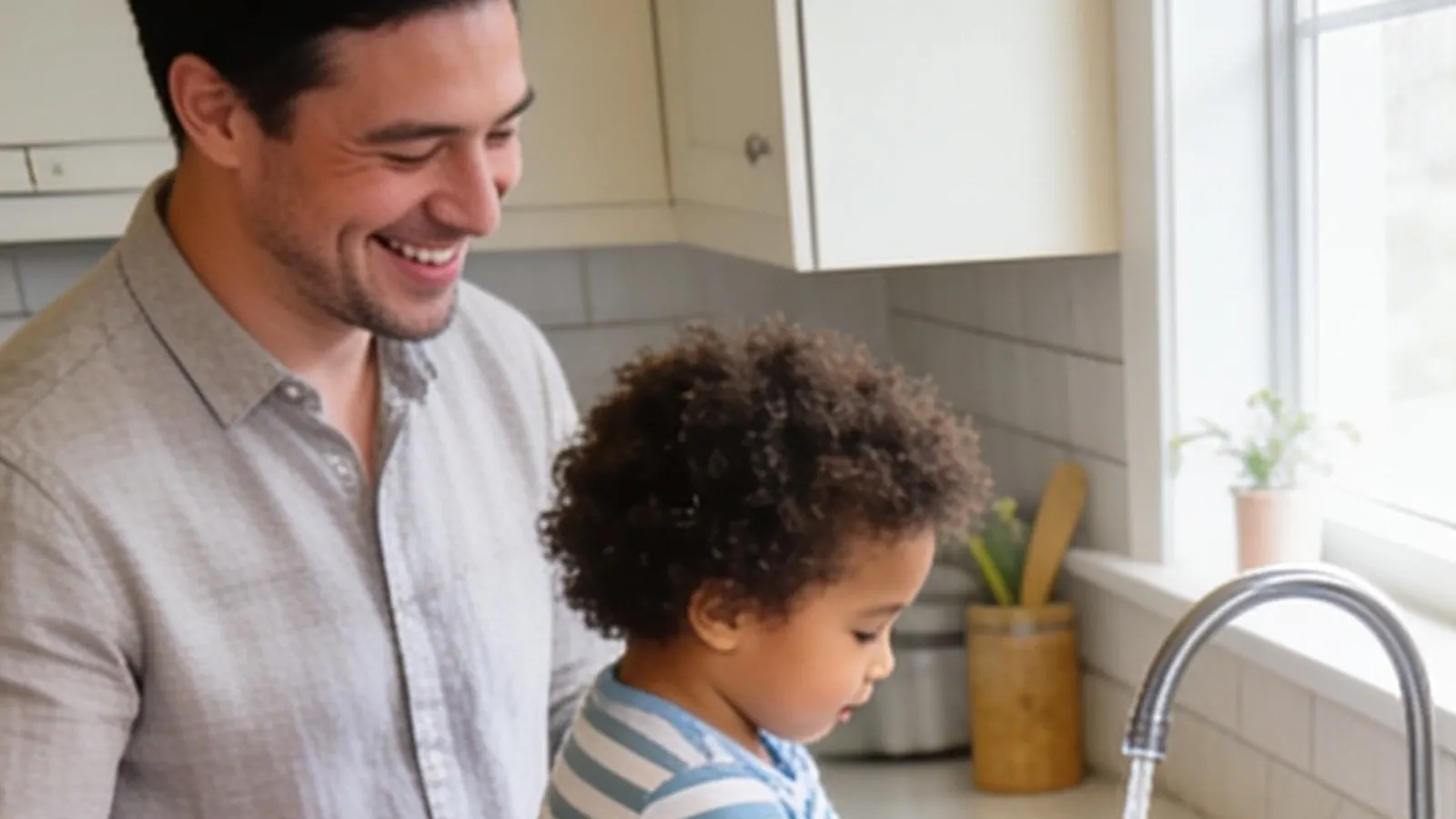
Kitchen helper
Emerging evidence- Time
- 10 minutes, during meal prep
- Builds
- Hand skills, following steps, pride in contributing
- Set your child up at the counter on a sturdy stool, away from the stove.
- Give one job: rinse the berries, tear the lettuce, or stir the batter.
- When they're ready, add a second step: "Stir, then pour it in the bowl."
Make it work: Keep your child out of the cooking area and away from hot liquids (AAP).
Evidence: Emerging. CDC suggests letting 3-year-olds help with simple cooking tasks like washing produce or stirring (CDC). In 9,971 US children, more frequent chores in kindergarten were linked with stronger self-competence in third grade, a correlation that can't prove cause (White et al., 2019).
Toy rescue cleanup
Emerging evidence- Time
- 5 minutes, before dinner or bed
- Builds
- Responsibility, sorting, routines
- Start a cleanup song or a short timer.
- Give one category at a time: "Rescue all the cars into the garage bin."
- Work alongside your child, then name what they did: "You put every car away."
Make it work: Picture labels on bins show a non-reader where things go.
Evidence: Emerging. The AAP says preschoolers can start with simple household tasks and recommends praising effort over results (AAP). In a lab study, toddlers given material rewards for helping later helped less, so leave prizes out of it (Warneken & Tomasello, 2008).
Three-jar coin sort
Emerging evidence- Time
- 10 minutes, once a week
- Builds
- Counting, sorting, early saving
- Label three clear jars with pictures: save (a piggy bank), spend (a shopping bag), share (a heart).
- You hold the coins. Count them out loud together while your child points to the jar each one goes in, and you drop it in.
- Pick one thing your child is saving for, and add a sticker to the jar each week.
Make it work: Coins are a choking hazard at this age, so the coins stay in your hand, the lids stay on, and the jars live out of reach (AAP). For hands-on sorting, paper play money works.
Evidence: Emerging. CFPB suggests telling young children that you may need to wait and save to buy something you want, and lists counting and sorting as skills developing now (CFPB; CFPB). Jar systems for preschoolers haven't been tested directly.
The waiting game
Emerging evidence- Time
- 1 to 5 minutes, a few times a week
- Builds
- Patience, planning, trust
- Offer a choice: one sticker now, or two after a short wait (start with 30 seconds).
- Suggest a waiting trick: sing a song, turn around, or hop in place.
- Deliver exactly what you promised, every time.
- Stretch the wait a little as your child succeeds.
Make it work: Keep it a game, not a test. Choosing "now" is allowed.
Evidence: Emerging. Classic delay studies identified attention strategies that help preschoolers wait (Mischel et al., 1989), and children wait longer when adults have proved reliable (Kidd et al., 2013). Whether practice like this builds lasting self-control hasn't been tested.
Living room obstacle course
Moderate evidence- Time
- Part of 3 hours of active play a day
- Builds
- Balance, coordination, strength
- Set up a course: crawl under a table, hop on one foot, jump over a pillow, walk along a tape line.
- Go through it first, then let your child lead.
- Time a round, then try to beat the clock.
Make it work: Outdoors, playground equipment should sit over at least 9 inches of soft material like wood chips, sand, or shredded rubber (AAP).
Evidence: Moderate. WHO recommends that 3- and 4-year-olds get at least 180 minutes of physical activity a day, including at least 60 minutes of moderate-to-vigorous activity (WHO); US guidelines say preschoolers should be active throughout the day, aiming for at least 3 hours (HHS).
Brush, book, bed
Moderate evidence- Time
- 20 to 30 minutes each night
- Builds
- Healthy teeth, sleep, language
- Brush with a pea-sized amount of fluoride toothpaste. Spit, but don't rinse.
- Read together for about 15 minutes.
- Lights out at the same time each night.
Make it work: The toothbrush should be the last thing to touch teeth before bed (AAP).
Evidence: Moderate. In an international survey of mothers of 10,085 children up to age 5, consistent bedtime routines were linked with earlier bedtimes, falling asleep faster, and fewer night wakings, and more consistent routines went with better sleep (Mindell et al., 2015). The AAP recommends this exact routine (AAP).
Swim lessons
Moderate evidence- Time
- Weekly sessions, when your child is ready
- Builds
- Water skills, confidence
- Ask your pediatrician whether your child seems ready.
- Pick a class where you get in the water with your child.
- Practice what they learn, always within arm's reach.
Make it work: Lessons don't make a child drown-proof. Pool fences, constant supervision, and life jackets still matter (AAP).
Evidence: Moderate. The AAP recommends swim lessons for children and parents as one layer of drowning protection, starting after the first birthday depending on readiness (AAP). In a case-control study, formal lessons were linked with an 88% lower drowning risk in 1- to 4-year-olds, though the estimate was imprecise (Brenner et al., 2009).
Bath-time body names
Emerging evidence- Time
- A few minutes, during baths
- Builds
- Body knowledge, safety language
- Name body parts as you wash, using real words for all of them.
- Say the rule simply: "The parts your swimsuit covers are private."
- Add: "If anyone touches your private parts or asks you to keep touching a secret, tell me. You won't be in trouble."
Make it work: Mention the exceptions: a doctor or nurse during a checkup, or a parent checking on pain in that area (AAP).
Evidence: Emerging. The AAP recommends teaching correct names for all body parts and which parts are private (AAP). A Cochrane review of 24 trials of school-based body safety programs found gains in children's knowledge and protective behaviors, with no increase in fear or anxiety, though it rated the evidence moderate in quality (Walsh et al., 2015).
Common questions#
What should a 3-year-old be able to do?
Most 3-year-olds can hold a short back-and-forth conversation, ask "why" and "where" questions, join other children in play, use a fork, and put on some clothes by themselves (CDC). These are skills at least 75% of children have by 3 (Zubler et al., 2022), so if your child is missing one, has lost skills, or something worries you, ask your pediatrician about developmental screening now (CDC).
Is it normal for my 3-year-old to have an imaginary friend?
Yes, imaginary friends are common and usually a healthy part of development. In one study, 65% of children had an imaginary companion at some point by age 7 (Taylor et al., 2004). The AAP says they don't mean your child is lonely and can help children practice social skills. Talk to your pediatrician if the friends never "go away," if they threaten your child or encourage violence, if you see sudden changes in speech, behavior, hygiene, or concentration, or if there's a strong family history of mental illness (AAP).
Why does my 3-year-old ask "why" all the time?
Because they're genuinely trying to figure out how the world works. Asking "who," "what," "where," and "why" questions is a 3-year milestone (CDC), and studies show preschoolers' questions mostly seek information: when they don't get a real answer, they ask again (Chouinard, 2007; Frazier et al., 2009). Keep answers short and simple, and when you don't know, say so and look it up together (AAP).
Does my 3-year-old need to go to preschool?
No, preschool isn't required, and a 3-year-old can thrive at home with plenty of reading, play, and time with other kids. The AAP says playdates and structured preschool both help children build skills, and your pediatrician can suggest other ways to get ready for school (AAP). If you do choose a program, quality matters more than the type of care (AAP), and large public programs have had mixed long-term results (Durkin et al., 2022). See choosing a preschool for what to look for.
How much sleep does a 3-year-old need, and should they still nap?
Most 3-year-olds need 10 to 13 hours of sleep in 24 hours, including any nap (Paruthi et al., 2016; WHO). Many 3-year-olds still nap, but when naps stop varies a lot; by age 5, 94% of children have stopped (Staton et al., 2020). Tell your pediatrician about frequent snoring, breathing problems at night, or daytime sleepiness, which can be signs of sleep apnea (AAP).
Is it normal for a 3-year-old to wet the bed?
Yes, wetting at night is very common at 3 and isn't a sign that toilet training failed. Night bladder control often comes months or years after day training, and many children under 6 aren't physically able to stay dry at night yet (AAP). Even at 5 and 7, about 15% of children wet the bed. Use training pants at night, skip blame, and call your pediatrician if a child who's been dry for 6 months suddenly starts wetting or has pain or burning when peeing (AAP).
How much screen time is OK for a 3-year-old?
WHO and CDC both suggest no more than 1 hour of screen time a day at this age, and WHO adds that less is better (WHO; CDC). CDC adds that an adult should be present and screens should stay out of the bedroom (CDC). The AAP's 2026 policy moved beyond simple time limits, focusing on a family media plan, watching together, high-quality content, and screen-free meals and bedtimes (Munzer, AAP).
Is it normal for my 3-year-old to stutter?
Yes, some stuttering is common between ages 2 and 6, and most children outgrow it. About 5 to 10% of children stutter for a while, and about 75% recover. Health professionals generally recommend an evaluation if stuttering has lasted 3 to 6 months, if your child shows signs of struggle while talking, or if stuttering runs in the family (NIDCD). From age 3, you can also ask your local public school system for an evaluation; you don't need a doctor's referral (CDC).
Are daily tantrums normal at age 3?
Tantrums are normal at 3, but daily ones are less common and worth mentioning to your pediatrician. In a study of 1,490 preschoolers, 83.7% had tantrums sometimes and 8.6% had them every day. Milder tantrums tended to happen in predictable, frustrating moments; the concerning kind were unpredictable, very long, or destructive (Wakschlag et al., 2012). The AAP says tantrums tend to improve after 3 (AAP) and lists lashing out without any self-control when angry as a reason to talk with your pediatrician (AAP).
How much toothpaste should a 3-year-old use?
Use a pea-sized amount of fluoride toothpaste twice a day once your child turns 3 (AAP). Teach them to spit without rinsing, and plan to help with brushing; most children need help until about 8. The AAP advises a first dental visit by the first birthday, so if your child hasn't been yet, book one now (AAP). The AAP also recommends fluoride varnish 2 to 4 times a year until age 5 and, if your water isn't fluoridated, asking about fluoride drops or tablets (AAP). Those supplements are now contested: in October 2025, the FDA said they shouldn't be used in children under 3 or in older children who aren't at high risk of cavities (FDA). Ask your pediatrician or dentist what fits your child.
Can my 3-year-old ride forward-facing or in a booster seat?
Keep your child rear-facing until they reach the highest weight or height their seat allows, then switch to a forward-facing seat with a harness, not a booster. Many convertible seats allow rear-facing for 2 years or more. After that, the AAP says to use a harnessed seat as long as possible, at least to age 4, always with the top tether. The back seat is the safest place for every child under 13 (AAP).
Should I pay my 3-year-old for chores?
No, at 3 it works better to treat chores as unpaid family jobs that everyone does. Research on paying children for chores is limited and mixed, and in one lab study, toddlers who got material rewards for helping later helped less than those who got praise (Warneken & Tomasello, 2008). CFPB says children this age are usually too young for abstract money ideas, though you can start talking about earning, waiting, and saving (CFPB). Paid extra jobs make more sense once kids understand money; see chores by age and how to stop nagging about chores.
Safety and when to get help#
Injuries are the leading cause of death for US children younger than 4 (AAP). Three-year-olds can climb, open, and reach almost anything, so the basics still apply.
Car seats and driveways
Car crashes are the greatest danger to your child's life and health, so use the car seat correctly on every ride, and walk behind your car before backing out of the driveway (AAP). For which seat to use now, see the car seat question above.
Water and drowning
More children ages 1 to 4 die from drowning than from any other cause (CDC). Researchers found that 69% of drownings in children 4 and younger happened during non-swim times (AAP). The AAP's layers of protection (AAP):
- Fence any pool, including large inflatable pools, on all 4 sides, at least 4 feet high, with a self-closing, self-latching gate.
- Empty buckets, kiddie pools, and coolers right after use, and keep bathroom doors closed.
- Stay within arm's reach in the bath or pool. Children shouldn't bathe alone until they're at least 6.
- At gatherings, name a "water watcher" who does nothing else, and trade off every 15 to 20 minutes.
- Use Coast Guard-approved life jackets near lakes and rivers; floaties and water wings don't prevent drowning.
Poisons, batteries, and small objects
Keep medicines and household products capped, up high, out of sight, and in their original containers. If your child swallows something that might be poisonous, call Poison Help at 1-800-222-1222 right away, and don't make them vomit (AAP). Poison centers are free and confidential, and there's also an online tool; if your child collapses, has a seizure, has trouble breathing, or can't be woken, call 911 (Poison Control). Button and lithium coin batteries can cause internal burns if swallowed (AAP); if you think your child swallowed a battery or a magnet, call Poison Help right away, even if they seem fine (AAP). Coins, balloons, whole grapes, and hot dogs are choking hazards. Keep high-risk foods away until about age 4, or chop round, firm foods into tiny pieces (AAP).
Guns in the home
Firearms are now the leading cause of death for US children and teens under 18. The safest home for a child is one without guns. If you keep one, store it unloaded and locked, with ammunition locked separately, and make sure children can't reach the keys or combinations. Even young toddlers can find unlocked guns and are strong enough to pull the trigger. Before playdates, ask, "Is there an unlocked gun in your house?" (AAP).
Falls, burns, and furniture
- Install operable window guards above the first floor and gates on stairs (AAP).
- Anchor dressers, bookshelves, and TVs to the wall (Anchor It).
- Set the water heater so the hottest tap water is no more than 120°F, and keep a working smoke alarm on every level of your home, tested monthly (AAP).
- For a burn, put cold water on it right away and keep it there for a few minutes, cover it loosely, and call your doctor (AAP).
Call 911 if your child
The AAP says to call 911 right away if your child (AAP):
- Can't breathe
- Has a seizure
- Loses consciousness
- Has a severe injury, like a broken bone, crushed limb, or deep wound
- Is bleeding and you can't stop it
- Has a serious burn
- Swallowed something poisonous and collapses, can't be woken, has a seizure, or has trouble breathing (Poison Control)
- Has a serious allergic reaction
- Is choking on something you can't get loose
- Is found unresponsive after being underwater
If you're not sure what's wrong but believe your child is in danger, call 911 (AAP).
Call your pediatrician if
- Development worries you. Your child has lost skills, is missing milestones, or you're simply concerned (CDC). The AAP's watch list for this age includes not using sentences of more than three words, not using "me" and "you" correctly, not responding to people outside the family, still clinging or crying whenever you leave, and not being able to hold a crayon between thumb and fingers (AAP).
- Stuttering has lasted 3 to 6 months or comes with visible struggle (NIDCD).
- Sleep: frequent snoring, breathing problems at night, or daytime sleepiness (AAP), or night terrors that keep happening (AAP).
- Toileting: a child who was dry for 6 months suddenly starts wetting, or has pain, burning, or unusual urine (AAP).
- Behavior and feelings: tantrums that are daily, unpredictable, very long, or destructive (Wakschlag et al., 2012); fears that get in the way of everyday life (AAP); or separation struggles that aren't easing (AAP).
- After any fall where your child doesn't act normally afterward (AAP).
Getting an evaluation after age 3
From age 3, you can also request a developmental evaluation through the school system. CDC suggests calling any local public elementary school, even one your child doesn't attend, and asking to have your child evaluated for preschool special education services. You don't need a doctor's referral or a diagnosis first (CDC).
The 3-year checkup
Expect a full physical exam and questions about language, reading, eating, toilet training, play, screen time, preschool plans, and safety, including window falls, firearms, water, and parking lots. Your pediatrician will also check vision and oral health and ask about lead exposure (AAP). Routine blood pressure checks start at 3, a vision screen is due, and fluoride varnish continues; a routine hearing screen comes at 4 (AAP, 2025). USPSTF recommends vision screening at least once between ages 3 and 5 to catch lazy eye or its risk factors (USPSTF, 2017), and the AAP recommends an eye chart test in cooperative 3-year-olds (AAP).
On vaccines, any missed or delayed shots can be given at this visit (AAP). The AAP recommends a flu vaccine every year for everyone 6 months and older, and recommends COVID vaccine for children 2 and up who have risk factors, while keeping it available for any child whose parent wants it (AAP). US guidance has been changing: the AAP's 2026 schedule differs from the CDC's (AAP). Ask your pediatrician which schedule they follow. Bring your questions in writing.
Sources#
- Centers for Disease Control and Prevention. "Milestones by 3 Years." Learn the Signs. Act Early. program, updated 2026. https://www.cdc.gov/act-early/milestones/3-years.html
- Centers for Disease Control and Prevention. "Milestones by 4 Years." Learn the Signs. Act Early. program, updated 2026. https://www.cdc.gov/act-early/milestones/4-years.html
- Centers for Disease Control and Prevention. "Concerned About Your Child's Development?" Accessed 2026. https://www.cdc.gov/act-early/families/concerned.html
- Centers for Disease Control and Prevention. "Drowning Facts." 2026. https://www.cdc.gov/drowning/data-research/facts/index.html
- American Academy of Pediatrics. "Developmental Milestones: 3 to 4 Year Olds." HealthyChildren.org, updated 2023. https://www.healthychildren.org/English/ages-stages/preschool/Pages/Developmental-Milestones-3-to-4-Year-Olds.aspx
- American Academy of Pediatrics. "Your Checkup Checklist: 3 Years Old." HealthyChildren.org, updated 2022. https://www.healthychildren.org/English/ages-stages/Your-Childs-Checkups/Pages/your-checkup-checklist-3-years-old.aspx
- American Academy of Pediatrics. "Emotional Development in Preschoolers." HealthyChildren.org, updated 2009. https://www.healthychildren.org/English/ages-stages/preschool/Pages/Emotional-Development-in-Preschoolers.aspx
- American Academy of Pediatrics. "Social Development in Preschoolers: Learning How to Share & Cooperate." HealthyChildren.org, updated 2024. https://www.healthychildren.org/English/ages-stages/preschool/Pages/Social-Development-in-Preschoolers.aspx
- American Academy of Pediatrics. "Cognitive Development in Preschool Children." HealthyChildren.org, updated 2009. https://www.healthychildren.org/English/ages-stages/preschool/Pages/Cognitive-Development-In-Preschool-Children.aspx
- Munshi D. "My child plays with an imaginary friend. Should I be concerned?" HealthyChildren.org, updated 2021. https://www.healthychildren.org/English/tips-tools/ask-the-pediatrician/Pages/invisible-friend-should-i-be-concerned.aspx
- American Academy of Pediatrics. "Nightmares, Night Terrors & Sleepwalking in Children: How Parents Can Help." HealthyChildren.org, updated 2023. https://www.healthychildren.org/English/ages-stages/preschool/Pages/Nightmares-and-Night-Terrors.aspx
- American Academy of Pediatrics. "Fears & Phobias in Children: How Parents Can Help." HealthyChildren.org, updated 2023. https://www.healthychildren.org/English/health-issues/conditions/emotional-problems/Pages/Understanding-Childhood-Fears-and-Anxieties.aspx
- Swanson WS. "Top Tips for Surviving Tantrums." HealthyChildren.org, updated 2021. https://www.healthychildren.org/English/family-life/family-dynamics/communication-discipline/Pages/Temper-Tantrums.aspx
- American Academy of Pediatrics. "How to Give a Time-Out." HealthyChildren.org, updated 2018. https://www.healthychildren.org/English/family-life/family-dynamics/communication-discipline/Pages/Time-Outs-101.aspx
- Swanson WS. "How to Ease Your Child's Separation Anxiety." HealthyChildren.org, updated 2026. https://www.healthychildren.org/English/ages-stages/toddler/Pages/Soothing-Your-Childs-Separation-Anxiety.aspx
- American Academy of Pediatrics. "Bedwetting: 3 Common Reasons & What Families Can Do." HealthyChildren.org, updated 2021. https://www.healthychildren.org/English/ages-stages/toddler/toilet-training/Pages/Bedwetting.aspx
- American Academy of Pediatrics. "Stages of Toilet Training: Different Skills, Different Schedules." HealthyChildren.org, updated 2009. https://www.healthychildren.org/English/ages-stages/toddler/toilet-training/Pages/Stages-of-Toilet-Training-Different-Skills-Different-Schedules.aspx
- American Academy of Pediatrics. "Emotional Issues and Potty Training Problems." HealthyChildren.org, updated 2022. https://www.healthychildren.org/English/ages-stages/toddler/toilet-training/Pages/Emotional-Issues-and-Bathroom-Problems.aspx
- American Academy of Pediatrics. "Healthy Sleep Habits: How Many Hours Does Your Child Need?" HealthyChildren.org, updated 2026. https://www.healthychildren.org/English/healthy-living/sleep/Pages/healthy-sleep-habits-how-many-hours-does-your-child-need.aspx
- American Academy of Pediatrics. "Brush, Book, Bed: How to Structure Your Child's Nighttime Routine." HealthyChildren.org, updated 2024. https://www.healthychildren.org/English/healthy-living/oral-health/Pages/Brush-Book-Bed.aspx
- American Academy of Pediatrics. "Sleep Apnea in Children: Detection & Treatment." HealthyChildren.org, updated 2024. https://www.healthychildren.org/English/ages-stages/baby/sleep/Pages/Sleep-Apnea-Detection.aspx
- American Academy of Pediatrics. "Fluoride for Children: Parent FAQs." HealthyChildren.org, updated 2025. https://www.healthychildren.org/English/healthy-living/oral-health/Pages/FAQ-Fluoride-and-Children.aspx
- American Academy of Pediatrics. "Toothbrushing Tips for Young Children." HealthyChildren.org, updated 2025. https://www.healthychildren.org/English/healthy-living/oral-health/Pages/Toothbrushing-Tips-for-Young-Children.aspx
- Munzer T. "Helping Kids Thrive in a Digital World: AAP Policy Explained." HealthyChildren.org, updated 2026. https://www.healthychildren.org/English/family-life/Media/Pages/helping-kids-thrive-in-a-digital-world-AAP-policy-explained.aspx
- American Academy of Pediatrics. "A Child-Friendly Digital World: AAP Releases New Media Recommendations." HealthyChildren.org, 2026. https://www.healthychildren.org/English/news/Pages/creating-a-child-friendly-digital-world-AAP-releases-new-media-recommendations.aspx
- American Academy of Pediatrics. "Why Quality Matters in Early Child Care & Preschool: AAP Policy Explained." HealthyChildren.org, updated 2022. https://www.healthychildren.org/English/family-life/work-and-child-care/Pages/why-quality-matters-in-early-child-care-aap-policy-explained.aspx
- American Academy of Pediatrics. "Age-Appropriate Chores for Children." HealthyChildren.org, updated 2024. https://www.healthychildren.org/English/family-life/family-dynamics/communication-discipline/Pages/Chores-and-Responsibility.aspx
- American Academy of Pediatrics. "Sexual Behaviors in Young Children: What's Normal, What's Not?" HealthyChildren.org, updated 2023. https://www.healthychildren.org/English/ages-stages/preschool/Pages/Sexual-Behaviors-Young-Children.aspx
- Nienow S. "Preventing Child Sexual Abuse: What Parents Need to Know." HealthyChildren.org, updated 2025. https://www.healthychildren.org/English/safety-prevention/at-home/Pages/Sexual-Abuse.aspx
- American Academy of Pediatrics. "Safety for Your Child: 2 to 4 Years Old." HealthyChildren.org, updated 2022. https://www.healthychildren.org/English/ages-stages/toddler/Pages/Safety-for-Your-Child-2-to-4-Years.aspx
- American Academy of Pediatrics. "Car Seats: Information for Families." HealthyChildren.org, updated 2026. https://www.healthychildren.org/English/safety-prevention/on-the-go/Pages/Car-Safety-Seats-Information-for-Families.aspx
- American Academy of Pediatrics. "Drowning Prevention for Curious Toddlers: What Parents Need to Know." HealthyChildren.org, updated 2026. https://www.healthychildren.org/English/safety-prevention/at-play/Pages/Water-Safety-And-Young-Children.aspx
- Schaechter J. "Guns in the Home: How to Keep Kids Safe." HealthyChildren.org, updated 2026. https://www.healthychildren.org/English/safety-prevention/at-home/Pages/Handguns-in-the-Home.aspx
- American Academy of Pediatrics. "Choking Prevention for Babies & Children: What Every Parent Needs to Know." HealthyChildren.org, updated 2026. https://www.healthychildren.org/English/health-issues/injuries-emergencies/Pages/Choking-Prevention.aspx
- Flynn-O'Brien K, Fallat ME. "When Your Child Needs Emergency Medical Services." HealthyChildren.org, updated 2025. https://www.healthychildren.org/English/health-issues/injuries-emergencies/Pages/When-Your-Child-Needs-Emergency-Medical-Services.aspx
- Greninger DA. "Vision Screenings for Babies & Children." HealthyChildren.org, updated 2022. https://www.healthychildren.org/English/health-issues/conditions/eyes/Pages/Vision-Screenings.aspx
- Bracho-Sánchez E. "AAP Guide: Vaccines Your Child Needs by Age 6." HealthyChildren.org, updated 2026. https://www.healthychildren.org/English/safety-prevention/immunizations/Pages/Your-Babys-First-Vaccines.aspx
- American Academy of Pediatrics. "AAP Releases Recommended Childhood and Adolescent Immunization Schedule for 2026." HealthyChildren.org, 2026. https://www.healthychildren.org/English/news/Pages/AAPs-recommended-childhood-and-adolescent-immunization-schedule-for-2026.aspx
- American Academy of Pediatrics and Bright Futures. "Recommendations for Preventive Pediatric Health Care" (Periodicity Schedule). 2025. https://downloads.aap.org/AAP/PDF/periodicity_schedule.pdf
- World Health Organization. "To grow up healthy, children need to sit less and play more." 2019. https://www.who.int/news/item/24-04-2019-to-grow-up-healthy-children-need-to-sit-less-and-play-more
- US Department of Health and Human Services, Office of Disease Prevention and Health Promotion. "Top 10 Things to Know About the Second Edition of the Physical Activity Guidelines for Americans." Accessed 2026. https://odphp.health.gov/our-work/nutrition-physical-activity/physical-activity-guidelines/current-guidelines/top-10-things-know
- US Preventive Services Task Force. "Vision in Children Ages 6 Months to 5 Years: Screening." 2017. https://www.uspreventiveservicestaskforce.org/uspstf/recommendation/vision-in-children-ages-6-months-to-5-years-screening
- National Institute on Deafness and Other Communication Disorders. "Stuttering." 2017. https://www.nidcd.nih.gov/health/stuttering
- US Food and Drug Administration. "FDA Acts to Protect Children from Unapproved Fluoride Drug Products." 2025. https://www.fda.gov/news-events/press-announcements/fda-acts-protect-children-unapproved-fluoride-drug-products
- Consumer Financial Protection Bureau. "Young children" (Money as You Grow). Updated 2026. https://www.consumerfinance.gov/consumer-tools/money-as-you-grow/young-children/
- Consumer Financial Protection Bureau. "Money milestones for young children" (Money as You Grow). Updated 2026. https://www.consumerfinance.gov/consumer-tools/money-as-you-grow/young-children/money-milestones/
- Consumer Financial Protection Bureau. "Building blocks to help youth achieve financial capability: A new model and recommendations." 2016. https://files.consumerfinance.gov/f/documents/092016_cfpb_BuildingBlocksReport_ModelAndRecommendations_web.pdf
- National Capital Poison Center. "Poison Control." Accessed 2026. https://www.poison.org/
- US Consumer Product Safety Commission. "Anchor It!" Accessed 2026. https://www.anchorit.gov/
- American Academy of Pediatrics, American Public Health Association, National Resource Center for Health and Safety in Child Care and Early Education. "Caring for Our Children, Standard 1.1.1.2: Ratios for Large Family Child Care Homes and Centers" (reproduced by the Minnesota Department of Human Services). 2019. https://www.developtoolmn.org/dhs/assets/Ratio-group-size-for-large-family-and-centers_tcm1053-410343.pdf
- Administration for Children and Families, Office of Planning, Research and Evaluation. "Third Grade Follow-up to the Head Start Impact Study: Executive Summary." 2012. https://acf.gov/sites/default/files/documents/opre/head_start_executive_summary.pdf
- Gray-Lobe G, Pathak PA, Walters CR. "The Long-Term Effects of Universal Preschool in Boston." NBER Working Paper 28756, 2021 (published in The Quarterly Journal of Economics). https://www.nber.org/papers/w28756
- University of Minnesota. "Involving Children in Household Tasks: Is It Worth the Effort?" (summary of research by Marty Rossmann). Undated. https://ghk.h-cdn.co/assets/cm/15/12/55071e0298a05_-_Involving-children-in-household-tasks-U-of-M.pdf
- Zubler JM, Wiggins LD, Macias MM, et al. "Evidence-Informed Milestones for Developmental Surveillance Tools." Pediatrics, 2022. https://pubmed.ncbi.nlm.nih.gov/35132439/
- Durkin K, Lipsey MW, Farran DC, Wiesen SE. "Effects of a statewide pre-kindergarten program on children's achievement and behavior through sixth grade." Developmental Psychology, 2022. https://pubmed.ncbi.nlm.nih.gov/35007113/
- Mischel W, Shoda Y, Rodriguez MI. "Delay of gratification in children." Science, 1989. https://pubmed.ncbi.nlm.nih.gov/2658056/
- Watts TW, Duncan GJ, Quan H. "Revisiting the Marshmallow Test: A Conceptual Replication Investigating Links Between Early Delay of Gratification and Later Outcomes." Psychological Science, 2018. https://pubmed.ncbi.nlm.nih.gov/29799765/
- Kidd C, Palmeri H, Aslin RN. "Rational snacking: young children's decision-making on the marshmallow task is moderated by beliefs about environmental reliability." Cognition, 2013. https://pubmed.ncbi.nlm.nih.gov/23063236/
- Moffitt TE, Arseneault L, Belsky D, et al. "A gradient of childhood self-control predicts health, wealth, and public safety." PNAS, 2011. https://pubmed.ncbi.nlm.nih.gov/21262822/
- Lillard AS, Lerner MD, Hopkins EJ, et al. "The impact of pretend play on children's development: a review of the evidence." Psychological Bulletin, 2013. https://pubmed.ncbi.nlm.nih.gov/22905949/
- Yogman M, Garner A, Hutchinson J, et al.; AAP Committee on Psychosocial Aspects of Child and Family Health, Council on Communications and Media. "The Power of Play: A Pediatric Role in Enhancing Development in Young Children." Pediatrics, 2018. https://pubmed.ncbi.nlm.nih.gov/30126932/
- Taylor M, Carlson SM, Maring BL, et al. "The characteristics and correlates of fantasy in school-age children: imaginary companions, impersonation, and social understanding." Developmental Psychology, 2004. https://pubmed.ncbi.nlm.nih.gov/15535765/
- Chouinard MM. "Children's questions: a mechanism for cognitive development." Monographs of the Society for Research in Child Development, 2007. https://pubmed.ncbi.nlm.nih.gov/17394580/
- Frazier BN, Gelman SA, Wellman HM. "Preschoolers' search for explanatory information within adult-child conversation." Child Development, 2009. https://pubmed.ncbi.nlm.nih.gov/19930340/
- Wellman HM, Cross D, Watson J. "Meta-analysis of theory-of-mind development: the truth about false belief." Child Development, 2001. https://pubmed.ncbi.nlm.nih.gov/11405571/
- Fehr E, Bernhard H, Rockenbach B. "Egalitarianism in young children." Nature, 2008. https://pubmed.ncbi.nlm.nih.gov/18756249/
- Wakschlag LS, Choi SW, Carter AS, et al. "Defining the developmental parameters of temper loss in early childhood: implications for developmental psychopathology." Journal of Child Psychology and Psychiatry, 2012. https://pubmed.ncbi.nlm.nih.gov/22928674/
- Roben CK, Cole PM, Armstrong LM. "Longitudinal relations among language skills, anger expression, and regulatory strategies in early childhood." Child Development, 2013. https://pubmed.ncbi.nlm.nih.gov/23278601/
- Havighurst SS, Wilson KR, Harley AE, et al. "Tuning in to Kids: improving emotion socialization practices in parents of preschool children." Journal of Child Psychology and Psychiatry, 2010. https://pubmed.ncbi.nlm.nih.gov/20735794/
- Sege RD, Siegel BS; AAP Council on Child Abuse and Neglect, Committee on Psychosocial Aspects of Child and Family Health. "Effective Discipline to Raise Healthy Children." Pediatrics, 2018. https://pubmed.ncbi.nlm.nih.gov/30397164/
- Gershoff ET, Grogan-Kaylor A. "Spanking and child outcomes: Old controversies and new meta-analyses." Journal of Family Psychology, 2016. https://pubmed.ncbi.nlm.nih.gov/27055181/
- Warneken F, Tomasello M. "Extrinsic rewards undermine altruistic tendencies in 20-month-olds." Developmental Psychology, 2008. https://pubmed.ncbi.nlm.nih.gov/18999339/
- Bryan CJ, Master A, Walton GM. "'Helping' versus 'being a helper': invoking the self to increase helping in young children." Child Development, 2014. https://pubmed.ncbi.nlm.nih.gov/24779480/
- Foster-Hanson E, Cimpian A, Leshin RA, Rhodes M. "Asking Children to 'Be Helpers' Can Backfire After Setbacks." Child Development, 2020. https://pubmed.ncbi.nlm.nih.gov/30230532/
- White EM, DeBoer MD, Scharf RJ. "Associations Between Household Chores and Childhood Self-Competency." Journal of Developmental & Behavioral Pediatrics, 2019. https://pubmed.ncbi.nlm.nih.gov/30507727/
- Madigan S, Browne D, Racine N, et al. "Association Between Screen Time and Children's Performance on a Developmental Screening Test." JAMA Pediatrics, 2019. https://pubmed.ncbi.nlm.nih.gov/30688984/
- Paruthi S, Brooks LJ, D'Ambrosio C, et al. "Recommended Amount of Sleep for Pediatric Populations: A Consensus Statement of the American Academy of Sleep Medicine." Journal of Clinical Sleep Medicine, 2016. https://pubmed.ncbi.nlm.nih.gov/27250809/
- Weissbluth M. "Naps in children: 6 months-7 years." Sleep, 1995. https://pubmed.ncbi.nlm.nih.gov/7792496/
- Staton S, Rankin PS, Harding M, et al. "Many naps, one nap, none: A systematic review and meta-analysis of napping patterns in children 0-12 years." Sleep Medicine Reviews, 2020. https://pubmed.ncbi.nlm.nih.gov/31862445/
- Mindell JA, Li AM, Sadeh A, et al. "Bedtime routines for young children: a dose-dependent association with sleep outcomes." Sleep, 2015. https://pubmed.ncbi.nlm.nih.gov/25325483/
- Mol SE, Bus AG, de Jong MT, Smeets DJH. "Added Value of Dialogic Parent–Child Book Readings: A Meta-Analysis." Early Education and Development, 2008. https://doi.org/10.1080/10409280701838603
- Klass P, Miller-Fitzwater A, High PC; AAP Council on Early Childhood. "Literacy Promotion: An Essential Component of Primary Care Pediatric Practice: Policy Statement." Pediatrics, 2024. https://pubmed.ncbi.nlm.nih.gov/39342414/
- Ramani GB, Siegler RS. "Promoting broad and stable improvements in low-income children's numerical knowledge through playing number board games." Child Development, 2008. https://pubmed.ncbi.nlm.nih.gov/18366429/
- McClelland MM, Tominey SL, Schmitt SA, et al. "Red Light, Purple Light! Results of an Intervention to Promote School Readiness for Children From Low-Income Backgrounds." Frontiers in Psychology, 2019. https://pubmed.ncbi.nlm.nih.gov/31695650/
- Brenner RA, Taneja GS, Haynie DL, et al. "Association between swimming lessons and drowning in childhood: a case-control study." Archives of Pediatrics & Adolescent Medicine, 2009. https://pubmed.ncbi.nlm.nih.gov/19255386/
- Walsh K, Zwi K, Woolfenden S, Shlonsky A. "School-based education programmes for the prevention of child sexual abuse." Cochrane Database of Systematic Reviews, 2015. https://pubmed.ncbi.nlm.nih.gov/25876919/
This guide is general education that summarizes published research and guidance from groups like the American Academy of Pediatrics, the CDC, and the WHO. It isn’t medical advice, and every child develops on their own timeline. Your pediatrician knows your child; if something feels wrong, call them. In an emergency, call 911.
Raising capable kids with Chorevia
When your kids are ready for responsibility, Chorevia turns chores into a family economy, with points, proof, a reward ladder you design, and monthly costs kids work off. Adults always make the call. Free for families.
Create your household