Toddlers · 12 to 24 months
12 to 24 Months: Development, Research, and What Helps
Last reviewed · 26 min read · 11 activities · 12 common questions · 96 sources · Plain-text version
This is the year your baby becomes a walking, talking, opinionated toddler. Here's what's developing, what the research says about words, tantrums, screens, and spanking, and how to welcome the helper in your house.

At a glance
- Most toddlers take a few steps by 15 months and walk on their own by 18 months. Not walking by 18 months is a reason to call, not to wait.
- Words grow from a few at 12 months to two-word phrases by 2. Back-and-forth conversation seems to matter more than how many words your toddler hears.
- Tantrums are normal. Stay calm and keep everyone safe. Spanking and yelling don't work and are linked to worse behavior over time.
- Autism screening is recommended at 18 and 24 months. You can ask for a free early intervention evaluation without a referral.
- Give 16 to 24 ounces of whole milk a day, no more than 24. Aim to finish the move from bottle to cup by 18 months.
- Toddlers love to help. Welcome it with tiny family jobs and a thank-you, not treats or stickers.
- Drowning is the leading cause of death at ages 1 to 4. Stay within arm's reach near water and fence pools on all 4 sides.
Your 12-to-24-month checklist
0 of 12 done
This is the year your baby becomes a toddler: walking, then running, pointing, naming, and insisting. For the months before, see the 7 to 12 months guide. Toilet training and the year ahead are in the age 2 guide.
What's developing#

CDC's milestone checklists list skills that at least 75% of children show by each age, so a missed milestone is a reason to check in, not to wait and see (Zubler et al., 2022). Born early? Use your child's corrected age for milestones during the first 2 years (AAP).
Milestones by 12 and 15 months
By 12 months, most babies (CDC):
- Social: play games with you, like pat-a-cake.
- Communication: wave bye-bye, call a parent "mama," "dada," or another special name, and understand "no" (they pause or stop when you say it).
- Thinking: put something in a container, like a block in a cup, and look for things they see you hide.
- Movement: pull up to stand, walk holding on to furniture, drink from an open cup you hold, and pick up small things between thumb and pointer finger.
By 15 months, most toddlers (CDC):
- Social: copy other children during play, show you an object they like, clap when excited, hug a stuffed toy, and show you affection.
- Communication: try to say one or two words besides "mama" or "dada," look at a familiar object when you name it, follow directions given with both a gesture and words, and point to ask for something or get help.
- Thinking: try to use things the right way, like a phone, cup, or book, and stack at least two small objects.
- Movement: take a few steps on their own and feed themselves some food with their fingers.
Milestones by 18 months and 2 years
By 18 months, most toddlers (CDC):
- Social: move away from you but check that you're close by, point to show you something interesting, hold out their hands to be washed, look at a few pages of a book with you, and help you dress them.
- Communication: try to say three or more words besides "mama" or "dada," and follow one-step directions without a gesture.
- Thinking: copy chores, like sweeping, and play with toys in simple ways, like pushing a toy car.
- Movement: walk without holding on, scribble, drink from an open cup with some spills, feed themselves with their fingers, try a spoon, and climb on and off a couch or chair.
By 2 years, most toddlers (CDC):
- Social: notice when others are hurt or upset, and look at your face to see how to react in a new situation.
- Communication: point to things in a book when you ask, put at least two words together, like "More milk," point to at least two body parts, and use gestures like nodding yes.
- Thinking: hold something in one hand while using the other, try switches, knobs, or buttons on toys, and play with more than one toy at a time.
- Movement: kick a ball, run, walk up a few stairs with or without help, and eat with a spoon.
When the checklists were rewritten in 2022, two-thirds of the milestones that changed ages moved later (Zubler et al., 2022). Speech-language pathologists worried this could slow referrals; CDC said the checklists are for tracking, not for deciding who qualifies for help (ASHA).
From first steps to running
First steps have one of the widest normal windows of any motor milestone. In a WHO study of 816 children in Ghana, India, Norway, Oman, and the US, nearly all healthy children started walking alone between 8.2 and 17.6 months (WHO Multicentre Growth Reference Study Group, 2006). By 2, most toddlers run and kick a ball (CDC).
Hands get busy too: towers of up to four blocks, turning pages, and scribbling, then five or six blocks nearing age 2. Many children don't show a dominant hand for years, and there's no need to push one (AAP).
Words, gestures, and two-word phrases
Early in the second year, toddlers suddenly seem to understand much of what you say (AAP). Between 18 months and 2 years, many learn about one new word a week. By 2, most say about 50 to 100 words, use several two-word phrases like "Daddy go" or "All gone," and are understood by others about half the time (AAP).
Pointing is a big deal. Toddlers point to get you to look, point so you'll name things, and bring objects to show you (AAP). Learning two languages doesn't cause delays. Count words across both: 25 words in English plus 25 in Spanish equals 50 (AAP).
Thinking and pretend play
Your toddler is running experiments: dropping, dumping, filling, and finding. By 12 months they look for a toy they saw you hide; by 18 months they push a toy car or copy you sweeping (CDC; CDC). Simple pretend play, like feeding a stuffed animal with a spoon, is worth trying now (CDC). Stacking and fitting things together teach ideas like "in," "on," and "under" (AAP).
Big feelings, clinginess, and "mine"
Expect your toddler to swing between fierce independence and clinging to you, especially when tired, sick, or scared. This is normal (AAP). Many toddlers who breezed through goodbyes as babies start protesting at 15 or 18 months (AAP).
Toddlers play alongside other children more than with them. Sharing means little yet, and grabbing and hitting are common. By about 18 months, many say their own name and recognize themselves in a mirror (AAP). The all-purpose "No!" is a sign of a growing sense of self, not defiance (AAP). Tantrums happen most between ages 1 and 3 (Swanson, AAP).
Sleep and the move to one nap
Children ages 1 to 2 need 11 to 14 hours of sleep a day, naps included, with regular sleep and wake times (WHO). In a study that followed 172 children, two naps a day were well established by 9 to 12 months, and one afternoon nap by 15 to 24 months (Weissbluth, 1995). Dropping naps entirely is rare this early: in a 2020 review, fewer than 2.5% of children stopped napping before age 2 (Staton et al., 2020).
Growth, appetite, and teeth
Growth slows down. Most toddlers gain only 3 to 5 pounds during the whole second year, and by 2 their head is about 90% of its adult size (AAP). So appetite drops, often sharply, after the first birthday. One-year-olds need about 1,000 calories a day across three meals and two snacks, and their eating is erratic from day to day (AAP).
Brush twice a day with a smear of fluoride toothpaste the size of a grain of rice, and see a dentist by the first birthday or within 6 months of the first tooth (AAP).
What the research says#
Some of this year's best-known findings are solid. A few famous ones are still being argued about.
1. Walking is learned one fall at a time. In a 2012 study of free play, 12- to 19-month-olds averaged 2,368 steps and 17 falls per hour. New walkers improved fast, taking more steps and falling less (Adolph et al., 2012). Takeaway: Give your toddler safe room to roam and lots of time. Tumbles are part of the practice.
2. Toddlers want to help, and rewards can dampen it. In lab studies, 18-month-olds helped an unfamiliar adult without being asked, for example by picking up a marker he dropped by accident or opening a cabinet he couldn't open (Warneken & Tomasello, 2006). When he dropped a clothespin, they usually helped within 10 seconds, with no thanks or reward (Max Planck Society, 2006). Even 14-month-olds handed over objects an adult was reaching for (Warneken & Tomasello, 2007). Among 36 toddlers about 20 months old, those given a toy for helping later helped less than those who got praise or nothing (Warneken & Tomasello, 2008). At home, most children start helping around their first birthday (Dahl, 2015). Takeaway: Your toddler's urge to help is real. Welcome it and say thank you; skip the treats.
3. The "30-million-word gap" is contested. Hart and Risley's 1995 claim that poor children hear 30 million fewer words than middle-class children wasn't supported when researchers recorded 42 children in five US communities and counted talk from everyone around them (Sperry et al., 2019). Others argue that speech aimed directly at a child is what counts, and that gap is real (Golinkoff et al., 2019). A 2022 meta-analysis of 19 studies found lower-income children heard less child-directed speech, but far less than a 30-million-word gap (Dailey & Bergelson, 2022). Conversation may matter most. In 146 children, back-and-forth turns at 18 to 24 months predicted IQ and vocabulary 10 years later, even accounting for family socioeconomic status; plain word counts held up less well (Gilkerson et al., 2018). That's a correlation, not proof. Takeaway: Aim for turns, not word counts. Any family can do this.
4. Spanking doesn't work, and it's linked to worse behavior. The AAP says physical punishment, yelling, and shaming work poorly in the short term and not at all in the long term (Sege & Siegel, 2018). Meta-analyses covering 160,927 children linked spanking to more behavior problems and other poor outcomes (Gershoff & Grogan-Kaylor, 2016). A review of 69 long-term studies found physical punishment predicted more behavior problems over time and wasn't linked to any positive outcomes (Heilmann et al., 2021). Most of this research is observational, and one meta-analysis found the effects small once earlier behavior was accounted for (Ferguson, 2013). Takeaway: The debate is over how much harm spanking does, not whether it helps. Use calmer tools.
5. Autism screening finds many children early, though not all. The AAP recommends autism screening at 18 and 24 months (Hyman et al., 2020). In 16,071 toddlers screened with the M-CHAT-R/F questionnaire, 47.5% of children who screened positive after a follow-up interview had autism, and 94.6% had some developmental delay or concern (Robins et al., 2014). Across 50 studies, it caught 83% of children with autism (Wieckowski et al., 2023). In 2016, the US Preventive Services Task Force found too little evidence to judge screening children with no concerns (Siu et al., 2016). Studies of early autism support show some benefits, but many have quality problems (Sandbank et al., 2023). Takeaway: Fill out the questionnaire. A positive screen isn't a diagnosis, and a negative one doesn't override your concerns.
6. Toddlers learn less from screens than from people. Across 59 reports, children up to age 6 learned less from video than from a person, by about half a standard deviation. The gap shrank with age, and the authors flagged possible publication bias (Strouse & Samson, 2021). Live video chat may be different: 12- to 25-month-olds learned more from a FaceTime partner than from a recorded video (Myers et al., 2017). In 2,441 Canadian children, more screen time at 24 and 36 months predicted slightly lower developmental screening scores a year or two later (Madigan et al., 2019). Takeaway: People first. If you use screens, keep them short, good, and shared.
7. Picky eating is common and often yields to repetition. In a national sample of 3,022 children, caregivers called 19% of 4-month-olds picky eaters, rising to 50% by 24 months. Caregivers offered a new food at most three to five times before deciding their child disliked it (Carruth et al., 2004). A review of 21 studies found moderate evidence that offering a taste of a vegetable or fruit daily for 8 to 10 days or more helps children up to 24 months accept it (Spill et al., 2019). Takeaway: "No" today isn't "no" forever. Keep offering without pressure.
Parenting techniques#

Childproof first, say "no" less
Your toddler can open drawers and climb onto counters but can't understand danger or remember "no" while exploring (AAP). So change the space, not just the child. Move hazards out of reach, redirect quickly, and save "no" for danger (CDC). The AAP suggests positive directions over "don't": "Feet on the floor," not "Don't climb" (AAP).
Script: "That's Daddy's phone. Here's your phone." (Hand over a toy and walk away from the real one.)
Riding out tantrums
- Before: Hunger and tiredness set off many tantrums, so protect naps and carry snacks (Swanson, AAP). Offer simple choices between two things you're happy with (CDC).
- During: Stay calm and close. Try distraction, or give your toddler time to calm down in a safe, quiet spot near you (CDC). Hitting, biting, or running into danger need you to step in right away (Swanson, AAP).
- After: Reconnect and name the feeling you saw (CDC). Consistency from day to day is key to fewer tantrums, and giving in a little now and then is okay (Swanson, AAP).
Tantrums are close to universal: in a study of 1,490 children ages 3 to 5, 83.7% had tantrums sometimes, but only 8.6% had them daily. The tantrums that stood out as possible problems were unpredictable, very long, or destructive, so raise those with your pediatrician (Wakschlag et al., 2012).
Script: "You're so mad. You wanted the red cup. I'm right here." (Then wait.)
Discipline that teaches
The AAP's approach rests on attention: notice and praise what you want to see, calmly ignore minor misbehavior that isn't dangerous, and redirect a bored toddler to something else (AAP). For toddlers, the AAP says to try short time-outs if needed (AAP), with a rule of thumb of 1 minute per year of age (AAP). With a 1-year-old, that often just means calmly moving them away from the problem. In one long-term study, parents' use of time-out at age 3 wasn't linked to later emotional or behavior problems (Knight et al., 2020).
Hitting and biting. Toddlers lack the self-control to show anger peacefully. Separate children, say calmly that hurting isn't allowed, show what to do instead, and praise gentle touches. Call your pediatrician if your child seems unusually aggressive for more than a few weeks (AAP).
Script: "Ouch. Biting hurts. I won't let you bite. You can stomp your feet when you're mad."
When you lose it. Put your toddler somewhere safe and take a few minutes yourself. Then go back, hug, and start over; if you yelled, apologize (AAP).
Talk with your toddler, not just to them
When your toddler points, babbles, or says a word, answer, then pause for their turn. These back-and-forth exchanges help build the brain's connections (Harvard Center on the Developing Child).
- Expand. Your toddler says "Dog." You say "Dogs say woof, woof" (CDC).
- Model, don't correct. Repeat words back correctly ("That's right, it's a ball!") instead of pointing out mistakes (AAP).
- Use real names, including for body parts: toes, not "piggies" (AAP).
- Go one-on-one. In home recordings of 26 babies, one-on-one "parentese" (the slow, warm, sing-song voice) at 11 and 14 months was linked to more words at 24 months (Ramírez-Esparza et al., 2014). Use whichever languages you're most comfortable in (AAP).
Mealtimes without battles
Your job is to offer a range of healthy foods; your toddler decides how much to eat (CDC). Encourage, but don't pressure; intake tends to balance out over several days (AAP). Keep putting a refused food on the plate; the new US Dietary Guidelines note it may take 8 to 10 exposures before a young child will try it (USDA & HHS, 2026).
- Milk: At 12 months, plain whole milk can start: 2 to 3 cups (16 to 24 ounces) a day until age 2. Toddler milks aren't recommended, and plant milks other than soy shouldn't replace dairy unless there's a medical or dietary reason (AAP). More than 24 ounces a day can crowd out iron-rich foods (AAP).
- Other drinks: Water between meals. If you serve juice, keep it to 4 ounces or less of 100% juice a day (CDC), and avoid added sugars in early childhood (USDA & HHS, 2026).
- Fats and iron: Don't cut fat; toddlers need it to grow (AAP). Offer iron-rich foods like beef, eggs, lentils, tofu, and iron-fortified cereal (AAP).
- Choking: Seated, supervised eating, with food cut into pieces no bigger than half an inch (AAP). Quarter hot dogs lengthwise before slicing, and spread nut butters thinly (AAP).
From bottle to cup
The AAP suggests finishing the move from bottle to cup between 12 and 18 months. Longer bottle use is linked to skipped meals, extra weight, and cavities. Drop the nap and bedtime bottles first, offer a cup at meals, and aim for an open cup by about 2 (Shu, AAP). Breastfeeding can continue as long as you and your child want, to age 2 or beyond (USDA & HHS, 2026).
Naps, bedtime, and night waking
- Keep a short, steady bedtime routine. In a 3-week trial of 405 families with children 7 to 36 months old, a consistent nightly routine helped children fall asleep faster and wake less, and mothers' moods improved (Mindell et al., 2009). The AAP suggests "brush, book, bed" (AAP).
- Plan the crib exit. Most crib falls happen during climbing out, so move your toddler to another bed at 35 inches tall (AAP) or once they can climb out. Keep the same routine, gate the doorway and stairs, and praise your toddler in the morning for staying in bed (Moon, AAP).
Screens in the second year
The advice has shifted. In 2026, the AAP replaced its earlier media guidance (AAP, 2026) with a policy that moves away from fixed time rules. It says infants don't learn from digital media, but an occasional brief, high-quality video isn't harmful, and families who want a limit might aim for under an hour a day for toddlers (Munzer et al., 2026). WHO is stricter: no sedentary screen time for 1-year-olds, and no more than an hour at age 2 (WHO). Either way:
- Video calls with family are fine (CDC).
- Watch together and talk about what you see, and put your own phone down at meals and bedtime (Munzer, AAP).
- Turn the TV off when no one is watching, and keep meals and bedtime screen-free (Munzer et al., 2026).
Easier goodbyes
For drop-offs, the AAP suggests a quick, loving goodbye ritual, done the same way each time. Give full attention, then leave, even through tears. Describe your return in toddler terms ("after nap, before snack"), and keep your promise (Swanson, AAP). Don't sneak out; toddlers who never know when you'll vanish may cling more (AAP).
What to teach#
Your toddler learns mostly through routines and copying you. This year's curriculum:
- Words for everything, including feelings. Name what you think your toddler feels (CDC), and talk about how others feel (CDC).
- Gentle hands. Toddlers need rules taught, not assumed (AAP).
- What comes next. Steady routines for meals, naps, and bedtime (CDC).
- Small choices. "Red cup or blue cup?" (CDC)
- Self-care steps. Holding out hands to wash and pushing an arm through a sleeve (CDC). Nearing 2, many can wash hands and brush teeth if shown how (AAP).
Family jobs for helpers in diapers
Toddlers copy household chores and love to join in (see the research above). CDC suggests including your child in everyday tasks, like fetching shoes, putting snacks in a bag, or carrying napkins to the table (CDC; CDC). The AAP's advice: even if it takes longer, make it a game, and if a job is unsafe, find another one they can do. Don't discourage the urge to help (AAP).
Tiny jobs that fit this age:
- Toys into a bin, with a clean-up song
- Socks into the laundry basket, or pulling clean clothes out of the dryer
- Napkins or spoons to the table
- Fetching their own shoes, diaper, or jacket
- Wiping a spill with a cloth
- Putting snacks into a bag
How to make it work:
- Show, then do it together. Your toddler copies what you do.
- Expect "unhelpful help." In a survey of more than 500 families, most parents of 1- to 4-year-olds said their child's help was sometimes unhelpful (Hammond & Brownell, 2018). That's normal.
- Thank them and describe the effort. "You carried all the napkins!" In a small study of 53 families, parents' praise of effort at 14 to 38 months predicted children's belief at 7 and 8 that ability can grow (Gunderson et al., 2013). Keep expectations modest, though: across studies, mindset's link to school achievement is weak (Sisk et al., 2018).
- Keep it unpaid. These are family jobs, part of belonging. Toy rewards made 20-month-olds less likely to keep helping (Warneken & Tomasello, 2008). Families differ: in one study, Mexican-heritage students recalled pocket money as a gift not tied to chores, while European American students recalled allowances paid for chores (Coppens & Alcalá, 2015). Optional paid extras and money lessons come later; see the age 3 guide, how to reward without bribery, and chores that build independent kids.
Safety note: Keep helping away from the stove, hot drinks, cleaning products, and buckets of water (AAP).
Activities to try#
These are for a toddler on the move with an adult close by. Keep them short, follow your toddler's lead, and stop when interest fades. Repeating favorites is fine.
How we rate the evidence
- Strong evidence
- Randomized trials or systematic reviews show a consistent benefit.
- Moderate evidence
- Consistent observational research, or a major guideline (AAP, WHO) built on research.
- Emerging evidence
- Small or early studies. Plausible, not yet proven.
- Mixed evidence
- Studies disagree, or reviews rate the evidence as weak.
Too tired to choose? Let us pick one.
Push-and-carry walks
Moderate evidence- Time
- 5 to 15 minutes, a few times a day
- Builds
- Balance, walking, leg strength
- Give your toddler a sturdy push toy, a laundry basket, or a small chair to push across the floor.
- Once they walk, hand them something light to carry from room to room.
- Cheer the trip, not just the arrival.
Make it work: On slippery floors, nonskid shoes like sneakers help toddlers stay steady (AAP). Gate the stairs (AAP).
Evidence: Moderate. New walkers get better through huge amounts of everyday practice (Adolph et al., 2012); CDC suggests letting babies push things to practice walking and avoiding baby walkers (CDC).
Ball roll and kick
Moderate evidence- Time
- 5 to 10 minutes
- Builds
- Coordination, taking turns
- Sit facing each other with legs apart and roll a soft ball back and forth.
- Once your toddler walks well, set the ball still and show them how to kick it.
- Chase it together.
Evidence: Moderate. WHO recommends at least 180 minutes of varied physical activity a day for 1- and 2-year-olds (WHO), and CDC suggests rolling balls together (CDC); this game itself hasn't been studied.
Point-and-name book time
Strong evidence- Time
- 5 to 10 minutes, once or twice a day
- Builds
- Vocabulary, attention, closeness
- Pick a sturdy book with clear pictures.
- Point to a picture and name it, then ask, "Where's the dog?" and wait for your toddler to point.
- When your toddler points or says a word, repeat it and add one more: "Yes, a big dog."
Make it work: Reading favorites again and again is fine. Stop while it's still fun.
Evidence: Strong. A meta-analysis of 19 randomized trials found that training parents in shared book reading had small but consistent benefits for children's language, with more effect at higher doses (Dowdall et al., 2020); the AAP recommends shared reading from birth (Klass et al., 2024).
Add-a-word talk
Moderate evidence- Time
- A few minutes, many times a day
- Builds
- Vocabulary, early sentences
- Wait for your toddler to say or sign something.
- Say it back with one or two words added: "Milk" becomes "More milk" or "Cold milk."
- Pause and give them a turn.
Evidence: Moderate. Conversational turns at 18 to 24 months predicted language and IQ a decade later in an observational study of 146 children (Gilkerson et al., 2018); CDC suggests expanding on your toddler's words (CDC).
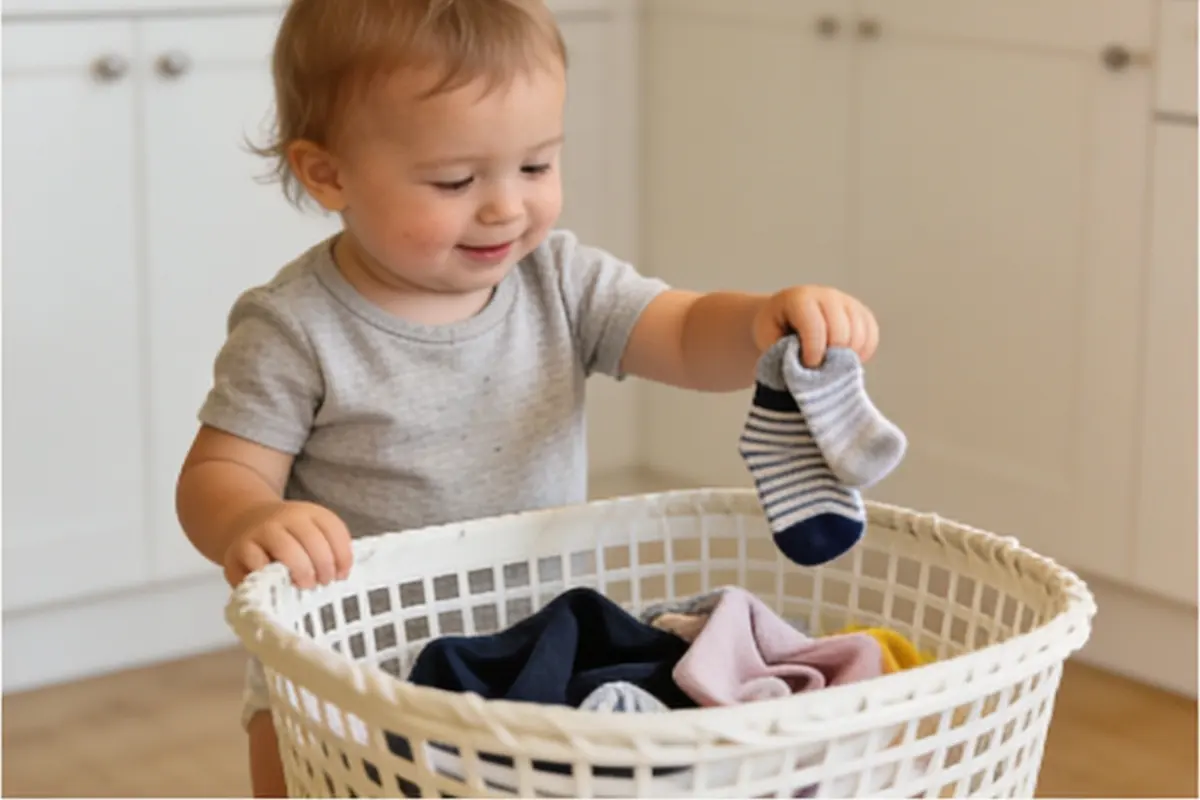
Laundry basket helper
Emerging evidence- Time
- 5 minutes, during your own laundry
- Builds
- Belonging, following directions, sorting
- Ask your toddler to drop socks into the basket, or pull clean clothes out of the dryer.
- Name things as they go: "Your sock. Daddy's shirt."
- Say thank you, and let them push the basket to its spot.
Make it work: Keep laundry packets locked away and out of sight, and consider traditional detergent while young children live in or visit your home (AAP).
Evidence: Emerging. Toddlers help spontaneously in lab and home studies (Warneken & Tomasello, 2006; Dahl, 2015), and copying chores is an 18-month milestone (CDC); whether chores now shape later behavior hasn't been tested.
Clean-up song
Emerging evidence- Time
- 2 to 5 minutes, before meals or bed
- Builds
- Routines, helping, following directions
- Sing the same short song every time it's time to tidy.
- Hand your toddler one toy at a time to drop into a bin.
- Clean up with them, and finish with a cheer.
Evidence: Emerging. CDC suggests a short clean-up song so your child helps tidy up (CDC); it hasn't been tested on its own.
Feed the teddy
Mixed evidence- Time
- 5 to 10 minutes
- Builds
- Pretend play, words, caring for others
- Set out a stuffed animal, a cup, a spoon, and a blanket.
- Pretend to feed the teddy and say, "Mmm. Teddy's hungry."
- Hand your toddler the spoon and take turns; tuck teddy in for a nap.
Evidence: Mixed. CDC suggests pretend play like feeding a stuffed animal with a spoon (CDC), but a major review found little proof that pretend play itself causes gains in language, thinking, or social skills (Lillard et al., 2013).
Name the feeling
Emerging evidence- Time
- A moment, whenever feelings run high
- Builds
- Emotion words, calming down
- When your toddler is upset or excited, name it simply: "You're sad. The ball rolled away."
- Point out feelings in books and in other people: "She's crying. She's sad."
Make it work: Naming a feeling doesn't mean giving in. "You're mad, and it's still time to go."
Evidence: Emerging. CDC suggests naming the feelings you think your child has (CDC); this activity hasn't been studied on its own.
Hide-and-find
Emerging evidence- Time
- 5 minutes
- Builds
- Memory, problem-solving, object permanence
- Hide a toy under a blanket while your toddler watches, and ask, "Where did it go?"
- Once that's easy, hide it under one of two cups.
- Later, hide yourself behind a door and call their name.
Evidence: Emerging. Finding a toy they saw you hide is a 12-month milestone (CDC), and CDC suggests simple hide-and-seek games (CDC).
Bubble turn-taking
Emerging evidence- Time
- 5 minutes
- Builds
- Turn-taking, words like "pop" and "more," hand-eye coordination
- Blow some bubbles and say "Pop!" as your toddler pops them.
- Stop and wait for your toddler to ask for "more," by word, sign, or point.
- Blow again right away to reward the request.
Evidence: Emerging. CDC suggests blowing bubbles for your toddler to pop while you name the action (CDC; CDC); turn-taking games like this haven't been studied on their own.
Outdoor explore walk
Moderate evidence- Time
- 20 minutes or more, every day if you can
- Builds
- Movement, words, curiosity
- Let your toddler walk part of the way instead of riding.
- Stop for whatever they point at, and name it.
- Collect a leaf or a stone to talk about at home.
Make it work: Hold hands near streets and driveways, and stay within arm's reach near any water (AAP).
Evidence: Moderate. WHO recommends at least 180 minutes of active play a day and not keeping 1- and 2-year-olds strapped in for more than an hour at a time (WHO); CDC suggests outdoor play and walks (CDC).
Common questions#
When should my baby start walking?
Most babies take a few steps on their own by 15 months and walk without holding on by 18 months (CDC; CDC). The normal range is wide: in a WHO study of 816 children in five countries, nearly all healthy children started walking alone between 8.2 and 17.6 months (WHO Multicentre Growth Reference Study Group, 2006). If your child isn't walking by 18 months or has lost skills, talk with your pediatrician (CDC). If your child was born early, use corrected age (AAP).
How many words should my toddler say by 18 months and by 2?
By 18 months, most toddlers try to say three or more words besides "mama" or "dada" (CDC), and by 2 most put two words together (CDC). The AAP says most 2-year-olds say about 50 to 100 words and are understood by others about half the time (AAP). For bilingual toddlers, count words in all their languages (AAP). If you're worried, ask now about a hearing test and an evaluation. The AAP says the sooner the better, and early intervention can make a significant difference (AAP).
How much milk should my 1-year-old drink?
From 12 months to 2 years, the AAP recommends 2 to 3 cups (16 to 24 ounces) of plain whole milk a day (AAP). Keep it to no more than 24 ounces, because milk is low in iron and fills toddlers up so they eat fewer iron-rich foods (AAP). Signs of a "milk habit" worth easing include drinking a quart (32 ounces) a day, skipping meals, or asking for milk at night; serve milk with meals and water in between (Schmitt, AAP). Breastfeeding can continue alongside (USDA & HHS, 2026).
When should my toddler stop using a bottle?
The AAP suggests finishing the switch from bottle to cup sometime between 12 and 18 months (Shu, AAP). Bottles that last longer are linked to filling up on milk, extra weight, and cavities. Drop the nap and bedtime bottles first, offer milk in a cup at meals, and replace the bedtime bottle with extra snuggles, songs, or a story (Shu, AAP). No bottles in bed: milk sugars linger on teeth and cause decay (AAP).
Is it normal for my toddler to be a picky eater?
Yes, picky eating is very common in the second year. In a national sample, caregivers described half of 2-year-olds as picky, and even picky eaters were meeting their energy needs (Carruth et al., 2004). Growth slows after the first birthday, so appetite drops (AAP). Keep offering refused foods alongside ones your toddler likes: daily tastes over 8 to 10 days or more help toddlers accept new foods (Spill et al., 2019). Don't force or pressure (AAP). If you're worried about growth, your pediatrician can check the growth chart with you.
How should I handle my toddler's tantrums?
Stay calm, keep your toddler safe, and wait it out, then reconnect. Tantrums are normal between ages 1 and 3 (Swanson, AAP). Head them off by protecting naps and meals (Swanson, AAP), offer small choices, and try distraction or a calm spot near you (CDC). Step in immediately for hitting, biting, or danger (Swanson, AAP). Talk with your pediatrician if tantrums are very long, destructive, or come out of nowhere (Wakschlag et al., 2012). See Riding out tantrums for scripts.
Is it okay to spank a toddler?
No, the AAP advises against spanking or hitting children of any age. It also warns against yelling and shaming, which it says don't work in the long run (Sege & Siegel, 2018). Spanking is linked to more behavior problems over time, not fewer (Heilmann et al., 2021), and physical punishment carries a higher injury risk in children under 18 months (AAP). The AAP recommends redirection, attention to good behavior, and brief time-outs instead. See Discipline that teaches.
When do toddlers go from two naps to one?
Most toddlers move to one afternoon nap sometime between 15 and 24 months (Weissbluth, 1995). Fewer than 2.5% of children stop napping altogether before age 2 (Staton et al., 2020). Aim for 11 to 14 hours of sleep in 24 hours, naps included, with regular sleep and wake times (WHO).
Can my 1-year-old watch TV or videos?
An occasional short, high-quality video won't hurt, but your toddler learns more from people than from screens (Strouse & Samson, 2021). The AAP's 2026 policy says infants don't learn from digital media, that occasional brief, high-quality videos aren't harmful, and, for families who want a limit, suggests under an hour a day for toddlers (Munzer et al., 2026). WHO recommends no sedentary screen time at age 1 (WHO), and CDC says to limit screens to video calls before age 2 (CDC). Video chats with family are fine. If you use screens, watch together and talk about it.
When is my toddler screened for autism, and what are the early signs?
The AAP recommends a standardized autism screening questionnaire at the 18- and 24-month checkups (Hyman et al., 2020). CDC lists signs such as not playing simple games like pat-a-cake or using few gestures by 12 months, not showing you things they like by 15 months, not pointing to show you something by 18 months, and not noticing when others are hurt or upset by 2 years (CDC). Losing words or skills at any age is a reason to call now (CDC). You can also ask your state's early intervention program for a free evaluation without a referral or diagnosis (CDC).
When can my toddler ride forward-facing in the car?
Not until your toddler outgrows the highest weight or height their seat allows for rear-facing. The AAP says to keep toddlers rear-facing as long as possible, and most convertible seats allow it until 2 or later (AAP). Bent legs are fine: children are flexible, and leg injuries in rear-facing seats are very rare. Never put a rear-facing seat in front of an active airbag (AAP).
What vaccines does my toddler get between 12 and 24 months?
The AAP recommends vaccines for measles, mumps, and rubella (MMR), chickenpox (varicella), and hepatitis A, starting around the first birthday, plus later doses of vaccines started in the first year, such as DTaP, Hib, pneumococcal, polio, and hepatitis B (Bracho-Sánchez, AAP). It also recommends a yearly flu shot and COVID-19 vaccination for children 6 to 23 months (Bracho-Sánchez, AAP). US guidance has been changing. The AAP and CDC schedules have differed in 2026 (AAP). In March 2026, a federal judge paused many of the federal changes to the CDC schedule, and the government has appealed (STAT, 2026). Ask your pediatrician which schedule they follow.
Safety and when to get help#
Injuries are the biggest threat
The AAP calls injuries the biggest threat to a toddler's life and health, and most can be prevented. Your toddler can walk, climb, and open things, but can't yet understand danger (AAP). Barriers and supervision do the work that "no" can't.
Water
More children ages 1 to 4 die from drowning than from any other cause (CDC). In one analysis, 69% of drownings in children 4 and under happened when they weren't expected to be in the water (AAP).
- Stay within arm's reach in the bath and near any water. Never leave your toddler with another child in charge (AAP, 2026).
- Fence pools, including big inflatable ones, on all 4 sides with a fence at least 4 feet high and a self-closing, self-latching gate (AAP).
- Empty buckets, wading pools, and coolers right after use, and keep bathroom doors closed (AAP).
- Swim lessons can start after the first birthday (AAP, 2026). In one case-control study, formal lessons were linked to an 88% lower drowning risk at ages 1 to 4, with wide uncertainty (Brenner et al., 2009). Lessons don't make a toddler water-safe (AAP).
- Learn CPR (AAP, 2026).
Car seats
Rear-facing until your toddler reaches the seat's rear-facing limit, every ride, with the harness snug, the chest clip at armpit level, and no bulky coat under the straps (AAP). The back seat is safest. Never leave your toddler alone in a car, and walk behind the car before backing out (AAP).
Medicines, cleaners, and batteries
- Keep medicines and household products out of sight and reach, in their original containers, with safety caps on (AAP).
- If your toddler swallows something poisonous, call Poison Help at 1-800-222-1222 right away, and don't make them vomit (AAP).
- Use traditional detergent instead of laundry packets while young children live in or visit your home (AAP).
- A coin battery from a remote, key fob, or toy can burn through the food pipe within 2 hours. Tape battery compartments shut. If your toddler might have swallowed one, call 911 or go to the ER. While you wait for care, a child over 12 months who can swallow can have 2 teaspoons of honey every 10 minutes, up to 6 doses, but don't delay care to find it (AAP).
Burns and scalds
Keep your toddler out of the kitchen while you cook, keep hot drinks out of reach, and never hold your toddler and a hot drink at the same time. Set your water heater so the hottest water at the tap is no more than 120°F. Put working smoke alarms on every level of your home. For a burn, put cold water on it for a few minutes, cover it loosely, and call your pediatrician (AAP).
Falls, windows, and tip-overs
- Stairs and windows: Use gates on stairs and window guards above the first floor (AAP). Window stops should keep windows from opening more than 4 inches, and screens won't stop a fall. About 5,600 children 12 and under were treated in emergency departments for window falls in 2024 (CPSC, 2026).
- Furniture and TVs: Anchor dressers, bookcases, and TVs to the wall. A child is treated in an emergency department for a tip-over injury about every 53 minutes, and more than half of reported tip-over deaths from 2013 to 2023 were children ages 1 to 3 (CPSC, 2024).
- Climbing: Move chairs away from counters and windows (AAP).
Choking
Balloons, balls, marbles, toy parts, and coins are common choking hazards. Hold off on nuts, popcorn, hard or sticky candy, gum, raw carrots, and chunks of meat or cheese until age 4 or later. Round, firm foods like hot dogs and grapes are okay only if chopped into tiny pieces (AAP). Balloons stay a hazard until age 8. A CPR and first aid class is worth taking (AAP).
Guns in the home
The safest home for a child has no guns. If you keep one, store it unloaded and locked, with ammunition locked separately, and ask about guns and storage in homes your toddler visits (AAP). In a case-control study, guns involved in youth suicide attempts and unintentional shootings were much less likely to have been stored locked or unloaded (Grossman et al., 2005).
Call 911 if your toddler
- Is struggling for each breath, can barely cry, has bluish lips, or has stopped breathing (AAP)
- Choked on something that could be stuck in their throat (AAP)
- Can't be woken up, or is not moving or too weak to stand (AAP)
- Has purple or blood-colored spots on the skin with a fever (AAP)
- After a head injury, has a seizure, was knocked out for more than a minute, or is confused or unsteady (AAP)
Go to the ER now if your toddler
- Might have swallowed a button battery or a magnet, or can't swallow, drools, or gags after swallowing something (AAP)
- Has ribs pulling in with each breath, or loud wheezing or harsh noisy breathing (AAP)
- Had a seizure with a fever, has a stiff neck, or is hard to wake or "out of it" (AAP)
- Vomited 2 or more times after a head injury, or cries nonstop after one (AAP)
Call your pediatrician right away if your toddler
- Has a fever over 104°F (40°C), or seems dehydrated: no urine in more than 8 hours, a very dry mouth, and no tears (AAP)
- Won't move an arm or leg normally, or cries when touched or moved (AAP)
- Has any burn (AAP), or had a serious fall or isn't acting normally after one (AAP)
- Looks or acts very sick, or you think they need to be seen urgently (AAP)
Call within a day for a fever that lasts more than 3 days, or more than 48 hours with no other symptoms in a child under 2 (AAP).
Don't wait on development worries
If your toddler isn't meeting milestones, has lost skills, or you're simply worried, talk with your pediatrician and ask about developmental screening (CDC). You can also call your state's early intervention program for a free evaluation. You don't need a referral or a diagnosis (CDC). Bring it up if your toddler:
- Isn't walking on their own by 18 months (CDC)
- Doesn't point to show you things, wave, or respond when you play simple games (CDC)
- Isn't trying to say three or more words by 18 months, or isn't putting two words together by 2 (CDC; CDC)
- Doesn't seem to hear you, or doesn't notice when you come into the room (AAP)
- Has tantrums that are very long, destructive, or come out of nowhere (Wakschlag et al., 2012)
- Has lost words or skills they used to have
The 12-, 15-, 18-, and 24-month checkups
The AAP recommends well visits at 12, 15, 18, and 24 months (AAP, 2025). Expect:
- 12 months: vaccines, an anemia check, and lead screening based on risk or local rules (AAP, 2025). Iron screening timing also depends on diet (AAP).
- 15 months: any vaccine doses that are due, plus fluoride varnish, which the AAP recommends every 6 months (every 3 if cavity risk is high) (AAP).
- 18 months: a developmental screen and an autism screen, both questionnaires you fill out (AAP).
- 24 months: a second autism screen and lead screening based on risk or local rules (AAP, 2025).
For vaccines, see What vaccines does my toddler get between 12 and 24 months? above. Bring your questions in writing.
Sources#
- Centers for Disease Control and Prevention. "Milestones by 1 Year." Learn the Signs. Act Early. program, updated 2026. https://www.cdc.gov/act-early/milestones/1-year.html
- Centers for Disease Control and Prevention. "Milestones by 15 Months." Learn the Signs. Act Early. program, updated 2026. https://www.cdc.gov/act-early/milestones/15-months.html
- Centers for Disease Control and Prevention. "Milestones by 18 Months." Learn the Signs. Act Early. program, updated 2026. https://www.cdc.gov/act-early/milestones/18-months.html
- Centers for Disease Control and Prevention. "Milestones by 2 Years." Learn the Signs. Act Early. program, updated 2026. https://www.cdc.gov/act-early/milestones/2-years.html
- Centers for Disease Control and Prevention. "Concerned About Your Child's Development?" 2026. https://www.cdc.gov/act-early/families/concerned.html
- Centers for Disease Control and Prevention. "Signs and Symptoms of Autism Spectrum Disorder." 2024. https://www.cdc.gov/autism/signs-symptoms/index.html
- Centers for Disease Control and Prevention. "Drowning Facts." 2026. https://www.cdc.gov/drowning/data-research/facts/index.html
- American Academy of Pediatrics. "Corrected Age For Preemies." HealthyChildren.org, updated 2018. https://www.healthychildren.org/English/ages-stages/baby/preemie/Pages/Corrected-Age-For-Preemies.aspx
- American Academy of Pediatrics. "Hand and Finger Skills: 1 Year Olds." HealthyChildren.org, updated 2009. https://www.healthychildren.org/English/ages-stages/toddler/Pages/Hand-and-Finger-Skills-1-Year-Olds.aspx
- American Academy of Pediatrics. "Language Development: 1 Year Olds." HealthyChildren.org, updated 2009. https://www.healthychildren.org/English/ages-stages/toddler/Pages/Language-Development-1-Year-Olds.aspx
- American Academy of Pediatrics. "Language Delays in Toddlers: Information for Parents." HealthyChildren.org, updated 2021. https://www.healthychildren.org/English/ages-stages/toddler/Pages/Language-Delay.aspx
- American Academy of Pediatrics. "Young Children Learning Multiple Languages: Parent FAQs." HealthyChildren.org, updated 2025. https://www.healthychildren.org/English/ages-stages/gradeschool/school/Pages/7-Myths-Facts-Bilingual-Children-Learning-Language.aspx
- American Academy of Pediatrics. "Emotional Development: 1 Year Olds." HealthyChildren.org, updated 2009. https://www.healthychildren.org/English/ages-stages/toddler/Pages/Emotional-Development-1-Year-Olds.aspx
- American Academy of Pediatrics. "Social Development: 1 Year Olds." HealthyChildren.org, updated 2009. https://www.healthychildren.org/English/ages-stages/toddler/Pages/Social-Development-1-Year-Olds.aspx
- Swanson WS. "How to Ease Your Child's Separation Anxiety." HealthyChildren.org, updated 2026. https://www.healthychildren.org/English/ages-stages/toddler/Pages/Soothing-Your-Childs-Separation-Anxiety.aspx
- Swanson WS. "Top Tips for Surviving Tantrums." HealthyChildren.org, updated 2021. https://www.healthychildren.org/English/family-life/family-dynamics/communication-discipline/Pages/Temper-Tantrums.aspx
- American Academy of Pediatrics. "What's the Best Way to Discipline My Child?" HealthyChildren.org, updated 2018. https://www.healthychildren.org/English/family-life/family-dynamics/communication-discipline/Pages/Disciplining-Your-Child.aspx
- American Academy of Pediatrics. "How to Give a Time-Out." HealthyChildren.org, updated 2018. https://www.healthychildren.org/English/family-life/family-dynamics/communication-discipline/Pages/Time-Outs-101.aspx
- American Academy of Pediatrics. "10 Tips to Prevent Aggressive Behavior in Young Children." HealthyChildren.org, updated 2023. https://www.healthychildren.org/English/ages-stages/toddler/Pages/Aggressive-Behavior.aspx
- American Academy of Pediatrics. "Your Child's Growth & Physical Development: 1 Year Old." HealthyChildren.org, updated 2026. https://www.healthychildren.org/English/ages-stages/toddler/Pages/Physical-Appearance-and-Growth-Your-1-Year-Old.aspx
- American Academy of Pediatrics Section on Obesity. "Feeding & Nutrition Tips: Your 1-Year-Old." HealthyChildren.org, updated 2020. https://www.healthychildren.org/English/ages-stages/toddler/nutrition/Pages/feeding-and-nutrition-your-one-year-old.aspx
- American Academy of Pediatrics Institute for Healthy Childhood Weight. "Healthy Beverage Quick Reference Guide." 2021. https://downloads.aap.org/AAP/PDF/HealthyBeverageQuickReferenceGuideDownload.pdf
- Schmitt B. "Your Toddler Only Wants Milk? How to Ease a Milk Dependency Habit." HealthyChildren.org, updated 2025. https://www.healthychildren.org/English/ages-stages/toddler/nutrition/Pages/your-toddler-only-wants-milk-how-to-ease-milk-dependency-and-encourage-a-healthy-diet.aspx
- Shu J. "From Bottle to Cup: Helping Your Child Make a Healthy Transition." HealthyChildren.org, updated 2023. https://www.healthychildren.org/English/ages-stages/baby/feeding-nutrition/Pages/Discontinuing-the-Bottle.aspx
- American Academy of Pediatrics. "Iron Deficiency and Anemia in Babies, Children & Teens." HealthyChildren.org, updated 2026. https://www.healthychildren.org/English/health-issues/conditions/chronic/Pages/Anemia-and-Your-Child.aspx
- American Academy of Pediatrics. "Why It's Important to Take Care of Baby Teeth." HealthyChildren.org, updated 2026. https://www.healthychildren.org/English/ages-stages/baby/teething-tooth-care/Pages/How-to-Prevent-Tooth-Decay-in-Your-Baby.aspx
- Krol D, Whelan K. "Good Oral Health Starts Early: AAP Policy Explained." HealthyChildren.org, updated 2026. https://www.healthychildren.org/English/healthy-living/oral-health/Pages/Brushing-Up-on-Oral-Health-Never-Too-Early-to-Start.aspx
- Bradin S. "Choking Prevention for Babies & Children: What Every Parent Needs to Know." HealthyChildren.org, updated 2026. https://www.healthychildren.org/English/health-issues/injuries-emergencies/Pages/Choking-Prevention.aspx
- American Academy of Pediatrics. "Shoes for Active Toddlers." HealthyChildren.org, accessed 2026. https://www.healthychildren.org/English/ages-stages/toddler/Pages/Shoes-for-Active-Toddlers.aspx
- American Academy of Pediatrics. "Make Baby's Room Safe: Parent Checklist." HealthyChildren.org, updated 2020. https://www.healthychildren.org/English/safety-prevention/at-home/Pages/Make-Babys-Room-Safe.aspx
- Moon RY. "Big Kid Beds: When to Switch From a Crib." HealthyChildren.org, updated 2022. https://www.healthychildren.org/English/healthy-living/sleep/Pages/Big-Kid-Beds-When-To-Make-the-Switch.aspx
- American Academy of Pediatrics. "A Child-Friendly Digital World: AAP Releases New Media Recommendations." HealthyChildren.org, 2026. https://www.healthychildren.org/English/news/Pages/creating-a-child-friendly-digital-world-AAP-releases-new-media-recommendations.aspx
- Munzer T. "Helping Kids Thrive in a Digital World: AAP Policy Explained." HealthyChildren.org, updated 2026. https://www.healthychildren.org/English/family-life/Media/Pages/helping-kids-thrive-in-a-digital-world-AAP-policy-explained.aspx
- American Academy of Pediatrics. "Safety for Your Child: 1 to 2 Years." HealthyChildren.org, updated 2022. https://www.healthychildren.org/English/ages-stages/toddler/Pages/safety-for-your-child-1-to-2-years.aspx
- American Academy of Pediatrics. "Drowning Prevention for Curious Toddlers: What Parents Need to Know." HealthyChildren.org, updated 2026. https://www.healthychildren.org/English/safety-prevention/at-play/Pages/Water-Safety-And-Young-Children.aspx
- American Academy of Pediatrics. "AAP Releases Updated Drowning Prevention Recommendations." HealthyChildren.org, 2026. https://www.healthychildren.org/English/news/Pages/AAP-releases-updated-drowning-prevention-recommendations.aspx
- American Academy of Pediatrics. "Car Seats: Information for Families." HealthyChildren.org, updated 2026. https://www.healthychildren.org/English/safety-prevention/on-the-go/Pages/Car-Safety-Seats-Information-for-Families.aspx
- American Academy of Pediatrics. "Laundry Room and Detergent Safety." HealthyChildren.org, updated 2024. https://www.healthychildren.org/English/safety-prevention/at-home/Pages/Laundry-Room-and-Detergent-Safety.aspx
- American Academy of Pediatrics. "What Parents Need to Know about Button Batteries and Lithium Coin Batteries." HealthyChildren.org, updated 2024. https://www.healthychildren.org/English/safety-prevention/at-home/Pages/what-parents-need-to-know-about-button-and-lithium-coin-batteries.aspx
- American Academy of Pediatrics. "Fever" (symptom checker). HealthyChildren.org, accessed 2026. https://www.healthychildren.org/English/tips-tools/symptom-checker/Pages/symptomviewer.aspx?symptom=Fever
- American Academy of Pediatrics. "Breathing Trouble" (symptom checker). HealthyChildren.org, accessed 2026. https://www.healthychildren.org/English/tips-tools/symptom-checker/Pages/symptomviewer.aspx?symptom=Breathing+Trouble
- American Academy of Pediatrics. "Head Injury" (symptom checker). HealthyChildren.org, accessed 2026. https://www.healthychildren.org/English/tips-tools/symptom-checker/Pages/symptomviewer.aspx?symptom=Head+Injury
- American Academy of Pediatrics. "Swallowed Foreign Object" (symptom checker). HealthyChildren.org, accessed 2026. https://www.healthychildren.org/English/tips-tools/symptom-checker/Pages/symptomviewer.aspx?symptom=Swallowed+Foreign+Object
- Bracho-Sánchez E. "AAP Guide: Vaccines Your Child Needs by Age 6." HealthyChildren.org, updated 2026. https://www.healthychildren.org/English/safety-prevention/immunizations/Pages/Your-Babys-First-Vaccines.aspx
- American Academy of Pediatrics. "AAP Releases Recommended Childhood and Adolescent Immunization Schedule for 2026." HealthyChildren.org, 2026. https://www.healthychildren.org/English/news/Pages/AAPs-recommended-childhood-and-adolescent-immunization-schedule-for-2026.aspx
- American Academy of Pediatrics. "Your Checkup Checklist: 18 Months Old." HealthyChildren.org, updated 2022. https://www.healthychildren.org/English/ages-stages/Your-Childs-Checkups/Pages/Your-Checkup-Checklist-18-Months-Old.aspx
- American Academy of Pediatrics and Bright Futures. "Recommendations for Preventive Pediatric Health Care" (Periodicity Schedule). 2025. https://downloads.aap.org/AAP/PDF/periodicity_schedule.pdf
- US Department of Agriculture and US Department of Health and Human Services. "Dietary Guidelines for Americans, 2025–2030." 2026. https://cdn.realfood.gov/DGA.pdf
- World Health Organization. "To grow up healthy, children need to sit less and play more." 2019. https://www.who.int/news/item/24-04-2019-to-grow-up-healthy-children-need-to-sit-less-and-play-more
- US Consumer Product Safety Commission. "CPSC Urges Families to Protect Children During National Window Safety Week." 2026. https://www.cpsc.gov/Newsroom/News-Releases/2026/CPSC-Urges-Families-to-Protect-Children-During-National-Window-Safety-Week
- US Consumer Product Safety Commission. "Ahead of Sunday's Game, CPSC Reminds Families to Tackle the Deadly Hazard of TV and Furniture Tip-Overs." 2024. https://www.cpsc.gov/Newsroom/News-Releases/2024/Ahead-of-Sundays-Game-CPSC-Reminds-Families-to-Tackle-the-Deadly-Hazard-of-TV-and-Furniture-Tip-Overs
- American Speech-Language-Hearing Association. "ASHA Comments on CDC and AAP Developmental Milestones Updates." Accessed 2026. https://www.asha.org/practice/asha-comments-on-aap-and-cdc-developmental-milestones-updates
- Center on the Developing Child at Harvard University. "Serve and Return." Accessed 2026. https://developingchild.harvard.edu/key-concept/serve-and-return/
- Max Planck Society. "Baby's helping hands." Press release, 2006. https://www.mpg.de/532681/pressRelease20060302
- STAT. "HHS appeals ruling that stalled many of Kennedy's vaccine policy changes." 2026. https://www.statnews.com/2026/04/29/hhs-appealing-acip-vaccine-policy-lawsuit-ruling/
- Zubler JM, Wiggins LD, Macias MM, et al. "Evidence-Informed Milestones for Developmental Surveillance Tools." Pediatrics, 2022. https://pubmed.ncbi.nlm.nih.gov/35132439/
- WHO Multicentre Growth Reference Study Group. "WHO Motor Development Study: windows of achievement for six gross motor development milestones." Acta Paediatrica Supplement, 2006. https://pubmed.ncbi.nlm.nih.gov/16817682/
- Adolph KE, Cole WG, Komati M, et al. "How do you learn to walk? Thousands of steps and dozens of falls per day." Psychological Science, 2012. https://pubmed.ncbi.nlm.nih.gov/23085640/
- Warneken F, Tomasello M. "Altruistic helping in human infants and young chimpanzees." Science, 2006. https://pubmed.ncbi.nlm.nih.gov/16513986/
- Warneken F, Tomasello M. "Helping and Cooperation at 14 Months of Age." Infancy, 2007. https://pubmed.ncbi.nlm.nih.gov/33412734/
- Warneken F, Tomasello M. "Extrinsic rewards undermine altruistic tendencies in 20-month-olds." Developmental Psychology, 2008. https://pubmed.ncbi.nlm.nih.gov/18999339/
- Dahl A. "The Developing Social Context of Infant Helping in Two U.S. Samples." Child Development, 2015. https://pubmed.ncbi.nlm.nih.gov/25800068/
- Hammond SI, Brownell CA. "Happily Unhelpful: Infants' Everyday Helping and its Connections to Early Prosocial Development." Frontiers in Psychology, 2018. https://pubmed.ncbi.nlm.nih.gov/30298039/
- Coppens AD, Alcalá L. "Supporting Children's Initiative: Appreciating Family Contributions or Paying Children for Chores." Advances in Child Development and Behavior, 2015. https://pubmed.ncbi.nlm.nih.gov/26955924/
- Gunderson EA, Gripshover SJ, Romero C, et al. "Parent praise to 1- to 3-year-olds predicts children's motivational frameworks 5 years later." Child Development, 2013. https://pubmed.ncbi.nlm.nih.gov/23397904/
- Sisk VF, Burgoyne AP, Sun J, et al. "To What Extent and Under Which Circumstances Are Growth Mind-Sets Important to Academic Achievement? Two Meta-Analyses." Psychological Science, 2018. https://pubmed.ncbi.nlm.nih.gov/29505339/
- Sperry DE, Sperry LL, Miller PJ. "Reexamining the Verbal Environments of Children From Different Socioeconomic Backgrounds." Child Development, 2019. https://pubmed.ncbi.nlm.nih.gov/29707767/
- Golinkoff RM, Hoff E, Rowe ML, et al. "Language Matters: Denying the Existence of the 30-Million-Word Gap Has Serious Consequences." Child Development, 2019. https://pubmed.ncbi.nlm.nih.gov/30102419/
- Dailey S, Bergelson E. "Language input to infants of different socioeconomic statuses: A quantitative meta-analysis." Developmental Science, 2022. https://pubmed.ncbi.nlm.nih.gov/34806256/
- Gilkerson J, Richards JA, Warren SF, et al. "Language Experience in the Second Year of Life and Language Outcomes in Late Childhood." Pediatrics, 2018. https://pubmed.ncbi.nlm.nih.gov/30201624/
- Ramírez-Esparza N, García-Sierra A, Kuhl PK. "Look who's talking: speech style and social context in language input to infants are linked to concurrent and future speech development." Developmental Science, 2014. https://pubmed.ncbi.nlm.nih.gov/24702819/
- Dowdall N, Melendez-Torres GJ, Murray L, et al. "Shared Picture Book Reading Interventions for Child Language Development: A Systematic Review and Meta-Analysis." Child Development, 2020. https://pubmed.ncbi.nlm.nih.gov/30737957/
- Klass P, Miller-Fitzwater A, High PC; AAP Council on Early Childhood. "Literacy Promotion: An Essential Component of Primary Care Pediatric Practice: Policy Statement." Pediatrics, 2024. https://pubmed.ncbi.nlm.nih.gov/39342414/
- Sege RD, Siegel BS; AAP Council on Child Abuse and Neglect, Committee on Psychosocial Aspects of Child and Family Health. "Effective Discipline to Raise Healthy Children." Pediatrics, 2018. https://pubmed.ncbi.nlm.nih.gov/30397164/
- Gershoff ET, Grogan-Kaylor A. "Spanking and child outcomes: Old controversies and new meta-analyses." Journal of Family Psychology, 2016. https://pubmed.ncbi.nlm.nih.gov/27055181/
- Heilmann A, Mehay A, Watt RG, et al. "Physical punishment and child outcomes: a narrative review of prospective studies." Lancet, 2021. https://pubmed.ncbi.nlm.nih.gov/34197808/
- Ferguson CJ. "Spanking, corporal punishment and negative long-term outcomes: a meta-analytic review of longitudinal studies." Clinical Psychology Review, 2013. https://pubmed.ncbi.nlm.nih.gov/23274727/
- Knight RM, Albright J, Deling L, et al. "Longitudinal Relationship Between Time-Out and Child Emotional and Behavioral Functioning." Journal of Developmental & Behavioral Pediatrics, 2020. https://pubmed.ncbi.nlm.nih.gov/31513092/
- Wakschlag LS, Choi SW, Carter AS, et al. "Defining the developmental parameters of temper loss in early childhood: implications for developmental psychopathology." Journal of Child Psychology and Psychiatry, 2012. https://pubmed.ncbi.nlm.nih.gov/22928674/
- Hyman SL, Levy SE, Myers SM; AAP Council on Children with Disabilities, Section on Developmental and Behavioral Pediatrics. "Identification, Evaluation, and Management of Children With Autism Spectrum Disorder." Pediatrics, 2020. https://pubmed.ncbi.nlm.nih.gov/31843864/
- Robins DL, Casagrande K, Barton M, et al. "Validation of the modified checklist for Autism in toddlers, revised with follow-up (M-CHAT-R/F)." Pediatrics, 2014. https://pubmed.ncbi.nlm.nih.gov/24366990/
- Wieckowski AT, Williams LN, Rando J, et al. "Sensitivity and Specificity of the Modified Checklist for Autism in Toddlers (Original and Revised): A Systematic Review and Meta-analysis." JAMA Pediatrics, 2023. https://pubmed.ncbi.nlm.nih.gov/36804771/
- Siu AL; US Preventive Services Task Force. "Screening for Autism Spectrum Disorder in Young Children: US Preventive Services Task Force Recommendation Statement." JAMA, 2016. https://pubmed.ncbi.nlm.nih.gov/26881372/
- Sandbank M, Bottema-Beutel K, Crowley LaPoint S, et al. "Autism intervention meta-analysis of early childhood studies (Project AIM): updated systematic review and secondary analysis." BMJ, 2023. https://pubmed.ncbi.nlm.nih.gov/37963634/
- Strouse GA, Samson JE. "Learning From Video: A Meta-Analysis of the Video Deficit in Children Ages 0 to 6 Years." Child Development, 2021. https://pubmed.ncbi.nlm.nih.gov/33491209/
- Myers LJ, LeWitt RB, Gallo RE, Maselli NM. "Baby FaceTime: can toddlers learn from online video chat?" Developmental Science, 2017. https://pubmed.ncbi.nlm.nih.gov/27417537/
- Madigan S, Browne D, Racine N, et al. "Association Between Screen Time and Children's Performance on a Developmental Screening Test." JAMA Pediatrics, 2019. https://pubmed.ncbi.nlm.nih.gov/30688984/
- Munzer T, Parga-Belinkie J, Milkovich LM, et al.; AAP Council on Communications and Media. "Digital Ecosystems, Children, and Adolescents: Policy Statement." Pediatrics, 2026. https://pubmed.ncbi.nlm.nih.gov/41556917/
- Carruth BR, Ziegler PJ, Gordon A, Barr SI. "Prevalence of picky eaters among infants and toddlers and their caregivers' decisions about offering a new food." Journal of the American Dietetic Association, 2004. https://pubmed.ncbi.nlm.nih.gov/14702019/
- Spill MK, Johns K, Callahan EH, et al. "Repeated exposure to food and food acceptability in infants and toddlers: a systematic review." American Journal of Clinical Nutrition, 2019. https://pubmed.ncbi.nlm.nih.gov/30982874/
- Weissbluth M. "Naps in children: 6 months-7 years." Sleep, 1995. https://pubmed.ncbi.nlm.nih.gov/7792496/
- Staton S, Rankin PS, Harding M, et al. "Many naps, one nap, none: A systematic review and meta-analysis of napping patterns in children 0-12 years." Sleep Medicine Reviews, 2020. https://pubmed.ncbi.nlm.nih.gov/31862445/
- Mindell JA, Telofski LS, Wiegand B, Kurtz ES. "A nightly bedtime routine: impact on sleep in young children and maternal mood." Sleep, 2009. https://pubmed.ncbi.nlm.nih.gov/19480226/
- Lillard AS, Lerner MD, Hopkins EJ, et al. "The impact of pretend play on children's development: a review of the evidence." Psychological Bulletin, 2013. https://pubmed.ncbi.nlm.nih.gov/22905949/
- Brenner RA, Taneja GS, Haynie DL, et al. "Association between swimming lessons and drowning in childhood: a case-control study." Archives of Pediatrics & Adolescent Medicine, 2009. https://pubmed.ncbi.nlm.nih.gov/19255386/
- Grossman DC, Mueller BA, Riedy C, et al. "Gun storage practices and risk of youth suicide and unintentional firearm injuries." JAMA, 2005. https://pubmed.ncbi.nlm.nih.gov/15701912/
This guide is general education that summarizes published research and guidance from groups like the American Academy of Pediatrics, the CDC, and the WHO. It isn’t medical advice, and every child develops on their own timeline. Your pediatrician knows your child; if something feels wrong, call them. In an emergency, call 911.
Raising capable kids with Chorevia
When your kids are ready for responsibility, Chorevia turns chores into a family economy, with points, proof, a reward ladder you design, and monthly costs kids work off. Adults always make the call. Free for families.
Create your household