The first year · 7 months to 1 year
7 to 12 Months: Development, Research, and What Helps
Last reviewed · 17 min read · 14 activities · 12 common questions · 73 sources · Plain-text version
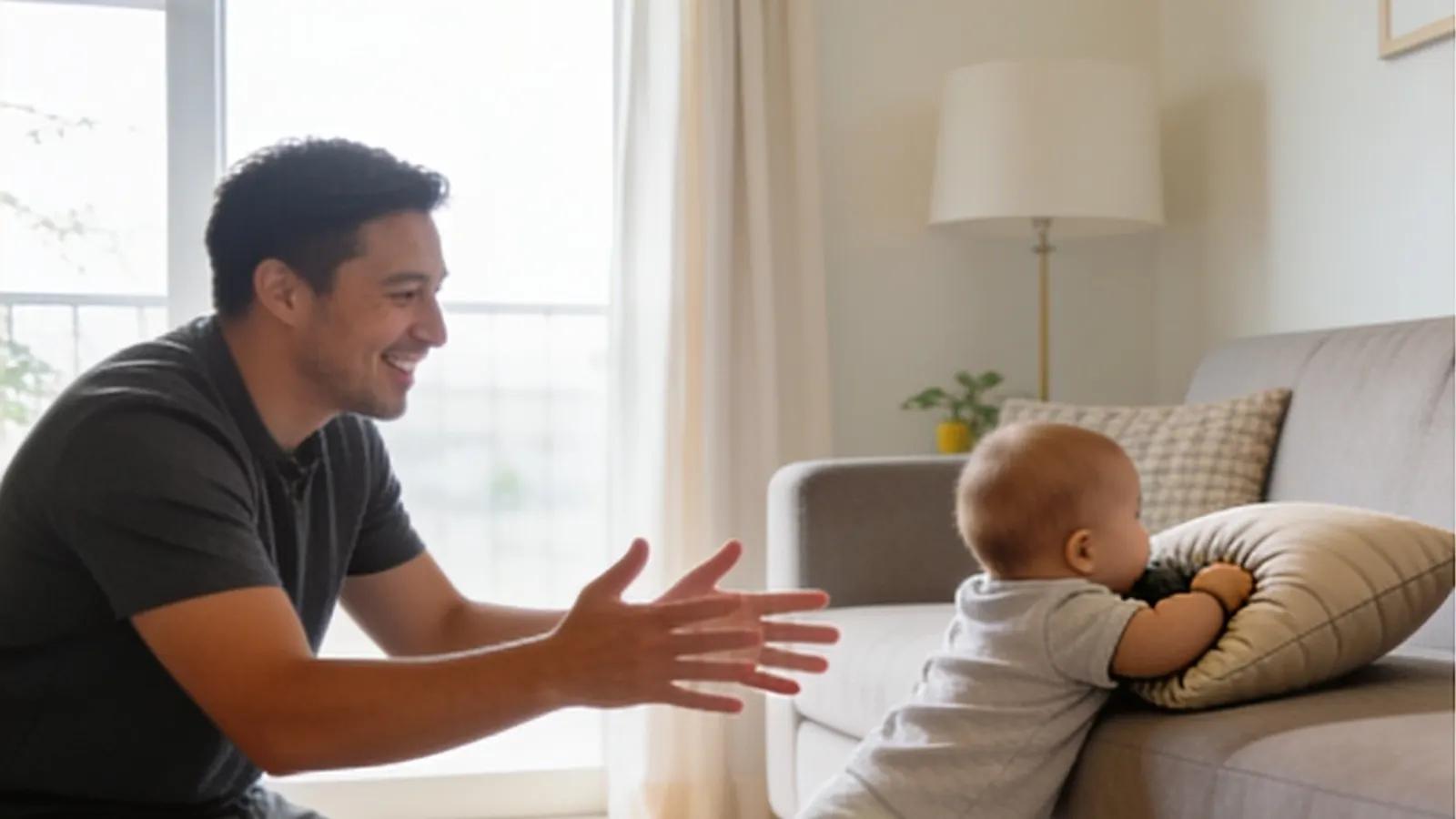
The second half of the first year turns a sitting baby into a mover, a pointer, and maybe a walker. Here's what's developing, what the research says about crawling, babble, and new foods, and how to keep a mobile baby safe.
At a glance
- Babies get moving in different ways. Some crawl, some scoot, some skip crawling, and that's fine. Pulling to stand and cruising along furniture by 12 months are the milestones to watch.
- First steps can come anywhere from about 8 to 18 months. Floor time helps; baby walkers don't, and they send thousands of children to hospitals.
- Babble, gestures, and pointing come before words. Answer your baby's sounds right away and name what they point at.
- Fear of strangers and tears at goodbyes are normal milestones. Keep goodbyes short, cheerful, and the same each time.
- Offer soft finger foods at family meals and keep offering foods your baby refuses. It can take 8 to 10 tastes.
- Offer a cup at meals now, switch to whole milk at 12 months, and finish moving off the bottle by 12 to 18 months.
- Discipline at this age means childproofing and redirecting. Spanking doesn't work and can injure a baby.
- A mobile baby needs a safer home: anchored furniture, stair gates, locked-up medicines and batteries, and no unsupervised water.
Your 7-to-12-month checklist
0 of 12 done
In these months your baby goes from sitting to crawling, pulling up, and maybe walking, and from babble to pointing and a first word or two. This guide covers 7 months to the first birthday. For first foods, allergens, and gagging versus choking, see the 6-month guide. Walking, talking toddlers are in the 1-year guide.
What's developing#
CDC's milestone checklists list skills that at least 75% of babies show by each age, so a missed milestone is a reason to check in, not to wait and see (Zubler et al., 2022). Born early? Use your baby's corrected age for milestones during the first 2 years (AAP).
Milestones by 9 months
By 9 months, most babies (CDC):
- Social: are shy, clingy, or fearful around strangers; show several facial expressions, like happy, sad, angry, and surprised; look when you call their name; react when you leave by looking, reaching for you, or crying; and smile or laugh at peekaboo.
- Communication: make lots of different sounds like "mamamama" and "bababababa," and lift their arms to be picked up.
- Thinking: look for objects dropped out of sight and bang two things together.
- Movement: get to a sitting position on their own, sit without support, move things from one hand to the other, and "rake" food toward themselves with their fingers.
Milestones by 12 months
By 1 year, most babies (CDC):
- Social: play games with you, like pat-a-cake.
- Communication: wave "bye-bye," call a parent "mama," "dada," or another special name, and understand "no" (they pause briefly or stop when you say it).
- Thinking: put something in a container, like a block in a cup, and look for things they saw you hide.
- Movement: pull up to stand, walk while holding on to furniture, drink from a cup without a lid as you hold it, and pick up small bits of food between thumb and pointer finger.
Notice what isn't on these lists. Crawling isn't on any CDC checklist (Kretch et al., 2022), and taking a few steps alone and pointing to ask for things are 15-month milestones (CDC).
Crawling, cruising, and first steps
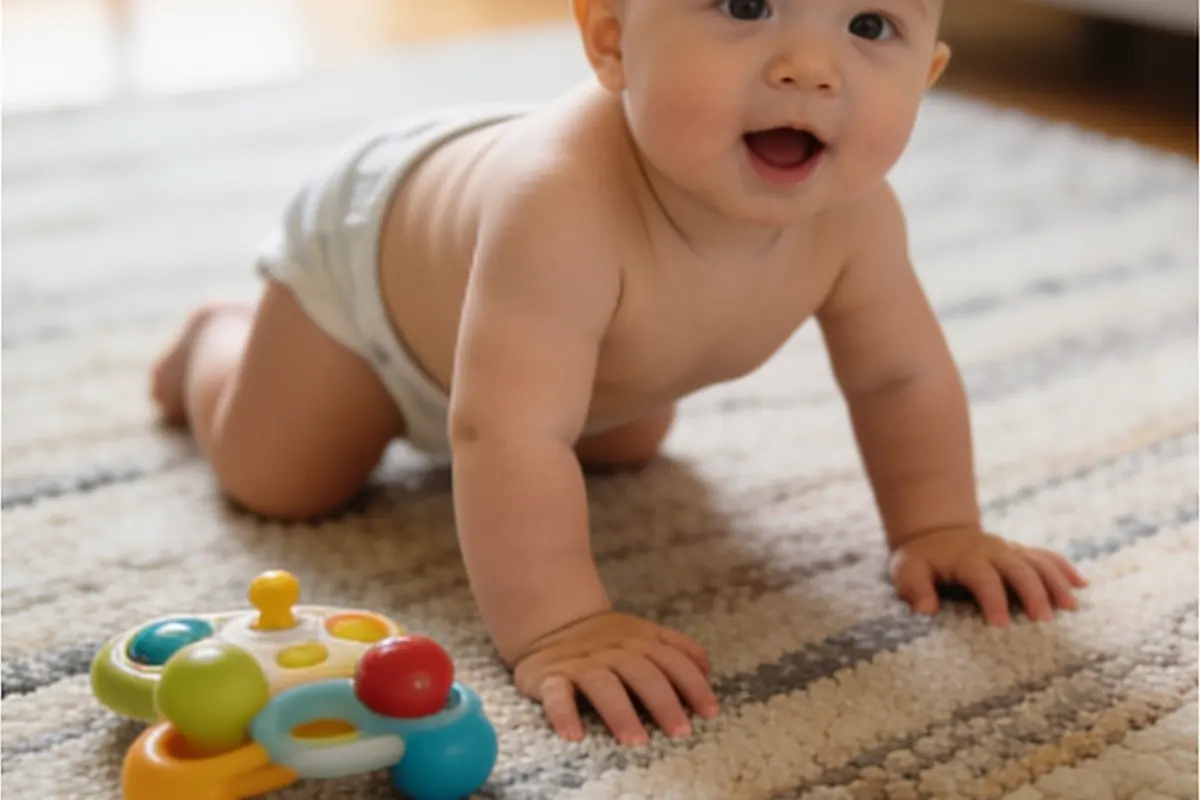
Crawling is usually mastered between 7 and 10 months, though a few babies scoot on their bottoms or slither instead. Next comes pulling up to stand (often before they know how to get back down), cruising sideways along furniture, and wobbly first steps, which many babies take around their first birthday (AAP).
From raking to pincer grasp
Early in this stage, your baby rakes things in with the whole hand. By the end, most pinch with thumb and finger and practice on anything small, from cereal to dust balls. Once they can let go on purpose, dropping and throwing become favorite games (AAP).
Babble, gestures, and first words
Coos turn into syllables like "ba," "da," and "ma," and babies understand more than they can say. To a baby, a "word" is any sound used the same way each time, so "mog" for milk counts (AAP).
Out of sight, not out of mind
By about 8 months, your baby will lift a scarf to find a hidden toy, and by 10 months they'll keep searching, because they now know objects exist out of sight. Dropping and banging are experiments in how things work. Everything still goes in the mouth, so check the floor often (AAP).
Stranger and separation anxiety
Wariness of strangers is often one of the first emotional milestones. It isn't caused by "spoiling"; your baby can now tell familiar from unfamiliar (AAP). Separation anxiety usually gets stronger around 9 months (Swanson, AAP) and peaks between 10 and 18 months, and new fears of the dark, thunder, or the vacuum are common too (AAP).
Sleep at 7 to 12 months
Babies 4 to 12 months need 12 to 16 hours of sleep a day, naps included (CDC; WHO), usually 9 to 12 hours at night plus two naps (Nemours KidsHealth). Separation anxiety can bring back night waking (AAP).
Eating and growth
At 9 months, the AAP suggests 3 meals and 2 to 3 snacks a day (AAP). Breast milk or formula is still the main drink, plus 4 to 8 ounces of water a day (Muth, AAP). Near 12 months, growth slows and appetite often levels off (AAP).
What the research says#
Some famous milestones rest on thinner research than you'd expect. Here's what holds up.
1. Motor milestones have wide, normal windows. The WHO followed 816 healthy children in Ghana, India, Norway, Oman, and the US. Hands-and-knees crawling started anywhere from 5.2 to 13.5 months, standing alone from 6.9 to 16.9 months, and walking alone from 8.2 to 17.6 months (1st to 99th percentiles). And 4.3% of children never crawled on hands and knees at all (WHO Multicentre Growth Reference Study Group, 2006). Takeaway: Compare your baby to the range, not to the baby down the street.
2. Crawling is common, but it doesn't look essential. CDC removed crawling from its checklists in 2022. A review for physical therapists found no good evidence that crawling itself is essential; the benefits linked to it seem to come from moving around independently in any form. The authors found only three studies comparing crawlers with non-crawlers, all of questionable quality, and said plainly that the question isn't settled. Many therapists disagree (Kretch et al., 2022). Takeaway: Scooting and slithering count. Mention it if your baby favors one side.
3. Walking is learned through huge amounts of practice. Filmed during free play, 12- to 19-month-olds averaged 2,368 steps and 17 falls per hour (Adolph et al., 2012). Baby walkers don't help; they can delay walking and cause injuries (AAP). Takeaway: Safe floor space beats any gadget.
4. Answering babble changes it. In a lab experiment, 9.5-month-olds whose mothers answered their babble right away quickly reshaped it using sounds from their mothers' speech; babies answered at random times didn't (Goldstein & Schwade, 2008). In a randomized trial of 71 families, coaching parents at 6, 10, and 14 months increased parentese and back-and-forth turns (Ferjan Ramírez et al., 2020), and in a follow-up of 59 children, the coached group had larger vocabularies through 30 months (Huber et al., 2023). The trial and its follow-up are small and come from one lab group. Takeaway: Talk with your baby: answer, then pause.
5. Pointing and shared attention come before words. In 24 babies followed monthly from 9 to 15 months, time spent sharing attention with their mothers, and mothers' talk about what the baby was already looking at, predicted the earliest gestures and words (Carpenter et al., 1998). In a study of 10 toddlers, many things children first pointed at later became words (Iverson & Goldin-Meadow, 2005). These studies show links, not cause. Takeaway: When your baby points, name what they're showing you.
6. Liking a new food takes repeated tastes. A systematic review of 21 studies, mostly controlled trials, found moderate evidence that tasting a vegetable or fruit daily for 8 to 10 or more days makes babies and toddlers more willing to eat it (Spill et al., 2019). Takeaway: A refusal usually means "not yet."
7. Stranger fear usually rises, but babies differ. In 1,285 twins followed from 6 to 36 months, the most common patterns started with little fear at 6 months that rose over time. Children whose fear was high and steady from the start, or rose sharply, were more inhibited at age 3 (Brooker et al., 2013). Takeaway: Some wariness is expected. Very intense fear is worth mentioning at checkups.
8. Spanking doesn't teach, and it can hurt babies. Meta-analyses covering 160,927 children found spanking linked to worse results on 13 of 17 outcomes, and to better results on none (Gershoff & Grogan-Kaylor, 2016). The research is mostly observational, but the AAP concludes that physical punishment works poorly in the short term and not at all in the long term (Sege & Siegel, 2018), and that hitting babies under 18 months raises the risk of injury (AAP). Takeaway: Move the baby or the object, and save "no" for danger.
Parenting techniques#
Make a yes space
Put tempting and dangerous things out of reach so you need "no" less often (AAP). Stock a low cabinet with wooden spoons, pots, and plastic containers; at this age, ordinary household objects are the most fascinating toys (AAP).
Redirect instead of punishing
The AAP's advice for babies is simple: model what you want, use positive words ("Time to sit" instead of "Don't stand"), save "no" for safety, and swap a forbidden object for one that's okay. Get every caregiver to agree on the same few rules (AAP).
Script: "Phones aren't for chewing. Here's your cup to bang." (Hand it over, then move the phone.)
If you feel yourself losing control, put your baby somewhere safe and take a few minutes to breathe (AAP). Tantrums and toddler limits are in the 1-year guide.
Ease goodbyes and new faces
- Never sneak away. Say a quick, cheerful goodbye, even if your baby cries (CDC). Use the same short ritual every time, and come back when you said you would (Swanson, AAP).
- Time it well. Separations are harder when babies are tired, hungry, or sick. Tears usually stop within minutes of your leaving (AAP).
- Starting child care? If you can, avoid starting during this stage or ease in slowly, and take a little extra time at drop-off (AAP).
- Ask visitors to go slowly. Even favorite relatives can make a baby cry if they swoop in fast (AAP).
Script: "Bye-bye! I'm going to work. I'll be back after your nap." (Kiss, wave, go.)
Follow the point, then talk
When your baby points, answer with words (CDC). Repeat their sounds, add simple words, and describe what they see (CDC). Keep names consistent ("cat" today, not "kitty" tomorrow), ask questions, and wait for an answer (AAP).
Script: (Baby points at a dog.) "Dog! A big dog. The dog says woof." (Pause for your baby's turn.)
From purees to family food
- Thicken textures as your baby is ready, from smooth to mashed and lumpy, then finely chopped (CDC).
- Offer soft finger foods cut into small pieces once your baby sits up and brings things to their mouth (AAP). The 6-month guide covers foods to avoid and gagging versus choking.
- Eat together, and let your baby's fullness cues, not the plate, decide when the meal is over (AAP).
- Keep offering foods your baby refused before (CDC).
Cups in, bottles out
Offer a cup at meals now and finish moving off bottles between 12 and 18 months (Shu, AAP). At 12 months, most babies can switch from formula to whole milk (AAP). The common questions below cover how.
Naps, nights, and night feeds
- Keep a short bedtime routine, like a bath, then stories or songs, and put your baby down drowsy but awake (Nemours KidsHealth).
- Night waking from separation anxiety is normal. Reassure your baby quietly, then leave (Nemours KidsHealth).
- Night feeds and sleep training: see the common questions below, and the 6-month guide for what sleep-training trials found.
What to teach#
Your baby is ready to learn a handful of big ideas, all through play and daily routines:
- Things have names. Name what your baby sees, touches, and eats, the same way each time (AAP).
- Gestures talk. Wave bye-bye, shake your head for "no," and lift your arms to say "up" (CDC).
- "No" means stop. By 12 months, most babies pause when they hear it (CDC), so save it for things that matter.
- Things have uses. Hand over a cup, a spoon, or a hairbrush and be an enthusiastic audience when your baby copies you (AAP).
First helping games
It's too early for chores. But the urge to help is starting. In experiments, 12-month-olds pointed to show an adult where a lost object was, more often when the adult hadn't seen where it went (Liszkowski et al., 2008), and by 18 months, toddlers readily help adults reach their goals, with nothing in it for them (Warneken & Tomasello, 2006). Give that urge somewhere to go. Pass a toy back and forth (CDC), ask your baby to hand you a sock or drop a block in the bin, and say a warm thank-you. The 1-year guide picks up first family jobs from there, and our post on chores that raise independent kids takes the longer view.
Screens before age 1
The WHO doesn't recommend any screen time for babies under 1 (WHO). The AAP calls TV and apps a bad idea before 18 months, with video chats with faraway family as the exception, and warns that a TV on in the background cuts down how much parents talk (Hill, AAP). Babies this age learn best from real-world interactions (Munzer, AAP).
Activities to try#
Every activity here is for an awake baby with an adult close by. Check the floor for small objects first, stop when your baby loses interest, and pick the few that fit your day.
How we rate the evidence
- Strong evidence
- Randomized trials or systematic reviews show a consistent benefit.
- Moderate evidence
- Consistent observational research, or a major guideline (AAP, WHO) built on research.
- Emerging evidence
- Small or early studies. Plausible, not yet proven.
- Mixed evidence
- Studies disagree, or reviews rate the evidence as weak.
Too tired to choose? Let us pick one.
Cushion crawl course
Emerging evidence- Time
- 5 to 10 minutes
- Builds
- Crawling, climbing, balance, problem-solving
- Lay sofa cushions and pillows on the floor in a low, bumpy path.
- Put a favorite toy at the far end.
- Cheer your baby on as they crawl, scoot, or climb over and around.
- Hide behind a cushion and pop up with "Peekaboo!"
Make it work: Stay right beside your baby. A baby who falls between pillows or under a box may not be able to get out and could smother (AAP).
Evidence: Emerging. The AAP suggests mini obstacle courses of pillows, boxes, and sofa cushions to encourage crawling (AAP), and babies learn to move through lots of varied practice (Adolph et al., 2012). The course itself hasn't been studied.
Cruise to the toy
Emerging evidence- Time
- A few minutes, several times a day
- Builds
- Pulling to stand, cruising, balance
- Check that the couch or table is sturdy, won't tip, and has no sharp edges.
- Set a toy at the far end, just out of reach.
- Let your baby pull up and step sideways to get it.
- If they get stuck standing, show them how to bend their knees to sit down.
Make it work: The AAP suggests that last step to save you many trips to a crib where a baby is standing and crying (AAP).
Evidence: Emerging. Pulling up and walking while holding furniture are 12-month milestones, and CDC suggests placing your baby near furniture they can safely pull up on (CDC; CDC). This game hasn't been studied.
Push-the-box walk
Emerging evidence- Time
- About 5 minutes
- Builds
- Walking with support, leg strength
- Find a sturdy empty box, like a diaper box.
- Help your baby stand behind it with both hands on the edge.
- Let them push it across a rug while you walk alongside.
Make it work: Keep the route well away from stairs.
Evidence: Emerging. CDC suggests letting babies push things around, such as empty boxes, and says baby walkers aren't recommended (CDC); walkers don't help children learn to walk (AAP).
Pincer picking
Emerging evidence- Time
- During a meal or snack
- Builds
- Pincer grasp, self-feeding
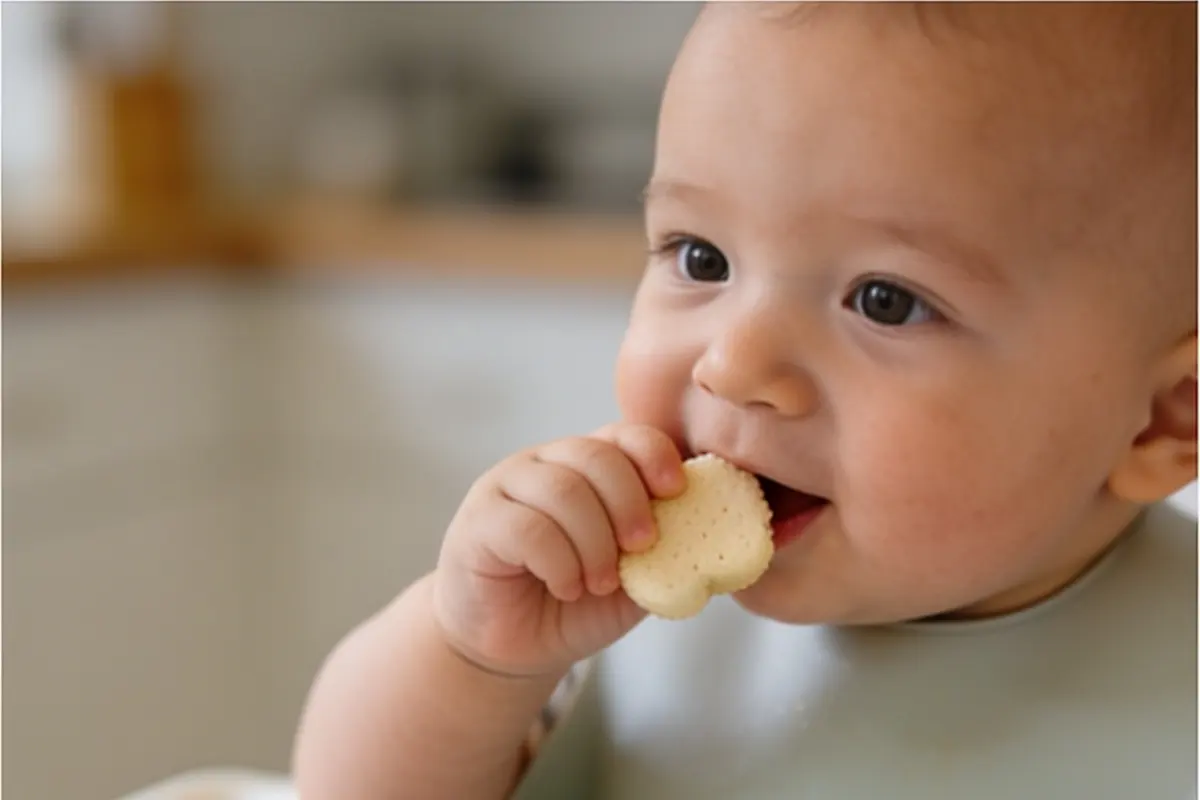
- Put a few soft pieces of food on the tray, like cooked peas or bits of banana.
- Let your baby work at picking them up.
- Name each food as they eat it.
Make it work: Keep pieces soft and no larger than half an inch, and stay with your baby while they eat (AAP).
Evidence: Emerging. Picking up small bits of food between thumb and pointer finger is a 12-month milestone (CDC), and CDC encourages letting babies pinch or pick up food with their fingers (CDC). Practice hasn't been shown to speed the skill up.
In and out
Emerging evidence- Time
- About 5 minutes
- Builds
- Hand control, letting go on purpose, cause and effect
- Give your baby a bowl or bucket and a few blocks or large plastic lids.
- Dump them out together, then drop them back in one at a time.
- Say "in!" and "out!" each time.
Make it work: Use objects too big to fit entirely in your baby's mouth (AAP).
Evidence: Emerging. Putting something in a container is a 12-month milestone, and CDC suggests practicing dumping and refilling blocks (CDC; CDC).
Where did it go?
Emerging evidence- Time
- 2 to 5 minutes
- Builds
- Object permanence, memory
- Let your baby watch you hide a toy under a cloth, then cheer when they find it.
- Once that's easy, use two cloths: hide it under one a few times, then switch to the other.
- If your baby searches the old spot, show them where it went and try again.
Evidence: Emerging. Looking for a toy they saw you hide is a 12-month milestone, and CDC and the AAP both suggest hiding games (CDC; CDC; AAP). In a classic lab study, babies 7.5 to 9 months old searched in the old hiding spot after delays of just 2 to 5 seconds, while 12-month-olds made the same mistake only after delays of more than 10 seconds (Diamond & Goldman-Rakic, 1989).

Follow the point
Moderate evidence- Time
- Anytime, all day
- Builds
- Shared attention, first words
- When your baby points or stares at something, look where they're looking.
- Name it: "A bird!"
- Add a little more, like "The bird is flying," then pause for your baby's turn.
Evidence: Moderate. CDC advises responding with words when your baby points (CDC), and in a study of 24 babies followed from 9 to 15 months, mothers' talk about what their baby was already looking at predicted the earliest gestures and words (Carpenter et al., 1998).
Talk back with words
Moderate evidence- Time
- A few minutes, many times a day
- Builds
- Babbling, turn-taking, vocabulary
- When your baby babbles, look at them and answer right away.
- Turn their sound into a word: "Ba-ba? Ball! Here's your ball."
- Use a warm, sing-song voice, then wait for a reply.
Evidence: Moderate. Babies 9.5 months old whose mothers answered their babble right away quickly reshaped their sounds (Goldstein & Schwade, 2008), and in a randomized trial of 71 families, coaching parents to use parentese and take turns increased conversation, with larger vocabularies in a follow-up (Ferjan Ramírez et al., 2020; Huber et al., 2023).
Bye-bye and pat-a-cake
Emerging evidence- Time
- A minute or two, many times a day
- Builds
- Gestures, imitation, social games
- Wave and say "bye-bye" whenever someone leaves, and help your baby wave too.
- Clap and sing "Pat-a-cake," gently guiding your baby's hands at first.
- Raise your arms for "So big!" and wait for your baby to copy.
Evidence: Emerging. Waving bye-bye and playing games like pat-a-cake are 12-month milestones, and CDC suggests teaching gestures like waving and shaking your head for "no" (CDC; CDC). Whether practice speeds them up hasn't been tested.
Board book time
Moderate evidence- Time
- 5 to 10 minutes, every day
- Builds
- Language, attention, closeness
- Choose board, cloth, or vinyl books with simple pictures of familiar things (AAP).
- Point and name: "Ball. Dog. Baby."
- Let your baby turn the pages, chew the corners, and decide when you're done.
Make it work: Ask whether your pediatrician's office takes part in Reach Out and Read, which gives families books at checkups and says it reaches 4.8 million children (Reach Out and Read).
Evidence: Moderate. The AAP recommends shared reading from birth and says research shows parents read more and children learn when pediatricians promote reading (Klass et al., 2024); CDC suggests naming pictures as you point to them (CDC).
Hand it to me
Emerging evidence- Time
- A few minutes
- Builds
- Turn-taking, following simple requests, early helping
- Hold out your hand and ask, "Can I have the spoon?"
- When your baby hands it over, say "Thank you!" and hand it back.
- Later, try a real job: "Put the sock in the basket."
Evidence: Emerging. CDC suggests turn-taking games like passing a toy back and forth (CDC), and 12-month-olds in experiments pointed to help an adult find a lost object (Liszkowski et al., 2008). Helping games at this age haven't been studied.
Baby at the family table
Moderate evidence- Time
- Family meals, as often as you can
- Builds
- Self-feeding, cup drinking, willingness to try new foods
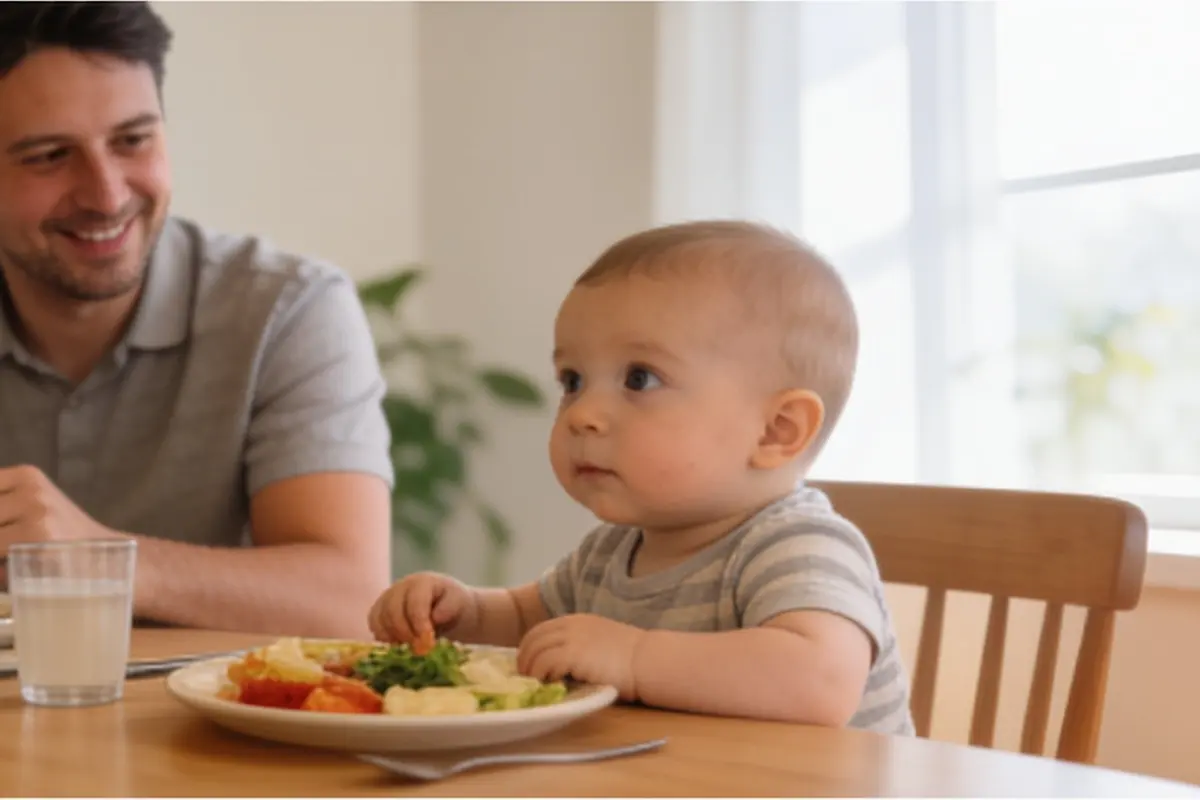
- Pull the high chair up to the table at family meals.
- Offer soft pieces of what everyone is eating, plus a cup with a little water.
- Eat the same foods yourself and let your baby decide how much to eat.
Make it work: Serve your baby's portion before adding salt, and skip the choking-hazard foods on the AAP's list (AAP; AAP).
Evidence: Moderate. The AAP encourages family meals from the first feeding (AAP), and a systematic review found that tasting a food daily for 8 to 10 or more days increases acceptance in babies and toddlers (Spill et al., 2019).
Practice goodbyes
Emerging evidence- Time
- A minute or two, a few times a day
- Builds
- Trust that you come back
- When you step into the next room, say, "I'll be right back."
- If your baby fusses, call out to them instead of rushing back.
- Come back when you said you would, with a big hello.
- When your baby crawls off into a safe room on their own, wait a minute or two before following.
Evidence: Emerging. The AAP suggests short practice separations at home and quick, consistent goodbye rituals (AAP; Swanson, AAP); these tips haven't been tested in trials.
Mirror faces
Emerging evidence- Time
- 2 to 5 minutes
- Builds
- Self-awareness, body parts, feeling words
- Sit with your baby in front of a mirror.
- Touch and name: "Here's your nose. Here's my nose."
- Make happy, sad, and surprised faces and name each one.
Evidence: Emerging. The AAP suggests mirror games that name body parts and label emotions as babies begin to recognize themselves (AAP), and naming feelings out loud is a CDC tip (CDC).
Common questions#
When do babies start crawling, and is it OK if mine skips it?
Most babies who crawl master it between about 7 and 10 months, and some never crawl at all, which is fine if they find another way to move. The AAP says a few babies scoot on their bottoms or slither on their bellies instead, and that's no cause for concern as long as they use each arm and leg equally (AAP). In a WHO study, 4.3% of healthy children never crawled on hands and knees (WHO Multicentre Growth Reference Study Group, 2006). Crawling isn't on CDC's checklists; pulling up to stand and walking while holding furniture by 12 months are (CDC). Talk with your pediatrician if your baby favors one side or doesn't seem to be moving normally (AAP).
Is it normal if my baby isn't walking by their first birthday?
Yes, many babies aren't walking alone at 12 months, and taking a few steps alone is a 15-month milestone on CDC's checklist (CDC). By 12 months, most babies pull up to stand and walk while holding on to furniture (CDC). Healthy children in the WHO's study started walking alone anywhere from 8.2 to 17.6 months (WHO Multicentre Growth Reference Study Group, 2006). If your baby isn't pulling to stand by 12 months or has lost skills, ask about a developmental screening (CDC). The 1-year guide covers walking after the first birthday.
When do babies say their first words?
Most babies call a parent "mama" or "dada" or another special name by 12 months, but having few or no other clear words at the first birthday is normal (CDC). Trying to say one or two words besides "mama" or "dada" is a 15-month milestone (CDC). The AAP says some babies have 2 or 3 words by their first birthday, but most 12-month speech is babble with the ups and downs of real talk, and any sound your baby uses consistently for the same thing counts as a word (AAP). Bring it up if your baby isn't babbling lots of different sounds by 9 months or doesn't look when you call their name (CDC).
When do babies start pointing and waving bye-bye?
Most babies wave bye-bye by 12 months, and most point to ask for something or get help by 15 months (CDC; CDC). Toward the end of the first year, babies start using pointing and gestures to say what they want, and they copy the gestures they see you use (AAP). When your baby points, name what they're showing you (CDC); what babies point at often becomes the words they say later (Iverson & Goldin-Meadow, 2005).
Why does my baby cry every time I leave the room?
It's separation anxiety, a normal stage that usually gets stronger around 9 months (Swanson, AAP). Your baby now knows you exist when you're gone but has little sense of time, so they don't know when you'll be back. It usually peaks between 10 and 18 months, and the AAP calls it a sign of attachment, not of spoiling (AAP). Say a quick, cheerful goodbye instead of sneaking out (CDC), and use the same short ritual every time (Swanson, AAP). See easing goodbyes and new faces for more.
What finger foods can my 9-month-old eat?
Good first finger foods are soft, easy to swallow, and cut into small pieces, like bits of banana, scrambled eggs, well-cooked pasta, finely chopped cooked chicken, and cooked potatoes or peas (AAP). Cut pieces no larger than half an inch (AAP). Before age 1, avoid hot dogs and meat sticks, nuts and seeds, chunks of meat or cheese, whole grapes, popcorn, chunks of peanut butter, raw vegetables, raw fruit chunks like apple, and hard, gooey, or sticky candy (AAP). Always stay with your baby while they eat; the 6-month guide explains how to tell gagging from choking.
When can my baby drink cow's milk?
Around 12 months, most babies can switch to whole cow's milk; before that, the AAP says babies shouldn't drink cow's milk or other milk substitutes (AAP). Cow's milk lacks enough iron and other nutrients babies need, and in some babies it irritates the gut and causes iron-deficiency anemia. After the first birthday, keep milk to about 16 ounces (2 cups) a day or less; more than 24 ounces is linked to iron deficiency (AAP). Whole milk is recommended for most children from 12 to 24 months, though your pediatrician may suggest 2% for some (AAP; Muth, AAP). If you're breastfeeding, the AAP supports continuing as long as you both want, to 2 years or beyond (Muth, AAP).
When should my baby stop using a bottle?
The AAP suggests offering a cup around 6 months and finishing the move off bottles sometime between 12 and 18 months (Shu, AAP). Bottles that go on longer are linked to cavities, skipped meals, and more resistance later. Cut bottles gradually: keep them at meals at first, drop the ones at naps and bedtime, and offer extra cuddles and stories instead. An open cup, a straw cup, or a sippy cup without a valve all work (Shu, AAP). Never put your baby to bed with a bottle; sugary residue left in the mouth overnight promotes tooth decay (AAP).
Should my 9-month-old still wake up to eat at night?
Many babies this age don't need to eat at night, but some still do, so ask your pediatrician before cutting night feeds. The AAP says most formula-fed babies no longer need a middle-of-the-night feeding after 2 to 4 months (AAP). Night waking at this age is often caused by separation anxiety, and cuddling, feeding, or talking at every waking can prompt your baby to wake for that attention (Nemours KidsHealth). Check with your pediatrician first if your baby isn't growing and gaining weight steadily (AAP).
Does my baby need shoes to learn to walk?
No, your baby doesn't need shoes until they start walking outside, and special "supportive" shoes have no proven benefit (AAP). Choose closed-toe, comfortable, flexible shoes with nonskid soles and room to grow; sneakers are a great choice. Skip wedges, inserts, high backs, and special arches: they have no proven benefit for most children and may make walking harder. A first pair usually lasts 2 to 3 months, so check the fit monthly (AAP).
How do I discipline a baby who keeps grabbing things they shouldn't?
At this age, discipline means changing the setting and redirecting, not punishing. The AAP advises putting dangerous or tempting things out of reach, saving "no" for safety, and swapping a forbidden object for one that's okay (AAP). By 12 months, most babies pause when they hear "no" (CDC), but they'll test it, and that's normal. Don't spank, slap, or hit: it doesn't work, and in babies under 18 months it raises the risk of injury (AAP).
What vaccines does my baby get between 7 and 12 months?
The AAP recommends a third hepatitis B dose between 6 and 18 months, a flu shot every year starting at 6 months (two doses, 4 weeks apart, the first time), and COVID vaccine for babies 6 through 23 months; at or soon after the first birthday come MMR, chickenpox, and hepatitis A, plus boosters (Bracho-Sánchez, AAP). A third polio dose may also come at the 9-month visit if it wasn't given earlier (AAP). For 2026-2027, the AAP still recommends RSV protection for babies under 8 months entering their first RSV season, unless they're already protected by an RSV vaccine given in pregnancy (AAP). US guidance is in flux: the AAP and CDC schedules differ in 2026 (AAP), and a federal judge paused many of the federal changes in March 2026, a ruling the government has appealed (STAT, 2026). Ask your pediatrician which schedule they follow.
Safety and when to call your pediatrician#
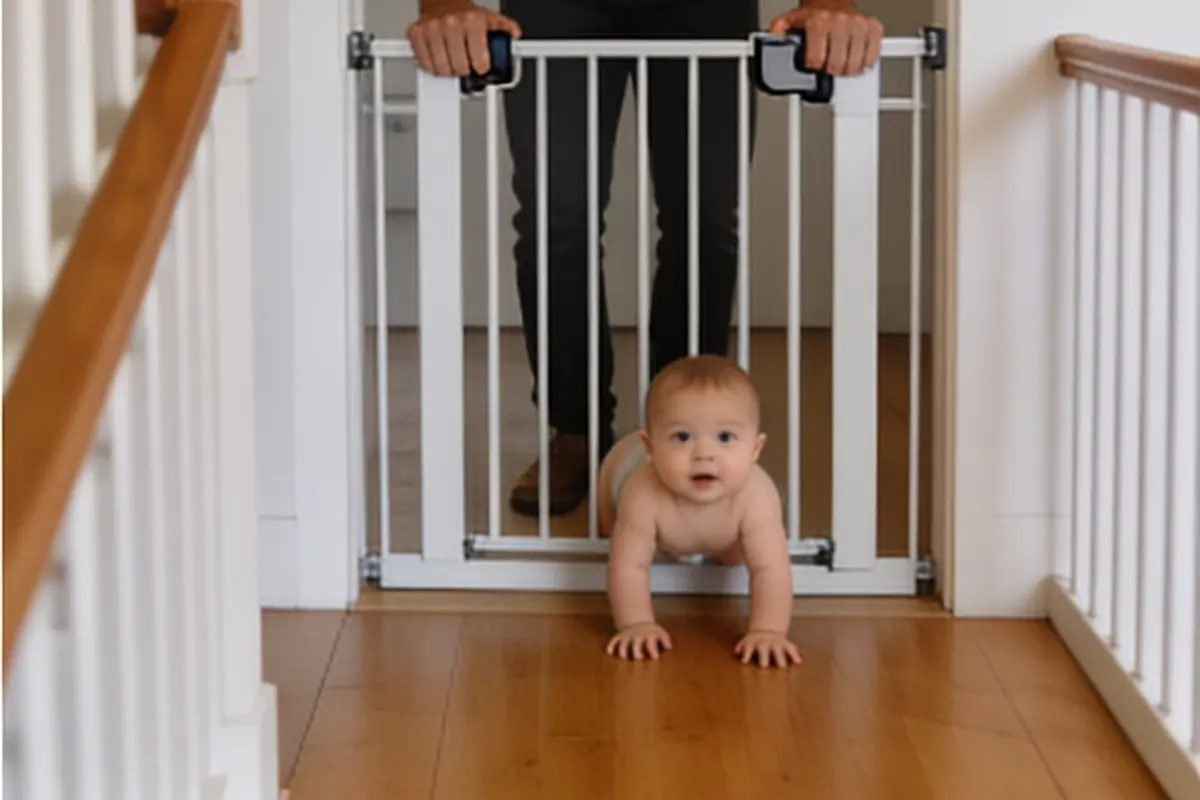
Your baby can now reach things they couldn't last month. Babyproof ahead of the next skill, not behind it.
Safe sleep until the first birthday
Place your baby on their back for every sleep until age 1 (AAP). If they roll both ways on their own, you don't need to flip them back, but keep the crib bare: no pillows, blankets, bumpers, or stuffed toys (Moon, AAP). Set the mattress at its lowest position before your baby learns to stand, and keep cords well away from the crib (AAP). The full rules are in the newborn guide.
Childproof at crawling height
- Gates: put them at the top and bottom of stairs, mounted firmly to the wall studs; skip accordion-style gates, which can trap an arm or neck (AAP).
- Windows: open them from the top or install window guards; a screen won't stop a fall (AAP).
- Outlets and cords: plug unused outlets and keep electrical cords out of reach (AAP). Cordless window coverings are the only way to remove the strangulation risk from blind cords (CPSC).
- Small things: check floors and between cushions for coins, toy parts, and pen caps (AAP).
- Walkers: skip them. They send thousands of children to hospitals each year, mostly from falls down stairs (AAP).
Furniture and TV tip-overs
Anchor bookcases, dressers, and TV stands to the wall (AAP). CPSC counted 234 deaths from dresser and other clothing-storage tip-overs from 2000 to April 2022, 199 of them children. Under the STURDY Act, dressers made since September 2023 must pass tougher stability tests, but CPSC still advises anchoring them (CPSC).
Button batteries and magnets
From 2011 to 2021, button and coin batteries were linked to 27 deaths and an estimated 54,300 emergency room visits (CPSC), and a battery stuck in the esophagus can cause severe damage in just 2 hours (Poison Control). Tape battery compartments shut and lock up spares (AAP). If your baby may have swallowed one, go to the ER now and call the National Battery Ingestion Hotline (1-800-498-8666) on the way (CPSC). The honey advice you may read is only for children over 12 months (AAP). Two or more swallowed magnets can pull together inside the body, and many cases have needed surgery, so get care immediately (CPSC).
Water and drowning
Babies can drown in 1 or 2 inches of water, silently, within seconds. Never leave your baby in the bath, even in a bath seat, which can tip (AAP). Empty buckets and wading pools right after use, latch toilet lids, and fence pools on all 4 sides (AAP).
Hot drinks and burns
Hot liquids in cups, mugs, and tableware cause 27% to 60% of scald burns in children under 5. Never carry a hot drink while holding your baby, and keep mugs away from table edges (AAP). Set your water heater to no more than 120°F (AAP).
Medicines, cleaners, and Poison Help
Lock up cleaners and alcohol; keep medicines (including the ones in your bag), vaping liquid, and cannabis edibles out of reach; and don't rely on child-resistant caps (AAP). Save Poison Help, 1-800-222-1222, in your phone; it's free and confidential. If your baby collapses, has a seizure, has trouble breathing, or can't be woken, call 911 (Poison Control).
Car seats
Keep your baby rear-facing until they reach the top weight or height their seat allows. When they outgrow an infant-only seat, switch to a convertible or all-in-one seat installed rear-facing (AAP).
Fever and febrile seizures
Call within 24 hours if your baby has a fever with no other symptoms for more than 2 days, any fever that lasts more than 3 days, or a fever that comes back after a day without one (AAP). Use a thermometer; feeling the forehead isn't accurate (AAP). Febrile seizures affect 3 or 4 of every 100 children between 6 months and 5 years. Lay your baby on the floor, turn their head to the side, put nothing in their mouth, and call 911 if it lasts more than 5 minutes (AAP). Even after a short seizure, get your baby seen right away (AAP).
Call 911 if your baby
- Is choking and can't breathe, cry, or make noise, turns bluish, or goes limp (AAP); start back blows and chest thrusts while someone calls
- Is struggling for each breath or can barely cry (AAP)
- Is not moving, is very weak, or can't be woken (AAP)
- Has purple or blood-colored spots or dots on the skin (AAP)
- Has a seizure that lasts more than 5 minutes (AAP)
Go to the ER now if your baby
- Swallowed a button battery or magnets (CPSC; CPSC)
- Had a seizure with a fever, has a stiff neck, or has a bulging soft spot (AAP)
- Is hard to wake, isn't alert when awake, or seems confused (AAP)
Call your pediatrician right away if your baby
- Has a fever over 104°F (40°C), or shaking chills lasting more than 30 minutes (AAP)
- Has trouble breathing that isn't severe, or great trouble swallowing fluids or spit (AAP)
- Cries nonstop, cries when touched or moved, or won't move an arm or leg normally (AAP)
- Shows signs of dehydration: no urine in more than 8 hours, dark urine, a very dry mouth, and no tears (AAP)
- Looks or acts very sick, or you think they need to be seen urgently (AAP)
Don't wait on development worries
If you're worried, ask your pediatrician about developmental screening, or call your state's early intervention program for a free evaluation; you don't need a referral (CDC; CDC). Bring it up if your baby:
- By 9 months, doesn't sit without support, look when you call their name, or babble lots of different sounds (CDC)
- By 12 months, doesn't pull up to stand, wave bye-bye, or look for a toy they saw you hide (CDC)
- Uses one arm or leg much more than the other (AAP)
- Seems not to see or hear well (AAP)
- Has lost skills they used to have (CDC)
The 9-month and 12-month checkups
The AAP recommends a standardized developmental screening at the 9-month visit (Lipkin & Macias, 2020; AAP, 2025), often a parent questionnaire like the Ages & Stages Questionnaires (ASQ) (ASQ). Expect a full exam, questions about sleep and pulling to stand, and fluoride varnish once teeth are in (AAP). At 12 months, your baby will be checked for anemia and, depending on risk, lead (AAP). For vaccines, see What vaccines does my baby get between 7 and 12 months?
Sources#
- Centers for Disease Control and Prevention. "Milestones by 9 Months." Learn the Signs. Act Early. program, updated 2026. https://www.cdc.gov/act-early/milestones/9-months.html
- Centers for Disease Control and Prevention. "Milestones by 1 Year." Learn the Signs. Act Early. program, updated 2026. https://www.cdc.gov/act-early/milestones/1-year.html
- Centers for Disease Control and Prevention. "Milestones by 15 Months." Learn the Signs. Act Early. program, accessed 2026. https://www.cdc.gov/act-early/milestones/15-months.html
- Centers for Disease Control and Prevention. "Concerned About Your Child's Development?" Updated 2026. https://www.cdc.gov/act-early/families/concerned.html
- Centers for Disease Control and Prevention. "Tastes and Textures." 2026. https://www.cdc.gov/infant-toddler-nutrition/foods-and-drinks/tastes-and-textures.html
- American Academy of Pediatrics. "Movement Milestones in Babies 8 to 12 Months Old." HealthyChildren.org, updated 2021. https://www.healthychildren.org/English/ages-stages/baby/Pages/Movement-8-to-12-Months.aspx
- American Academy of Pediatrics. "Hand and Finger Skills." HealthyChildren.org, updated 2009. https://www.healthychildren.org/English/ages-stages/baby/Pages/Hand-and-Finger-Skills.aspx
- American Academy of Pediatrics. "Language Development: 8 to 12 Months." HealthyChildren.org, updated 2009. https://www.healthychildren.org/English/ages-stages/baby/Pages/Language-Development-8-to-12-Months.aspx
- American Academy of Pediatrics. "Cognitive Development in Infants: 8 to 12 Months." HealthyChildren.org, updated 2023. https://www.healthychildren.org/English/ages-stages/baby/Pages/Cognitive-Development-8-to-12-Months.aspx
- American Academy of Pediatrics. "Emotional and Social Development: 8 to 12 Months." HealthyChildren.org, updated 2009. https://www.healthychildren.org/English/ages-stages/baby/Pages/Emotional-and-Social-Development-8-12-Months.aspx
- Swanson WS. "How to Ease Your Child's Separation Anxiety." HealthyChildren.org, updated 2026. https://www.healthychildren.org/English/ages-stages/toddler/Pages/Soothing-Your-Childs-Separation-Anxiety.aspx
- American Academy of Pediatrics. "Making Baby Drop Off at Child Care Easier." HealthyChildren.org, updated 2022. https://www.healthychildren.org/English/family-life/work-and-child-care/Pages/making-baby-drop-off-at-child-care-easier.aspx
- American Academy of Pediatrics. "Separation Anxiety & Sleeping Trouble in Young Children." HealthyChildren.org, updated 2022. https://www.healthychildren.org/English/healthy-living/sleep/Pages/separation-anxiety-and-sleeping.aspx
- American Academy of Pediatrics. "Corrected Age For Preemies." HealthyChildren.org, updated 2018. https://www.healthychildren.org/English/ages-stages/baby/preemie/Pages/Corrected-Age-For-Preemies.aspx
- American Academy of Pediatrics. "When Can Babies Start Solid Foods? Readiness & Feeding Tips." HealthyChildren.org, updated 2026. https://www.healthychildren.org/English/ages-stages/baby/feeding-nutrition/Pages/Starting-Solid-Foods.aspx
- Shu J. "From Bottle to Cup: Helping Your Child Make a Healthy Transition." HealthyChildren.org, updated 2023. https://www.healthychildren.org/English/ages-stages/baby/feeding-nutrition/Pages/Discontinuing-the-Bottle.aspx
- American Academy of Pediatrics. "Why Do Infants Need Baby Formula Instead of Cow's Milk?" HealthyChildren.org, updated 2024. https://www.healthychildren.org/English/ages-stages/baby/formula-feeding/Pages/Why-Formula-Instead-of-Cows-Milk.aspx
- Muth ND. "Recommended Drinks for Children Age 5 & Younger." HealthyChildren.org, updated 2023. https://www.healthychildren.org/English/healthy-living/nutrition/Pages/Recommended-Drinks-for-Young-Children-Ages-0-5.aspx
- American Academy of Pediatrics. "Amount and Schedule of Baby Formula Feedings." HealthyChildren.org, updated 2022. https://www.healthychildren.org/English/ages-stages/baby/formula-feeding/Pages/amount-and-schedule-of-formula-feedings.aspx
- American Academy of Pediatrics. "Sleeping Through the Night." HealthyChildren.org, updated 2013. https://www.healthychildren.org/English/ages-stages/baby/sleep/Pages/Sleeping-Through-the-Night.aspx
- American Academy of Pediatrics. "Getting Your Baby to Sleep." HealthyChildren.org, updated 2024. https://www.healthychildren.org/English/ages-stages/baby/sleep/Pages/getting-your-baby-to-sleep.aspx
- Moon RY. "How to Keep Your Sleeping Baby Safe: AAP Policy Explained." HealthyChildren.org, updated 2026. https://www.healthychildren.org/English/ages-stages/baby/sleep/Pages/a-parents-guide-to-safe-sleep.aspx
- American Academy of Pediatrics. "Make Baby's Room Safe: Parent Checklist." HealthyChildren.org, updated 2020. https://www.healthychildren.org/English/safety-prevention/at-home/Pages/Make-Babys-Room-Safe.aspx
- American Academy of Pediatrics. "What's the Best Way to Discipline My Child?" HealthyChildren.org, updated 2018. https://www.healthychildren.org/English/family-life/family-dynamics/communication-discipline/Pages/Disciplining-Your-Child.aspx
- American Academy of Pediatrics. "Where We Stand: Spanking." HealthyChildren.org, updated 2018. https://www.healthychildren.org/English/family-life/family-dynamics/communication-discipline/Pages/Where-We-Stand-Spanking.aspx
- American Academy of Pediatrics. "Baby Walkers: A Dangerous Choice." HealthyChildren.org, updated 2022. https://www.healthychildren.org/English/safety-prevention/at-home/Pages/Baby-Walkers-A-Dangerous-Choice.aspx
- American Academy of Pediatrics. "Home Safety: Tips for Families With Young Children." HealthyChildren.org, updated 2022. https://www.healthychildren.org/English/safety-prevention/at-home/Pages/Home-Safety-Heres-How.aspx
- American Academy of Pediatrics. "How Small Batteries Can Become Dangerous to Children." HealthyChildren.org, updated 2021. https://www.healthychildren.org/English/safety-prevention/at-home/Pages/Button-Battery-Injuries-in-Children-A-Growing-Risk.aspx
- Bradin S. "Choking Prevention for Babies & Children: What Every Parent Needs to Know." HealthyChildren.org, updated 2026. https://www.healthychildren.org/English/health-issues/injuries-emergencies/Pages/Choking-Prevention.aspx
- American Academy of Pediatrics. "Drowning Prevention for Curious Toddlers: What Parents Need to Know." HealthyChildren.org, updated 2026. https://www.healthychildren.org/English/safety-prevention/at-play/Pages/Water-Safety-And-Young-Children.aspx
- American Academy of Pediatrics. "Infant Drowning Prevention & Water Safety: How to Protect Your Baby." HealthyChildren.org, updated 2026. https://www.healthychildren.org/English/safety-prevention/at-play/Pages/Infant-Water-Safety.aspx
- American Academy of Pediatrics. "Burn Treatment & Prevention Tips for Families." HealthyChildren.org, updated 2023. https://www.healthychildren.org/English/health-issues/injuries-emergencies/Pages/Treating-and-Preventing-Burns.aspx
- American Academy of Pediatrics. "Car Seats: Information for Families." HealthyChildren.org, updated 2026. https://www.healthychildren.org/English/safety-prevention/on-the-go/Pages/Car-Safety-Seats-Information-for-Families.aspx
- American Academy of Pediatrics. "Fever and Your Baby." HealthyChildren.org, updated 2025. https://www.healthychildren.org/English/health-issues/conditions/fever/Pages/Fever-and-Your-Baby.aspx
- American Academy of Pediatrics. "Fever" (symptom checker). HealthyChildren.org, accessed 2026. https://www.healthychildren.org/English/tips-tools/symptom-checker/Pages/symptomviewer.aspx?symptom=Fever
- Di Giovine M, Catenaccio E. "Febrile Seizures in Children." HealthyChildren.org, updated 2025. https://www.healthychildren.org/English/health-issues/conditions/fever/Pages/Febrile-Seizures.aspx
- American Academy of Pediatrics. "Checkup Checklist: 9 Months Old." HealthyChildren.org, updated 2021. https://www.healthychildren.org/English/ages-stages/Your-Childs-Checkups/Pages/Your-Checkup-Checklist-9-Months-Old.aspx
- American Academy of Pediatrics. "Checkup Checklist: First Birthday (12 Months Old)." HealthyChildren.org, updated 2021. https://www.healthychildren.org/English/ages-stages/Your-Childs-Checkups/Pages/Your-Checkup-Checklist-12-Months-Old.aspx
- American Academy of Pediatrics and Bright Futures. "Recommendations for Preventive Pediatric Health Care" (Periodicity Schedule). 2025. https://downloads.aap.org/AAP/PDF/periodicity_schedule.pdf
- Bracho-Sánchez E. "AAP Guide: Vaccines Your Child Needs by Age 6." HealthyChildren.org, updated 2026. https://www.healthychildren.org/English/safety-prevention/immunizations/Pages/Your-Babys-First-Vaccines.aspx
- American Academy of Pediatrics. "AAP Releases Recommended Childhood and Adolescent Immunization Schedule for 2026." HealthyChildren.org, 2026. https://www.healthychildren.org/English/news/Pages/AAPs-recommended-childhood-and-adolescent-immunization-schedule-for-2026.aspx
- American Academy of Pediatrics. "AAP Releases RSV Immunization Recommendations for 2026-2027 Season." HealthyChildren.org, 2026. https://www.healthychildren.org/English/news/Pages/aap-updates-rsv-immunization-recommendations-for-2026-2027-season.aspx
- Hill DL. "Why to Avoid TV for Infants & Toddlers." HealthyChildren.org, updated 2016. https://www.healthychildren.org/English/family-life/Media/Pages/Why-to-Avoid-TV-Before-Age-2.aspx
- Munzer T. "Helping Kids Thrive in a Digital World: AAP Policy Explained." HealthyChildren.org, updated 2026. https://www.healthychildren.org/English/family-life/Media/Pages/helping-kids-thrive-in-a-digital-world-AAP-policy-explained.aspx
- World Health Organization. "To grow up healthy, children need to sit less and play more." 2019. https://www.who.int/news/item/24-04-2019-to-grow-up-healthy-children-need-to-sit-less-and-play-more
- Nemours KidsHealth. "Baby Sleep: 8- to 12-Month-Olds." Reviewed 2025. https://kidshealth.org/en/parents/sleep812m.html
- US Consumer Product Safety Commission. "CPSC Adopts Final Consumer Product Safety Standard to Prevent Tip-overs of Dressers and Other Clothing Storage Units." 2023. https://www.cpsc.gov/Newsroom/News-Releases/2023/CPSC-Adopts-Final-Consumer-Product-Safety-Standard-to-Prevent-Tip-overs-of-Dressers-and-Other-Clothing-Storage-Units
- US Consumer Product Safety Commission. "Making Families Safer from Button Cell or Coin Battery Dangers; Reese's Law Leads to New Federal Mandatory Safety Standard." 2023. https://www.cpsc.gov/Newsroom/News-Releases/2023/Making-Families-Safer-from-Button-Cell-or-Coin-Battery-Dangers-Reeses-Law-Leads-to-New-Federal-Mandatory-Safety-Standard
- US Consumer Product Safety Commission. "Magnets" (Safety Education Center). Accessed 2026. https://www.cpsc.gov/Safety-Education/Safety-Education-Centers/Magnets
- US Consumer Product Safety Commission. "Window Covering Cords." Accessed 2026. https://www.cpsc.gov/gocordless
- National Capital Poison Center. "Button Battery Ingestion." Poison Control, accessed 2026. https://www.poison.org/battery
- National Capital Poison Center. "Poison Control." Accessed 2026. https://www.poison.org/
- Reach Out and Read. "About." Accessed 2026. https://reachoutandread.org/about/
- Brookes Publishing. "About ASQ." Ages & Stages Questionnaires, accessed 2026. https://agesandstages.com/about-asq/
- STAT. "HHS appeals ruling that stalled many of Kennedy's vaccine policy changes." 2026. https://www.statnews.com/2026/04/29/hhs-appealing-acip-vaccine-policy-lawsuit-ruling/
- Zubler JM, Wiggins LD, Macias MM, et al. "Evidence-Informed Milestones for Developmental Surveillance Tools." Pediatrics, 2022. https://pubmed.ncbi.nlm.nih.gov/35132439/
- Kretch KS, Willett SL, Hsu LY, et al. "'Learn the Signs. Act Early.': Updates and Implications for Physical Therapists." Pediatric Physical Therapy, 2022. https://pubmed.ncbi.nlm.nih.gov/35876833/
- WHO Multicentre Growth Reference Study Group. "WHO Motor Development Study: windows of achievement for six gross motor development milestones." Acta Paediatrica Supplement, 2006. https://pubmed.ncbi.nlm.nih.gov/16817682/
- Adolph KE, Cole WG, Komati M, et al. "How do you learn to walk? Thousands of steps and dozens of falls per day." Psychological Science, 2012. https://pubmed.ncbi.nlm.nih.gov/23085640/
- Goldstein MH, Schwade JA. "Social feedback to infants' babbling facilitates rapid phonological learning." Psychological Science, 2008. https://pubmed.ncbi.nlm.nih.gov/18466414/
- Ferjan Ramírez N, Lytle SR, Kuhl PK. "Parent coaching increases conversational turns and advances infant language development." Proceedings of the National Academy of Sciences, 2020. https://pubmed.ncbi.nlm.nih.gov/32015127/
- Huber E, Ferjan Ramírez N, Corrigan NM, Kuhl PK. "Parent coaching from 6 to 18 months improves child language outcomes through 30 months of age." Developmental Science, 2023. https://pubmed.ncbi.nlm.nih.gov/36999222/
- Carpenter M, Nagell K, Tomasello M. "Social cognition, joint attention, and communicative competence from 9 to 15 months of age." Monographs of the Society for Research in Child Development, 1998. https://pubmed.ncbi.nlm.nih.gov/9835078/
- Iverson JM, Goldin-Meadow S. "Gesture paves the way for language development." Psychological Science, 2005. https://pubmed.ncbi.nlm.nih.gov/15869695/
- Liszkowski U, Carpenter M, Tomasello M. "Twelve-month-olds communicate helpfully and appropriately for knowledgeable and ignorant partners." Cognition, 2008. https://pubmed.ncbi.nlm.nih.gov/18721918/
- Warneken F, Tomasello M. "Altruistic helping in human infants and young chimpanzees." Science, 2006. https://pubmed.ncbi.nlm.nih.gov/16513986/
- Diamond A, Goldman-Rakic PS. "Comparison of human infants and rhesus monkeys on Piaget's AB task: evidence for dependence on dorsolateral prefrontal cortex." Experimental Brain Research, 1989. https://pubmed.ncbi.nlm.nih.gov/2924839/
- Spill MK, Johns K, Callahan EH, et al. "Repeated exposure to food and food acceptability in infants and toddlers: a systematic review." American Journal of Clinical Nutrition, 2019. https://pubmed.ncbi.nlm.nih.gov/30982874/
- Brooker RJ, Buss KA, Lemery-Chalfant K, et al. "The development of stranger fear in infancy and toddlerhood: normative development, individual differences, antecedents, and outcomes." Developmental Science, 2013. https://pubmed.ncbi.nlm.nih.gov/24118713/
- Gershoff ET, Grogan-Kaylor A. "Spanking and child outcomes: Old controversies and new meta-analyses." Journal of Family Psychology, 2016. https://pubmed.ncbi.nlm.nih.gov/27055181/
- Sege RD, Siegel BS; AAP Council on Child Abuse and Neglect; Committee on Psychosocial Aspects of Child and Family Health. "Effective Discipline to Raise Healthy Children." Pediatrics, 2018. https://pubmed.ncbi.nlm.nih.gov/30397164/
- Lipkin PH, Macias MM; AAP Council on Children With Disabilities, Section on Developmental and Behavioral Pediatrics. "Promoting Optimal Development: Identifying Infants and Young Children With Developmental Disorders Through Developmental Surveillance and Screening." Pediatrics, 2020. https://pubmed.ncbi.nlm.nih.gov/31843861/
- Klass P, Miller-Fitzwater A, High PC; AAP Council on Early Childhood. "Literacy Promotion: An Essential Component of Primary Care Pediatric Practice: Policy Statement." Pediatrics, 2024. https://pubmed.ncbi.nlm.nih.gov/39342414/
This guide is general education that summarizes published research and guidance from groups like the American Academy of Pediatrics, the CDC, and the WHO. It isn’t medical advice, and every child develops on their own timeline. Your pediatrician knows your child; if something feels wrong, call them. In an emergency, call 911.
Raising capable kids with Chorevia
When your kids are ready for responsibility, Chorevia turns chores into a family economy, with points, proof, a reward ladder you design, and monthly costs kids work off. Adults always make the call. Free for families.
Create your household