The first year · 6 to 7 months
6 to 7 Months: Development, Research, and What Helps
Last reviewed · 27 min read · 11 activities · 11 common questions · 95 sources · Plain-text version
Six months brings first foods, first teeth for many babies, wobbly sitting, and babble that starts to sound like talk. Here's what's developing, what the research says about allergens and baby-led weaning, and what actually helps.
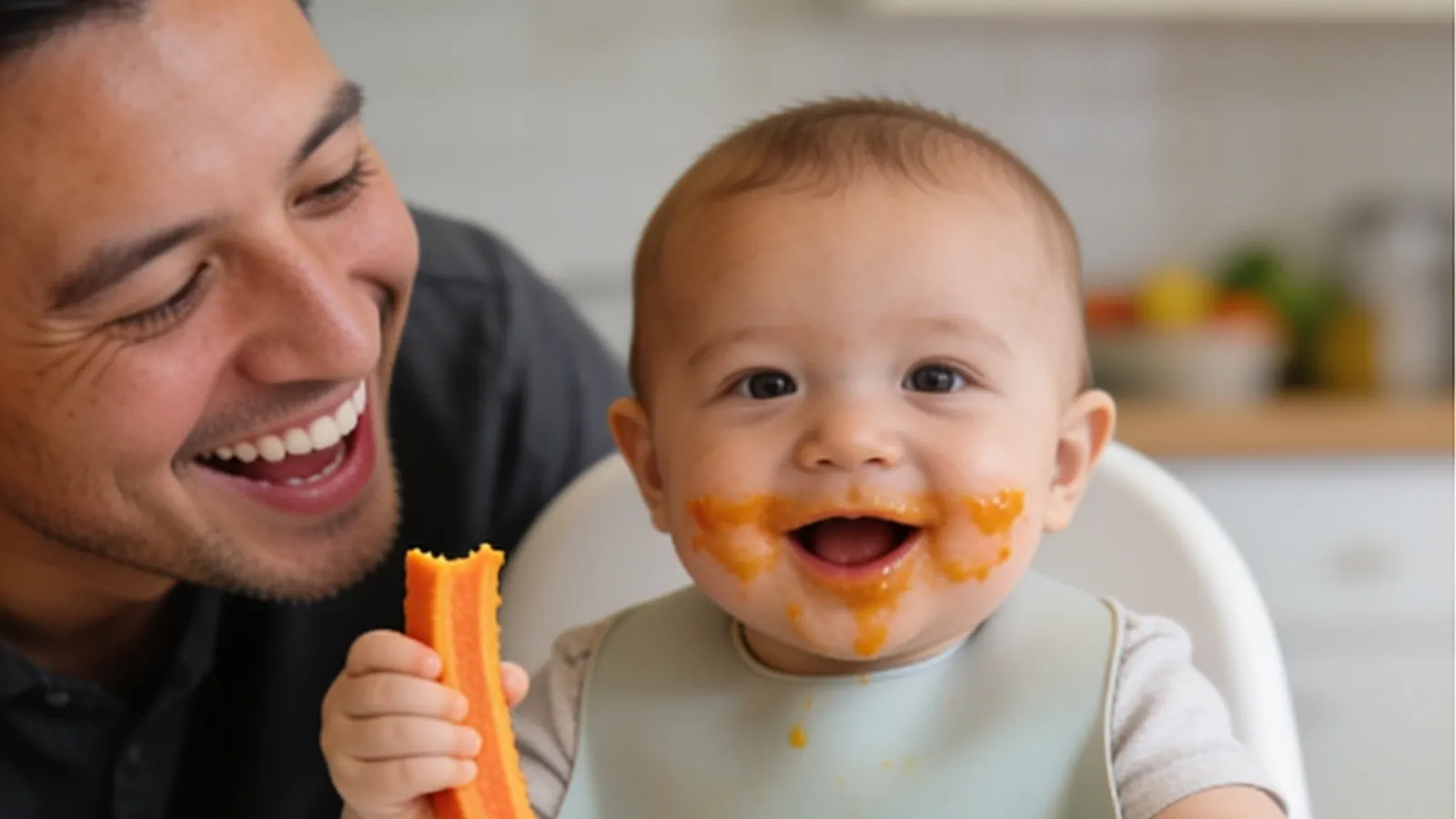
At a glance
- Most babies are ready for solids around 6 months. Breast milk or formula is still the main food; solids are practice.
- Lead with iron-rich foods like meat or iron-fortified cereal. The AAP recommends an iron supplement for exclusively breastfed babies by 6 months; ask your pediatrician.
- Introduce peanut and egg around 6 months and keep serving them. If your baby has severe eczema or an egg allergy, talk to your pediatrician first.
- Spoon-feeding and baby-led weaning both work. In trials, babies who fed themselves soft, safe foods didn't choke more.
- Gagging is noisy and normal. Choking is silent: if your baby can't cry, cough, or breathe, call 911 and start back blows and chest thrusts.
- No honey, juice, or cow's milk to drink before age 1. A few sips of water from a cup are fine.
- Brush the first tooth twice a day with a rice-grain smear of fluoride toothpaste.
- Night waking is still normal. If you try sleep training, studies have found no long-term harm.
Your 6-to-7-month checklist
0 of 12 done
Half a year in, a lot changes at once: first foods, first teeth for many babies, wobbly sitting, and babble that starts to sound like talk. This guide covers 6 to 7 months. For the months just before, see the 5-month guide; crawling, first words, and the rest of the first year are in the 7-to-12-month guide.
What's developing#
CDC's milestone checklists list skills that at least 75% of babies show by each age, so a missed milestone is a reason to check in, not to wait and see (Zubler et al., 2022).
Milestones by 6 months
By 6 months, most babies (CDC):
- Social: know familiar people, like to look at themselves in a mirror, and laugh.
- Communication: take turns making sounds with you, blow raspberries, and squeal.
- Thinking: put things in their mouth to explore them, reach to grab a toy they want, and close their lips to show they don't want more food.
- Movement: roll from tummy to back, push up on straight arms when on their tummy, and lean on their hands to hold themselves up when sitting.
Born early? Use your baby's corrected age (age minus the weeks they were born early) for milestones until age 2 (AAP).
Sitting, rolling, and reaching
By the end of this stage, many babies roll both ways; most roll tummy to back first (AAP). Sitting comes in steps. First your baby "tripods," leaning forward on their arms. By 6 to 8 months, many can stay upright without leaning on their hands once you sit them up, though getting into a sit alone comes later (AAP). Sitting without support is on CDC's 9-month list (CDC). In a WHO study of 816 children in five countries, healthy babies first sat alone anywhere from 3.8 to 9.2 months (WHO Multicentre Growth Reference Study Group, 2006).
Hands get busier too. Between 6 and 8 months, babies learn to pass objects from hand to hand and to turn and twist them; the finger-and-thumb pincer grasp usually arrives around 9 months. Held upright with their feet on the floor, many babies bounce, a warm-up for standing (AAP).
Babbling and listening
Babies start to babble around 4 months, using the rhythms of the language they hear. From about 6 or 7 months, they get much better at imitating the sounds you make (AAP). In lab tests, 4.5-month-olds already recognized the sound of their own name (Mandel et al., 1995); looking when you call their name is a 9-month milestone (CDC). The AAP advises telling your pediatrician if your baby doesn't babble or imitate any sounds by 7 months, since that can signal a hearing problem (AAP).
Cause, effect, and out of sight
Your baby is running experiments: shake the rattle, hear the noise; drop the spoon, watch you pick it up. Soon they drop things on purpose to see what happens. Toward the end of this stage, many start to grasp object permanence, the idea that things still exist when they're hidden. Games like peekaboo help them keep practicing for months (AAP). Just how early that understanding begins is still debated (see the research below).
Familiar faces and new people
Stranger anxiety normally shows up between 7 and 12 months (AAP), and being shy, clingy, or fearful around strangers is on CDC's 9-month list (CDC). Beginning in the second half of the first year, separation anxiety can also disrupt sleep, with babies waking and crying for a parent. The AAP calls it a normal stage of emotional development (AAP).
First teeth
Most babies get teeth between 6 and 12 months, usually starting with the lower front teeth, and some have none by their first birthday (AAP). A 2016 meta-analysis of 16 studies (3,506 children) found gum irritation, irritability, and drooling were the most common teething signs, and that teething could nudge temperature up but didn't cause fever (Massignan et al., 2016).
Growth and feeding
Most babies have doubled their birth weight by 6 months (AAP). Even as solids begin, breast milk or formula is still the most important source of nutrition (CDC). Iron becomes a focus now. The AAP's 2026 guidance calls for iron supplements for exclusively breastfed babies by 6 months (AAP, 2026), and iron-rich foods matter once solids start (CDC). Vitamin D drops of 400 IU a day continue for breastfed babies and for babies drinking less than 32 ounces of formula a day (AAP).
Sleep at 6 to 7 months
Sleep experts recommend 12 to 16 hours of sleep in 24 hours, naps included, for babies 4 to 12 months old (Paruthi et al., 2016; WHO). The AAP says it's normal for a 6-month-old to wake during the night and go back to sleep after a few minutes (AAP).
What the research says#
Some findings for this stage are about as solid as infant research gets. Others are smaller than the headlines suggest, and one classic is still argued about.
1. Early peanut prevents most peanut allergy in high-risk babies. In the LEAP trial, 640 babies 4 to 11 months old with severe eczema, egg allergy, or both were randomly assigned to eat peanut regularly or avoid it until age 5. Among the 530 whose skin tests were negative at the start, 13.7% of avoiders had peanut allergy at age 5, versus 1.9% of eaters (Du Toit et al., 2015). At age 12, after years of eating peanut or not as they pleased, 15.4% of the original avoiders were allergic, versus 4.4% of the eaters (Du Toit et al., 2024). A meta-analysis rated the evidence for early egg (4 to 6 months) and early peanut as moderate certainty (Ierodiakonou et al., 2016). Takeaway: Early and regular beats waiting. This research changed US guidance in 2017.
2. For most families, the benefit looks smaller, and consistency is hard. The EAT trial randomized 1,303 breastfed 3-month-olds in the UK to start six allergenic foods early or at about 6 months. In the main analysis, food allergy developed in 5.6% of the early group and 7.1% of the standard group, a difference that could have been chance. Families who stuck with the plan had less peanut and egg allergy, but many found it hard to keep up (Perkin et al., 2016). After US guidelines changed, peanut allergy diagnoses by age 3 in primary care records fell from 0.79% to 0.45% (Gabryszewski et al., 2025), and in Melbourne, egg allergy at age 1 fell from 9.2% to 7.6% as early egg became common (Koplin et al., 2026). Before-and-after comparisons like these can't prove cause. And a parent's diet is no shortcut: in a 2026 trial of 2,137 pregnant people with a family history of allergy, eating lots of eggs and peanuts through pregnancy and early breastfeeding didn't lower babies' egg or peanut allergy at age 1 (7.8% versus 8.4%) (Palmer et al., 2026). Takeaway: Introduce allergens around 6 months and keep them coming. What protects your baby is your baby eating the food.
3. Baby-led weaning: fewer dangers than feared, fewer benefits than promised. In New Zealand's BLISS trial of 206 families, babies who fed themselves soft finger foods (with coaching on iron and choking) had body mass similar to spoon-fed babies at ages 1 and 2 (Taylor et al., 2017), similar iron levels at age 1 (Daniels et al., 2018), and no more choking. But 35% of all the babies in the trial choked at least once between 6 and 8 months, and 52% were offered a choking-risk food during a 3-day food record at 7 months (Fangupo et al., 2016). Reviews of 7 studies (Correia et al., 2024) and of 4 randomized trials (Márquez-Díaz et al., 2026) found no clear difference in choking, while noting the evidence is limited. Takeaway: Pick the approach that fits your family. Food shape, texture, and supervision matter more than the label.
4. Taste is learned one bite at a time. When 36 babies 4 to 6 months old were fed a new vegetable 10 times, all of them ate more of it afterward (Sullivan & Birch, 1994). In a trial of 45 babies, 8 days of green beans raised intake from 56.8 to 93.6 grams, even though many babies kept making faces (Forestell & Mennella, 2007). In a UK cohort of 7,821 children, those first given lumpy foods after 9 months ate less fruit and vegetables and had more feeding problems at age 7, a link that doesn't prove cause (Coulthard et al., 2009). Takeaway: A grimace isn't a verdict. Offer it again, and move toward thicker textures over the next few months.
5. Your replies shape your baby's babble. When mothers of 8-month-olds responded right after their babies' sounds, the babies' babbling quickly became more mature and speech-like; the same attention given at random times didn't have that effect (Goldstein et al., 2003). Nearly all babies with normal hearing start repeated syllables like "bababa" by 10 months. In a screening of more than 3,400 at-risk babies, those who started late had smaller vocabularies at 18 to 30 months (Oller et al., 1999). Takeaway: Answer the babble. If it hasn't started, mention it at the next checkup.
6. Object permanence: earlier than once thought, maybe. Searching for something dropped out of sight is a 9-month milestone (CDC). In 1985, Baillargeon and colleagues reported that 5-month-olds looked longer at a screen that seemed to rotate right through a hidden box, as if they knew the box was still there (Baillargeon et al., 1985, as described by Rivera et al., 1999). When another team removed the box entirely, babies still looked longer at the bigger rotation, suggesting a simple preference for more motion (Rivera et al., 1999). The debate isn't settled. Takeaway: Hiding games are good fun either way. Don't read too much into a single look.
7. "Sleeping through the night" is a moving target. In a Canadian study of 388 babies, depending on whether "through the night" meant 6 or 8 hours, 27.9% to 57.0% of 6- and 12-month-olds didn't, and that wasn't linked to their development or to mothers' mood (Pennestri et al., 2018). Sleep training trials are small but reassuring: in 43 babies 6 to 16 months old, graduated extinction and bedtime fading improved sleep with no effect on attachment a year later (Gradisar et al., 2016), and a trial of 326 children with sleep problems at 7 months found no lasting harms or benefits at age 6 (Price et al., 2012). On room-sharing, one US study linked sharing a room at 9 months with about 40 minutes less night sleep and more bed-sharing (Paul et al., 2017); the AAP still recommends room-sharing for at least the first 6 months because it lowers SIDS risk (AAP). Takeaway: Night waking at this age is normal. If it isn't working for your family, you have options.
Parenting techniques#
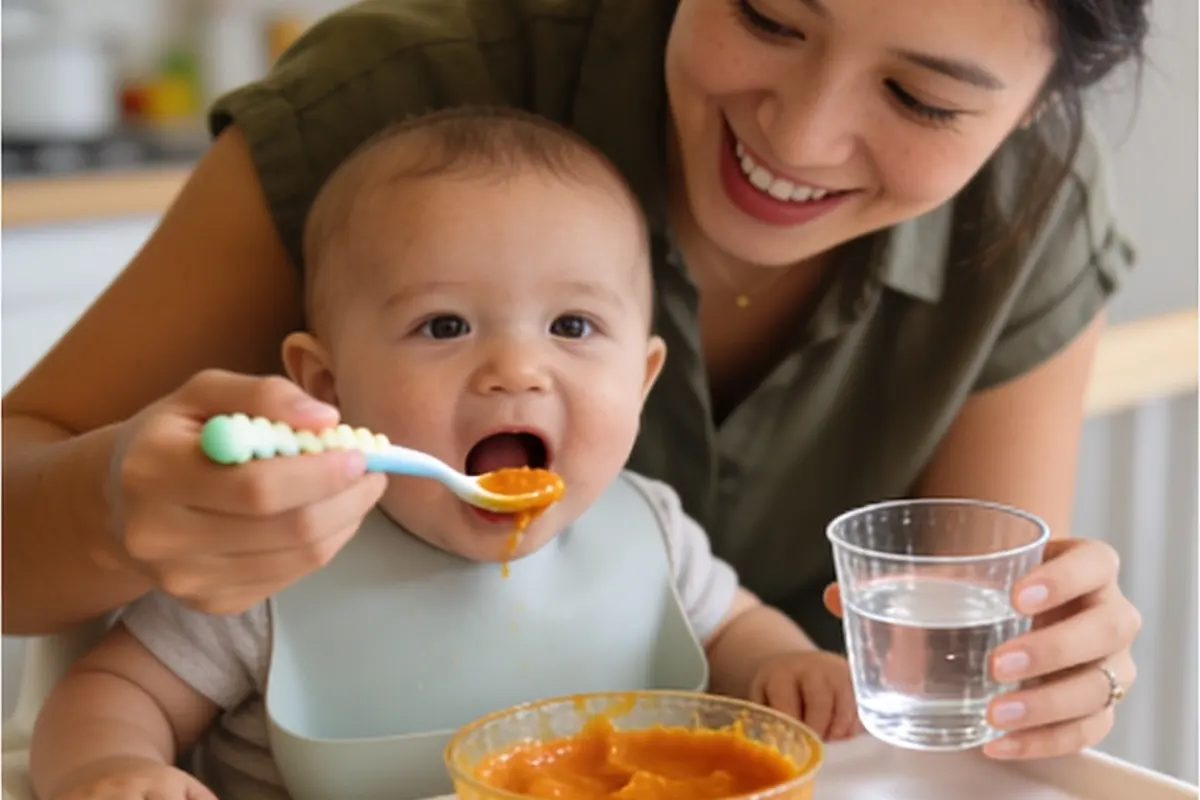
Starting solids, step by step
- Watch your baby, not the calendar. Readiness signs include sitting with support and good head control, opening their mouth when food comes, and swallowing rather than pushing food back out with the tongue (AAP; CDC). If your baby keeps pushing food out, wait a week or two and try again (AAP).
- Start small. Begin with half a spoonful or less and work up to a teaspoon or two. Offering a little breast milk or formula first keeps your baby from getting frustrated when very hungry (AAP).
- One new food at a time. The AAP and CDC suggest one single-ingredient food every 3 to 5 days so you can spot a reaction. There's no required order, and starting with fruit doesn't make babies dislike vegetables (AAP; CDC).
- Lead with iron and zinc. Meat purees and iron-fortified infant cereal are good early choices; don't put cereal in a bottle (AAP). Eggs, fish, beans, lentils, and tofu also supply iron, and vitamin C foods like tomatoes or berries help babies absorb iron from plants (CDC).
Script: "Here comes some sweet potato. Mmm." (Hold the spoon near your baby's lips and wait for them to open up, or not.)
Spoon, finger foods, or both
There's no single right way. The AAP says families can flex baby-led weaning to fit: babies who are spoon-fed for a while still learn to feed themselves, and you may need to take the lead on allergens like peanut and egg (AAP). Either way:
- Upright and buckled. Seat your baby in a high chair with the harness on (AAP), and don't let them eat in a car seat or stroller or while lying down (CDC).
- Soft and finger-shaped. Offer foods your baby can mash with their gums, cut into strips about the size of a small baby carrot. Avoid round, coin-shaped slices (AAP).
- Iron at every meal. In the BLISS trial, self-feeding babies had normal iron levels when parents were coached to offer a "high-iron" food at each meal (Daniels et al., 2018).
- Eyes on your baby. Watch at all times while they eat, and keep meals calm and unhurried (CDC).
Peanut, egg, and other allergens
The 2017 US guidelines sort babies into three groups (NIAID):
- Severe eczema, egg allergy, or both: start peanut as early as 4 to 6 months, after checking with your pediatrician, who may order an allergy test or refer you to a specialist first.
- Mild to moderate eczema: start peanut around 6 months.
- No eczema or food allergy: introduce peanut freely at home, along with other solids.
A 2021 consensus from US and Canadian allergy societies recommends introducing both peanut and egg around 6 months (not before 4), with no screening test required, and other allergens around the same time (Fleischer et al., 2021). If your pediatrician doesn't bring it up, ask.
- Start after a few first foods (NIAID). Thin 2 teaspoons of smooth peanut butter with 2 to 3 teaspoons of hot water and let it cool, or stir it into a puree your baby already eats (NIAID). For egg, offer about a third of a well-cooked egg, mashed (AAP).
- Taste, wait, continue. NIAID's home-feeding steps, written for babies with severe eczema or egg allergy whose tests were reassuring: feed at home on a day your baby is well, offer a small taste, wait 10 minutes, give the rest, and watch for 2 hours (NIAID).
- Keep it up. The goal is about 6 to 7 grams of peanut protein a week over 3 or more feedings (NIAID); 2 teaspoons of peanut butter has about 2 grams (NIAID). Keep egg and other allergens in the diet too, and never serve whole nuts (AAP).
Know the signs of a reaction. Mild signs include a new rash or a few hives around the mouth or face. Lip, face, or tongue swelling, vomiting, widespread hives, trouble breathing, wheezing, repeated coughing, pale or blue skin, or sudden tiredness or floppiness are serious; call 911 (NIAID).
Gagging is normal. Choking is silent.
Gagging is your baby's natural defense against choking. At 6 months the gag reflex sits farther forward in the mouth and moves back as babies grow, so coughing, gagging, and pushing food out are expected in the first months of solids. Give your baby a moment to work it out, and don't sweep food out with your finger, which can push it deeper (Children's Wisconsin).
Choking means the airway is blocked. Signs include a weak or no cough, high-pitched squeaks or no sound, being unable to cry, pale or blue skin, and a panicked look (Red Cross). Have someone call 911 while you hold your baby face-down along your forearm, head lower than the body, and give 5 firm back blows, then turn them face-up and give 5 chest thrusts. Repeat until the food comes out or your baby can cough or cry, and start CPR if they become unresponsive (Red Cross). The 2025 AHA and AAP guidelines keep this approach and advise against abdominal thrusts for babies (AAP, 2025). Reading isn't practice, so take a hands-on infant CPR class (AAP).
Drinks and foods to skip before age 1
- Drinks: a few sips of water from a cup are fine (see What can my 6-month-old drink?), but no juice before 12 months (AAP) and no cow's milk as a drink; plain yogurt and cheese are fine (CDC).
- Honey: none before 12 months, not even on a pacifier, because it can cause botulism (CDC).
- Also skip added sugar, salty foods, caffeine, high-mercury fish like shark and swordfish, and unpasteurized milk, cheese, and juice (CDC).
- Rotate your grains. Rice absorbs more arsenic than other crops, so rice cereal shouldn't be the first or only cereal; try oat, barley, or multigrain. The AAP says the low levels of heavy metals in baby foods are likely a small part of a child's overall exposure, and serving a variety of foods lowers it further (AAP).
Feed with your baby, not at them
Watch for hunger signs, like reaching for food, opening up for the spoon, or getting excited when food appears, and fullness signs, like pushing food away, closing their mouth, or turning their head. Let your baby decide how much; they don't need to finish the jar, and food shouldn't be a reward or punishment (CDC). If your baby cries or turns away, stop and try again another time (AAP). It may take 10 to 15 tries before a baby accepts a new food (AAP).
Script: "You're turning away. All done? Okay. We'll try carrots again tomorrow."
Caring for first teeth
- Brush from the first tooth. Twice a day, with a smear of fluoride toothpaste the size of a grain of rice (AAP). Brush after the last drink or food of the day, and don't put your baby to bed with a bottle (AAP).
- Ask about varnish. The AAP and the US Preventive Services Task Force recommend fluoride varnish once teeth appear; your pediatrician can paint it on (AAP). In a Cochrane review, varnish prevented about 37% of decay in baby teeth, with moderate-quality evidence (Marinho et al., 2013).
- Check your water. If your tap water isn't fluoridated, ask your pediatrician or dentist about your baby's cavity risk (AAP). Fluoride drops are now contested: in October 2025 the FDA said these unapproved products shouldn't be used before age 3 (FDA), while the American Academy of Pediatric Dentistry still supports them after a risk assessment (AAPD). Ask what your pediatrician recommends.
- Soothe sore gums simply with a clean finger, a solid teething ring, or a cold, wet washcloth, and ask your pediatrician for the right dose if your baby needs pain medicine. Skip teething tablets, benzocaine gels, and amber necklaces. Plan a first dental visit after the first tooth and by the first birthday (AAP).
Sleep: routine first, then decide
- Keep a short, predictable bedtime routine. The AAP's version is "Brush, Book, Bed" at a regular bedtime (AAP). In a survey of mothers of 10,085 young children, more consistent routines went with better sleep, though a survey can't prove cause (Mindell et al., 2015).
- Drowsy but awake. For babies 4 months and older, the AAP suggests putting them down drowsy and giving them a few minutes to resettle after waking. You can still feed, change, or comfort them when needed (AAP).
- Sleep training is a choice, not a requirement. Methods like graduated extinction and bedtime fading have improved sleep in trials without lasting harm (see the research above). If you try one, pick a method you can stick with.
- Expect setbacks. When separation anxiety brings new night waking, reassure calmly and consistently (AAP).
Warming up to new people
Even favorite relatives can make a wary baby cry if they swoop in too fast (AAP), so let your baby watch new people from your arms first. Tell your baby matter-of-factly when you're leaving, even just for another room. A familiar sitter helps, and a new one should arrive early enough to get acquainted; then offer a distraction, say goodbye, and go (AAP). If you can, avoid starting child care in the 7- to 12-month window or ease into it, with a short goodbye ritual you repeat every day (AAP).
Look after yourself too
The 6-month visit is the last of four checkups at which the AAP recommends screening the birthing parent for postpartum depression (Earls et al., 2019). Partners count: about 10% of fathers have depression around a birth, and studies reported higher rates, 25.6%, at 3 to 6 months after, though results varied widely (Paulson & Bazemore, 2010). Help now: call or text the National Maternal Mental Health Hotline at 1-833-TLC-MAMA (1-833-852-6262), or call or text 988. In an emergency, call 911 (CDC).
What to teach#
Your baby learns all day from ordinary routines with you. Right now the curriculum is:
- Eating is a skill. Sitting up, taking food from a spoon, resting between bites, and stopping when full are all learned (AAP).
- I can make things happen. Banging, shaking, and dropping teach cause and effect (AAP).
- Conversations take turns. You talk, you pause, your baby answers (CDC).
- Things come back. Peekaboo and hiding games teach that people and toys still exist out of sight (AAP).
Words before words
When your baby babbles or gestures and you answer with eye contact, words, or a hug, that back-and-forth, called serve and return, helps build connections in the brain (Harvard Center on the Developing Child). When your baby lands on a syllable like "bah," say it back, then add words with that sound, like "ball" and "box" (AAP). And name what your baby looks at, all day long (CDC).
Script: "Ba-ba-ba! You said 'ba.' Ball! Here's your ball." (Pause for your baby's turn.)
Baby sign language is popular, but in the first randomized trial, which followed 40 babies from 8 to 20 months, encouraging gestures didn't speed up language. Mothers who used signs did become more responsive to their babies' cues (Kirk et al., 2013). Sign if you enjoy it; talking is what builds language.
Screens: video chat only
CDC doesn't recommend screen time before age 2, with video calls to loved ones as the exception (CDC), and the WHO doesn't recommend any screen time for babies under 1 (WHO). The AAP says babies under 18 months learn best from real-world interactions (Munzer, AAP).
Family jobs come later; family life starts now
Chores aren't on the list yet. Your baby's work is eating, sleeping, playing, and learning. But babies watch everything, so bring them into family life: a seat at family meals, which the AAP encourages from the very first feeding (AAP), and a running commentary while you cook or fold laundry. In lab studies, toddlers as young as 18 months readily helped adults reach their goals without being asked or rewarded (Warneken & Tomasello, 2006). The 1-year guide picks up first family jobs from there, and our post on chores that raise independent kids takes the longer view.
Activities to try#
Every activity here is for an awake, alert baby with an adult right there. Stop when your baby turns away, fusses, or arches. Feeding activities assume your baby is sitting upright and buckled into a high chair (AAP).
How we rate the evidence
- Strong evidence
- Randomized trials or systematic reviews show a consistent benefit.
- Moderate evidence
- Consistent observational research, or a major guideline (AAP, WHO) built on research.
- Emerging evidence
- Small or early studies. Plausible, not yet proven.
- Mixed evidence
- Studies disagree, or reviews rate the evidence as weak.
Too tired to choose? Let us pick one.
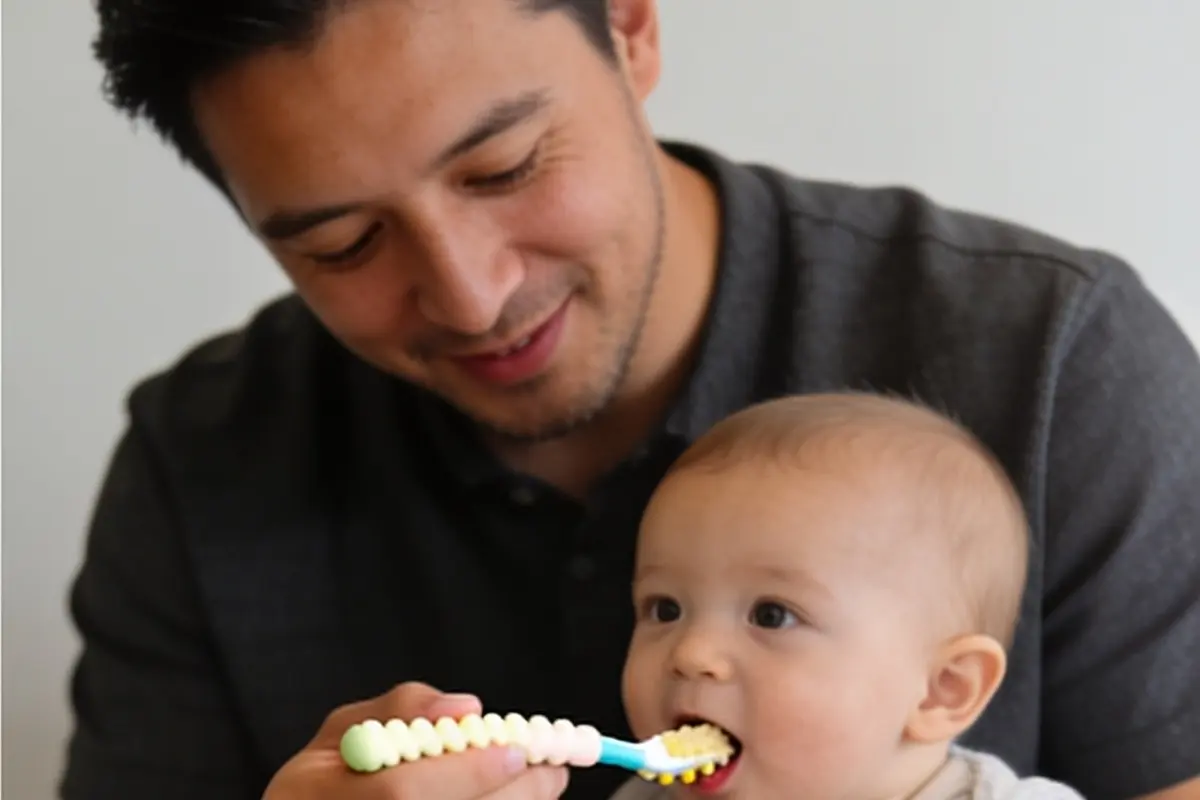
First tastes from a spoon
Moderate evidence- Time
- A few minutes, once a day to start
- Builds
- Eating skills, new flavors, iron intake
- Pick a time when your baby is alert and only a little hungry.
- Offer half a spoonful or less of a smooth, iron-rich puree, like meat or iron-fortified oat cereal.
- Wait for your baby to open their mouth before the spoon goes in.
- Stop when they turn away or close their lips.
Make it work: Messy faces and grimaces are normal. If your baby makes a face at a food, offer it again over the next week or so; in one trial, babies ate more green beans after 8 days even though many kept grimacing (Forestell & Mennella, 2007).
Evidence: Moderate. The AAP recommends small, soft, iron-rich first foods (AAP), and small trials show babies eat more of a new food after repeated tastes (Sullivan & Birch, 1994).
Peanut and egg, early and often
Strong evidence- Time
- A few minutes, 3 or more times a week once started
- Builds
- Lower risk of peanut and egg allergy
- If your baby has severe eczema or an egg allergy, talk to your pediatrician before starting.
- Thin 2 teaspoons of smooth peanut butter with 2 to 3 teaspoons of hot water and let it cool.
- Offer a small taste, wait 10 minutes, then offer the rest at your baby's usual pace.
- On another day, offer about a third of a well-cooked egg, mashed.
Make it work: Keep both in the weekly rotation once they're in. Never offer whole nuts or thick globs of nut butter (AAP).
Evidence: Strong. A randomized trial found early, regular peanut prevented most peanut allergy in high-risk babies, with protection lasting to age 12 (Du Toit et al., 2015; Du Toit et al., 2024), and a meta-analysis found moderate-certainty evidence for early egg and peanut (Ierodiakonou et al., 2016).
Soft finger-food practice
Moderate evidence- Time
- Part of one meal a day
- Builds
- Self-feeding, hand skills, chewing practice
- Cut a soft food, like ripe avocado or well-steamed sweet potato, into finger-length strips.
- Check that it's soft enough for your baby to mash with their gums.
- Put a piece or two on the tray and let your baby explore, gum, and spit out.
- Stay at the table and watch the whole time.
Make it work: Skip round, coin-shaped slices, which raise choking risk (AAP).
Evidence: Moderate. In a randomized trial of 206 families, babies who fed themselves soft foods didn't choke more or have lower iron than spoon-fed babies (Fangupo et al., 2016; Daniels et al., 2018); a 2026 review agrees but calls the evidence limited (Márquez-Díaz et al., 2026).
Sips from an open cup
Emerging evidence- Time
- A few sips with meals
- Builds
- Cup skills, a taste for plain water
- Pour a tablespoon or two of water into a small open cup.
- Hold it to your baby's lips and tip it just enough for a sip.
- Let your baby put their hands on the cup alongside yours.
Make it work: Keep water to 4 to 8 ounces a day at most. Breast milk or formula is still the main drink (AAP).
Evidence: Emerging. The AAP suggests small amounts of water in a cup from about 6 months to build cup skills (AAP); it's expert advice, not tested in trials.
Sitting practice
Emerging evidence- Time
- A few minutes, several times a day
- Builds
- Balance, trunk strength, a new view of the room
- Sit your baby on the floor between your legs, or with pillows around them.
- Put a toy in front so they lean forward on their hands.
- Stay within arm's reach for the topples.
Make it work: Floor time beats baby seats. The WHO advises not keeping babies strapped into strollers, high chairs, or carriers for more than an hour at a time (WHO).
Evidence: Emerging. CDC and the AAP suggest supported sitting with toys to look at while babies learn to balance (CDC; AAP); it hasn't been tested as a way to speed sitting.
Roll to reach
Emerging evidence- Time
- About 5 minutes, a few times a day
- Builds
- Rolling, reaching, problem-solving
- Lay your baby on a blanket on the floor, on their tummy or back.
- Put a favorite toy just out of reach to one side.
- Cheer them on, and hand it over before frustration takes over.
Evidence: Emerging. CDC suggests placing toys just out of reach to encourage rolling (CDC), and the WHO recommends interactive floor play several times a day for babies (WHO).
Peekaboo and hide the toy
Emerging evidence- Time
- A few minutes
- Builds
- Early object permanence, anticipation, laughter
- Cover your face with your hands or a cloth, then pop out: "Peekaboo!"
- Next, partly hide a toy under a cloth while your baby watches.
- See whether they pull the cloth away, and celebrate if they do.
Make it work: Start with the toy partly showing. Searching for things that are fully out of sight is a 9-month milestone (CDC).
Evidence: Emerging. The AAP says hiding games help babies learn that hidden things still exist (AAP), but lab studies disagree about what babies this age understand (Rivera et al., 1999).
The drop game
Emerging evidence- Time
- As long as your patience lasts
- Builds
- Cause and effect
- Give your baby an unbreakable spoon, cup, or toy in the high chair.
- When it drops, say "Uh-oh!" and hand it back.
- Narrate what happened: "It fell down. Here it is."
Make it work: Use things that are lightweight, unbreakable, and too big to swallow (AAP).
Evidence: Emerging. CDC suggests picking up dropped toys and handing them back to teach cause and effect (CDC), and the AAP calls dropping things on purpose an important way babies learn (AAP).
Babble back
Emerging evidence- Time
- A few minutes, during alert times
- Builds
- Turn-taking, speech sounds
- Wait for your baby to make a sound.
- Repeat it back with a smile: "Ba!"
- Add a real word with that sound: "Ball!"
- Pause and wait for a reply.
Evidence: Emerging. In one experiment, 8-month-olds' babble became more speech-like when their mothers responded right after their sounds (Goldstein et al., 2003), and CDC suggests copying your baby's sounds (CDC).
Read and point
Moderate evidence- Time
- 5 to 10 minutes a day
- Builds
- Language, attention, a shared routine
- Pick a sturdy board book with big, clear pictures.
- Point to a picture and name it.
- Let your baby pat, hold, and mouth the book.
- When your baby babbles, answer: "Yes, that's the doggy!"
Evidence: Moderate. The AAP recommends shared reading from birth, based on research with young children (Klass et al., 2024); CDC suggests "reading" colorful pictures every day and talking about them (CDC).
Brush, book, bed
Moderate evidence- Time
- 10 to 20 minutes each night
- Builds
- Healthy teeth, a calm, predictable bedtime
- After the last feed, brush any teeth with a soft brush and a rice-grain smear of fluoride toothpaste, or wipe gums with a soft washcloth if none are in yet.
- Read one short book in a dim, quiet room.
- Lay your baby on their back in their crib, drowsy but awake.
Evidence: Moderate. The AAP recommends fluoride toothpaste from the first tooth (AAP) and promotes this routine (AAP); a large survey linked consistent bedtime routines with better sleep, though it can't prove cause (Mindell et al., 2015).
Common questions#
When can my baby start eating solid food?
Most babies are ready for solid food around 6 months. CDC advises against starting before 4 months (CDC). Look for readiness signs: sitting with support and good head control, opening their mouth when food comes, and swallowing instead of pushing food back out (AAP). If your baby was born early, has trouble sitting up, or struggles to swallow soft foods, it's better to wait; ask your pediatrician (AAP).
What should my baby's first foods be?
Any soft, single-ingredient food can come first, but iron- and zinc-rich foods like pureed meat or iron-fortified infant cereal are smart early choices (AAP). Introduce one new food every 3 to 5 days. By 7 to 8 months, babies can eat vegetables, fruits, meats and other proteins, plain yogurt and cheese, and grains (CDC). Rotate cereals instead of relying on rice, which absorbs more arsenic (AAP).
How do I give my baby peanut butter safely?
Thin a little smooth peanut butter and offer it from a spoon, never as whole peanuts or a thick glob. NIAID's recipe is 2 teaspoons of smooth peanut butter stirred with 2 to 3 teaspoons of hot water and cooled (NIAID). If your baby has severe eczema or an egg allergy, talk to your pediatrician first; otherwise, introduce it at home around 6 months, after a few other foods (NIAID), and keep serving it 3 or more times a week (NIAID). See Peanut, egg, and other allergens for the details.
Is baby-led weaning safe?
Baby-led weaning appears to be about as safe as spoon-feeding when foods are soft and safely shaped and your baby is upright and watched. In the BLISS trial of 206 families, self-feeding babies didn't choke more than spoon-fed babies (Fangupo et al., 2016), and a 2024 review of seven studies found no difference in choking by feeding approach (Correia et al., 2024). The AAP cautions that self-feeding babies may get too few calories or too little iron, and that mixing spoon-feeding with finger foods is fine (AAP).
How can I tell if my baby is gagging or choking?
A gagging baby is noisy, coughing and sputtering, while a choking baby is silent or squeaky and can't cry or cough well. Gagging is a protective reflex that's common in the first months of solids; give your baby a moment and don't fish for the food with your finger (Children's Wisconsin). Signs of choking include a weak or no cough, high-pitched sounds or none, pale or blue skin, and a panicked look. Call 911 and start back blows and chest thrusts (Red Cross).
What can my 6-month-old drink?
Breast milk or formula is still the main drink at 6 months, plus a few sips of water from a cup; juice, cow's milk as a drink, and honey all wait until after the first birthday. You can offer up to 4 to 8 ounces of water a day in an open, sippy, or straw cup, and fluoridated tap water helps protect teeth (AAP). Babies under 12 months shouldn't have juice (AAP). Cow's milk as a drink can cause intestinal bleeding before 12 months, and honey can cause botulism, so keep it out of food, drinks, and pacifiers (CDC). Plain yogurt and cheese are fine now (CDC).
When should I start brushing my baby's teeth?
Start as soon as the first tooth appears, twice a day, with a smear of fluoride toothpaste the size of a grain of rice (AAP). Ask your pediatrician about fluoride varnish, which the AAP and USPSTF recommend once teeth come in, and plan a first dental visit after the first tooth and by the first birthday. Don't put your baby to bed with a bottle (AAP).
Does teething cause a fever?
No, teething doesn't cause a true fever, though it can nudge your baby's temperature up slightly. A temperature over 100.4°F (38°C) points to an illness, not teeth (AAP; Massignan et al., 2016). For sore gums, try a clean finger, a solid teething ring, or a cold, wet washcloth, and skip teething tablets, benzocaine gels, and amber necklaces (AAP).
Should my 6-month-old be sleeping through the night?
Not necessarily; night waking is still common and normal at 6 months. The AAP says it's normal for a 6-month-old to wake and resettle after a few minutes (AAP). In a study of 388 babies, 27.9% to 57.0% of 6- and 12-month-olds didn't sleep 6 or 8 hours straight, and that wasn't linked to their development (Pennestri et al., 2018). If night waking is wearing your family down, ask your pediatrician about options, including sleep training (Price et al., 2012).
When do babies sit up on their own?
Most babies can sit without support by 9 months, but the timing varies widely: healthy babies in a WHO study first did it anywhere from 3.8 to 9.2 months (WHO Multicentre Growth Reference Study Group, 2006). At 6 months, many sit while leaning on their hands (CDC); sitting without support is on the 9-month list (CDC). Tell your pediatrician if your baby can't sit with help by 6 months, or seems very stiff or very floppy (AAP).
What vaccines does my baby get at 6 months?
At 6 months, the AAP schedule continues the series started at 2 months and adds flu and COVID-19 protection. Its checklist says your baby may get third doses of DTaP, Hib, pneumococcal, polio, hepatitis B, and rotavirus vaccines, though some depend on the brand used (AAP). The third hepatitis B dose can come anywhere from 6 to 18 months, and a first flu vaccine takes two doses 4 weeks apart (AAP; AAP). The AAP also recommends a 2026–2027 COVID-19 vaccine for all babies 6 through 23 months, and RSV protection for babies under 8 months entering their first RSV season unless the birthing parent was vaccinated in pregnancy (AAP). US guidance has been changing. The AAP and CDC schedules have differed in 2026 (AAP), and federal vaccine changes have been challenged in court (STAT, 2026). Ask your pediatrician which schedule they follow.
Safety and when to call your pediatrician#
Safe sleep, now that your baby rolls
Every rule in the newborn guide still applies. Keep placing your baby on their back to sleep; if they roll both ways comfortably, you don't need to flip them back, as long as the crib is bare. Room-share without bed-sharing for at least the first 6 months (AAP). Lower the crib mattress before your baby can sit up, move it to the lowest position before they can stand, and take down any mobile once your baby is 5 months old or gets up on hands and knees (AAP).
Mealtime safety
Choking is a leading cause of death for young children, and two-thirds of children who die from choking are babies under 1 (AAP). Before age 1, avoid hot dogs and meat sticks, nuts and seeds, chunks of meat or cheese, whole grapes, popcorn, chunks of peanut butter, raw vegetables, raw fruit chunks like apple, and hard, gooey, or sticky candy (AAP). Learn what to do if your baby chokes.
Babyproof before your baby moves
- Look at floor level for coins, buttons, small toy parts, and button or coin batteries, which can cause swift, life-threatening damage if swallowed (AAP). If you think your baby swallowed a battery, call Poison Help at 1-800-222-1222 right away, without waiting to see what happens: your baby may need an X-ray at once, because a battery stuck in the esophagus can do severe damage in 2 hours (Poison Control).
- Anchor dressers, bookcases, and TV stands to the wall; gate the top and bottom of stairs with gates mounted to the wall studs, not accordion-style; plug unused outlets; and choose cordless window coverings or tie cords out of reach (AAP).
- Lock up medicines, cleaners, and alcohol, and save Poison Help (1-800-222-1222) in your phone (AAP).
- Skip baby walkers. They don't help babies learn to walk and can delay it, and they send thousands of children to hospitals each year, mostly from falls down stairs. The AAP has called for a ban; stationary activity centers are a safer swap (AAP).
Water, baths, and burns
Babies can drown in 1 or 2 inches of water, silently and within seconds. Most child drownings at home happen in bathtubs, and more than half of bathtub deaths involve babies under 1, so never leave your baby alone in the bath, even in a bath seat, which can tip over. Set your water heater so the hottest tap water is no more than 120°F, never carry a hot drink while holding your baby, and keep mugs away from table edges (AAP).
Car seats
Keep your baby rear-facing as long as possible, until they reach the highest weight or height their seat allows. Rear-facing-only infant seats typically fit babies up to 22 to 35 pounds and 26 to 35 inches, depending on the model; when your baby outgrows theirs, switch to a convertible or all-in-one seat installed rear-facing. Keep the harness snug, the chest clip at armpit level, and bulky coats off under the straps (AAP).
Sun protection
From 6 months, sunscreen is fine on uncovered skin like the face and hands. Choose broad-spectrum SPF 15 or higher, ideally a mineral formula (zinc oxide or titanium dioxide), and reapply every 90 minutes to 2 hours. Shade still comes first (AAP).
Call 911 if your baby
- Is choking and can't cry, cough, or breathe, or has a weak cough, high-pitched sounds, or blue or pale skin (Red Cross)
- Is struggling for each breath, has stopped breathing, or has bluish lips or face (AAP)
- Has trouble breathing, swelling of the lips, face, or tongue, widespread hives, or sudden floppiness after eating a food (NIAID; AAP)
- Can't be woken up, isn't moving, or is very weak, or has purple or blood-colored spots on the skin (AAP)
- Has a seizure, or was knocked out for more than a minute, after a head injury (AAP)
Go to the ER now if your baby
- Has any trouble breathing, including ribs pulling in with each breath or loud wheezing (AAP)
- Has a seizure with a fever, a stiff neck, or a bulging soft spot, or is hard to wake or not alert when awake (AAP)
- After a head injury, vomits 2 or more times, cries and won't stop, or is awake but not alert (AAP)
Call your pediatrician right away if your baby
- Has a fever higher than 104°F (40°C) (AAP); the AAP also says you may need to call about a temperature of 103°F (39.4°C) or higher in babies over 6 months (AAP)
- Seems dehydrated: no urine in more than 8 hours, dark urine, a very dry mouth, or no tears (AAP)
- Cries nonstop, cries when touched or moved, or won't move an arm or leg normally (AAP)
- Has had any head injury; a call is advised for every baby under 1 (AAP)
- Has a mild reaction after a new food, like a new rash, a few hives around the mouth or face, or diarrhea; hold off on that food until you've talked, but call 911 for vomiting or any of the serious signs above (NIAID; AAP)
- Looks or acts very sick, or you think they need to be seen urgently (AAP)
Call within a day if your baby has had a fever for more than 48 hours with no other symptoms, or any fever for more than 3 days (AAP). If you think your baby swallowed something poisonous, call Poison Help at 1-800-222-1222 (AAP).
Don't wait on development worries
CDC's advice is not to wait: talk with your pediatrician, ask about developmental screening, and know that you can call your state's early intervention program for a free evaluation without a referral or diagnosis (CDC). Bring it up if your baby:
- Doesn't laugh, squeal, or trade sounds with you (CDC)
- Doesn't reach for toys, or has trouble getting things to their mouth (AAP)
- Can't sit with help, doesn't roll in either direction, or doesn't bear some weight on their legs by 7 months (AAP)
- Seems very stiff or very floppy, or reaches with only one hand (AAP)
- Doesn't respond to sounds, or doesn't babble or imitate sounds by 7 months (AAP; AAP)
- Has eyes that consistently turn in or out (AAP)
- Has lost skills they used to have (CDC)
The 6-month checkup
Expect measurements, an exam, and questions about solids, rolling, sitting, teeth, and childproofing (AAP). The AAP schedule for this visit also includes developmental surveillance, an oral health risk assessment, a check on fluoride needs, lead and hearing risk questions, and a depression screen for the birthing parent (AAP, 2025). Your pediatrician may apply fluoride varnish if a tooth has come in (AAP). For vaccines, see What vaccines does my baby get at 6 months? above. Bring your questions in writing.
Sources#
- Centers for Disease Control and Prevention. "Milestones by 6 Months." Learn the Signs. Act Early. program, updated 2026. https://www.cdc.gov/act-early/milestones/6-months.html
- Centers for Disease Control and Prevention. "Milestones by 9 Months." Learn the Signs. Act Early. program, updated 2026. https://www.cdc.gov/act-early/milestones/9-months.html
- Centers for Disease Control and Prevention. "Concerned About Your Child's Development?" 2026. https://www.cdc.gov/act-early/families/concerned.html
- Centers for Disease Control and Prevention. "When, What, and How to Introduce Solid Foods." 2026. https://www.cdc.gov/infant-toddler-nutrition/foods-and-drinks/when-what-and-how-to-introduce-solid-foods.html
- Centers for Disease Control and Prevention. "Foods and Drinks to Avoid or Limit." 2026. https://www.cdc.gov/infant-toddler-nutrition/foods-and-drinks/foods-and-drinks-to-avoid-or-limit.html
- Centers for Disease Control and Prevention. "Choking Hazards." 2026. https://www.cdc.gov/infant-toddler-nutrition/foods-and-drinks/choking-hazards.html
- Centers for Disease Control and Prevention. "Iron." Infant and Toddler Nutrition, 2026. https://www.cdc.gov/infant-toddler-nutrition/vitamins-minerals/iron.html
- Centers for Disease Control and Prevention. "Signs Your Child Is Hungry or Full." 2026. https://www.cdc.gov/infant-toddler-nutrition/mealtime/signs-your-child-is-hungry-or-full.html
- Centers for Disease Control and Prevention. "Symptoms of Depression Among Women." 2024. https://www.cdc.gov/reproductive-health/depression/index.html
- American Academy of Pediatrics. "When Can Babies Start Solid Foods? Readiness & Feeding Tips." HealthyChildren.org, updated 2026. https://www.healthychildren.org/English/ages-stages/baby/feeding-nutrition/Pages/Starting-Solid-Foods.aspx
- Cox A, Pistiner M. "When to Introduce Egg, Peanut Butter & Other Common Food Allergens to a Baby." HealthyChildren.org, updated 2025. https://www.healthychildren.org/English/healthy-living/nutrition/Pages/when-to-introduce-egg-peanut-butter-and-other-common-food-allergens-to-your-baby-food-allergy-prevention-tips.aspx
- Agbim IA, Hurtado CW. "Baby-Led Weaning: Is It Safe?" HealthyChildren.org, updated 2024. https://www.healthychildren.org/English/ages-stages/baby/feeding-nutrition/Pages/baby-led-weaning-is-it-safe.aspx
- Bradin S. "Choking Prevention for Babies & Children: What Every Parent Needs to Know." HealthyChildren.org, updated 2026. https://www.healthychildren.org/English/health-issues/injuries-emergencies/Pages/Choking-Prevention.aspx
- American Academy of Pediatrics. "AHA, AAP Update CPR Guidelines To Help Save Young Lives." HealthyChildren.org, 2025. https://www.healthychildren.org/English/news/Pages/AHA-and-AAP-release-update-CPR-guidelines-to-help-save-young-lives.aspx
- Muth ND. "Recommended Drinks for Children Age 5 & Younger." HealthyChildren.org, updated 2023. https://www.healthychildren.org/English/healthy-living/nutrition/Pages/Recommended-Drinks-for-Young-Children-Ages-0-5.aspx
- American Academy of Pediatrics. "Heavy Metals in Baby Food: Reducing Risk of Exposure." HealthyChildren.org, updated 2025. https://www.healthychildren.org/English/ages-stages/baby/feeding-nutrition/Pages/Metals-in-Baby-Food.aspx
- American Academy of Pediatrics Section on Oral Health. "Fluoride for Children: Parent FAQs." HealthyChildren.org, updated 2025. https://www.healthychildren.org/English/healthy-living/oral-health/Pages/FAQ-Fluoride-and-Children.aspx
- DiMaggio D, Cernigliaro J. "Baby's First Tooth: 7 Facts Parents Should Know." HealthyChildren.org, updated 2022. https://www.healthychildren.org/English/ages-stages/baby/teething-tooth-care/Pages/Babys-First-Tooth-Facts-Parents-Should-Know.aspx
- American Academy of Pediatrics. "Brush, Book, Bed: How to Structure Your Child's Nighttime Routine." HealthyChildren.org, updated 2024. https://www.healthychildren.org/English/healthy-living/oral-health/Pages/Brush-Book-Bed.aspx
- American Academy of Pediatrics. "Movement Milestones: Babies 4 to 7 Months." HealthyChildren.org, updated 2021. https://www.healthychildren.org/English/ages-stages/baby/Pages/Movement-4-to-7-Months.aspx
- American Academy of Pediatrics. "Cognitive Development in Infants: 4 to 7 Months." HealthyChildren.org, updated 2023. https://www.healthychildren.org/English/ages-stages/baby/Pages/Cognitive-Development-4-to-7-Months.aspx
- American Academy of Pediatrics. "Language Development: 4 to 7 Months." HealthyChildren.org, updated 2009. https://www.healthychildren.org/English/ages-stages/baby/Pages/Language-Development-4-to-7-Months.aspx
- American Academy of Pediatrics. "Developmental Milestones: 7 Months." HealthyChildren.org, updated 2009. https://www.healthychildren.org/English/ages-stages/baby/Pages/Developmental-Milestones-7-Months.aspx
- American Academy of Pediatrics. "Checkup Checklist: 6 Months Old." HealthyChildren.org, updated 2023. https://www.healthychildren.org/English/ages-stages/Your-Childs-Checkups/Pages/Your-Checkup-Checklist-6-Months-Old.aspx
- American Academy of Pediatrics. "Corrected Age For Preemies." HealthyChildren.org, accessed 2026. https://www.healthychildren.org/English/ages-stages/baby/preemie/Pages/Corrected-Age-For-Preemies.aspx
- American Academy of Pediatrics. "AAP Guide: Vaccines Your Child Needs by Age 6." HealthyChildren.org, updated 2026. https://www.healthychildren.org/English/safety-prevention/immunizations/Pages/Your-Babys-First-Vaccines.aspx
- American Academy of Pediatrics. "AAP Releases Recommended Childhood and Adolescent Immunization Schedule for 2026." HealthyChildren.org, 2026. https://www.healthychildren.org/English/news/Pages/AAPs-recommended-childhood-and-adolescent-immunization-schedule-for-2026.aspx
- American Academy of Pediatrics. "AAP (Influenza) Flu Prevention & Treatment Recommendations for 2026-27." HealthyChildren.org, 2026. https://www.healthychildren.org/English/news/Pages/aap-%28influenza%29-flu-prevention-recommendations-for-2026-27.aspx
- American Academy of Pediatrics. "AAP Releases RSV Immunization Recommendations for 2026-2027 Season." HealthyChildren.org, 2026. https://www.healthychildren.org/English/news/Pages/aap-updates-rsv-immunization-recommendations-for-2026-2027-season.aspx
- American Academy of Pediatrics. "Iron Deficiency & Iron Deficiency Anemia: AAP Updates Screening, Prevention & Treatment Guidance." HealthyChildren.org, 2026. https://www.healthychildren.org/English/news/Pages/iron-deficiency-anemia-prevention-screening-treatment-AAP-updates-guidance.aspx
- American Academy of Pediatrics Section on Gastroenterology, Hepatology and Nutrition. "Vitamin D for Babies, Children & Adolescents." HealthyChildren.org, updated 2022. https://www.healthychildren.org/English/healthy-living/nutrition/Pages/vitamin-d-on-the-double.aspx
- Moon RY. "How to Keep Your Sleeping Baby Safe: AAP Policy Explained." HealthyChildren.org, updated 2026. https://www.healthychildren.org/English/ages-stages/baby/sleep/Pages/a-parents-guide-to-safe-sleep.aspx
- American Academy of Pediatrics. "Getting Your Baby to Sleep." HealthyChildren.org, updated 2024. https://www.healthychildren.org/English/ages-stages/baby/sleep/Pages/getting-your-baby-to-sleep.aspx
- American Academy of Pediatrics. "Separation Anxiety & Sleeping Trouble in Young Children." HealthyChildren.org, updated 2022. https://www.healthychildren.org/English/healthy-living/sleep/Pages/separation-anxiety-and-sleeping.aspx
- American Academy of Pediatrics. "Emotional and Social Development: 8 to 12 Months." HealthyChildren.org, updated 2009. https://www.healthychildren.org/English/ages-stages/baby/Pages/Emotional-and-Social-Development-8-12-Months.aspx
- American Academy of Pediatrics. "Making Baby Drop Off at Child Care Easier." HealthyChildren.org, updated 2022. https://www.healthychildren.org/English/family-life/work-and-child-care/Pages/making-baby-drop-off-at-child-care-easier.aspx
- American Academy of Pediatrics. "Make Baby's Room Safe: Parent Checklist." HealthyChildren.org, updated 2020. https://www.healthychildren.org/English/safety-prevention/at-home/Pages/Make-Babys-Room-Safe.aspx
- American Academy of Pediatrics. "Home Safety: Tips for Families With Young Children." HealthyChildren.org, updated 2022. https://www.healthychildren.org/English/safety-prevention/at-home/Pages/Home-Safety-Heres-How.aspx
- American Academy of Pediatrics. "Baby Walkers: A Dangerous Choice." HealthyChildren.org, updated 2022. https://www.healthychildren.org/English/safety-prevention/at-home/Pages/Baby-Walkers-A-Dangerous-Choice.aspx
- American Academy of Pediatrics Council on Injury, Violence & Poison Prevention. "Infant Drowning Prevention & Water Safety: How to Protect Your Baby." HealthyChildren.org, updated 2026. https://www.healthychildren.org/English/safety-prevention/at-play/Pages/Infant-Water-Safety.aspx
- American Academy of Pediatrics. "Car Seats: Information for Families." HealthyChildren.org, updated 2026. https://www.healthychildren.org/English/safety-prevention/on-the-go/Pages/Car-Safety-Seats-Information-for-Families.aspx
- American Academy of Pediatrics. "Baby Sunburn Prevention Tips." HealthyChildren.org, updated 2026. https://www.healthychildren.org/English/ages-stages/baby/bathing-skin-care/Pages/Baby-Sunburn-Prevention.aspx
- American Academy of Pediatrics. "Fever and Your Baby." HealthyChildren.org, updated 2025. https://www.healthychildren.org/English/health-issues/conditions/fever/Pages/Fever-and-Your-Baby.aspx
- American Academy of Pediatrics. "Fever" (symptom checker). HealthyChildren.org, accessed 2026. https://www.healthychildren.org/English/tips-tools/symptom-checker/Pages/symptomviewer.aspx?symptom=Fever
- American Academy of Pediatrics. "Breathing Trouble" (symptom checker). HealthyChildren.org, accessed 2026. https://www.healthychildren.org/English/tips-tools/symptom-checker/Pages/symptomviewer.aspx?symptom=Breathing+Trouble
- American Academy of Pediatrics. "Head Injury" (symptom checker). HealthyChildren.org, accessed 2026. https://www.healthychildren.org/English/tips-tools/symptom-checker/Pages/symptomviewer.aspx?symptom=Head+Injury
- Munzer T. "Helping Kids Thrive in a Digital World: AAP Policy Explained." HealthyChildren.org, updated 2026. https://www.healthychildren.org/English/family-life/Media/Pages/helping-kids-thrive-in-a-digital-world-AAP-policy-explained.aspx
- American Academy of Pediatrics and Bright Futures. "Recommendations for Preventive Pediatric Health Care" (Periodicity Schedule). 2025. https://downloads.aap.org/AAP/PDF/periodicity_schedule.pdf
- National Institute of Allergy and Infectious Diseases. "Addendum Guidelines for the Prevention of Peanut Allergy in the United States: Summary for Parents and Caregivers." 2017. https://www.niaid.nih.gov/sites/default/files/peanut-allergy-prevention-guidelines-parent-summary.pdf
- National Institute of Allergy and Infectious Diseases. "Instructions for Home Feeding of Peanut Protein for Infants at Low Risk of an Allergic Reaction to Peanut" (Appendix D). 2017. https://www.niaid.nih.gov/sites/default/files/addendum_guidelines_peanut_appx_d.pdf
- Togias A, Cooper SF, Acebal ML, et al. "Addendum Guidelines for the Prevention of Peanut Allergy in the United States: Report of the NIAID-Sponsored Expert Panel." NIAID, 2017. https://www.niaid.nih.gov/sites/default/files/addendum-peanut-allergy-prevention-guidelines.pdf
- US Food and Drug Administration. "FDA Acts to Protect Children from Unapproved Fluoride Drug Products." 2025. https://www.fda.gov/news-events/press-announcements/fda-acts-protect-children-unapproved-fluoride-drug-products
- American Academy of Pediatric Dentistry. "AAPD Statement on Recent FDA Announcement Related to Fluoride Supplements." 2025. https://www.aapd.org/statement-on-recent-fda-announcement-to-fluoride-supplements/
- World Health Organization. "To grow up healthy, children need to sit less and play more." 2019. https://www.who.int/news/item/24-04-2019-to-grow-up-healthy-children-need-to-sit-less-and-play-more
- Lehman P. "Choking vs. gagging: What parents need to know when introducing solid foods to children." Children's Wisconsin, 2024. https://childrenswi.org/at-every-turn/stories/2024/03/choking-vs-gagging-what-parents-need-to-know-when-introducing-solid-foods-to-children
- American Red Cross. "Infant Choking: How To Help." Accessed 2026. https://www.redcross.org/take-a-class/resources/learn-first-aid/infant-choking
- National Capital Poison Center. "Swallowed a button battery? Battery in the nose or ear?" Poison Control, accessed 2026. https://www.poison.org/battery
- Center on the Developing Child at Harvard University. "Serve and Return." Accessed 2026. https://developingchild.harvard.edu/key-concept/serve-and-return/
- STAT. "HHS appeals ruling that stalled many of Kennedy's vaccine policy changes." 2026. https://www.statnews.com/2026/04/29/hhs-appealing-acip-vaccine-policy-lawsuit-ruling/
- Zubler JM, Wiggins LD, Macias MM, et al. "Evidence-Informed Milestones for Developmental Surveillance Tools." Pediatrics, 2022. https://pubmed.ncbi.nlm.nih.gov/35132439/
- Du Toit G, Roberts G, Sayre PH, et al. "Randomized trial of peanut consumption in infants at risk for peanut allergy." New England Journal of Medicine, 2015. https://pubmed.ncbi.nlm.nih.gov/25705822/
- Du Toit G, Huffaker MF, Radulovic S, et al. "Follow-up to Adolescence after Early Peanut Introduction for Allergy Prevention." NEJM Evidence, 2024. https://pubmed.ncbi.nlm.nih.gov/38804779/
- Perkin MR, Logan K, Tseng A, et al. "Randomized Trial of Introduction of Allergenic Foods in Breast-Fed Infants." New England Journal of Medicine, 2016. https://pubmed.ncbi.nlm.nih.gov/26943128/
- Ierodiakonou D, Garcia-Larsen V, Logan A, et al. "Timing of Allergenic Food Introduction to the Infant Diet and Risk of Allergic or Autoimmune Disease: A Systematic Review and Meta-analysis." JAMA, 2016. https://pubmed.ncbi.nlm.nih.gov/27654604/
- Fleischer DM, Chan ES, Venter C, et al. "A Consensus Approach to the Primary Prevention of Food Allergy Through Nutrition." Journal of Allergy and Clinical Immunology: In Practice, 2021. https://pubmed.ncbi.nlm.nih.gov/33250376/
- Gabryszewski SJ, Dudley J, Faerber JA, et al. "Guidelines for Early Food Introduction and Patterns of Food Allergy." Pediatrics, 2025. https://pubmed.ncbi.nlm.nih.gov/41110838/
- Koplin JJ, Shifti DM, Soriano VX, et al. "Egg Allergy Prevalence Before and After Guidelines for Earlier Egg Introduction." JAMA Pediatrics, 2026. https://pubmed.ncbi.nlm.nih.gov/42258202/
- Palmer DJ, Campbell DE, Nanan R, et al. "Trial of a Maternal Diet Rich in Eggs and Peanuts to Reduce Infant Allergy." New England Journal of Medicine, 2026. https://pubmed.ncbi.nlm.nih.gov/42748429/
- Taylor RW, Williams SM, Fangupo LJ, et al. "Effect of a Baby-Led Approach to Complementary Feeding on Infant Growth and Overweight: A Randomized Clinical Trial." JAMA Pediatrics, 2017. https://pubmed.ncbi.nlm.nih.gov/28692728/
- Fangupo LJ, Heath AM, Williams SM, et al. "A Baby-Led Approach to Eating Solids and Risk of Choking." Pediatrics, 2016. https://pubmed.ncbi.nlm.nih.gov/27647715/
- Daniels L, Taylor RW, Williams SM, et al. "Impact of a modified version of baby-led weaning on iron intake and status: a randomised controlled trial." BMJ Open, 2018. https://pubmed.ncbi.nlm.nih.gov/29950456/
- Correia L, Sousa AR, Capitão C, Pedro AR. "Complementary feeding approaches and risk of choking: A systematic review." Journal of Pediatric Gastroenterology and Nutrition, 2024. https://pubmed.ncbi.nlm.nih.gov/38937992/
- Márquez-Díaz RR, Ruíz-Fernández MD, Arcas-Rueda M, et al. "Baby-Led Weaning vs Traditional Spoon-Feeding: A Systematic Review of Infant Growth, Choking Risk, and Iron Status Among Infants Aged 6-12 Months." Nutrition Reviews, 2026. https://pubmed.ncbi.nlm.nih.gov/41528760/
- Sullivan SA, Birch LL. "Infant dietary experience and acceptance of solid foods." Pediatrics, 1994. https://pubmed.ncbi.nlm.nih.gov/8121740/
- Forestell CA, Mennella JA. "Early determinants of fruit and vegetable acceptance." Pediatrics, 2007. https://pubmed.ncbi.nlm.nih.gov/18055673/
- Coulthard H, Harris G, Emmett P. "Delayed introduction of lumpy foods to children during the complementary feeding period affects child's food acceptance and feeding at 7 years of age." Maternal & Child Nutrition, 2009. https://pubmed.ncbi.nlm.nih.gov/19161546/
- Goldstein MH, King AP, West MJ. "Social interaction shapes babbling: testing parallels between birdsong and speech." Proceedings of the National Academy of Sciences, 2003. https://pubmed.ncbi.nlm.nih.gov/12808137/
- Mandel DR, Jusczyk PW, Pisoni DB. "Infants' recognition of the sound patterns of their own names." Psychological Science, 1995. https://pubmed.ncbi.nlm.nih.gov/25152566/
- Oller DK, Eilers RE, Neal AR, Schwartz HK. "Precursors to speech in infancy: the prediction of speech and language disorders." Journal of Communication Disorders, 1999. https://pubmed.ncbi.nlm.nih.gov/10466095/
- Baillargeon R, Spelke ES, Wasserman S. "Object permanence in five-month-old infants." Cognition, 1985. https://pubmed.ncbi.nlm.nih.gov/4064606/
- Rivera SM, Wakeley A, Langer J. "The drawbridge phenomenon: representational reasoning or perceptual preference?" Developmental Psychology, 1999. https://pubmed.ncbi.nlm.nih.gov/10082013/
- WHO Multicentre Growth Reference Study Group. "WHO Motor Development Study: windows of achievement for six gross motor development milestones." Acta Paediatrica Supplement, 2006. https://pubmed.ncbi.nlm.nih.gov/16817682/
- Pennestri MH, Laganière C, Bouvette-Turcot AA, et al. "Uninterrupted Infant Sleep, Development, and Maternal Mood." Pediatrics, 2018. https://pubmed.ncbi.nlm.nih.gov/30420470/
- Gradisar M, Jackson K, Spurrier NJ, et al. "Behavioral Interventions for Infant Sleep Problems: A Randomized Controlled Trial." Pediatrics, 2016. https://pubmed.ncbi.nlm.nih.gov/27221288/
- Price AMH, Wake M, Ukoumunne OC, Hiscock H. "Five-year follow-up of harms and benefits of behavioral infant sleep intervention: randomized trial." Pediatrics, 2012. https://pubmed.ncbi.nlm.nih.gov/22966034/
- Paul IM, Hohman EE, Loken E, et al. "Mother-Infant Room-Sharing and Sleep Outcomes in the INSIGHT Study." Pediatrics, 2017. https://pubmed.ncbi.nlm.nih.gov/28759407/
- Mindell JA, Li AM, Sadeh A, et al. "Bedtime routines for young children: a dose-dependent association with sleep outcomes." Sleep, 2015. https://pubmed.ncbi.nlm.nih.gov/25325483/
- Paruthi S, Brooks LJ, D'Ambrosio C, et al. "Recommended Amount of Sleep for Pediatric Populations: A Consensus Statement of the American Academy of Sleep Medicine." Journal of Clinical Sleep Medicine, 2016. https://pubmed.ncbi.nlm.nih.gov/27250809/
- Massignan C, Cardoso M, Porporatti AL, et al. "Signs and Symptoms of Primary Tooth Eruption: A Meta-analysis." Pediatrics, 2016. https://pubmed.ncbi.nlm.nih.gov/26908659/
- Marinho VCC, Worthington HV, Walsh T, Clarkson JE. "Fluoride varnishes for preventing dental caries in children and adolescents." Cochrane Database of Systematic Reviews, 2013. https://pubmed.ncbi.nlm.nih.gov/23846772/
- Kirk E, Howlett N, Pine KJ, Fletcher BC. "To sign or not to sign? The impact of encouraging infants to gesture on infant language and maternal mind-mindedness." Child Development, 2013. https://pubmed.ncbi.nlm.nih.gov/23033858/
- Klass P, Miller-Fitzwater A, High PC; AAP Council on Early Childhood. "Literacy Promotion: An Essential Component of Primary Care Pediatric Practice: Policy Statement." Pediatrics, 2024. https://pubmed.ncbi.nlm.nih.gov/39342414/
- Warneken F, Tomasello M. "Altruistic helping in human infants and young chimpanzees." Science, 2006. https://pubmed.ncbi.nlm.nih.gov/16513986/
- Paulson JF, Bazemore SD. "Prenatal and postpartum depression in fathers and its association with maternal depression: a meta-analysis." JAMA, 2010. https://pubmed.ncbi.nlm.nih.gov/20483973/
- Earls MF, Yogman MW, Mattson G, Rafferty J; AAP Committee on Psychosocial Aspects of Child and Family Health. "Incorporating Recognition and Management of Perinatal Depression Into Pediatric Practice." Pediatrics, 2019. https://pubmed.ncbi.nlm.nih.gov/30559120/
This guide is general education that summarizes published research and guidance from groups like the American Academy of Pediatrics, the CDC, and the WHO. It isn’t medical advice, and every child develops on their own timeline. Your pediatrician knows your child; if something feels wrong, call them. In an emergency, call 911.
Raising capable kids with Chorevia
When your kids are ready for responsibility, Chorevia turns chores into a family economy, with points, proof, a reward ladder you design, and monthly costs kids work off. Adults always make the call. Free for families.
Create your household