The first year · 5 to 6 months
5 to 6 Months: Development, Research, and What Helps
Last reviewed · 17 min read · 14 activities · 12 common questions · 89 sources · Plain-text version
Month six brings rolling, wobbly sitting, babble with the first consonants, and a lot of questions about food. Here's what's developing, what the research says about peanut, egg, teething, and baby walkers, and what actually helps.
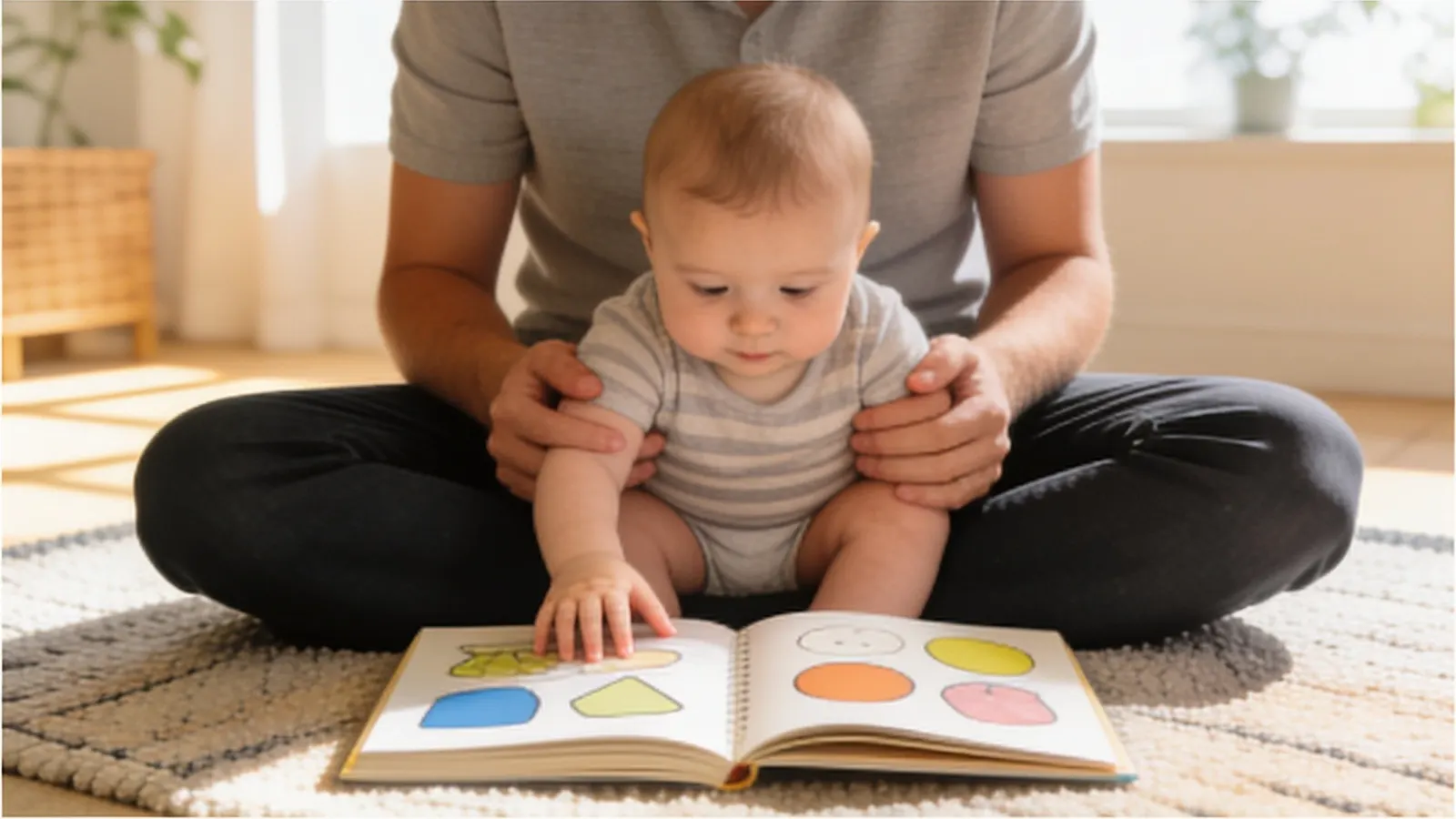
At a glance
- Rolling both ways, sitting with support, and babbling with consonant sounds are all on the way. The timing varies a lot from baby to baby.
- Most babies are ready for solids around 6 months, and not before 4. Watch for readiness signs, not the calendar.
- Severe eczema or an egg allergy? Talk to your pediatrician now. Peanut may start as early as 4 to 6 months, after a check-in.
- For most other babies, peanut and egg can start around 6 months, at home, alongside other first foods. Then keep serving them.
- Teething doesn't cause a true fever. Skip benzocaine gels, homeopathic tablets, and teething necklaces.
- Baby walkers don't teach walking and send thousands of babies to the ER. Floor time is better.
- Go cordless on blinds, and keep a hand on your baby at bath time. A bath seat is not a safety device.
Your 5-to-6-month checklist
0 of 12 done
Somewhere in month six, many babies roll both ways, sit propped up, and start adding consonants to their babble. Food questions arrive too. This guide covers 5 to 6 months. For the month before, see the 4-month guide; for starting solids in earnest, see the 6-month guide.
What's developing#

CDC's milestone checklists list skills that at least 75% of babies show by each age, so a missed milestone is a reason to check in, not to wait and see (Zubler et al., 2022). There's no 5-month checklist, so this month sits between two of them.
From the 4-month to the 6-month milestones
By 6 months, most babies (CDC):
- Social: know familiar people, like to look at themselves in a mirror, and laugh.
- Communication: take turns making sounds with you, blow raspberries, and squeal.
- Thinking: put things in their mouth to explore them, reach for a toy they want, and close their lips to show they don't want more food.
- Movement: roll from tummy to back, push up on straight arms on their tummy, and lean on their hands to hold themselves up when sitting.
Born early? Use your baby's corrected age for milestones until age 2 (AAP).
Rolling and sitting
Around 5 months, babies often rock on their tummy, kick, and "swim" with their arms, warming up for rolling. By about 7 months, many roll both ways, usually tummy to back first. Sitting starts with "tripod" sitting, leaning forward on both hands; by 6 to 8 months, many stay upright once you set them in a sit. Meanwhile, hands rake, grab feet, and bring everything to the mouth (AAP). The normal range is wide: in a WHO study of 816 children in five countries, almost all healthy babies first sat alone somewhere between 3.8 and 9.2 months (WHO Multicentre Growth Reference Study Group, 2006).
Babble, giggles, and their own name
Babbling usually starts around 4 months, with the rhythm of the language your baby hears, and a baby may repeat one favorite sound for days (AAP). From 4 to 6 months, babies giggle, blow raspberries, and make vowel sounds sometimes joined to a consonant, like "aaaagoo" or "daaaa"; strings like "babababa" come at 7 to 9 months (ASHA). Your baby is learning their name too: 4.5-month-olds in lab tests preferred the sound of it (Mandel et al., 1995), though looking up when you call it comes at 7 to 9 months (ASHA).
Personality and cause and effect
Between 4 and 7 months, many babies turn from fairly passive to eager and assertive, and their temperament becomes clearer (AAP). Stranger anxiety usually arrives at 7 to 12 months (AAP), though some babies are wary earlier (see the research below). Your baby is also learning they can make things happen: wave the rattle and it rattles, drop the spoon and you pick it up (AAP).
Teeth on the way
First teeth usually appear between 6 and 10 months, starting with the bottom front two, but discomfort can start weeks or months earlier (AAP). Some babies have no teeth by their first birthday (AAP).
Sleep and naps
Sleep experts recommend 12 to 16 hours in 24 hours, naps included, for babies 4 to 12 months old (Paruthi et al., 2016). Most babies this age take at least two naps, about 3 to 4 hours of daytime sleep in all (Nemours KidsHealth). Brief night waking is still normal (AAP).
What the research says#
Some of this stage's research is unusually strong, especially on peanut. Some is small or easy to over-read.
1. Early peanut prevents most peanut allergy in high-risk babies. The LEAP trial randomly assigned 640 babies 4 to 11 months old with severe eczema, egg allergy, or both to eat peanut regularly or avoid it until age 5. Among the 530 whose skin tests were negative at the start, 13.7% of avoiders had peanut allergy at age 5, versus 1.9% of eaters (Du Toit et al., 2015). The protection lasted: at age 12, 15.4% of the original avoiders were allergic, versus 4.4% of the eaters (Du Toit et al., 2024). Takeaway: For high-risk babies, the 4-to-6-month window matters. Month five is the time to ask.
2. For other babies, early allergens help modestly, if they keep eating them. The EAT trial assigned 1,303 breastfed 3-month-olds in the UK to start six allergenic foods early or at about 6 months. Allergy developed in 5.6% versus 7.1%, a difference that could have been chance; families who stuck to the plan saw less peanut and egg allergy, but many found it hard (Perkin et al., 2016). In PreventADALL, a trial of 2,397 Scandinavian babies, tastes of peanut, milk, wheat, and egg from 3 months cut food allergy at age 3 from 2.3% to 0.9% (Skjerven et al., 2022). A meta-analysis rated the evidence for early egg and peanut as moderate certainty (Ierodiakonou et al., 2016). Takeaway: Plan on peanut and egg around 6 months. Regular servings matter more than the first one.
3. "About 6 months" for solids rests on solid ground. A Cochrane review of 23 studies found that babies breastfed exclusively for 6 months, rather than 3 to 4, grew just as well and had fewer stomach infections; where newborn iron stores may be low, iron status could suffer without drops (Kramer & Kakuma, 2012). And the AAP finds no evidence that delaying allergenic foods past 4 to 6 months prevents allergy (Greer et al., 2019). Takeaway: There's no prize for starting early, and no reason to hold allergens back once your baby is ready.
4. Teething gets blamed for more than it causes. Parents of 125 babies logged symptoms daily from 4 months to age 1, covering 475 new teeth. Drooling, biting, gum-rubbing, fussiness, wakefulness, and a mild temperature rise clustered in the 8 days around each tooth; congestion, loose stools, vomiting, and fever over 102°F did not. No symptom showed up in more than 35% of teething babies (Macknin et al., 2000). A 2016 meta-analysis of 16 studies agreed: a slight temperature rise, but not a fever (Massignan et al., 2016). Takeaway: A real fever, diarrhea, or a very unhappy baby isn't "just teething." Call.
5. Walkers don't teach walking, and they cause injuries. Among 109 babies, walker users sat, crawled, and walked later and scored lower on developmental tests (Siegel & Burton, 1999); in a Northern Ireland survey covering 190 babies, more walker use went with walking alone later (Garrett et al., 2002). Both are observational. The injury data are clearer: from 1990 to 2014, an estimated 230,676 US children under 15 months were treated in emergency rooms for walker injuries, 74.1% from falls down stairs (Sims et al., 2018). The AAP has long called for a ban on their sale (AAP, 2001). Takeaway: Skip the walker. There's no upside.
6. Your baby's brain is tuning in to the faces around them. In a lab study, 6-month-olds could tell individual monkey faces apart; 9-month-olds and adults couldn't (Pascalis et al., 2002). Among 192 white British babies, 3-month-olds recognized faces from four ethnic groups, 6-month-olds from two, and 9-month-olds only from their own (Kelly et al., 2007). In a later lab study, babies shown monkey faces with a name for each from 6 to 9 months kept the skill (Scott & Monesson, 2009). Takeaway: Experience shapes what babies notice. Naming the people your baby meets is an easy habit, though long-term effects haven't been tested.
7. Early shyness is common, and often fades. A study of 1,285 twins tracked fear of strangers from 6 to 36 months. On average, it rose between 6 and 12 months. About 1 in 4 babies were already quite fearful at 6 months, and half of those became less fearful by age 3 (Brooker et al., 2013). Takeaway: A wary 5-month-old isn't a problem to fix. Give them time to warm up.
8. Half of 5-month-olds "sleep through," and half don't. In sleep diaries for 75 babies, half slept from 10 p.m. to 6 a.m. without needing a parent by 5 months. At 12 months, 21 of the 75 still didn't (Henderson et al., 2010). Takeaway: Both patterns are normal at this age.
Parenting techniques#
Get ready for solids without rushing
- Watch for readiness, not the date. Signs include sitting up alone or with support, good head and neck control, opening their mouth when food comes, and swallowing food instead of pushing it out (CDC).
- Aim for about 6 months. The AAP recommends only breast milk for about the first 6 months (AAP), the WHO starts other foods at 6 months (WHO, 2023), and starting before 4 months isn't recommended (CDC). If your baby was premature or struggles to sit or swallow, wait (AAP).
- Gear is simple. A high chair with a harness you buckle every time (AAP), a soft spoon, a bib, and later a small cup for sips of water (AAP).
- Pick first foods that carry iron. There's no required order, but include iron- and zinc-rich foods like pureed meat or iron-fortified infant cereal, and don't put cereal in a bottle unless your pediatrician advises it (AAP). Rotate oat, barley, or multigrain cereal rather than rice alone, and try one new food at a time, 3 to 5 days apart (CDC).
First bites, gagging versus choking, and spoon versus finger foods are in the 6-month guide.
Make an allergen plan now
US guidelines sort babies into three groups (NIAID):
- Severe eczema, egg allergy, or both: start peanut as early as 4 to 6 months, after checking with your pediatrician, who may order a blood test or send you to an allergist first. "Severe" means eczema that persists or keeps coming back and needs frequent prescription-strength treatment despite regular moisturizing (Togias et al., 2017).
- Mild to moderate eczema: peanut around 6 months.
- No eczema or food allergy: introduce peanut freely at home along with other solids.
A 2021 consensus from US and Canadian allergy societies adds egg: introduce both peanut and egg around 6 months, not before 4, with no screening test required, and other allergens around the same time (Fleischer et al., 2021).
When the time comes, start with a few low-allergy first foods, then add allergens one at a time in baby-safe forms, like 2 teaspoons of smooth peanut butter thinned into a puree or a third of a well-cooked egg, and keep serving them. Never give whole nuts (AAP). NIAID's home-feeding steps were written for higher-risk babies whose tests were reassuring, but they make a good habit for any baby: first tastes at home, on a day your baby is well, then watch for 2 hours. Swelling of the lips or face, widespread hives, vomiting, wheezing, or trouble breathing means call 911 (NIAID).
Ask about iron and vitamin D
Breast milk or formula is still all your baby needs until about 6 months (CDC), but the iron babies are born with runs low (AAP). AAP advice on timing has shifted. Its parent page says breastfed babies need iron drops from 4 months until iron-rich foods are in their diet (AAP); its July 2026 clinical report says by 6 months for exclusively breastfed babies (AAP, 2026; Powers et al., 2026). Iron-fortified formula covers iron needs (CDC). Babies who get breast milk, or less than 32 ounces of formula a day, need 400 IU of vitamin D daily (AAP). Ask your pediatrician what your baby needs.
Soothe sore gums safely
- What helps: rub the gums with a clean finger, offer a firm rubber teether (not liquid-filled), or let your baby chew a cold, damp washcloth. Skip teethers frozen rock-hard (AAP).
- Medicine: on a rough night, ask your pediatrician about a weight-based dose of acetaminophen. Ibuprofen is only for babies over 6 months (AAP).
- What to avoid: benzocaine gels, which can cause a dangerous blood condition called methemoglobinemia; lidocaine; homeopathic teething tablets; and teething necklaces or bracelets, which have caused deaths (FDA; AAP).
Clean gums now, brush the first tooth
Wipe your baby's gums with a clean, damp washcloth after feedings, skip bottles in bed, and don't share spoons or pacifiers mouth to mouth (AAP). Once a tooth appears, brush twice a day with a rice-grain smear of fluoride toothpaste (AAP), ask about fluoride varnish, and book a dental visit after the first tooth and by the first birthday (AAP).
Naps, nights, and a baby who rolls
- Drowsy but awake. For babies 4 months and older, the AAP suggests putting your baby down drowsy and giving them a few minutes to resettle before rushing in; you can still feed or comfort them when needed (AAP).
- A short, repeatable routine at a regular bedtime helps your baby know what comes next (AAP).
- Rolling changes one rule. Always start your baby on their back, but once they roll both ways comfortably, you don't need to flip them back (AAP).
Sleep training research and options are in the 6-month guide.
Floor time over containers
The WHO advises plenty of floor play and not keeping babies strapped into a stroller, high chair, or carrier for more than 1 hour at a time (WHO). Stationary activity centers are safer than walkers (AAP), but in a small study of 43 babies, more time in equipment went with lower motor scores at 8 months, a link that doesn't prove cause (Abbott & Bartlett, 2001). Use them for short breaks.
Let new people warm up
Shy or sensitive babies need time and people who approach slowly (AAP). Hold your baby while visitors talk to you first, then let your baby decide when to look, smile, or reach.
Script: "This is Grandpa. We're going to watch him for a minute." (Let Grandpa talk to you, not your baby, until your baby leans in.)
What to teach#
No lessons yet. Your baby learns from ordinary moments with you:
- My sounds get answers. Replies that come right after your baby's babble, not at random times, make their sounds more speech-like (Goldstein et al., 2003).
- Things and people have names. Naming what your baby sees builds language connections before they understand words (Harvard Center on the Developing Child).
- I can make things happen. Shaking, banging, and dropping are experiments (AAP).
- Meals are together time. The AAP encourages family meals from the first feeding (AAP).
Screens: video chat only
CDC doesn't recommend screen time before age 2, except video calls with loved ones (CDC). Babies under 18 months learn best from real-world interaction (Munzer, AAP).
Family jobs come later; the 1-year guide picks them up. For now, a seat at the table and a running commentary while you cook or fold laundry is plenty.
Activities to try#
Every activity is for an awake, alert baby with an adult watching. Stop when your baby turns away, fusses, or arches. If your baby gets sleepy, move them to their back in their own sleep space (AAP).
How we rate the evidence
- Strong evidence
- Randomized trials or systematic reviews show a consistent benefit.
- Moderate evidence
- Consistent observational research, or a major guideline (AAP, WHO) built on research.
- Emerging evidence
- Small or early studies. Plausible, not yet proven.
- Mixed evidence
- Studies disagree, or reviews rate the evidence as weak.
Too tired to choose? Let us pick one.
Reach-and-roll tummy time
Moderate evidence- Time
- A few minutes, several times a day
- Builds
- Rolling, reaching, core and shoulder strength
- Lay your baby on their tummy on a blanket on the floor.
- Place a few toys in a circle around them, just out of reach.
- Cheer each reach, pivot, or roll, and move a toy if they get frustrated.
Make it work: The WHO suggests at least 30 minutes of tummy time a day, spread out, for babies who aren't crawling yet (WHO). Placing toys in a circle is an AAP tip (AAP).
Evidence: Moderate. A systematic review of 16 mostly observational studies linked tummy time to better gross motor development, including rolling (Hewitt et al., 2020). In a study of 351 babies, back sleepers rolled tummy to back later than tummy sleepers, though all were within the normal range (Davis et al., 1998). The AAP recommends awake tummy time every day (AAP).
Supported sitting
Emerging evidence- Time
- A few minutes at a time
- Builds
- Balance, trunk strength, a new view of the world
- Sit on the floor with your legs in a V and your baby sitting between them, or ring them with pillows.
- Put an interesting toy in front of them so they lean on their hands to look.
- Stay right there to catch the topple.
Evidence: Emerging. The AAP and CDC suggest holding babies or propping them with pillows so they can practice balancing (AAP; CDC); practice hasn't been shown to speed up sitting.
Lap bounces
Emerging evidence- Time
- A song's worth
- Builds
- Leg strength, body awareness, shared fun
- Hold your baby securely under the arms with their feet on your thighs.
- Let them push and bounce at their own pace while you sing.
- Sit them down when their legs get wobbly.
Make it work: This is the free, safe version of a walker or jumper.
Evidence: Emerging. CDC suggests holding your baby under the arms while they stand and naming what you see (CDC), and the AAP notes that babies with feet on a surface often bounce as a warm-up for standing (AAP).
Free floor play
Moderate evidence- Time
- Several times a day
- Builds
- Movement, problem-solving, independence
- Clear a safe patch of floor and lay down a blanket or mat.
- Offer two or three safe toys on their back, side, or tummy.
- Let your baby explore and only step in when they need help.
Evidence: Moderate. WHO guidelines recommend interactive floor-based play several times a day for babies and limits on time strapped into seats and carriers (WHO); CDC also suggests daily play on the floor or a mat (CDC).
Babble back
Emerging evidence- Time
- 2 to 5 minutes, during calm, alert times
- Builds
- Turn-taking, early speech sounds
- Wait for your baby to make a sound.
- Copy it back, smiling, then pause for their turn.
- When they land on a syllable like "bah," add words with it: "bottle," "box" (AAP).
Evidence: Emerging. In a small study of 30 babies around 8 months old, replying right after babbling made babies' sounds more speech-like (Goldstein et al., 2003); CDC suggests copying your baby's sounds (CDC).
The name game
Emerging evidence- Time
- A minute, a few times a day
- Builds
- Listening, recognizing their name
- While your baby is playing, call their name softly from one side.
- Smile and wave when they turn, or come into view if they don't.
- Try from the other side.
Evidence: Emerging. Babies as young as 4.5 months already prefer the sound of their own name (Mandel et al., 1995), and CDC suggests using your baby's name often (CDC); the game itself hasn't been studied.
Mirror smiles
Emerging evidence- Time
- 2 to 3 minutes
- Builds
- Social interest, attention to faces
- Hold your baby in front of an unbreakable mirror, or prop one beside them at tummy time.
- Point and name: "There's your nose. There's Mama."
- Make faces and watch whether they copy you.
Evidence: Emerging. Liking to look at themselves in a mirror is a 6-month milestone (CDC), and the AAP lists an unbreakable mirror among good toys for this age (AAP).
Peekaboo
Emerging evidence- Time
- A few rounds
- Builds
- Early understanding that hidden things still exist, laughter
- Cover your face with your hands or a cloth.
- Pop out with a smile and "Peekaboo!"
- Later, partly hide a toy under a cloth and see if your baby pulls it off.
Evidence: Emerging. The AAP says hiding games help babies learn object permanence over many months (AAP), and CDC suggests playing peekaboo (CDC); the game hasn't been tested on its own.
The people book
Emerging evidence- Time
- 5 minutes
- Builds
- Face recognition, names of the people they love
- Make a small album of close-up photos of family, friends, and caregivers.
- Look at it together and say each person's name.
- When that person visits, show their photo and say their name again.
Evidence: Emerging. In a lab study, babies who saw faces paired with individual names from 6 to 9 months kept the ability to tell those faces apart (Scott & Monesson, 2009); whether family photo books help in the long run hasn't been tested.
Board-book reading
Moderate evidence- Time
- About 5 minutes, once or twice a day
- Builds
- Language, attention, a calm routine
- Choose a sturdy board, cloth, or vinyl book with big, bright pictures.
- Point, name, and pause for your baby's sounds.
- Let them grab, pat, and chew the book.
Evidence: Moderate. The AAP recommends shared reading from birth (Klass et al., 2024). In a randomized trial that coached parents to read and play from infancy, children had fewer behavior problems at 4.5 years (Mendelsohn et al., 2018); a meta-analysis of 19 trials with children 1 to 6 found book-sharing programs improved language (Dowdall et al., 2020).
Shake, bang, drop
Emerging evidence- Time
- As long as it's fun
- Builds
- Cause and effect, hand skills
- Offer a see-through rattle, a wooden spoon, or a plastic bowl.
- Name the sound: "Bang! Shake, shake."
- Pick up the dropped spoon, again and again.
Make it work: Use toys too big to swallow, light, and unbreakable (AAP).
Evidence: Emerging. The AAP describes banging and dropping as how babies learn cause and effect (AAP), and CDC suggests returning dropped toys to teach it (CDC).
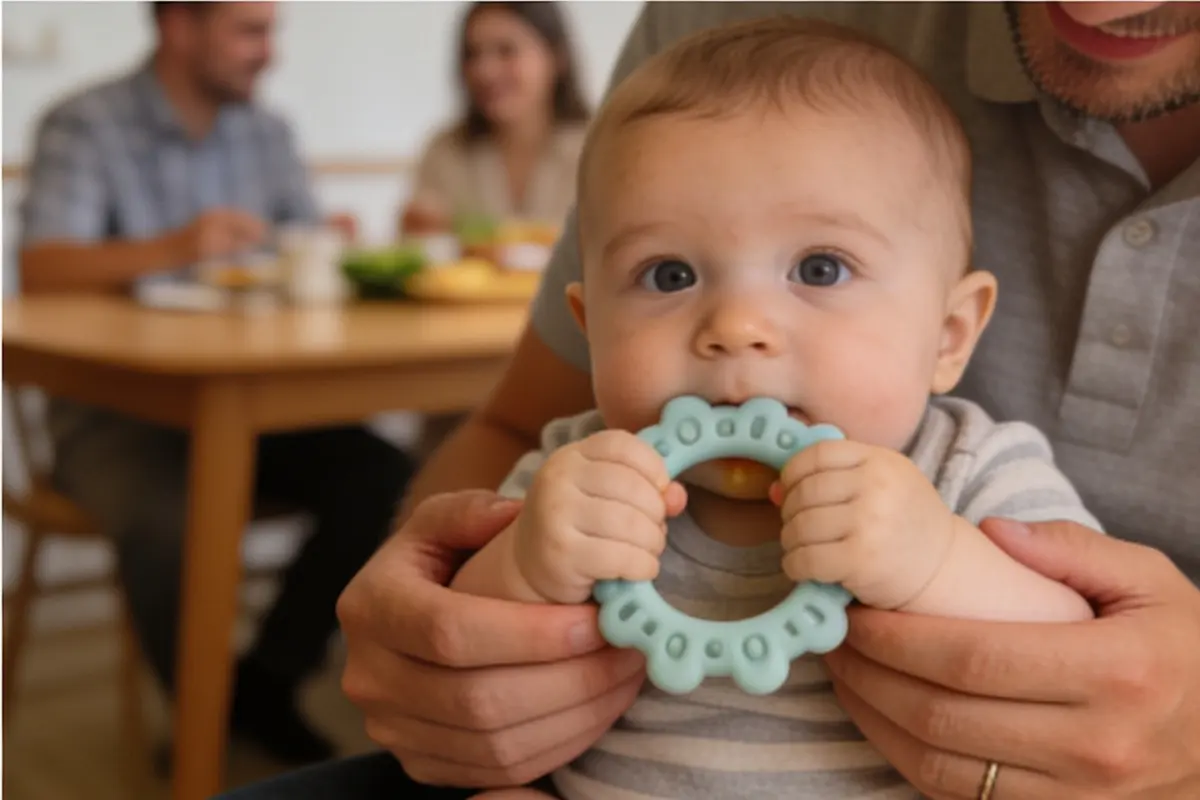
Teething comfort, three ways
Emerging evidence- Time
- As needed
- Builds
- Comfort
- Wash your hands and rub your baby's gums gently with a fingertip.
- Offer a firm rubber teether that isn't liquid-filled.
- Twist a damp washcloth, chill it, and let your baby gnaw on it.
Make it work: Don't freeze teethers rock-hard, and never tie anything around your baby's neck (AAP).
Evidence: Emerging. The AAP and FDA recommend gum massage and firm rubber teethers (AAP; FDA); how well these simple remedies work hasn't been well studied, but they carry little risk.
A seat at the table
Emerging evidence- Time
- One family meal a day
- Builds
- Interest in food, family connection
- Buckle your baby into a high chair, or hold them on your lap, at the table.
- Talk about the food: "Crunchy carrots. Warm soup."
- Give them a spoon or cup to hold while you eat.
Make it work: Keep hot drinks and plates out of reach (AAP), and don't offer food until your baby is ready.
Evidence: Emerging. Watching you eat and reaching for food are readiness signs, and the AAP encourages family meals from the first feeding (AAP); whether watching speeds readiness hasn't been studied.
Splash time
Emerging evidence- Time
- 5 to 10 minutes at bath time
- Builds
- Sensory play, body awareness
- Use shallow, warm water, tested with your wrist or elbow.
- Keep one hand on your baby while they kick and slap the water.
- Name body parts as you wash.
Make it work: Gather the towel and soap first. If you must leave, take your baby with you (AAP).
Evidence: Emerging. Bath play itself hasn't been studied, but the safety rules are firm: babies can drown in 1 or 2 inches of water, so keep a hand on them the whole time (AAP).
Common questions#
Can I start my baby on solid food at 5 months?
Most babies are ready around 6 months, so for many 5-month-olds it's a little early. The AAP recommends only breast milk for about the first 6 months, and the CDC says solids can start at about 6 months and not before 4 (AAP; CDC). Some babies are ready a bit earlier (AAP). Look for readiness signs: sitting with support, good head control, opening up for a spoon, and swallowing rather than pushing food out (CDC). The exception is a baby with severe eczema or egg allergy, who may need peanut as early as 4 to 6 months; talk with your pediatrician (NIAID).
My baby has eczema. Should they have peanut before 6 months?
It depends on how severe the eczema is, so ask your pediatrician now. For babies with severe eczema, egg allergy, or both, US guidelines recommend peanut as early as 4 to 6 months, sometimes after an allergy test; for mild to moderate eczema, around 6 months (NIAID). In the LEAP trial of high-risk babies, eating peanut regularly from infancy cut peanut allergy at age 5 from 13.7% to 1.9% among babies who weren't already sensitized (Du Toit et al., 2015). The AAP also advises checking with your pediatrician first if your baby has ever had an immediate reaction to a food (AAP).
Is my 5-month-old teething?
Possibly; teething discomfort can start weeks or months before the first tooth, which usually appears between 6 and 10 months (AAP). Common signs are drooling, chewing on everything, swollen or tender gums, mild fussiness, and a rash around the mouth from drool (AAP). But babies this age mouth everything anyway (AAP). Teething doesn't cause a true fever of 100.4°F (38°C) or higher (AAP), diarrhea, or lots of extra crying; if you see those, call your pediatrician (AAP).
What can I give my baby for teething pain?
Start with gum massage, a firm rubber teether, or a chilled washcloth; on a rough night, ask your pediatrician about acetaminophen (AAP). Get the dose in milliliters for your baby's weight, and wait until 6 months for ibuprofen (AAP). Don't use benzocaine or lidocaine gels or homeopathic teething tablets (FDA).
Are amber teething necklaces safe?
Are baby walkers and jumpers safe?
Baby walkers with wheels aren't safe, and the AAP has called for a ban. Babies in walkers can roll down stairs, reach hot liquids, and move more than 3 feet in a second, faster than an adult can react; walkers are banned in Canada (AAP). They don't help babies walk and may delay it (Siegel & Burton, 1999). The AAP's safer alternatives are play yards and stationary activity centers, which have no wheels and often have seats that rotate, tip, or bounce (AAP). Keep those sessions short too: the WHO advises not restraining babies for more than an hour at a time (WHO), and a 2025 review flagged concerns about activity centers and motor and language development, along with gaps in the research (Khare, 2025).
When do babies roll over both ways?
Many babies roll both ways by about 7 months, usually tummy to back first, though back to tummy first is normal too (AAP). Rolling tummy to back is on CDC's 6-month list (CDC). Daily awake tummy time helps (Hewitt et al., 2020). Once your baby rolls both ways comfortably, you can let them stay in the position they choose during sleep, but always start them on their back (AAP).
When should my baby sit up?
Many babies sit with support around 5 to 6 months and stay upright on their own by 6 to 8 months, but the normal range runs from about 4 to 9 months. By 6 months, most lean on their hands to hold themselves up (CDC), and by 6 to 8 months, many stay upright when you set them in a sit (AAP). In a WHO study, almost all healthy babies first sat alone somewhere between 3.8 and 9.2 months (WHO Multicentre Growth Reference Study Group, 2006). Getting into a sitting position on their own comes later.
How much should a 5-month-old sleep?
About 12 to 16 hours in 24 hours, including naps (Paruthi et al., 2016; WHO). Most babies this age take at least two naps a day, for 3 to 4 hours of daytime sleep in all (Nemours KidsHealth). Night waking varies: in one study, half of 5-month-olds slept 10 p.m. to 6 a.m. without help, and half didn't (Henderson et al., 2010).
Does my baby need iron or vitamin D drops?
It depends on how your baby is fed, so ask your pediatrician. AAP guidance calls for iron supplements for breastfed babies, starting at 4 months on its parent page and by 6 months for exclusively breastfed babies in its 2026 report, until iron-rich foods are part of the diet (AAP; AAP, 2026). Iron-fortified formula covers iron (CDC). Breastfed babies, and babies drinking less than 32 ounces of formula a day, need 400 IU of vitamin D daily (AAP).
Should my 5-month-old respond to their name?
Not reliably yet. Babies recognize the sound of their own name surprisingly early, by about 4.5 months in lab tests (Mandel et al., 1995), but looking at you when you call it is a 7- to 9-month skill (ASHA). What matters now is that your baby turns toward your voice and makes sounds back (CDC). If your baby doesn't babble or imitate sounds by 7 months, tell your pediatrician, since it can signal a hearing problem (AAP).
Does my baby need any shots at 5 months?
Usually not, because there's no routine 5-month checkup; the next one is at 6 months (AAP). One exception: the AAP recommends RSV immunization for all babies under 8 months who are entering their first RSV season, unless they're protected by a vaccine the birthing parent got in pregnancy (AAP). At 6 months, the AAP adds flu and COVID-19 vaccines to the routine shots (AAP). US vaccine guidance has been changing: the AAP and federal schedules have differed in 2026 (AAP), so ask your pediatrician which one they follow.
Safety and when to call your pediatrician#
Safe sleep for a baby who rolls
Back to sleep, on a firm, flat surface with only a fitted sheet, in your room but not your bed. Stop swaddling once your baby tries to roll, and don't hang a pacifier around their neck or clip it to clothing for sleep (AAP). The full rules are in the newborn guide.
Bath time and water
Babies can drown silently in 1 or 2 inches of water, and more than half of bathtub drowning deaths involve babies under 1. Bath seats can tip over or let babies slip out (AAP). In a federal review of 32 bath-seat drownings, caregivers had stepped away for 6 minutes on average, often to answer the phone or get a towel (CPSC, 1997). Keep a hand on your baby (AAP, 2026), empty buckets right away, keep toilet lids down, and keep faucet water no hotter than 120°F (AAP).
Cords, blinds, and necklaces
About nine children 5 and under die each year from window-cord strangulation, which can happen in under a minute. Choose cordless window coverings, and move cribs and furniture away from windows (CPSC, 2021); two-thirds of investigated blind-cord entanglements in young children were fatal (Onders et al., 2018). Keep baby monitor, lamp, and night-light cords at least 3 feet from the crib (CPSC, 2019), and skip necklaces and other jewelry (AAP).
Falls, burns, choking, and poisons
Don't leave your baby alone on a bed, sofa, or changing table, even for a second, and keep bouncy seats and car seats on the floor, not on a table or counter (NHS). Never hold a hot drink and your baby at the same time (AAP). Everything goes in the mouth now. Most children who die from choking are under 5, two-thirds of them babies under 1, so keep small objects, balls, and balloons out of reach (AAP). Lock up medicines and cleaning products, and save Poison Help: 1-800-222-1222 (AAP).
Car seats and sun
Ride rear-facing as long as the seat allows; if your baby outgrows a rear-facing-only infant seat, switch to a convertible seat installed rear-facing (AAP). Under 6 months, keep your baby out of direct sun and avoid 10 a.m. to 4 p.m. outings (Gupta & Mahoney, AAP).
Call 911 if your baby
- Is not moving or is very weak, or can't be woken up (AAP)
- Is struggling for each breath, or has purple or blood-colored spots on the skin (AAP)
- Has swelling of the lips, face, or tongue, widespread hives, vomiting, wheezing, repeated coughing, pale or blue skin, or sudden floppiness after eating a food (NIAID)
- Is choking: a weak or no cough, no sound, can't cry, or pale or blue skin. Start back blows and chest thrusts (Red Cross), and take a CPR class before you need one (AAP)
Go to the ER now if your baby
- Has a bulging or swollen soft spot, or a stiff neck (AAP)
- Had a seizure with a fever, or isn't alert when awake (AAP)
- Screams and can't be consoled, or cries when you touch or move them (AAP)
Call your pediatrician right away if your baby
- Has a fever higher than 104°F (40°C), or looks or acts very sick (AAP)
- Has had no urine in more than 8 hours, a very dry mouth, or no tears (AAP)
- Has cried nonstop for more than 2 hours, or you're afraid someone might hurt or shake them (AAP)
For any fever of 100.4°F (38°C) or higher at 3 to 6 months, call within 24 hours (AAP). Don't blame it on teething (AAP).
Don't wait on development worries
Talk to your pediatrician, or ask your state's early intervention program for a free evaluation; you don't need a referral (CDC). Bring it up if your baby:
- Doesn't hold their head steady, push up on their arms, or bring hands to mouth, skills most babies have by 4 months (CDC)
- Doesn't make sounds back when you talk or turn toward your voice (CDC)
- Doesn't laugh or seem to know familiar people (CDC)
- Doesn't reach for toys or try to bring things to their mouth (CDC)
- Doesn't babble or imitate any sounds by 7 months (AAP)
- Has lost skills they once had (CDC)
The 6-month checkup
There's no routine visit at 5 months; the next is at 6 months (AAP). Expect growth checks, an exam, vaccines, a check on how you're feeling, and questions about solids, rolling, sitting, and teeth (AAP). Bring your allergen and iron questions, in writing.
Sources#
- Centers for Disease Control and Prevention. "Milestones by 4 Months." Learn the Signs. Act Early. program, updated 2026. https://www.cdc.gov/act-early/milestones/4-months.html
- Centers for Disease Control and Prevention. "Milestones by 6 Months." Learn the Signs. Act Early. program, updated 2026. https://www.cdc.gov/act-early/milestones/6-months.html
- Centers for Disease Control and Prevention. "Concerned About Your Child's Development?" 2026. https://www.cdc.gov/act-early/families/concerned.html
- Centers for Disease Control and Prevention. "When, What, and How to Introduce Solid Foods." 2026. https://www.cdc.gov/infant-toddler-nutrition/foods-and-drinks/when-what-and-how-to-introduce-solid-foods.html
- Centers for Disease Control and Prevention. "Iron." Infant and Toddler Nutrition, 2026. https://www.cdc.gov/infant-toddler-nutrition/vitamins-minerals/iron.html
- American Academy of Pediatrics. "Movement Milestones: Babies 4 to 7 Months." HealthyChildren.org, updated 2021. https://www.healthychildren.org/English/ages-stages/baby/Pages/Movement-4-to-7-Months.aspx
- American Academy of Pediatrics. "Language Development: 4 to 7 Months." HealthyChildren.org, updated 2009. https://www.healthychildren.org/English/ages-stages/baby/Pages/Language-Development-4-to-7-Months.aspx
- American Academy of Pediatrics. "Cognitive Development in Infants: 4 to 7 Months." HealthyChildren.org, updated 2023. https://www.healthychildren.org/English/ages-stages/baby/Pages/Cognitive-Development-4-to-7-Months.aspx
- American Academy of Pediatrics. "Emotional and Social Development: 4 to 7 Months." HealthyChildren.org, updated 2009. https://www.healthychildren.org/English/ages-stages/baby/Pages/Emotional-and-Social-Development-4-7-Months.aspx
- American Academy of Pediatrics. "Corrected Age For Preemies." HealthyChildren.org, updated 2018. https://www.healthychildren.org/English/ages-stages/baby/preemie/Pages/Corrected-Age-For-Preemies.aspx
- American Academy of Pediatrics. "Making Baby Drop Off at Child Care Easier." HealthyChildren.org, updated 2022. https://www.healthychildren.org/English/family-life/work-and-child-care/Pages/making-baby-drop-off-at-child-care-easier.aspx
- American Academy of Pediatrics. "When Can Babies Start Solid Foods? Readiness & Feeding Tips." HealthyChildren.org, updated 2026. https://www.healthychildren.org/English/ages-stages/baby/feeding-nutrition/Pages/Starting-Solid-Foods.aspx
- Cox A, Pistiner M. "When to Introduce Egg, Peanut Butter & Other Common Food Allergens to a Baby." HealthyChildren.org, updated 2025. https://www.healthychildren.org/English/healthy-living/nutrition/Pages/when-to-introduce-egg-peanut-butter-and-other-common-food-allergens-to-your-baby-food-allergy-prevention-tips.aspx
- Agbim IA, Hurtado CW. "Baby-Led Weaning: Is It Safe?" HealthyChildren.org, updated 2024. https://www.healthychildren.org/English/ages-stages/baby/feeding-nutrition/Pages/baby-led-weaning-is-it-safe.aspx
- American Academy of Pediatrics. "Where We Stand: Vitamin D & Iron Supplements for Babies." HealthyChildren.org, updated 2022. https://www.healthychildren.org/English/ages-stages/baby/feeding-nutrition/Pages/vitamin-iron-supplements.aspx
- American Academy of Pediatrics. "Iron Deficiency & Iron Deficiency Anemia: AAP Updates Screening, Prevention & Treatment Guidance." HealthyChildren.org, 2026. https://www.healthychildren.org/English/news/Pages/iron-deficiency-anemia-prevention-screening-treatment-AAP-updates-guidance.aspx
- American Academy of Pediatrics Section on Gastroenterology, Hepatology and Nutrition. "Vitamin D for Babies, Children & Adolescents." HealthyChildren.org, updated 2022. https://www.healthychildren.org/English/healthy-living/nutrition/Pages/vitamin-d-on-the-double.aspx
- American Academy of Pediatrics Section on Oral Health. "Teething Pain Relief: How to Soothe Your Baby's Discomfort." HealthyChildren.org, updated 2025. https://www.healthychildren.org/English/ages-stages/baby/teething-tooth-care/Pages/Teething-Pain.aspx
- DiMaggio D, Cernigliaro J. "Baby's First Tooth: 7 Facts Parents Should Know." HealthyChildren.org, updated 2022. https://www.healthychildren.org/English/ages-stages/baby/teething-tooth-care/Pages/Babys-First-Tooth-Facts-Parents-Should-Know.aspx
- American Academy of Pediatrics. "Teething Necklaces and Beads: A Caution for Parents." HealthyChildren.org, 2018. https://www.healthychildren.org/English/ages-stages/baby/teething-tooth-care/Pages/Amber-Teething-Necklaces.aspx
- American Academy of Pediatrics. "When Does Teething Start?" HealthyChildren.org, updated 2024. https://www.healthychildren.org/English/ages-stages/baby/teething-tooth-care/Pages/Teething-4-to-7-Months.aspx
- Braun P. "Why It's Important to Take Care of Baby Teeth." HealthyChildren.org, updated 2026. https://www.healthychildren.org/English/ages-stages/baby/teething-tooth-care/Pages/How-to-Prevent-Tooth-Decay-in-Your-Baby.aspx
- American Academy of Pediatrics Section on Oral Health. "Fluoride for Children: Parent FAQs." HealthyChildren.org, updated 2025. https://www.healthychildren.org/English/healthy-living/oral-health/Pages/FAQ-Fluoride-and-Children.aspx
- American Academy of Pediatrics. "Brush, Book, Bed: How to Structure Your Child's Nighttime Routine." HealthyChildren.org, updated 2024. https://www.healthychildren.org/English/healthy-living/oral-health/Pages/Brush-Book-Bed.aspx
- American Academy of Pediatrics. "Getting Your Baby to Sleep." HealthyChildren.org, updated 2024. https://www.healthychildren.org/English/ages-stages/baby/sleep/Pages/getting-your-baby-to-sleep.aspx
- Moon RY. "How to Keep Your Sleeping Baby Safe: AAP Policy Explained." HealthyChildren.org, updated 2026. https://www.healthychildren.org/English/ages-stages/baby/sleep/Pages/a-parents-guide-to-safe-sleep.aspx
- American Academy of Pediatrics. "Back to Sleep, Tummy to Play: Give Your Baby a Safe, Strong Start." HealthyChildren.org, updated 2026. https://www.healthychildren.org/English/ages-stages/baby/sleep/Pages/back-to-sleep-tummy-to-play.aspx
- American Academy of Pediatrics. "Baby Walkers: A Dangerous Choice." HealthyChildren.org, updated 2022. https://www.healthychildren.org/English/safety-prevention/at-home/Pages/Baby-Walkers-A-Dangerous-Choice.aspx
- American Academy of Pediatrics Council on Injury, Violence and Poison Prevention. "Infant Drowning Prevention & Water Safety: How to Protect Your Baby." HealthyChildren.org, updated 2026. https://www.healthychildren.org/English/safety-prevention/at-play/Pages/Infant-Water-Safety.aspx
- American Academy of Pediatrics. "AAP Releases Updated Drowning Prevention Recommendations." HealthyChildren.org, 2026. https://www.healthychildren.org/English/news/Pages/AAP-releases-updated-drowning-prevention-recommendations.aspx
- American Academy of Pediatrics. "Poison Prevention & Treatment Tips for Parents." HealthyChildren.org, updated 2026. https://www.healthychildren.org/English/safety-prevention/all-around/Pages/Poison-Prevention.aspx
- American Academy of Pediatrics. "Car Seats: Information for Families." HealthyChildren.org, updated 2026. https://www.healthychildren.org/English/safety-prevention/on-the-go/Pages/Car-Safety-Seats-Information-for-Families.aspx
- Gupta D, Mahoney M. "Baby Sunburn Prevention Tips." HealthyChildren.org, updated 2026. https://www.healthychildren.org/English/ages-stages/baby/bathing-skin-care/Pages/Baby-Sunburn-Prevention.aspx
- American Academy of Pediatrics. "Fever" (symptom checker). HealthyChildren.org, accessed 2026. https://www.healthychildren.org/English/tips-tools/symptom-checker/Pages/symptomviewer.aspx?symptom=Fever
- American Academy of Pediatrics. "Crying Child - 3 Months and Older" (symptom checker). HealthyChildren.org, accessed 2026. https://www.healthychildren.org/English/tips-tools/symptom-checker/Pages/symptomviewer.aspx?symptom=Crying+Child+-+3+Months+and+Older
- American Academy of Pediatrics. "Checkup Checklist: 6 Months Old." HealthyChildren.org, updated 2023. https://www.healthychildren.org/English/ages-stages/Your-Childs-Checkups/Pages/Your-Checkup-Checklist-6-Months-Old.aspx
- American Academy of Pediatrics and Bright Futures. "Recommendations for Preventive Pediatric Health Care" (Periodicity Schedule). 2025. https://downloads.aap.org/AAP/PDF/periodicity_schedule.pdf
- Bracho-Sánchez E. "AAP Guide: Vaccines Your Child Needs by Age 6." HealthyChildren.org, updated 2026. https://www.healthychildren.org/English/safety-prevention/immunizations/Pages/Your-Babys-First-Vaccines.aspx
- American Academy of Pediatrics. "AAP Releases RSV Immunization Recommendations for 2026-2027 Season." HealthyChildren.org, 2026. https://www.healthychildren.org/English/news/Pages/aap-updates-rsv-immunization-recommendations-for-2026-2027-season.aspx
- American Academy of Pediatrics. "AAP Releases Recommended Childhood and Adolescent Immunization Schedule for 2026." HealthyChildren.org, 2026. https://www.healthychildren.org/English/news/Pages/AAPs-recommended-childhood-and-adolescent-immunization-schedule-for-2026.aspx
- Munzer T. "Helping Kids Thrive in a Digital World: AAP Policy Explained." HealthyChildren.org, updated 2026. https://www.healthychildren.org/English/family-life/Media/Pages/helping-kids-thrive-in-a-digital-world-AAP-policy-explained.aspx
- National Institute of Allergy and Infectious Diseases. "Addendum Guidelines for the Prevention of Peanut Allergy in the United States: Summary for Parents and Caregivers." 2017. https://www.niaid.nih.gov/sites/default/files/peanut-allergy-prevention-guidelines-parent-summary.pdf
- National Institute of Allergy and Infectious Diseases. "Appendix D: Instructions for Home Feeding of Peanut Protein for Infants at Low Risk of an Allergic Reaction to Peanut." 2017. https://www.niaid.nih.gov/sites/default/files/addendum_guidelines_peanut_appx_d.pdf
- Togias A, Cooper SF, Acebal ML, et al. "Addendum guidelines for the prevention of peanut allergy in the United States: Report of the National Institute of Allergy and Infectious Diseases-sponsored expert panel." Journal of Allergy and Clinical Immunology, 2017. https://www.niaid.nih.gov/sites/default/files/addendum-peanut-allergy-prevention-guidelines.pdf
- American Academy of Pediatrics. "Choking Prevention for Babies & Children: What Every Parent Needs to Know." HealthyChildren.org, updated 2026. https://www.healthychildren.org/English/health-issues/injuries-emergencies/Pages/Choking-Prevention.aspx
- American Red Cross. "Infant Choking: How To Help." Accessed 2026. https://www.redcross.org/take-a-class/resources/learn-first-aid/infant-choking
- US Food and Drug Administration. "Safely Soothing Teething Pain in Infants and Children." Consumer update, 2024. https://www.fda.gov/consumers/consumer-updates/safely-soothing-teething-pain-infants-and-children
- US Consumer Product Safety Commission. "CPSC to Consumers: The Safest Window Coverings When Young Children Are Present Are Cordless." 2021. https://www.cpsc.gov/Newsroom/News-Releases/2022/CPSC-to-Consumers-The-Safest-Window-Coverings-When-Young-Children-Are-Present-Are-Cordless
- US Consumer Product Safety Commission. "CPSC Announces Study Results of Drowning Danger Using Infant Bathtub Seats." 1997. https://www.cpsc.gov/Newsroom/News-Releases/1998/CPSC-Announces-Study-Results-of-Drowning-Danger-Using-Infant-Bathtub-Seats
- US Consumer Product Safety Commission. "CPSC Issues Call to Action: Check Your Homes for Recalled Products; Babies' Lives Depend on It!" OnSafety, 2019. https://onsafety.cpsc.gov/blog/2019/09/11/cpsc-issues-call-to-action-check-your-homes-for-recalled-products-babies-lives-depend-on-it
- World Health Organization. "To grow up healthy, children need to sit less and play more." 2019. https://www.who.int/news/item/24-04-2019-to-grow-up-healthy-children-need-to-sit-less-and-play-more
- World Health Organization. "WHO Guideline for complementary feeding of infants and young children 6-23 months of age." 2023. https://www.who.int/publications/i/item/9789240081864
- American Speech-Language-Hearing Association. "Communication Milestones: Birth to 1 Year." Accessed 2026. https://www.asha.org/public/developmental-milestones/communication-milestones-birth-to-1-year/
- Center on the Developing Child at Harvard University. "Serve and Return." Accessed 2026. https://developingchild.harvard.edu/key-concept/serve-and-return/
- National Health Service (UK). "Baby and toddler safety." Accessed 2026. https://www.nhs.uk/baby/first-aid-and-safety/safety/baby-and-toddler-safety/
- Nemours KidsHealth. "Baby Sleep: 4- to 7-Month-Olds." Reviewed 2022. https://kidshealth.org/en/parents/sleep47m.html
- Zubler JM, Wiggins LD, Macias MM, et al. "Evidence-Informed Milestones for Developmental Surveillance Tools." Pediatrics, 2022. https://pubmed.ncbi.nlm.nih.gov/35132439/
- WHO Multicentre Growth Reference Study Group. "WHO Motor Development Study: windows of achievement for six gross motor development milestones." Acta Paediatrica Supplement, 2006. https://pubmed.ncbi.nlm.nih.gov/16817682/
- Du Toit G, Roberts G, Sayre PH, et al. "Randomized trial of peanut consumption in infants at risk for peanut allergy." New England Journal of Medicine, 2015. https://pubmed.ncbi.nlm.nih.gov/25705822/
- Du Toit G, Huffaker MF, Radulovic S, et al. "Follow-up to Adolescence after Early Peanut Introduction for Allergy Prevention." NEJM Evidence, 2024. https://pubmed.ncbi.nlm.nih.gov/38804779/
- Perkin MR, Logan K, Tseng A, et al. "Randomized Trial of Introduction of Allergenic Foods in Breast-Fed Infants." New England Journal of Medicine, 2016. https://pubmed.ncbi.nlm.nih.gov/26943128/
- Skjerven HO, Lie A, Vettukattil R, et al. "Early food intervention and skin emollients to prevent food allergy in young children (PreventADALL): a factorial, multicentre, cluster-randomised trial." Lancet, 2022. https://pubmed.ncbi.nlm.nih.gov/35753340/
- Ierodiakonou D, Garcia-Larsen V, Logan A, et al. "Timing of Allergenic Food Introduction to the Infant Diet and Risk of Allergic or Autoimmune Disease: A Systematic Review and Meta-analysis." JAMA, 2016. https://pubmed.ncbi.nlm.nih.gov/27654604/
- Fleischer DM, Chan ES, Venter C, et al. "A Consensus Approach to the Primary Prevention of Food Allergy Through Nutrition." Journal of Allergy and Clinical Immunology: In Practice, 2021. https://pubmed.ncbi.nlm.nih.gov/33250376/
- Greer FR, Sicherer SH, Burks AW; AAP Committee on Nutrition, Section on Allergy and Immunology. "The Effects of Early Nutritional Interventions on the Development of Atopic Disease in Infants and Children." Pediatrics, 2019. https://pubmed.ncbi.nlm.nih.gov/30886111/
- Kramer MS, Kakuma R. "Optimal duration of exclusive breastfeeding." Cochrane Database of Systematic Reviews, 2012. https://pubmed.ncbi.nlm.nih.gov/22895934/
- Powers JM, Heeney MM, Hord J, et al. "Prevention, Screening, Diagnosis, and Treatment of Iron Deficiency and Iron Deficiency Anemia in Infants, Children, and Adolescents: Clinical Report." Pediatrics, 2026. https://pubmed.ncbi.nlm.nih.gov/42324084/
- Macknin ML, Piedmonte M, Jacobs J, Skibinski C. "Symptoms associated with infant teething: a prospective study." Pediatrics, 2000. https://pubmed.ncbi.nlm.nih.gov/10742315/
- Massignan C, Cardoso M, Porporatti AL, et al. "Signs and Symptoms of Primary Tooth Eruption: A Meta-analysis." Pediatrics, 2016. https://pubmed.ncbi.nlm.nih.gov/26908659/
- Siegel AC, Burton RV. "Effects of baby walkers on motor and mental development in human infants." Journal of Developmental and Behavioral Pediatrics, 1999. https://pubmed.ncbi.nlm.nih.gov/10533994/
- Garrett M, McElroy AM, Staines A. "Locomotor milestones and babywalkers: cross sectional study." BMJ, 2002. https://pubmed.ncbi.nlm.nih.gov/12077035/
- Sims A, Chounthirath T, Yang J, Hodges NL, Smith GA. "Infant Walker-Related Injuries in the United States." Pediatrics, 2018. https://pubmed.ncbi.nlm.nih.gov/30224365/
- American Academy of Pediatrics Committee on Injury and Poison Prevention. "Injuries associated with infant walkers." Pediatrics, 2001. https://pubmed.ncbi.nlm.nih.gov/11533353/
- Abbott AL, Bartlett DJ. "Infant motor development and equipment use in the home." Child: Care, Health and Development, 2001. https://pubmed.ncbi.nlm.nih.gov/11350456/
- Khare S. "Exersaucers: a comprehensive review of their developmental and safety implications." Injury Prevention, 2025. https://pubmed.ncbi.nlm.nih.gov/40118461/
- Onders B, Kim EH, Chounthirath T, Hodges NL, Smith GA. "Pediatric Injuries Related to Window Blinds, Shades, and Cords." Pediatrics, 2018. https://pubmed.ncbi.nlm.nih.gov/29229682/
- Pascalis O, de Haan M, Nelson CA. "Is face processing species-specific during the first year of life?" Science, 2002. https://pubmed.ncbi.nlm.nih.gov/12016317/
- Kelly DJ, Quinn PC, Slater AM, et al. "The other-race effect develops during infancy: evidence of perceptual narrowing." Psychological Science, 2007. https://pubmed.ncbi.nlm.nih.gov/18031416/
- Scott LS, Monesson A. "The origin of biases in face perception." Psychological Science, 2009. https://pubmed.ncbi.nlm.nih.gov/19422630/
- Brooker RJ, Buss KA, Lemery-Chalfant K, et al. "The development of stranger fear in infancy and toddlerhood: normative development, individual differences, antecedents, and outcomes." Developmental Science, 2013. https://pubmed.ncbi.nlm.nih.gov/24118713/
- Mandel DR, Jusczyk PW, Pisoni DB. "Infants' recognition of the sound patterns of their own names." Psychological Science, 1995. https://pubmed.ncbi.nlm.nih.gov/25152566/
- Goldstein MH, King AP, West MJ. "Social interaction shapes babbling: testing parallels between birdsong and speech." Proceedings of the National Academy of Sciences, 2003. https://pubmed.ncbi.nlm.nih.gov/12808137/
- Henderson JM, France KG, Owens JL, Blampied NM. "Sleeping through the night: the consolidation of self-regulated sleep across the first year of life." Pediatrics, 2010. https://pubmed.ncbi.nlm.nih.gov/20974775/
- Paruthi S, Brooks LJ, D'Ambrosio C, et al. "Recommended Amount of Sleep for Pediatric Populations: A Consensus Statement of the American Academy of Sleep Medicine." Journal of Clinical Sleep Medicine, 2016. https://pubmed.ncbi.nlm.nih.gov/27250809/
- Hewitt L, Kerr E, Stanley RM, Okely AD. "Tummy Time and Infant Health Outcomes: A Systematic Review." Pediatrics, 2020. https://pubmed.ncbi.nlm.nih.gov/32371428/
- Davis BE, Moon RY, Sachs HC, Ottolini MC. "Effects of sleep position on infant motor development." Pediatrics, 1998. https://pubmed.ncbi.nlm.nih.gov/9794945/
- Klass P, Miller-Fitzwater A, High PC; AAP Council on Early Childhood. "Literacy Promotion: An Essential Component of Primary Care Pediatric Practice: Policy Statement." Pediatrics, 2024. https://pubmed.ncbi.nlm.nih.gov/39342414/
- Mendelsohn AL, Cates CB, Weisleder A, et al. "Reading Aloud, Play, and Social-Emotional Development." Pediatrics, 2018. https://pubmed.ncbi.nlm.nih.gov/29632254/
- Dowdall N, Melendez-Torres GJ, Murray L, et al. "Shared Picture Book Reading Interventions for Child Language Development: A Systematic Review and Meta-Analysis." Child Development, 2020. https://pubmed.ncbi.nlm.nih.gov/30737957/
This guide is general education that summarizes published research and guidance from groups like the American Academy of Pediatrics, the CDC, and the WHO. It isn’t medical advice, and every child develops on their own timeline. Your pediatrician knows your child; if something feels wrong, call them. In an emergency, call 911.
Raising capable kids with Chorevia
When your kids are ready for responsibility, Chorevia turns chores into a family economy, with points, proof, a reward ladder you design, and monthly costs kids work off. Adults always make the call. Free for families.
Create your household