Day 216 of 280 · 30 weeks + 6 days
Stress, said out loud
Last reviewed · 3 min read · 4 sources · Plain-text version
Thirty weeks and six days. Stress gets smaller when someone else hears it. Today you spend fifteen minutes saying the loudest worry out loud.
- Size this week
- about the size of a cabbage
- Length this week
- around 39.9 cm from head to heel
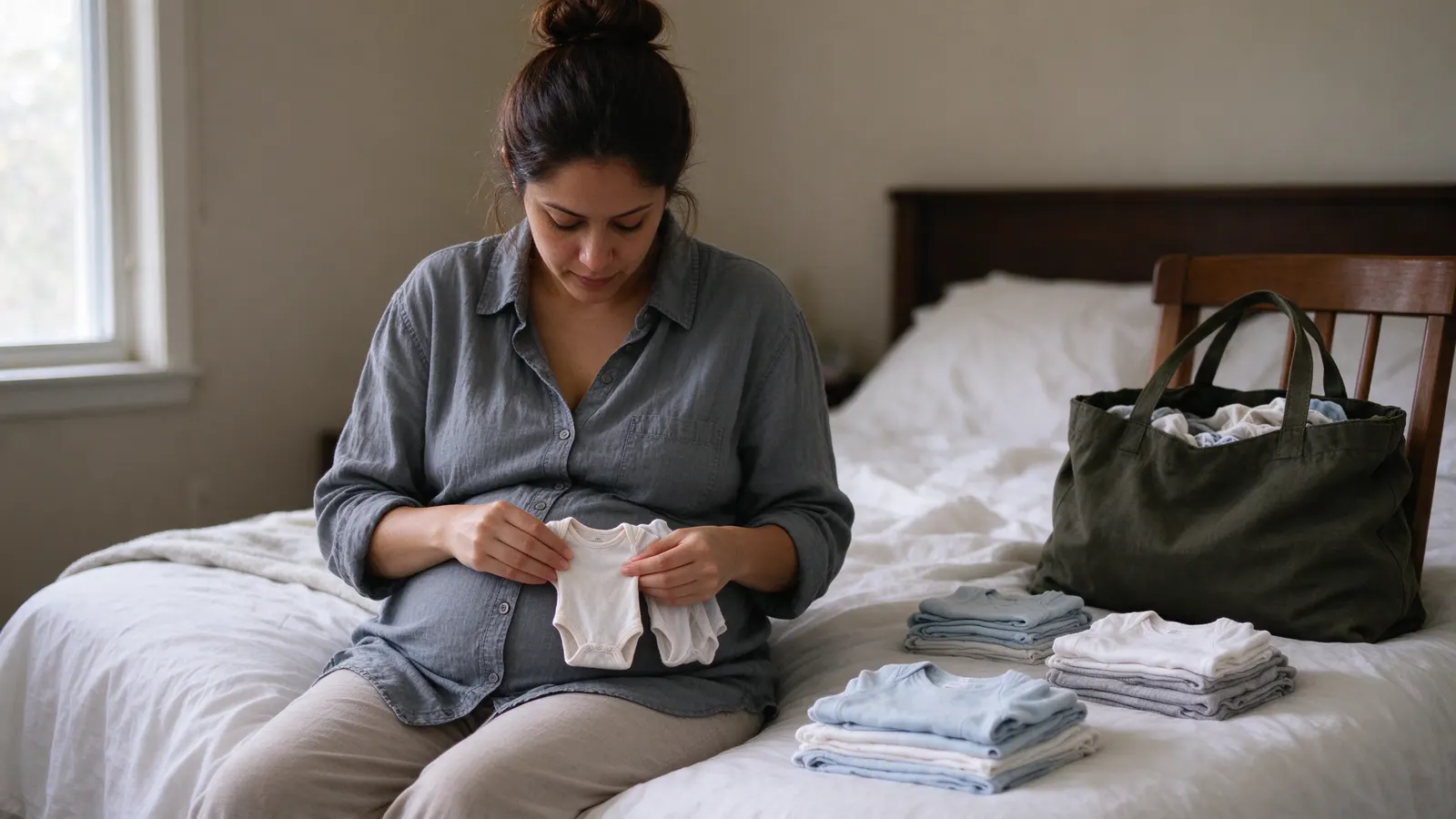
Thirty weeks and six days, the last day of week 30. Today is about the thing that keeps circling at 3am, and getting it out of your head and into a room with someone else in it.
Your baby

Your body
The NHS's week 30 page says plainly that sleep may be disrupted around now, with disturbing dreams fuelled by hormones and anxiety, and it says to discuss stress with your midwife or doctor (NHS). Stress at this point is often practical: money, leave, the birth, who'll help.
MedlinePlus's list for stress is ordinary on purpose: talk with your partner or a friend, keep up your prenatal care, eat well, stay active, get enough sleep, try meditation, and raise stress that persists with your provider (MedlinePlus). The first item on it costs nothing and takes fifteen minutes.
Try today
The stress talk
Time: 15 minutes
Pick the one worry that's loudest this week. Just one.
Ask your partner or a friend for fifteen minutes, phones away, somewhere you won't be interrupted.
Say it out loud from start to finish, including the part that sounds silly. They listen; no fixing yet.
Then ask them one question: "What did you hear?"
If it's a worry that has been there for weeks, write it on the list for your next visit (MedlinePlus).
Make it work:A walk works as well as a sofa. Talking side by side is easier for some people than face to face.
Watch for
Normal
the usual third-trimester symptoms, and some earlier ones coming back (NHS).
Call your provider
for any bleeding; the NHS says it needs medical advice (NHS).
Normal
being worn out at the end of a long day.
Call your provider
right away for overwhelming tiredness, which is on the CDC's list of urgent maternal warning signs (CDC).
Normal
worry that comes and goes.
Call your provider
if sadness or worry lasts, because depression can be treated and the CDC says to seek treatment as soon as possible (CDC).
Normal
a bad night.
Call 911
, or call or text 988 or 1-833-TLC-MAMA (1-833-852-6262), for thoughts about harming yourself or your baby (CDC).
For you
If you're the partner: today you're the listener. The hardest part is not jumping in with a plan. Let her finish, say back what you heard, and only then ask whether she wants help or just wanted it heard. Then take your own turn another night; your worries count too.
If the stress doesn't ease after talking, that's not a failure of the talk. It's the signal MedlinePlus means when it says to bring persistent stress to your provider (MedlinePlus).
Sources
- NHS. "Week 30." Week-by-week guide to pregnancy, Best Start in Life. https://www.nhs.uk/best-start-in-life/pregnancy/week-by-week-guide-to-pregnancy/3rd-trimester/week-30/
- MedlinePlus. "Pregnancy and work." National Library of Medicine. https://medlineplus.gov/ency/patientinstructions/000609.htm
- Centers for Disease Control and Prevention. "Urgent Maternal Warning Signs and Symptoms." HEAR HER campaign, 2024. https://www.cdc.gov/hearher/maternal-warning-signs/index.html
- Centers for Disease Control and Prevention. "Symptoms of Depression Among Women." Reproductive Health, 2024. https://www.cdc.gov/reproductive-health/depression/index.html
This guide is general education that summarizes published research and guidance from groups like the American Academy of Pediatrics, the CDC, and the WHO. It isn’t medical advice, and every child develops on their own timeline. Your pediatrician knows your child; if something feels wrong, call them. In an emergency, call 911.
Get each day’s note the morning it applies
Add your due date to a free Chorevia household, and every morning until the birth the day's note arrives in the app and by email: what's forming, what your body is doing, one thing to try, what to watch for, and a word for you.
Create your household