Day 200 of 280 · 28 weeks + 4 days
Where will the baby sleep
Last reviewed · 3 min read · 9 sources · Plain-text version
Twenty-eight weeks and four days. Crib, bassinet, or play yard: today you decide where your baby will sleep, and what goes in it (almost nothing).
- Size this week
- about the size of an aubergine
- Length this week
- around 37.6 cm from head to heel
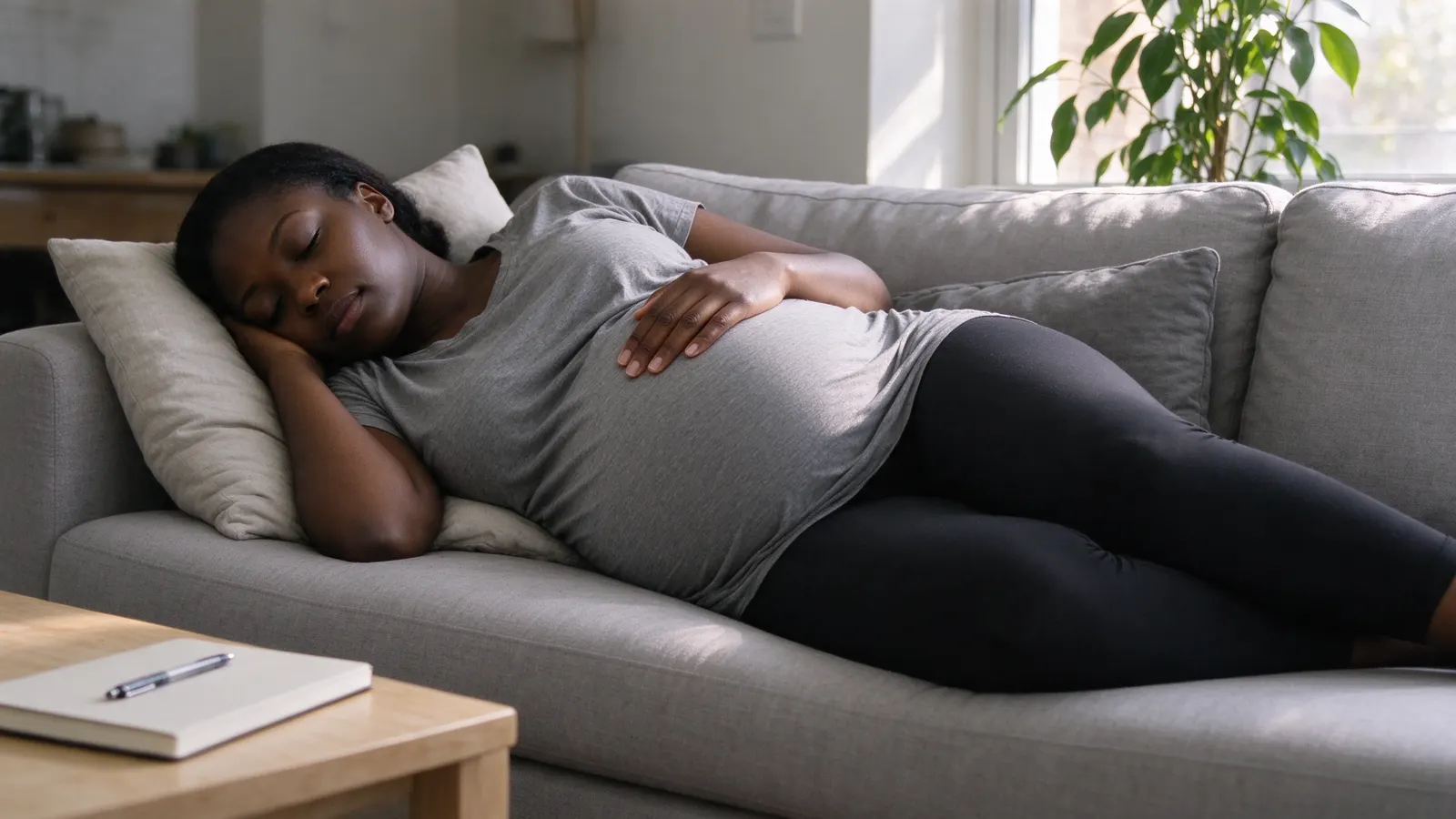
Twenty-eight weeks and four days, and day 200. Deciding where your baby will sleep is on the NHS's list for this week (NHS). It's one decision with a short set of rules, and today you make it.
Your baby

Around 37.6cm from head to heel, about the size of an aubergine (NHS). Your baby already has a sleep pattern of sorts: by 24 weeks a fetus sleeps and wakes on a regular schedule (NICHD). That pattern won't match your nights after birth for a while, which is all the more reason to have the sleep space ready before then.
Your body
Your back is under strain from the extra weight and looser joints (NHS), and a flat-pack crib box is heavy. At work, MedlinePlus says most pregnant women are advised to lift only objects under 20 pounds (9 kilograms) (MedlinePlus). Use the same rule at home: someone else carries the box and builds the crib.
The rules for the space itself are short. The CPSC says to use a product made for sleep, meaning a crib, bassinet, play yard, or bedside sleeper that meets federal requirements, and that "Bare is Best": nothing in it but a fitted sheet (CPSC). Your baby always goes down on their back, and inclined products over 10 degrees, such as rockers, gliders, and swings, should never be used for sleep (CPSC). For a crib, the AAP adds: slats no more than 2 3/8 inches apart, a very firm mattress that fits snugly, no drop rails, no bumper pads, and no pillows, bulky comforters, or heavy blankets (AAP).
Try today
The sleep-space decision
Time: 20 minutes · Safe sleep, every sleep in the guide
Choose the product: a crib, bassinet, play yard, or bedside sleeper made for infant sleep (CPSC).
Choose the spot, away from windows and radiators, with blind and curtain cords out of reach (AAP).
If it's a crib, check the slats, the mattress fit, and the sides against the AAP list above.
Look up the exact model on SaferProducts.gov for recalls, especially if it's borrowed or second-hand (CPSC).
Make it work:The shopping list for inside the crib is one fitted sheet. Gifts of bumpers, pillows, or sleep positioners can go back to the shop.
Watch for
Normal
eyes that feel tired at the end of the day.
Call your provider
for vision changes or blind spots (MedlinePlus).
Normal
some itchiness; about 20 percent of pregnant women feel itchy, and it typically goes away after delivery (OWH).
Call your provider
about itching that won't stop with no rash, which MedlinePlus says may be a sign of cholestasis (MedlinePlus).
Normal
being tired.
Call your provider
for overwhelming tiredness, which the CDC lists as an urgent warning sign (CDC).
For you
The baby-product aisle will offer you a lot of things for the crib. The AAP's answer to nearly all of them is no (AAP). That's money and decisions saved.
If you're the partner: building the crib, checking the recall, and saying no to the bumper gift are all yours.
Sources
- NHS. "Week 28." Week-by-week guide to pregnancy, Best Start in Life. https://www.nhs.uk/best-start-in-life/pregnancy/week-by-week-guide-to-pregnancy/3rd-trimester/week-28/
- National Institute of Child Health and Human Development. "About Pregnancy." NIH. https://www.nichd.nih.gov/health/topics/pregnancy/conditioninfo
- MedlinePlus. "Pregnancy and work." National Library of Medicine. https://medlineplus.gov/ency/patientinstructions/000609.htm
- U.S. Consumer Product Safety Commission. "Safe Sleep – Cribs and Infant Products." CPSC. https://www.cpsc.gov/Safety-Education/Safety-Education-Centers/cribs
- American Academy of Pediatrics. "Choosing a Crib." HealthyChildren.org. https://www.healthychildren.org/English/ages-stages/prenatal/decisions-to-make/Pages/Choosing-a-Crib.aspx
- MedlinePlus. "Prenatal care in your third trimester." National Library of Medicine. https://medlineplus.gov/ency/patientinstructions/000558.htm
- Office on Women's Health. "Body changes and discomforts." U.S. Department of Health and Human Services. https://womenshealth.gov/pregnancy/youre-pregnant-now-what/body-changes-and-discomforts
- MedlinePlus. "Skin and hair changes during pregnancy." National Library of Medicine. https://medlineplus.gov/ency/patientinstructions/000611.htm
- Centers for Disease Control and Prevention. "Urgent Maternal Warning Signs and Symptoms." HEAR HER campaign, 2024. https://www.cdc.gov/hearher/maternal-warning-signs/index.html
This guide is general education that summarizes published research and guidance from groups like the American Academy of Pediatrics, the CDC, and the WHO. It isn’t medical advice, and every child develops on their own timeline. Your pediatrician knows your child; if something feels wrong, call them. In an emergency, call 911.
Get each day’s note the morning it applies
Add your due date to a free Chorevia household, and every morning until the birth the day's note arrives in the app and by email: what's forming, what your body is doing, one thing to try, what to watch for, and a word for you.
Create your household