Early school years · 5 to 6 years
Age 5: Development, Research, and What Helps
Last reviewed · 18 min read · 13 activities · 12 common questions · 79 sources · Plain-text version
Five is the kindergarten year. Here's what's developing, what the research really says about phonics, reading aloud, early math, and starting school young, and what helps at home, from family jobs to a first save jar.
At a glance
- Most 5-year-olds tell simple stories, count to 10, hop on one foot, and follow game rules. A missed milestone is a reason to ask now, not wait.
- Kindergarten readiness is about getting along and following directions as much as letters. Holding a child back has mixed evidence.
- Phonics at school plus reading aloud at home is the evidence-backed mix. Keep reading to your child after they start reading.
- Plan on 10 to 13 hours of sleep a day at 5, and 9 to 12 hours from age 6. Nearly all children have dropped naps by now.
- Wet nights are still common at 5 and usually outgrown. They aren't your child's fault, and punishment doesn't help.
- Five-year-olds can own real family jobs, like making their bed and setting the table. Keep them unpaid; research on paying kids is mixed.
- Keep the harness car seat until your child outgrows it, then use a booster in the back seat. Most kids aren't ready to cross streets alone until at least 10.
- The 5-year checkup includes vision and hearing checks and school-entry vaccines. Ask your pediatrician which vaccine schedule they follow.
Your age-5 checklist
0 of 12 done
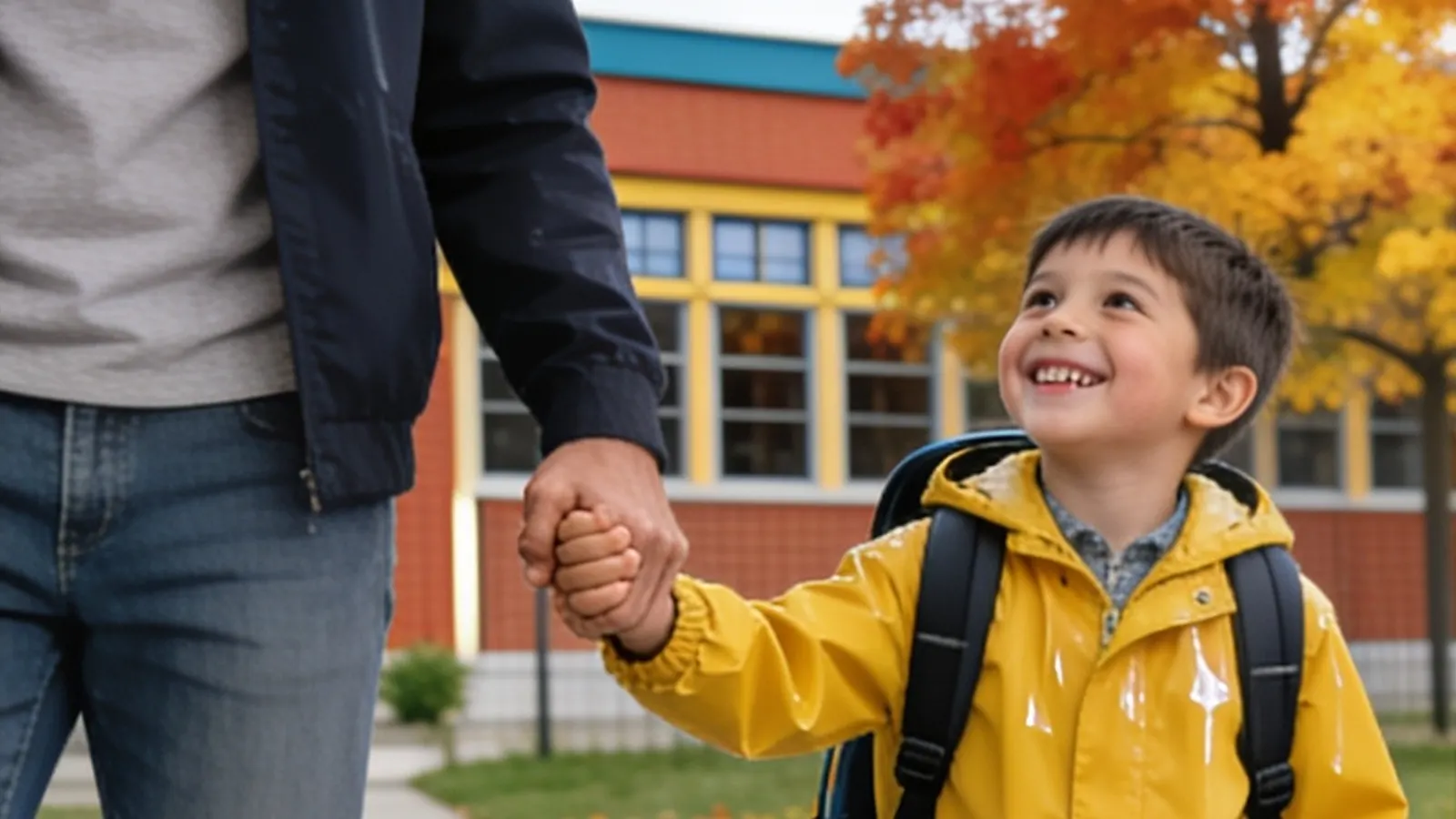
Five is the kindergarten year for most US children; in most of the country, the age requirement is 5 for kindergarten and 6 for first grade (AAP). This guide covers ages 5 to 6. For the year before, see the 4-year guide; for what comes next, see the 6-year guide.
What's developing#
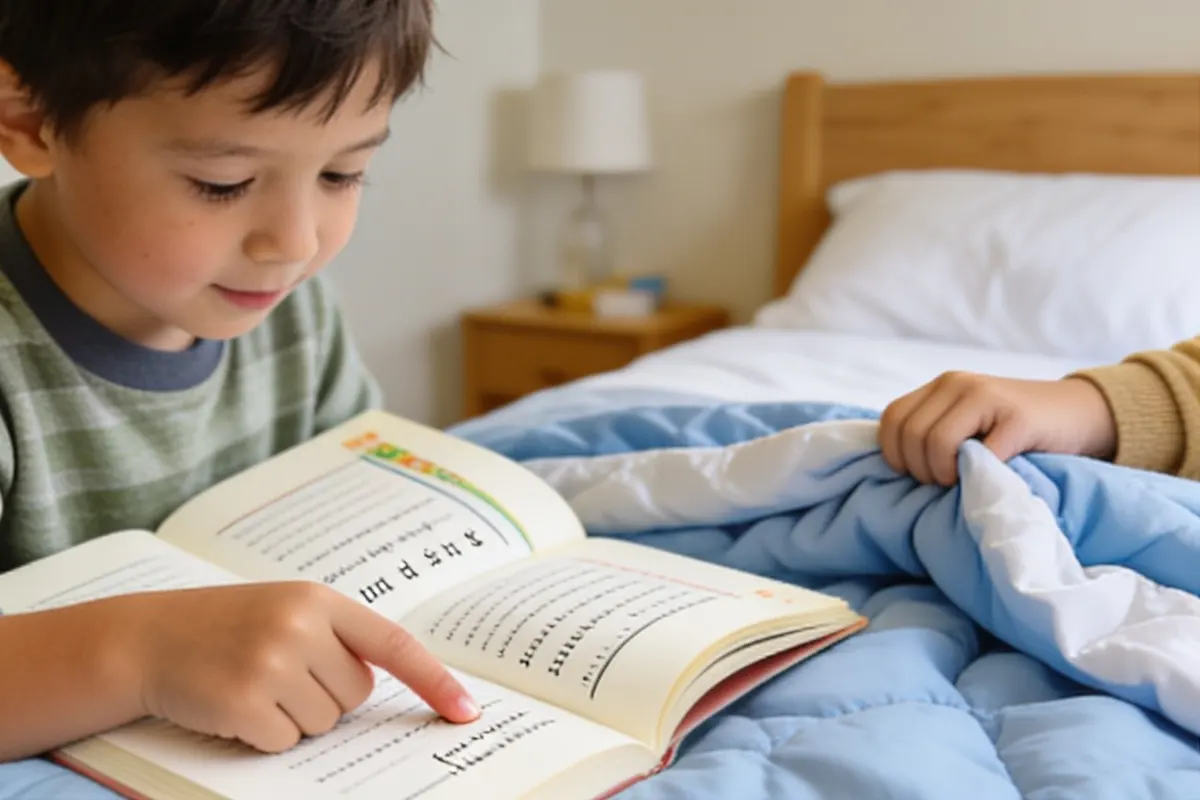
CDC's milestone checklists list skills that at least 75% of children show by each age, so a missed milestone is a reason to check in now, not to wait and see (Zubler et al., 2022).
Milestones by 5 years
By 5, most children (CDC):
- Social: follow rules or take turns in games with other children; sing, dance, or act for you; and do simple chores, like matching socks or clearing the table.
- Language: tell a story they heard or made up with at least two events, answer simple questions about a book after you read it, keep a conversation going for more than three back-and-forth turns, and use or recognize simple rhymes (bat, cat).
- Thinking: count to 10, name some numbers between 1 and 5 when you point to them, use time words like "yesterday" and "tomorrow," pay attention for 5 to 10 minutes during activities (screen time doesn't count), write some letters in their name, and name some letters.
- Movement: button some buttons and hop on one foot.
Body and hands
Many 5-year-olds can stand on one foot for 10 seconds, climb stairs alternating feet without support, copy a triangle, and dress and undress without help (AAP). Most can hold a pencil correctly and draw a person with at least 6 body parts (AAP).
Teeth on the move
Baby teeth usually start falling out at about 6, front teeth first (AAP), and the first permanent molars arrive around then too (see the teeth question). Most children need help brushing until about 8 (AAP).
Stories, letters, and early reading
Speech should now be understandable to strangers (AAP). Some children start sounding out words this year; many need another year or so. The AAP sees no need to push, since some early readers lose their head start by second or third grade (AAP).
Friends, rules, and feelings
Five-year-olds want more time with friends and often test limits, and teachers care most about social skills and language, especially getting along with other children and following directions (AAP). The AAP's school-readiness list leans social too: paying attention, controlling impulses and emotions, taking turns, making friends, and showing empathy (AAP).
Sleep and the end of naps
The American Academy of Sleep Medicine recommends 10 to 13 hours a day, naps included, for ages 3 to 5, and 9 to 12 hours for ages 6 to 12 (Paruthi et al., 2016). Across studies worldwide, 94% of children have stopped napping by 5 (Staton et al., 2020).
Dry nights
Bedwetting is still common. The AAP cites studies finding that 15% of 5- and 7-year-olds wet the bed; by 15, fewer than 1% do (AAP).
What the research says#
Some of the loudest debates in early education land in the kindergarten year.
1. Systematic phonics helps beginning readers. The National Reading Panel analyzed 38 studies (66 comparisons). Teaching letter-sound links in a planned sequence beat little or no phonics, with "significant and substantial" effects in kindergarten and first grade. The panel added that phonics is one part of a complete program, and that children's reading shouldn't be judged on phonics alone (NICHD). A 2016 federal guide rated teaching sound awareness and decoding as backed by strong evidence (What Works Clearinghouse). It's still debated: a 2020 review of 12 meta-analyses argued phonics' edge over other methods is weaker than claimed (Bowers, 2020); others replied that the evidence consistently supports explicit phonics within a broader approach (Fletcher et al., 2021). Takeaway: Expect letter-sound teaching at school and support it at home, alongside lots of real books.
2. Reading aloud still matters, but it isn't magic. A meta-analysis of 99 studies (7,669 people) found that more exposure to books, from being read to in preschool to reading for fun later on, goes with stronger language and reading skills, and that in preschool and kindergarten, print exposure accounted for 12% of the differences in oral language (Mol & Bus, 2011). Those are correlations. Across 54 studies of 5,569 children that tested shared-reading programs directly, the boost to language was small, and close to zero compared with other active activities (Noble et al., 2019). The AAP still recommends shared reading from birth through at least kindergarten for language, relationships, and school readiness (Klass et al., 2024). Takeaway: Read together because it builds language and closeness, not as a test-prep program.
3. Early math predicts later success, but drilling isn't a shortcut. Across 6 long-term studies, math skills at school entry were the strongest predictor of later achievement, ahead of reading and then attention (Duncan et al., 2007), and math at 54 months predicted math at 15 (Watts et al., 2014). But experiments that boosted young children's math skills had much smaller long-term effects than those correlations suggest (Bailey et al., 2018). Play helps: low-income preschoolers (average age 5.4) who played a numbered board game for about an hour improved on four number skills for at least 9 weeks (Ramani & Siegler, 2008). Takeaway: Make numbers part of everyday play, and skip the flash-card pressure.
4. The youngest in the class get more ADHD diagnoses; holding back is debated. In a study of 407,846 US children, in states with a September 1 kindergarten cutoff, those born in August were diagnosed with ADHD at 85.1 per 10,000, versus 63.6 for those born in September. Normal immaturity may be mistaken for ADHD (Layton et al., 2018). In Denmark, a one-year delay in starting school sharply reduced inattention and hyperactivity at 7, mostly in girls, lasting to 11 (Dee & Sievertsen, 2018). But the AAP notes that academic gaps for the youngest mostly disappear by third or fourth grade, while children old for their grade face more behavior problems as teens (AAP). Takeaway: Decide on timing for your child, not a rule. If ADHD comes up, ask whether age is part of the picture.
5. Praise effort, but don't expect a mindset slogan to change grades. In a study of 53 families, parents who praised effort when children were 14 to 38 months old had children who, at 7 to 8, more often believed abilities can grow (Gunderson et al., 2013). But two meta-analyses (273 studies of 365,915 students, and 43 studies of 57,155 students) found weak overall links between growth mindset and achievement, and weak effects from mindset programs, with possible benefits for students from low-income families or at academic risk (Sisk et al., 2018). Takeaway: Notice effort and strategies because it's encouraging and honest, not as a guarantee.
6. Sampling sports beats specializing early. A review found more intense specialization is likely linked to overuse injuries, though the age when risk begins isn't known; sports medicine groups recommend several sports (Jayanthi et al., 2019). The AAP warns that specializing too early can harm young athletes physically and psychologically (Brenner, 2016), and that nearly 70% of US kids drop their favorite sport before 13 (Brenner & Watson, AAP). The evidence is mostly observational. Takeaway: At 5, aim for free play and a sampler of activities, not a one-sport track.
7. Family jobs go with later confidence. In a US study of 9,971 children, kindergartners who did chores more often rated their social and academic competence and life satisfaction higher in third grade, regardless of family income or parents' education (White et al., 2019). In an online survey of 207 parents of 5- to 13-year-olds, most of them in Australia, chores predicted better parent-rated working memory and impulse control (Tepper et al., 2022). Both are correlations; capable kids may simply get more jobs. Takeaway: Give your child real work that matters to the family, and expect it to take practice.
Parenting techniques#
A smooth start to kindergarten
- Make it familiar. Visit the school before the first day, play on its playground, and practice the route (AAP). CDC suggests stories and pretend play about kindergarten (CDC).
- Shift bedtime early. Start the school bedtime a week or two ahead (AAP).
- Keep goodbyes short. Use the same ritual each day, then leave, and don't come back to check in; it restarts the upset (Swanson, AAP).
- Partner with the teacher. Share what you know about your child (AAP).
Script: "Two hugs and a high-five at the door, then I go to work. I'll be at pickup after recess."
After school: snack, downtime, then talk
Plan a snack and some unscheduled time before questions or activities, and avoid overscheduling weeknights; the AAP says children need downtime (AAP). Five minutes of play where your child leads, especially right after you get home, goes a long way (AAP).
Script: Skip "How was school?" Try "Who did you sit with at lunch?" or "What made you laugh today?"
Supporting a new reader
- Keep reading aloud, and ask about the story afterward (CDC). Mix in some books above your child's own reading level, so stories stay interesting while decoding catches up.
- Listen to them read. When your child brings home simple books, let them read to you. Guided repeated reading aloud, with feedback from teachers, peers, or parents, improved word recognition, fluency, and comprehension in the panel's review (NICHD).
- Keep it fun. The AAP says enthusiasm matters more than the age a child learns to read; don't drill letters or words (AAP).
Friendships and playing by the rules
Stay close during playdates so you can coach sharing and solving conflicts without hitting. When your child gets angry at a friend, help them notice the feeling, express it without hurting anyone, and remember it will pass (AAP). CDC suggests teaching your child to follow rules in games (CDC).
Script: "You're mad you lost. That makes sense. Want to take a breath and then ask for a rematch?"
Big feelings and calming down
- Model it out loud. "I'm really frustrated. Help me take 10 deep breaths." Then help your child name their own feelings (AAP).
- Make a calm spot for when your child is upset (CDC), and once they're calm, walk through how to solve the problem (CDC).
- Coaching feelings helps. In a trial of 216 parents of 4- and 5-year-olds, a six-session emotion-coaching program improved children's understanding of emotions and reduced reported behavior problems (Havighurst et al., 2010).
Discipline that teaches
Give lots of attention for behavior you want, and praise real effort. Ignore minor attention-seeking misbehavior, but never unsafe behavior (AAP). Use consequences you'll follow through on, and time-outs of about 1 minute per year of age, or let your child return "when you feel ready." The AAP advises against spanking, yelling, and shaming, which don't work and can harm children (AAP).
Sleep on school nights
Keep the same wake time every day, use a short routine like "brush, book, bed," and keep screens out of the bedroom and off for an hour before bed (AAP).
Screens: a family plan
The AAP's 2026 guidance focuses less on minutes and more on content, watching together, and apps built to keep kids hooked (AAP; Munzer, AAP). For specifics, see the screen time question.
Active play and a first sport
Children 3 through 5 should be active throughout the day, with at least 3 hours of active play, and from 6, at least 60 minutes of moderate-to-vigorous activity daily (HHS). The AAP suggests waiting until about 6 for organized sports (Brenner & Watson, AAP). For a first team, look for small fields, short games, and little scorekeeping (AAP).
Wet nights without blame
Bedwetting isn't your child's fault, so don't punish it. Set a no-teasing rule, protect the mattress, and let your child help change the sheets if it doesn't feel like punishment. If wet nights continue for months, ask about a bedwetting alarm, which works 50% to 75% of the time (AAP).
What to teach#
Five-year-olds are ready for real responsibility, first money ideas, and safety rules, taught in small steps.
Family jobs for 5-year-olds
The AAP lists jobs that children 5 to 7 can do: making their bed, setting and clearing the table, putting toys away, putting dirty clothes in the hamper, filling a pet's food dish, sorting laundry, watering plants, helping make and pack lunches, and washing plastic dishes (AAP). Add packing their own backpack for school.
Family jobs are part of belonging, so consider keeping them unpaid. The AAP suggests a chart or checklist, one new task at a time, and praise for effort rather than results; it also mentions stickers or an allowance tied to chores as an option some families use (AAP). Research on paying kids is mixed (see money). Let your child do things themselves, even imperfectly (CDC). For more, see raising independent kids through chores and how to stop nagging.
How to teach a task step by step
- Show it. Do the job slowly while you name each step: "Pull the sheet up, smooth it, then the pillow on top."
- Do it together. You do the hard parts; your child does the rest.
- Watch them do it. Help only when asked or stuck.
- Hand it over. Post a picture checklist, and check in less over time.
This approach is common teaching practice, not something studied for chores. Expect lumpy beds for a while, and don't redo the job in front of your child.
Money: first real lessons
CFPB says children 3 to 5 are usually too young for abstract money ideas, but you can talk about four: you earn money by working, you may have to wait and save for something you want, you plan ahead for what you'll need, and needs differ from wants. Thinking out loud while you shop shows how you decide (CFPB; CFPB). From about 6, money habits and norms start forming as children watch you and handle small amounts themselves (CFPB, 2016).
Allowance is optional, and the evidence is mixed. The AAP calls it a family decision and suggests save, spend, and share containers, or a sticker chart instead of cash for young children (AAP). Allowances are modestly linked to financial responsibility in young adulthood (Collins & Odders-White, 2021), but in a Dutch study, pocket money alone didn't make adults more likely to save; pairing it with oversight and advice worked best (Bucciol & Veronesi, 2013). And across 128 experiments, mostly short lab tasks, expected tangible rewards reduced interest in the rewarded activity, especially in children (Deci et al., 1999).
If you want your child to earn, keep family jobs unpaid and offer a few optional paid extras, like helping wash the car. See chores by age and what to pay, rewards without bribery, and teaching kids financial skills.
Body safety and consent
- Use the real names for all body parts (AAP).
- Your child is in charge of who touches them (CDC). It's fine to say no to anyone, including adults; doctors may examine private parts to keep them healthy (AAP).
- Surprises are fine to keep; other secrets should always be told to a trusted adult. Promise you'll believe them, and help them name other safe adults, since abusers are usually someone the child knows (AAP).
Safety rules to practice
Activities to try#
Pick a few that fit your week. The evidence ratings show how well each idea has been tested; most everyday activities haven't been studied directly, and that's fine.
How we rate the evidence
- Strong evidence
- Randomized trials or systematic reviews show a consistent benefit.
- Moderate evidence
- Consistent observational research, or a major guideline (AAP, WHO) built on research.
- Emerging evidence
- Small or early studies. Plausible, not yet proven.
- Mixed evidence
- Studies disagree, or reviews rate the evidence as weak.
Too tired to choose? Let us pick one.
Chapter-book read-aloud
Moderate evidence- Time
- 10 to 20 minutes, most days
- Builds
- Vocabulary, attention, a love of stories
- Pick a short chapter book with a few pictures, above what your child can read alone.
- Read one chapter a night, and stop at a cliffhanger.
- Before you start, ask your child what happened last time.
Make it work: If your child wiggles, let them draw or build quietly while they listen.
Evidence: Moderate. The AAP recommends shared reading through at least kindergarten (Klass et al., 2024), and reading more goes with stronger language, though studies of reading programs show small effects (Mol & Bus, 2011; Noble et al., 2019).
Rhyme and first-sound games
Moderate evidence- Time
- 5 minutes, in the car or at dinner
- Builds
- Hearing the sounds in words, a base for reading
- Say a word and take turns finding rhymes, real or silly: "cat, hat, zat."
- Play "I spy something that starts with /b/," using the letter's sound, not its name.
- Clap the syllables in family members' names.
Evidence: Moderate. Teaching children to hear the sounds in words and link them to letters is rated strong evidence for kindergarten through 3rd grade classrooms (What Works Clearinghouse), and CDC suggests rhyming games at 5 (CDC). The home games themselves haven't been tested.
Story retell: first, next, last
Emerging evidence- Time
- 5 minutes after a book or outing
- Builds
- Storytelling, memory, time words
- After a story or a trip, ask, "What happened first?"
- Then ask, "What happened next?" and "How did it end?"
- Write their words down and read the "book" back to them.
Evidence: Emerging. Telling a story with at least two events and using time words are 5-year milestones (CDC); a federal guide rates teaching narrative language as supported by only minimal evidence so far (What Works Clearinghouse).
Number board game
Emerging evidence- Time
- 15 minutes, a few times a week
- Builds
- Counting, number sense, taking turns, losing well
- Use a game with numbered squares in a straight line, like Chutes and Ladders, or draw a track numbered 1 to 10.
- Have your child count out loud from where their piece sits: "6, 7, 8."
- Ask, "Who's closer to the end?" after each turn.
Evidence: Emerging. Low-income preschoolers who played a numbered, linear board game for about an hour gained in four number skills, still there 9 weeks later (Ramani & Siegler, 2008).
Kitchen helper
Emerging evidence- Time
- 15 to 30 minutes
- Builds
- Measuring and counting, trying new foods, real responsibility
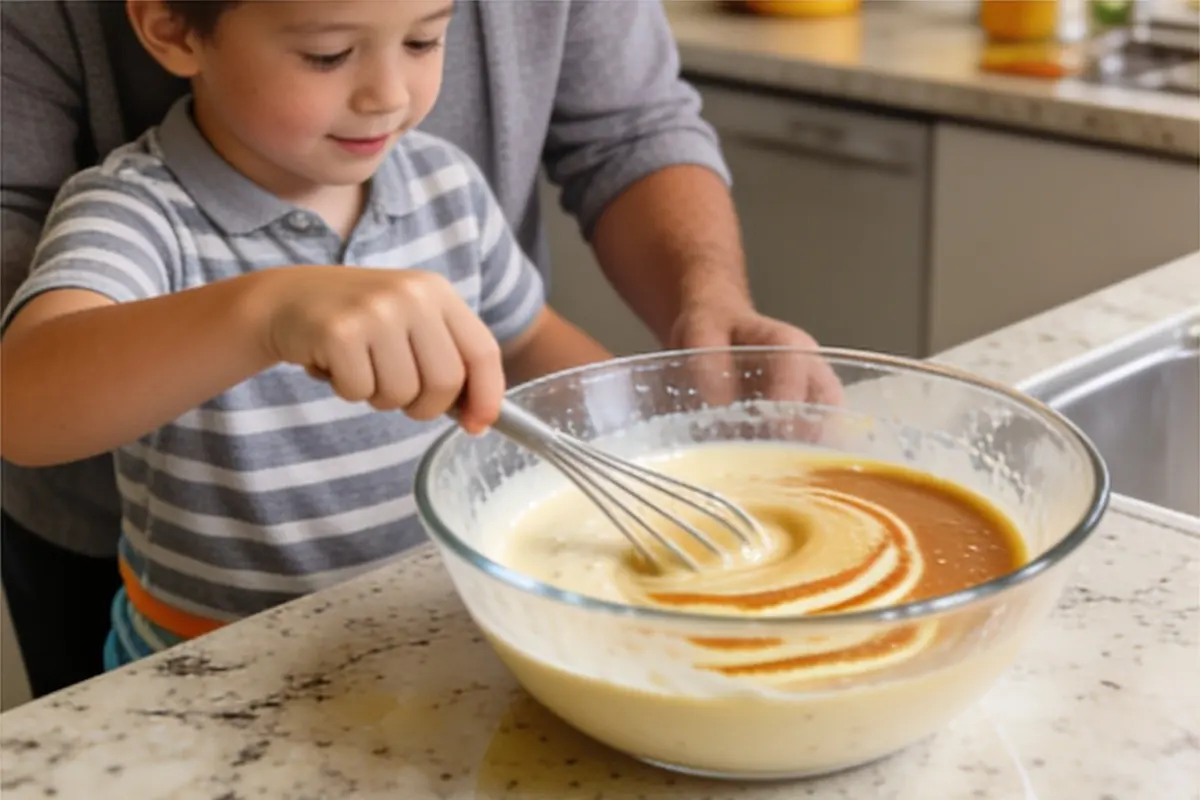
- Give your child a real job: rinse vegetables, tear lettuce, measure, or stir.
- Count scoops and cups out loud together.
- Let them serve the dish they helped make.
Make it work: Teach your child to hold kitchen tools safely and use oven mitts, and always supervise (Fernando, AAP).
Evidence: Emerging. In one experiment with 47 children ages 6 to 10, those who helped cook lunch ate 76% more salad than those whose parent cooked alone (van der Horst et al., 2014); the AAP notes cooking teaches counting and measuring (Fernando, AAP).
Morning picture checklist
Emerging evidence- Time
- 20 minutes to make, then daily
- Builds
- Independence, remembering steps, fewer reminders
- Photograph your child doing each morning step: dress, breakfast, brush teeth, shoes, backpack.
- Print the photos in order and put them at your child's eye level.
- Point to the chart instead of repeating instructions.
Evidence: Emerging. The AAP suggests a chore chart or checklist as a visual reminder that also gives a sense of accomplishment (AAP); picture checklists for young children haven't been tested directly.
Teach one family job
Emerging evidence- Time
- A few minutes a day for 2 weeks
- Builds
- Competence, responsibility, pride
- Pick one job from the AAP's list for ages 5 to 7, such as setting the table.
- Show it, do it together, then watch your child do it.
- After a week or so, hand it over and add it to the checklist.
Make it work: Thank your child for effort. Don't pay for family jobs.
Evidence: Emerging. Kindergartners who did more chores reported more social and academic confidence in third grade, a link that can't prove cause (White et al., 2019).
Save jar with a goal
Emerging evidence- Time
- 15 minutes to set up, then weekly
- Builds
- Waiting, planning, counting money
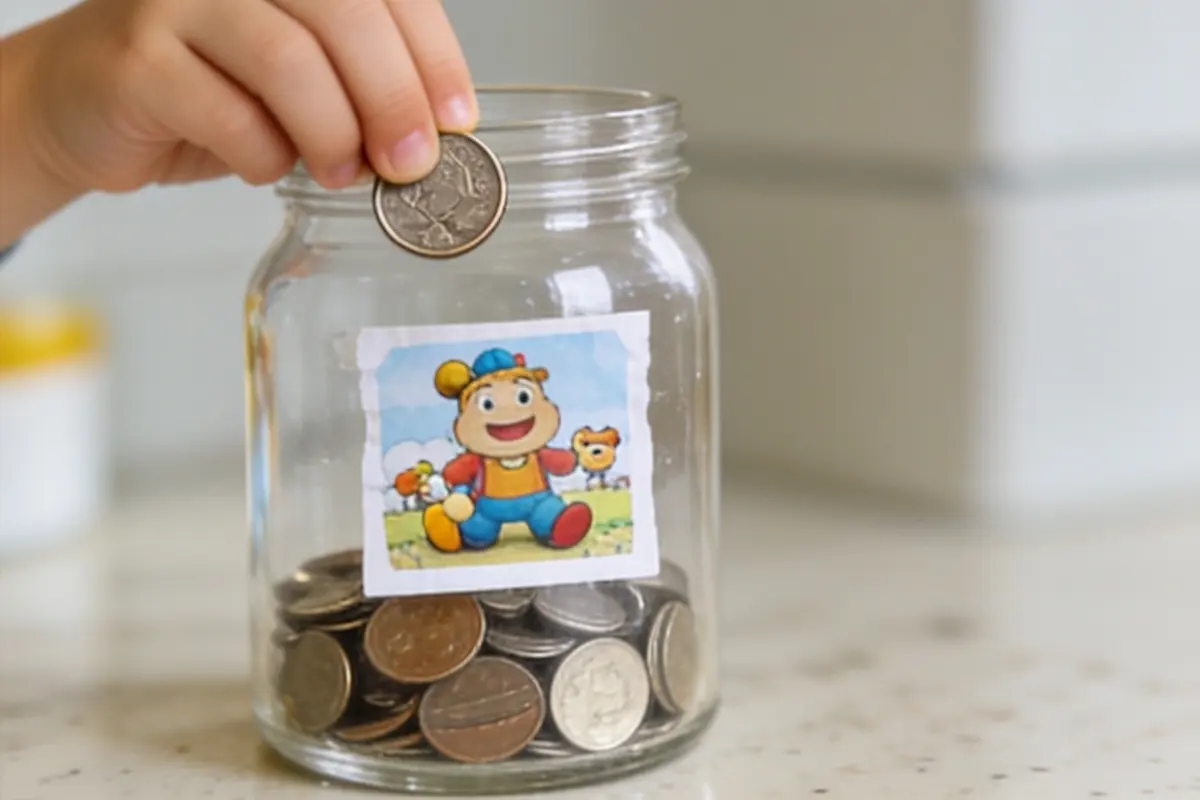
- Choose a small, reachable goal with your child and tape a picture of it to a clear jar.
- Add coins from gifts or optional paid extras, and count them together each week.
- When the jar is full, go buy the thing together and let your child pay.
Make it work: Draw a line on the jar for "halfway" so progress is visible.
Evidence: Emerging. CFPB suggests teaching that you may need to wait and save for things you want (CFPB), and the AAP suggests labeled save, spend, and share containers (AAP); jars themselves haven't been studied.
Needs-and-wants shopping game
Emerging evidence- Time
- One grocery trip
- Builds
- Understanding choices and trade-offs
- Give your child a short picture list of what you need.
- As you shop, ask, "Is this a need or a want?"
- Let them pick one small "want" within a set amount, and help them compare two choices.
Evidence: Emerging. CFPB suggests talking about needs versus wants (CFPB) and thinking out loud as you handle money (CFPB); the game hasn't been studied.
Stop-and-go games
Emerging evidence- Time
- 10 minutes
- Builds
- Self-control, listening, following rules
- Play Red Light, Green Light, then switch the rules: red means go, green means stop.
- Try "Head, Toes, Knees, Shoulders": when you say "touch your head," your child touches their toes.
- Speed up as your child gets better.
Evidence: Emerging. In a preschool study of 157 children, classroom music-and-movement games like Red Light, Purple Light produced self-control gains that fell short of statistical significance, along with significant math gains (McClelland et al., 2019).
Curb-and-crosswalk walks
Emerging evidence- Time
- Every walk together
- Builds
- Pedestrian habits your child will need later
- Stop together at every curb, and hold hands to cross.
- Narrate: "I'm looking left, right, and left again. That driver saw me wave."
- Let your child tell you when it's safe, then check for yourself before you go.
Evidence: Emerging. The AAP recommends walking with your child, explaining what you do, and teaching left-right-left looking, crosswalks, and eye contact with drivers (Kendi, AAP); this practice can't make a 5-year-old safe to cross alone.
Swim lessons
Moderate evidence- Time
- A session of weekly lessons
- Builds
- Water safety skills, confidence, fitness
- Look for a program that teaches the Red Cross water skills: get in over their head, surface and float, turn around, swim 25 yards, and climb out (AAP).
- Practice floating and finding the wall together during family swims.
Make it work: Lessons never replace an adult watching. By 5 or 6, most children can learn basic strokes like the front crawl (AAP).
Evidence: Moderate. In a case-control study, formal swim lessons were linked to 88% lower odds of drowning in children 1 to 4; for ages 5 to 19, the result pointed the same way but wasn't statistically certain (Brenner et al., 2009). The AAP recommends lessons for all children (AAP).
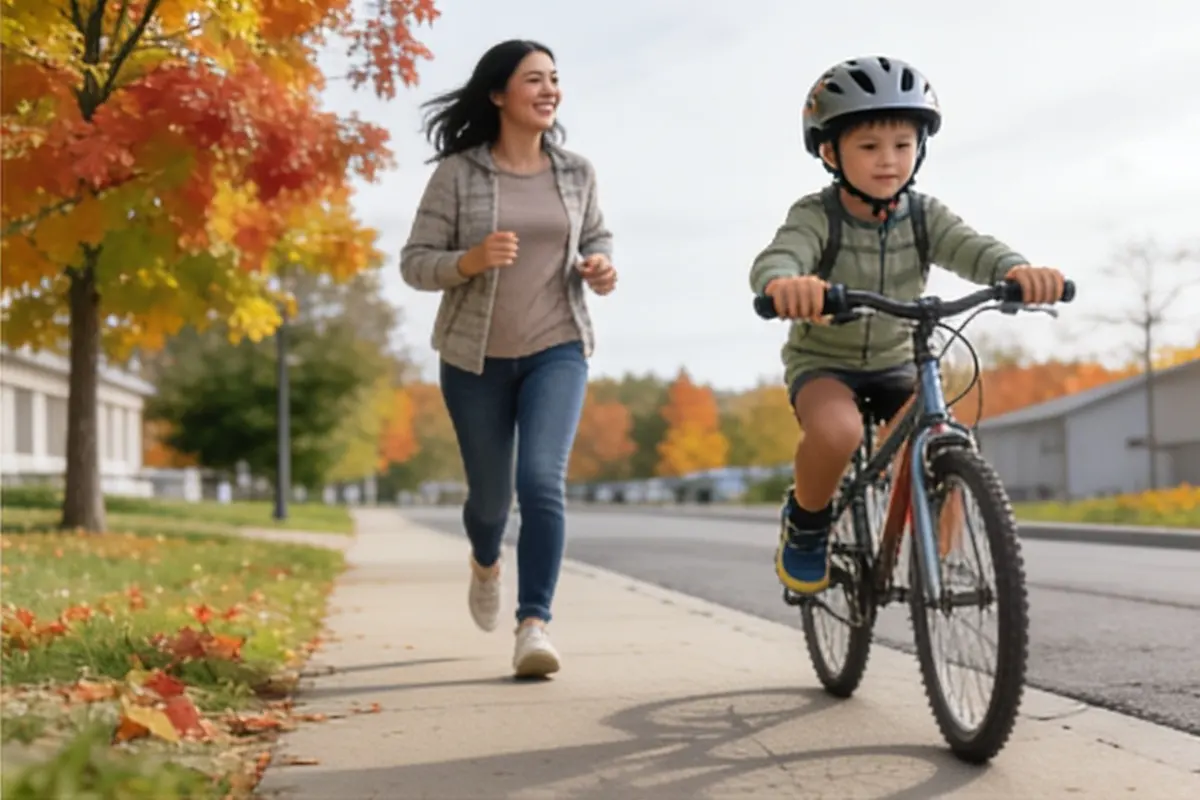
Learning to ride a bike
Moderate evidence- Time
- 20 to 30 minutes, on a few weekends
- Builds
- Balance, coordination, confidence
- Choose a bike your child can sit on with the balls of both feet on the ground, with foot brakes (AAP).
- Fit a CPSC-certified helmet level on the forehead, with a snug chin strap (AAP).
- Practice in a park or empty lot, away from streets and driveways.
Make it work: Five-year-olds shouldn't ride in the street (AAP) or at dusk or after dark (AAP).
Evidence: Moderate. Across 40 studies of more than 64,000 injured cyclists, helmets were linked to about half the odds of head injury and lower odds of serious and fatal head injury (Olivier & Creighton, 2017).
Common questions#
What should a 5-year-old be able to do?
Most 5-year-olds can tell a simple story with two events, count to 10, name some letters and numbers, hop on one foot, button some buttons, and follow rules in games (CDC). Many also dress themselves and hold a pencil correctly (AAP). These are skills at least 75% of children have by 5, so a missed one is a reason to talk with your pediatrician, not a diagnosis (Zubler et al., 2022). See the full milestone list.
Should I hold my child back from kindergarten if they have a summer birthday?
There's no single right answer, and the AAP cautions that waiting a year isn't necessarily an advantage. It notes that most academic gaps for the youngest children fade by third or fourth grade, while children old for their grade face a greater risk of behavior problems as teens (AAP). On the other side, the youngest children in a class are more likely to be diagnosed with ADHD (Layton et al., 2018), and a Danish study found a later start reduced inattention and hyperactivity (Dee & Sievertsen, 2018). Talk with your child's preschool teacher and pediatrician about your child's social, emotional, and language skills, not just letters (AAP).
Should my 5-year-old be reading yet?
Not necessarily; the AAP says there's no need to push, and many children need until kindergarten or first grade to develop the skills for formal reading. Some early readers lose their advantage by second or third grade, and enthusiasm for learning matters more than the age a child starts reading (AAP). At 5, most children can name some letters, write some letters in their name, and recognize simple rhymes (CDC). If your child struggles with these, or seems to be struggling at school, talk with the teacher and your pediatrician (AAP).
How much sleep does a 5-year-old need?
A 5-year-old needs 10 to 13 hours of sleep a day, and from age 6, 9 to 12 hours (Paruthi et al., 2016). Most 5-year-olds no longer nap, so that's mostly nighttime sleep (Staton et al., 2020). For a 7 a.m. wake-up, 11 hours of sleep means being asleep by 8 p.m. Signs of too little sleep include irritability and trouble concentrating, and snoring or loud breathing at night are worth mentioning to your pediatrician (AAP).
Is it normal for a 5-year-old to wet the bed?
Yes, bedwetting is common at 5 and most children outgrow it. The AAP cites studies finding 15% of 5- and 7-year-olds wet the bed, and fewer than 1% by 15. Often the brain and bladder aren't yet communicating well during deep sleep; it isn't laziness or defiance. Call your pediatrician if a child who was dry for 6 months or more starts wetting again, or if wetting comes with pain or burning when peeing, cloudy or pink urine, or changes in how often they pee during the day (AAP). See wet nights without blame.
When do kids start losing baby teeth?
Most children lose their first baby tooth at about age 6, usually one of the middle front teeth (AAP). The first permanent molars also come in around 6, and NIDCR recommends sealants on them as soon as they appear (NIDCR). In a Cochrane review, sealants on first permanent molars in children 5 to 10 cut decay on those surfaces from an assumed 16% to about 5% over 2 years (Ahovuo-Saloranta et al., 2017). Keep using a pea-sized amount of fluoride toothpaste twice a day (AAP).
Why is my child so cranky after kindergarten?
Tiredness and hunger are worth checking first: the AAP says too little sleep often leads to irritability and trouble concentrating, and that children need downtime, not overscheduled days (AAP). Hunger affects how children do in class, and a breakfast with some protein helps them concentrate (AAP). Try a snack and quiet time before questions or activities (see after school). If your child dreads school, seems scared, or is struggling for weeks, talk with the teacher and your pediatrician (AAP).
Should I give my 5-year-old an allowance?
You don't have to; the AAP calls allowances a family decision (AAP), and research on them is limited and mixed. Allowances have been modestly linked to financial responsibility in young adulthood (Collins & Odders-White, 2021), but in one Dutch study, pocket money by itself didn't make adults more likely to save, while pocket money combined with guidance and advice did best (Bucciol & Veronesi, 2013). If you start, keep it small and regular, pair it with a save jar and a goal, and keep everyday family jobs unpaid. See money: first real lessons.
How much screen time is OK for a 5-year-old?
CDC suggests no more than 1 hour a day of screen time at this age, with no screens during meals or for 1 to 2 hours before bed (CDC). The AAP's 2026 guidance focuses less on a number and more on quality content, watching together, and avoiding apps designed to keep kids hooked (AAP). For families who want a number, the policy suggests limits ranging from under 1 hour a day for toddlers and preschoolers to 1 to 2 hours a day of entertainment media for school-age children (Munzer et al., 2026). It suggests a Family Media Plan, screen-free bedrooms and meals, and shared devices rather than a personal tablet (Munzer, AAP).
Is my 5-year-old ready for a booster seat?
Probably not yet if they still fit their harness seat; the AAP says most 5-year-olds aren't big enough for a booster (AAP). Keep using a forward-facing seat with a harness until your child reaches its top weight or height limit or their shoulders are above the top harness slots. Then use a belt-positioning booster until the seat belt fits, usually at about 4 feet 9 inches and 8 to 12 years old. All children under 13 should ride in the back seat (AAP).
What shots does my child need before kindergarten?
The AAP recommends booster doses between 4 and 6: the fifth DTaP, fourth polio, second MMR, and second chickenpox (varicella) shot, plus a flu vaccine each flu season (AAP). It also recommends COVID vaccine for children 2 and older with risk factors and keeps it available for any child whose parent wants it (Bracho-Sánchez, AAP). Schools usually require proof of vaccination, and some states require more (AAP). US guidance has been changing: the AAP's 2026 schedule differs from the CDC's (AAP). A January 2026 CDC schedule, which among other changes stopped routinely recommending a yearly flu shot for all children, was paused by a federal court in March 2026, and the government appealed (Congressional Research Service, 2026). Ask your pediatrician which schedule they follow, and ask for a copy of the record.
Should my 5-year-old focus on one sport?
No; the AAP advises against early specialization and suggests waiting until about age 6 for organized sports, with daily free play in the meantime (Brenner & Watson, AAP). Playing only one sport may keep children from developing a variety of motor skills, and early, intensive, year-round training raises concerns about overuse injury and burnout (AAP). Swimming is a good first activity because it is also a safety skill (AAP).
Safety and when to get help#
Injuries are the leading cause of death in school-age children, and 5-year-olds still can't judge what's safe (AAP).
Car seats and boosters
Car crashes are among the biggest dangers to a young child's life and health, so buckle up correctly on every ride (AAP). For when to switch to a booster, see the booster question.
Streets, driveways, and bikes
Most children aren't ready to cross the street alone until at least 10, and drivers backing out of driveways may not see them (Kendi, AAP). Most aren't ready to walk to school without an adult until about fifth grade (Agran, AAP). Use a helmet on every ride, however short; most bike crashes happen near home (AAP). Replace helmets after a crash and about every 5 years (AAP).
Water
For children 5 to 14, drowning is the second leading cause of unintentional injury death, after car crashes (CDC). Even if your child can swim, never let them swim alone; use life jackets on boats; and don't let them dive until an adult has checked the depth (AAP). Children shouldn't bathe alone until at least 6. Fence home pools on all 4 sides, and at gatherings, name a "water watcher" who does nothing else (AAP).
Guns in the home
Firearms are now the leading cause of death for US children and teens, and preschool-age children (5 and younger) are involved in more than 1 in 3 unintentional shootings by children. The safest home is one without guns. If you keep one, store it unloaded and locked, with ammunition locked separately, and keep keys and combinations away from children. Before playdates, ask, "Is there an unlocked gun in your house?" (AAP).
Fire, poisons, and emergencies at home
Put smoke alarms in your home, test them monthly, and keep matches and lighters out of reach (AAP). If your child swallows something that could be poisonous, call Poison Help at 1-800-222-1222 right away, even without symptoms, with the package in hand (AAP). It's free and confidential, and there's an online tool too (Poison Control).
Call 911 if your child
The AAP says to call 911 right away if your child (AAP):
- Can't breathe
- Has a seizure
- Loses consciousness
- Has a severe injury, like a broken bone, crushed limb, or deep wound
- Is bleeding and you can't stop it
- Has a serious burn
- Swallowed something poisonous and collapses, has a seizure, has trouble breathing, or can't be woken (Poison Control)
- Has a serious allergic reaction
- Is choking on something you can't get loose
- Is found unresponsive after being underwater
If you're not sure what's wrong but believe your child is in danger, call 911 (AAP).
Call your pediatrician if
- Development worries you, or your child has lost skills or is missing milestones (CDC). The AAP's watch list includes extreme fearfulness, being unable to focus on one activity for more than 5 minutes, little interest in other children, not telling fantasy from reality, and not giving their first and last name (AAP).
- School is a struggle. Your pediatrician may suggest screening for ADHD or learning differences (AAP).
- Separation upset isn't easing. It rarely persists daily after preschool (Swanson, AAP).
- Wetting starts again after 6 dry months, or comes with pain or unusual urine (AAP).
- Your child seems stressed, with nightmares or extreme fears, or says something worrying about an adult (AAP).
Getting an evaluation through school
From age 3, you can ask your local public school to evaluate your child. CDC suggests calling any local public elementary school, even one your child doesn't attend, and saying you have concerns about your child's development and would like your child evaluated through the school system. You don't need a doctor's referral or a diagnosis first (CDC).
The 5-year checkup
Expect questions for your child, a full exam with hearing and vision screening, a motor skills check, BMI, and possibly a lead screen (AAP). A vision chart test is recommended at 4 and 5 (Greninger, AAP), and blood pressure is checked every year (AAP, 2025). For vaccines, see the vaccine question. Bring school forms and written questions.
Sources#
- Centers for Disease Control and Prevention. "Milestones by 5 Years." Learn the Signs. Act Early. program, updated 2026. https://www.cdc.gov/act-early/milestones/5-years.html
- Centers for Disease Control and Prevention. "Concerned About Your Child's Development?" 2026. https://www.cdc.gov/act-early/families/concerned.html
- Centers for Disease Control and Prevention. "Positive Parenting Tips: Preschoolers (3-5 years old)." 2026. https://www.cdc.gov/child-development/positive-parenting-tips/preschooler-3-5-years.html
- Centers for Disease Control and Prevention. "Drowning Facts." 2026. https://www.cdc.gov/drowning/data-research/facts/index.html
- American Academy of Pediatrics. "Your Checkup Checklist: 5 Years Old." HealthyChildren.org, updated 2023. https://www.healthychildren.org/English/ages-stages/Your-Childs-Checkups/Pages/Your-Checkup-Checklist-5-Years-Old.aspx
- American Academy of Pediatrics. "Is Your Preschooler Ready for Kindergarten?" HealthyChildren.org, updated 2025. https://www.healthychildren.org/English/ages-stages/preschool/Pages/Is-Your-Child-Ready-for-School.aspx
- American Academy of Pediatrics. "Developmental Milestones: 4 to 5 Year Olds." HealthyChildren.org, updated 2023. https://www.healthychildren.org/English/ages-stages/preschool/Pages/Developmental-Milestones-4-to-5-Year-Olds.aspx
- American Academy of Pediatrics. "Is Your Child Ready to Read?" HealthyChildren.org, updated 2024. https://www.healthychildren.org/English/ages-stages/preschool/Pages/Is-Your-Child-Ready-to-Read.aspx
- American Academy of Pediatrics. "When Children Begin to Lose their Baby Teeth." HealthyChildren.org, updated 2007. https://www.healthychildren.org/English/healthy-living/oral-health/Pages/When-Children-Begin-to-Lose-their-Baby-Teeth.aspx
- American Academy of Pediatrics. "Toothbrushing Tips for Young Children." HealthyChildren.org, updated 2025. https://www.healthychildren.org/English/healthy-living/oral-health/Pages/Toothbrushing-Tips-for-Young-Children.aspx
- American Academy of Pediatrics. "Healthy Sleep Habits: How Many Hours Does Your Child Need?" HealthyChildren.org, updated 2026. https://www.healthychildren.org/English/healthy-living/sleep/Pages/healthy-sleep-habits-how-many-hours-does-your-child-need.aspx
- American Academy of Pediatrics. "Bedwetting: 3 Common Reasons & What Families Can Do." HealthyChildren.org, updated 2021. https://www.healthychildren.org/English/ages-stages/toddler/toilet-training/Pages/Bedwetting.aspx
- American Academy of Pediatrics. "Back-to-School Tips for Families." HealthyChildren.org, updated 2026. https://www.healthychildren.org/English/ages-stages/gradeschool/school/Pages/Back-to-School-Tips.aspx
- Swanson WS. "How to Ease Your Child's Separation Anxiety." HealthyChildren.org, updated 2026. https://www.healthychildren.org/English/ages-stages/toddler/Pages/Soothing-Your-Childs-Separation-Anxiety.aspx
- American Academy of Pediatrics. "How to Shape & Manage Your Young Child's Behavior." HealthyChildren.org, updated 2018. https://www.healthychildren.org/English/family-life/family-dynamics/communication-discipline/Pages/How-to-Shape-Manage-Young-Child-Behavior.aspx
- American Academy of Pediatrics. "What's the Best Way to Discipline My Child?" HealthyChildren.org, updated 2018. https://www.healthychildren.org/English/family-life/family-dynamics/communication-discipline/Pages/Disciplining-Your-Child.aspx
- American Academy of Pediatrics. "What Parents Can Do to Support Friendships." HealthyChildren.org, updated 2022. https://www.healthychildren.org/English/family-life/power-of-play/Pages/What-Parents-Can-Do-to-Support-Friendships.aspx
- American Academy of Pediatrics. "A Child-Friendly Digital World: AAP Releases New Media Recommendations." HealthyChildren.org, 2026. https://www.healthychildren.org/English/news/Pages/creating-a-child-friendly-digital-world-AAP-releases-new-media-recommendations.aspx
- Munzer T. "Helping Kids Thrive in a Digital World: AAP Policy Explained." HealthyChildren.org, updated 2026. https://www.healthychildren.org/English/family-life/Media/Pages/helping-kids-thrive-in-a-digital-world-AAP-policy-explained.aspx
- American Academy of Pediatrics. "Family Media Plan." HealthyChildren.org, accessed 2026. https://www.healthychildren.org/English/fmp/Pages/MediaPlan.aspx
- American Academy of Pediatrics. "Is Your Child Ready for Sports?" HealthyChildren.org, updated 2024. https://www.healthychildren.org/English/healthy-living/sports/Pages/Is-Your-Child-Ready-for-Sports.aspx
- Brenner JS, Watson A. "Burnout in Young Athletes: How to Keep the Fun in Sports." HealthyChildren.org, updated 2024. https://www.healthychildren.org/English/health-issues/injuries-emergencies/sports-injuries/Pages/Too-Much-Too-Soon-Overtraining.aspx
- American Academy of Pediatrics. "What is the best first sport for kids?" HealthyChildren.org, updated 2023. https://www.healthychildren.org/English/tips-tools/ask-the-pediatrician/Pages/what-is-the-best-first-sport-for-kids.aspx
- American Academy of Pediatrics. "Age-Appropriate Chores for Children." HealthyChildren.org, updated 2024. https://www.healthychildren.org/English/family-life/family-dynamics/communication-discipline/Pages/Chores-and-Responsibility.aspx
- American Academy of Pediatrics. "Kids & Money: Help Your Child Learn Good Financial Habits." HealthyChildren.org, updated 2026. https://www.healthychildren.org/English/family-life/family-dynamics/communication-discipline/Pages/Money-Matters-Helping-Your-Kids-Create-Good-Habits.aspx
- Fernando N. "5 Great Reasons to Cook with Your Kids." HealthyChildren.org, updated 2024. https://www.healthychildren.org/English/healthy-living/nutrition/Pages/Cooking-With-Your-Children.aspx
- American Academy of Pediatrics. "Preventing Child Sexual Abuse: What Parents Need to Know." HealthyChildren.org, updated 2025. https://www.healthychildren.org/English/safety-prevention/at-home/Pages/Sexual-Abuse.aspx
- American Academy of Pediatrics. "Safety for Your Child: 5 Years." HealthyChildren.org, updated 2015. https://www.healthychildren.org/English/ages-stages/preschool/Pages/Safety-for-Your-Child-5-Years.aspx
- American Academy of Pediatrics. "Car Seats: Information for Families." HealthyChildren.org, updated 2026. https://www.healthychildren.org/English/safety-prevention/on-the-go/Pages/Car-Safety-Seats-Information-for-Families.aspx
- Kendi S. "Pedestrian Safety Tips for Families." HealthyChildren.org, updated 2026. https://www.healthychildren.org/English/safety-prevention/all-around/Pages/pedestrian-safety-tips-for-families.aspx
- Agran P. "Walking and Biking to School: How to Keep Kids Safe." HealthyChildren.org, updated 2026. https://www.healthychildren.org/English/safety-prevention/on-the-go/Pages/safety-on-the-way-to-school.aspx
- American Academy of Pediatrics. "Bicycle Safety for Children: Myths & Facts." HealthyChildren.org, updated 2026. https://www.healthychildren.org/english/safety-prevention/at-play/pages/bicycle-safety-myths-and-facts.aspx
- American Academy of Pediatrics. "Bike Helmets for Kids: Parent FAQs." HealthyChildren.org, updated 2024. https://www.healthychildren.org/English/safety-prevention/at-play/Pages/Bicycle-Helmets-What-Every-Parent-Should-Know.aspx
- American Academy of Pediatrics. "Drowning Prevention for Curious Toddlers: What Parents Need to Know." HealthyChildren.org, updated 2026. https://www.healthychildren.org/English/safety-prevention/at-play/Pages/Water-Safety-And-Young-Children.aspx
- Schaechter J. "Guns in the Home: How to Keep Kids Safe." HealthyChildren.org, updated 2026. https://www.healthychildren.org/English/safety-prevention/at-home/Pages/Handguns-in-the-Home.aspx
- Flynn-O'Brien K, Fallat ME. "When Your Child Needs Emergency Medical Services." HealthyChildren.org, updated 2025. https://www.healthychildren.org/English/health-issues/injuries-emergencies/Pages/When-Your-Child-Needs-Emergency-Medical-Services.aspx
- Greninger DA. "Vision Screenings for Babies & Children." HealthyChildren.org, updated 2022. https://www.healthychildren.org/English/health-issues/conditions/eyes/Pages/Vision-Screenings.aspx
- Bracho-Sánchez E. "AAP Guide: Vaccines Your Child Needs by Age 6." HealthyChildren.org, updated 2026. https://www.healthychildren.org/English/safety-prevention/immunizations/Pages/Your-Babys-First-Vaccines.aspx
- American Academy of Pediatrics. "AAP Releases Recommended Childhood and Adolescent Immunization Schedule for 2026." HealthyChildren.org, 2026. https://www.healthychildren.org/English/news/Pages/AAPs-recommended-childhood-and-adolescent-immunization-schedule-for-2026.aspx
- Congressional Research Service. "The 2026 Childhood Immunization Schedule" (R48982). 2026. https://www.everycrsreport.com/reports/R48982.html
- American Academy of Pediatrics and Bright Futures. "Recommendations for Preventive Pediatric Health Care" (Periodicity Schedule). 2025. https://downloads.aap.org/AAP/PDF/periodicity_schedule.pdf
- National Institute of Dental and Craniofacial Research. "Dental Sealants." Accessed 2026. https://www.nidcr.nih.gov/health-info/dental-sealants
- US Department of Health and Human Services. "Top 10 Things to Know About the Second Edition of the Physical Activity Guidelines for Americans." Accessed 2026. https://odphp.health.gov/our-work/nutrition-physical-activity/physical-activity-guidelines/current-guidelines/top-10-things-know
- Consumer Financial Protection Bureau. "Young children." Money as You Grow, accessed 2026. https://www.consumerfinance.gov/consumer-tools/money-as-you-grow/young-children/
- Consumer Financial Protection Bureau. "Money milestones for young children." Money as You Grow, accessed 2026. https://www.consumerfinance.gov/consumer-tools/money-as-you-grow/young-children/money-milestones/
- Consumer Financial Protection Bureau. "Building Blocks to Help Youth Achieve Financial Capability: A New Model and Recommendations." 2016. https://files.consumerfinance.gov/f/documents/092016_cfpb_BuildingBlocksReport_ModelAndRecommendations_web.pdf
- National Reading Panel. "Findings and Determinations of the National Reading Panel by Topic Areas." NICHD, 2000. https://www.nichd.nih.gov/publications/pubs/nrp/Pages/findings.aspx
- Foorman B, Coyne M, Denton CA, et al. "Foundational Skills to Support Reading for Understanding in Kindergarten Through 3rd Grade." What Works Clearinghouse, Institute of Education Sciences, 2016. https://ies.ed.gov/ncee/wwc/PracticeGuide/21
- Poison Control (National Capital Poison Center). "Poison Control." Accessed 2026. https://www.poison.org/
- Munzer T, Parga-Belinkie J, Milkovich LM, et al.; AAP Council on Communications and Media. "Digital Ecosystems, Children, and Adolescents: Policy Statement." Pediatrics, 2026. https://pubmed.ncbi.nlm.nih.gov/41556917/
- Zubler JM, Wiggins LD, Macias MM, et al. "Evidence-Informed Milestones for Developmental Surveillance Tools." Pediatrics, 2022. https://pubmed.ncbi.nlm.nih.gov/35132439/
- Paruthi S, Brooks LJ, D'Ambrosio C, et al. "Recommended Amount of Sleep for Pediatric Populations: A Consensus Statement of the American Academy of Sleep Medicine." Journal of Clinical Sleep Medicine, 2016. https://pmc.ncbi.nlm.nih.gov/articles/PMC4877308/
- Staton S, Rankin PS, Harding M, et al. "Many naps, one nap, none: A systematic review and meta-analysis of napping patterns in children 0-12 years." Sleep Medicine Reviews, 2020. https://pubmed.ncbi.nlm.nih.gov/31862445/
- Bowers JS. "Reconsidering the Evidence That Systematic Phonics Is More Effective Than Alternative Methods of Reading Instruction." Educational Psychology Review, 2020. https://eric.ed.gov/?id=EJ1263190
- Fletcher JM, Savage R, Vaughn S. "A Commentary on Bowers (2020) and the Role of Phonics Instruction in Reading." Educational Psychology Review, 2021. https://eric.ed.gov/?id=EJ1310133
- Mol SE, Bus AG. "To read or not to read: a meta-analysis of print exposure from infancy to early adulthood." Psychological Bulletin, 2011. https://pubmed.ncbi.nlm.nih.gov/21219054/
- Noble C, Sala G, Peter M, et al. "The impact of shared book reading on children's language skills: A meta-analysis." Educational Research Review, 2019. https://hira.hope.ac.uk/id/eprint/3756/
- Klass P, Miller-Fitzwater A, High PC; AAP Council on Early Childhood. "Literacy Promotion: An Essential Component of Primary Care Pediatric Practice: Policy Statement." Pediatrics, 2024. https://pubmed.ncbi.nlm.nih.gov/39342414/
- Duncan GJ, Dowsett CJ, Claessens A, et al. "School readiness and later achievement." Developmental Psychology, 2007. https://pubmed.ncbi.nlm.nih.gov/18020822/
- Watts TW, Duncan GJ, Siegler RS, Davis-Kean PE. "What's Past is Prologue: Relations Between Early Mathematics Knowledge and High School Achievement." Educational Researcher, 2014. https://pubmed.ncbi.nlm.nih.gov/26806961/
- Bailey DH, Duncan GJ, Watts T, Clements DH, Sarama J. "Risky business: Correlation and causation in longitudinal studies of skill development." American Psychologist, 2018. https://pubmed.ncbi.nlm.nih.gov/29345488/
- Ramani GB, Siegler RS. "Promoting broad and stable improvements in low-income children's numerical knowledge through playing number board games." Child Development, 2008. https://pubmed.ncbi.nlm.nih.gov/18366429/
- Layton TJ, Barnett ML, Hicks TR, Jena AB. "Attention Deficit-Hyperactivity Disorder and Month of School Enrollment." New England Journal of Medicine, 2018. https://pubmed.ncbi.nlm.nih.gov/30485780/
- Dee TS, Sievertsen HH. "The gift of time? School starting age and mental health." Health Economics, 2018. https://pubmed.ncbi.nlm.nih.gov/29424005/
- Gunderson EA, Gripshover SJ, Romero C, et al. "Parent praise to 1- to 3-year-olds predicts children's motivational frameworks 5 years later." Child Development, 2013. https://pubmed.ncbi.nlm.nih.gov/23397904/
- Sisk VF, Burgoyne AP, Sun J, Butler JL, Macnamara BN. "To What Extent and Under Which Circumstances Are Growth Mind-Sets Important to Academic Achievement? Two Meta-Analyses." Psychological Science, 2018. https://pubmed.ncbi.nlm.nih.gov/29505339/
- Jayanthi NA, Post EG, Laury TC, Fabricant PD. "Health Consequences of Youth Sport Specialization." Journal of Athletic Training, 2019. https://pubmed.ncbi.nlm.nih.gov/31633420/
- Brenner JS; AAP Council on Sports Medicine and Fitness. "Sports Specialization and Intensive Training in Young Athletes." Pediatrics, 2016. https://pubmed.ncbi.nlm.nih.gov/27573090/
- White EM, DeBoer MD, Scharf RJ. "Associations Between Household Chores and Childhood Self-Competency." Journal of Developmental and Behavioral Pediatrics, 2019. https://pubmed.ncbi.nlm.nih.gov/30507727/
- Tepper DL, Howell TJ, Bennett PC. "Executive functions and household chores: Does engagement in chores predict children's cognition?" Australian Occupational Therapy Journal, 2022. https://pubmed.ncbi.nlm.nih.gov/35640882/
- Deci EL, Koestner R, Ryan RM. "A meta-analytic review of experiments examining the effects of extrinsic rewards on intrinsic motivation." Psychological Bulletin, 1999. https://pubmed.ncbi.nlm.nih.gov/10589297/
- Bucciol A, Veronesi M. "Teaching children to save: What is the best strategy for lifetime savings?" Netspar Discussion Paper, 2013. https://www.netspar.nl/kennisplein/teaching-children-to-save-what-is-the-best-strategy-for-lifetime-savings/
- Collins JM, Odders-White E. "Allowances: Incidence in the US and Relationship to Financial Capability in Young Adulthood." Journal of Family and Economic Issues, 2021. https://ideas.repec.org/a/kap/jfamec/v42y2021i3d10.1007_s10834-020-09748-y.html
- Havighurst SS, Wilson KR, Harley AE, Prior MR, Kehoe C. "Tuning in to Kids: improving emotion socialization practices in parents of preschool children." Journal of Child Psychology and Psychiatry, 2010. https://pubmed.ncbi.nlm.nih.gov/20735794/
- McClelland MM, Tominey SL, Schmitt SA, et al. "Red Light, Purple Light! Results of an Intervention to Promote School Readiness for Children From Low-Income Backgrounds." Frontiers in Psychology, 2019. https://pubmed.ncbi.nlm.nih.gov/31695650/
- van der Horst K, Ferrage A, Rytz A. "Involving children in meal preparation. Effects on food intake." Appetite, 2014. https://pubmed.ncbi.nlm.nih.gov/24709485/
- Brenner RA, Taneja GS, Haynie DL, et al. "Association between swimming lessons and drowning in childhood: a case-control study." Archives of Pediatrics & Adolescent Medicine, 2009. https://pubmed.ncbi.nlm.nih.gov/19255386/
- Olivier J, Creighton P. "Bicycle injuries and helmet use: a systematic review and meta-analysis." International Journal of Epidemiology, 2017. https://pubmed.ncbi.nlm.nih.gov/27450862/
- Ahovuo-Saloranta A, Forss H, Walsh T, et al. "Pit and fissure sealants for preventing dental decay in permanent teeth." Cochrane Database of Systematic Reviews, 2017. https://pubmed.ncbi.nlm.nih.gov/28759120/
This guide is general education that summarizes published research and guidance from groups like the American Academy of Pediatrics, the CDC, and the WHO. It isn’t medical advice, and every child develops on their own timeline. Your pediatrician knows your child; if something feels wrong, call them. In an emergency, call 911.
Raising capable kids with Chorevia
When your kids are ready for responsibility, Chorevia turns chores into a family economy, with points, proof, a reward ladder you design, and monthly costs kids work off. Adults always make the call. Free for families.
Create your household