Early school years · 6 to 7 years
Age 6: Development, Research, and What Helps
Last reviewed · 16 min read · 14 activities · 12 common questions · 83 sources · Plain-text version
Six is the start of middle childhood: first grade, wiggly teeth, best friends, and big feelings about fairness. Here's what's developing, what the research really says about homework, praise, and mindset, and what actually helps.
At a glance
- Six-year-olds need 9 to 12 hours of sleep. In one trial, about 27 minutes more sleep a night made kids calmer at school and less sleepy.
- Homework in the early grades shows little measurable benefit. Reading together every day is a better use of the time.
- Praise effort and strategies, not "smart." Growth mindset research is real, but the effects are smaller than the hype.
- Give two or three real family jobs with a simple chart, like setting the table or sorting laundry. Keep them expected, not paid.
- Keep your child in a booster seat until the seat belt fits, usually at about 4 feet 9 inches tall and 8 to 12 years old.
- Most kids aren't ready to cross streets alone until about age 10. Walk together and teach as you go.
- Worried about attention, reading, or behavior? Ask the teacher and your pediatrician now rather than waiting.
- The safest home has no guns. If you keep one, store it unloaded and locked, with ammunition locked separately.
Your age-6 checklist
0 of 12 done
Six is the start of what pediatricians call middle childhood. First grade brings real reading and math, friendships deepen, and fairness suddenly matters a lot. For the year before, see the 5-year guide.
What's developing#
Formal developmental screening tests are scheduled only in the early years. From now on, your pediatrician keeps watch at each yearly visit and screens for behavioral, social, and emotional concerns (AAP periodicity schedule).
Middle childhood begins
School-age kids are becoming more rule-based thinkers. They can talk more about their feelings, and their big jobs are learning to read, paying attention to schoolwork, and building friendships (AAP). AAP guidance for the 5- and 6-year visits covers family routines, chores, learning right from wrong, handling anger, school, and safety (Bright Futures).
Growth and movement
On average, kids grow a little over 2 inches and gain about 6.5 pounds a year in middle childhood, often in spurts. Many look slimmer as their legs lengthen, and strength and coordination improve. Heights in one classroom can differ by 4 to 5 inches (AAP). The AAP advises having a pediatrician check signs of puberty that start before 8 in girls or before 9 in boys (same source).
Wiggly teeth and new molars
Baby teeth usually start falling out around age 6, beginning with the front teeth (AAP). The first permanent molars come in at the back around 6 to 7 (ADA). Many kids still need help brushing until somewhere between 7 and 10 (AAP).
Thinking, attention, and self-control
Executive function, the mix of working memory, mental flexibility, and self-control, keeps maturing through the teen years and into early adulthood (Harvard Center on the Developing Child). Attention spans at 6 to 9 are still short, and long, detailed directions overload most kids (AAP). Give one or two steps at a time.
First grade: reading and math
Standards vary by state. In states that use the Common Core, first graders learn to decode one- and two-syllable words and to read grade-level text aloud with accuracy, a natural pace, and expression (Common Core). In math, they add and subtract within 20, become fluent within 10, learn tens and ones, and tell time to the hour and half-hour (Common Core; Common Core). Kids in one class span a wide range.
Friends, rules, and fairness
Friendships take on new meaning, but few kids learn friendship without some coaching (AAP). In the early school years, the wish to win is strong, and breaking rules or cheating at games is common (AAP). "That's not fair!" is a normal stage, as the research below shows.
Feelings and self-image
Self-esteem grows from how kids judge their own abilities and how parents, teachers, and friends treat them. Kids this age feel capable when they solve problems on their own and see results from their effort (AAP).
Sleep and activity
Children 6 to 12 need 9 to 12 hours of sleep per 24 hours (Paruthi et al., 2016), a guideline the AAP supports (AAP). Kids 6 and up need 60 minutes or more of moderate-to-vigorous activity a day, including vigorous, muscle-strengthening, and bone-strengthening activity each on at least 3 days a week (HHS).
What the research says#
Several popular ideas about school-age kids hold up only partly.
1. Homework in the early grades shows little measurable benefit. A 2006 synthesis of US homework research since 1987 found a clear link between homework and achievement in grades 7 to 12. In elementary school, the link was close to zero, and few studies looked at the early grades at all (Cooper et al., 2006). The familiar "10-minute rule," 10 minutes per grade per night, is a common teaching practice. The review's lead author called it consistent with the research, but it isn't a tested dose (Duke University, 2006). Takeaway: Keep first-grade homework short and positive. Daily reading together is time well spent.
2. Growth mindset effects are real but small. Two 2018 meta-analyses found only a weak link between mindset and school achievement across 129 studies of 365,915 students, and weak overall effects from mindset programs across 29 studies of 57,155 students. Students from low-income families or at academic risk may benefit more (Sisk et al., 2018). In a national experiment with 12,490 ninth graders, an online lesson under an hour long raised lower-achieving students' GPAs by 0.10 grade points (Yeager et al., 2019). There's little research on young children. Takeaway: Teach that skills grow with practice, but don't expect a slogan to transform school.
3. How you praise matters, though the classic study is contested. In six experiments, fifth graders praised for intelligence persisted less and did worse after failure than those praised for effort (Mueller & Dweck, 1998). Replication studies with 624 children aged 9 to 13 in China found little of that effect (Li & Bates, 2019). Still, in 53 families, parents' praise of effort at 14 to 38 months predicted children's belief at 7 to 8 that ability can grow (Gunderson et al., 2013). Over-the-top praise lowered challenge-seeking in kids with low self-esteem (Brummelman et al., 2014). In 565 kids aged 7 to 12, parental warmth predicted self-esteem, while parents' inflated views predicted narcissism (Brummelman et al., 2015). Takeaway: Be warm and specific. Praise what your child did, not what they are.
4. The youngest in a class are diagnosed with ADHD more often. Among 407,846 insured children, in states with a September 1 kindergarten cutoff, August-born kids were diagnosed at 85.1 per 10,000 versus 63.6 for September-born kids, a gap not seen in other states (Layton et al., 2018). Ordinary immaturity can look like ADHD. ADHD itself is common: about 1 in 9 US children aged 3 to 17 had ever been diagnosed as of 2022 (Danielson et al., 2024). Takeaway: Keep age in mind. A diagnosis needs symptoms and problems in more than one setting (Wolraich et al., 2019).
5. "Learning styles" lack evidence; phonics has it. A major review found virtually no evidence that matching teaching to a child's preferred style, such as "visual learner," improves learning (Pashler et al., 2008). By contrast, a federal review rated teaching kids to hear the sounds in words, link them to letters, and decode words as having strong evidence in kindergarten through 3rd grade (What Works Clearinghouse). Takeaway: Skip learning-style quizzes. Sounding out words and reading real books every day are what help.
6. A little more sleep shows up at school. In a randomized study of 34 children aged 7 to 11, kids who slept about 27 minutes more a night for five nights got better teacher ratings of emotional control and restlessness and were less sleepy, while kids who lost about 54 minutes a night got worse ratings. Teachers didn't know who was in which group (Gruber et al., 2012). Takeaway: Protect bedtime. Even 20 to 30 minutes counts.
7. Fairness develops in steps. In a candy-sharing game, 4- to 7-year-olds turned down deals that gave them less than a peer but accepted deals that gave them more. By 8, children rejected both kinds of unfairness (Blake & McAuliffe, 2011). Takeaway: "Not fair!" at 6 is normal. Use it to talk about how the other person feels.
8. Chores go with competence, but cause is unproven. In 9,971 US children, doing chores more often in kindergarten was linked to higher self-competence and life satisfaction in 3rd grade, after accounting for income and parent education, and doing any chores was linked to better math scores (White et al., 2019). In 207 families of kids 5 to 13, self-care and family-care chores were linked with working memory and self-control (Tepper et al., 2022). Both studies are observational. Takeaway: Family jobs are worth it. Just don't sell them as a brain booster.
Parenting techniques#
Praise the process, specifically
The AAP recommends specific praise for good behavior and good tries (AAP) and noticing small improvements (AAP). Skip the superlatives.
Script: "You tried three ways to sound out that word, and the third one worked."
Treat mistakes as information
Parents who see failure as harmful tend to focus on performance, and their children are more likely to believe intelligence is fixed (Haimovitz & Dweck, 2016). The AAP suggests sharing your own mistakes and how you moved past them (AAP).
Script: "I burned the rice. Next time I'll set a timer. What was tricky for you today?"
Build a short school-day routine
Keep the same order every day, pick one "launch pad" spot for the backpack, and set up a homework spot with supplies (AAP). Homework for young kids should be short and lead to success without much struggle (Duke University, 2006). Stay nearby, but let your child do the work. If it regularly ends in tears, talk to the teacher.
Read together every day
Keep reading aloud after your child learns to read. Let them choose the book, read to you, and guess what happens next (AAP). Talk about your days so they can teach you what they learned (AAP).
Teach winning and losing
Games of chance let kids practice competing without cheating, and heavy pressure to win can push kids to cheat (AAP). In sports at this age, the focus should be skills, teamwork, and fun, not winning (AAP).
Script: Before: "Someone will lose this game. What will you say if it's you?" After: "Good game. Want a rematch tomorrow?"
Discipline that teaches
Set clear rules, follow through on consequences, and give lots of attention to good behavior. With school-age kids, talk through choices and give more privileges as they follow rules (AAP). Spanking, yelling, and shaming work poorly in the short term and not at all in the long term (Sege & Siegel, 2018). Teach your child to walk away when angry and calm down with something else (Bright Futures).
Coach friendships
Invite friends over, and help your child name their feelings and consider the friend's side (AAP). Feeling left out now and then is common. If it becomes a pattern, meet with the teacher and consider bringing in the school counselor (AAP).
Make a family media plan
The AAP's 2026 policy moves beyond simple time limits to the quality of what kids use and what it crowds out, and warns that autoplay and endless scrolling are built to hold attention (Munzer et al., 2026; AAP). Set screen-free zones such as meals, homework, and bedtime, and make a plan for everyone, parents included (AAP).
What to teach#
Six-year-olds can do a lot for themselves. Hand over real responsibility in small steps.
Self-care skills
The AAP's advice for this age is to help your child do things for themselves. That includes brushing twice a day with a pea-sized amount of fluoride toothpaste, with your help, and flossing once a day (Bright Futures). Getting dressed, packing a backpack, and clearing their own dishes are good next steps.
Family jobs
Give your child chores and expect them to be done (Bright Futures). The AAP's list for ages 5 to 7 includes making the bed, setting and clearing the table, putting dirty clothes in the hamper, filling the pet's dish, sorting laundry, and watering flowers. Add one new task at a time, use a chart, and praise effort over the result (AAP). Keep these family jobs expected and unpaid; they're part of belonging to the household. For more, see how chores build independent kids and how to stop nagging.
First money lessons
Ages 6 to 12 are when kids absorb day-to-day habits about earning, saving, and shopping (CFPB). Start with three jars: save, spend, and share (AAP). An allowance is optional. If you give one, the CFPB says the most important part is talking with your child about plans for the money (CFPB).
Research here is thin. One Dutch survey linked getting pocket money in childhood to higher self-rated money knowledge as adults (Sansone et al., 2019). Paying for chores hasn't been well studied, and expected rewards can reduce kids' interest in activities they already enjoy (Deci et al., 1999). If you pay, pay for extra jobs beyond family jobs. See chores by age and what to pay, teaching financial skills, and the 7-year guide.
Body safety
Teach three rules: no adult should ask a child to keep secrets from parents, ask to see a child's private parts, or ask a child for help with the adult's private parts (Bright Futures). Tell your child they can always tell you, and they won't be in trouble.
Safety rules, with you in charge
Teach your child to stop at the curb and look left, right, and left again, and never to cross without a grown-up (AAP). Teach them to stay away from any gun they find and tell an adult, but know that teaching alone isn't enough (AAP).
Activities to try#
These activities fit into ordinary days: a book at bedtime, a game after dinner, a walk to school. Pick a few and repeat them.
How we rate the evidence
- Strong evidence
- Randomized trials or systematic reviews show a consistent benefit.
- Moderate evidence
- Consistent observational research, or a major guideline (AAP, WHO) built on research.
- Emerging evidence
- Small or early studies. Plausible, not yet proven.
- Mixed evidence
- Studies disagree, or reviews rate the evidence as weak.
Too tired to choose? Let us pick one.
Take-turns reading
Moderate evidence- Time
- 15 to 20 minutes, most days
- Builds
- Reading fluency, vocabulary, a shared habit
- Let your child pick the book, even a favorite for the tenth time.
- Read a page, then let your child read the next one.
- When they get stuck, wait a moment, then help them sound out the word.
- Stop now and then to ask what might happen next.
Make it work: Stop while it's still fun. You don't have to finish the book.
Evidence: Moderate. A federal review rates daily reading of real text as moderate evidence for accuracy, fluency, and comprehension in kindergarten through 3rd grade (What Works Clearinghouse), and the AAP encourages reading aloud even after kids can read (AAP).
Sound-it-out word building
Moderate evidence- Time
- 5 to 10 minutes
- Builds
- Phonics, spelling
- Use letter magnets, tiles, or cards to build a short word like "cat."
- Have your child say each sound, then blend them into the word.
- Swap one letter to make a new word: cat, hat, hit, hip.
- Then say a word and let your child build it.
Evidence: Moderate. Classroom teaching that links speech sounds to letters and teaches decoding has strong evidence in kindergarten through 3rd grade (What Works Clearinghouse); home games like this one haven't been tested on their own.
Make-ten card game
Emerging evidence- Time
- 10 minutes
- Builds
- Addition facts within 10 and 20
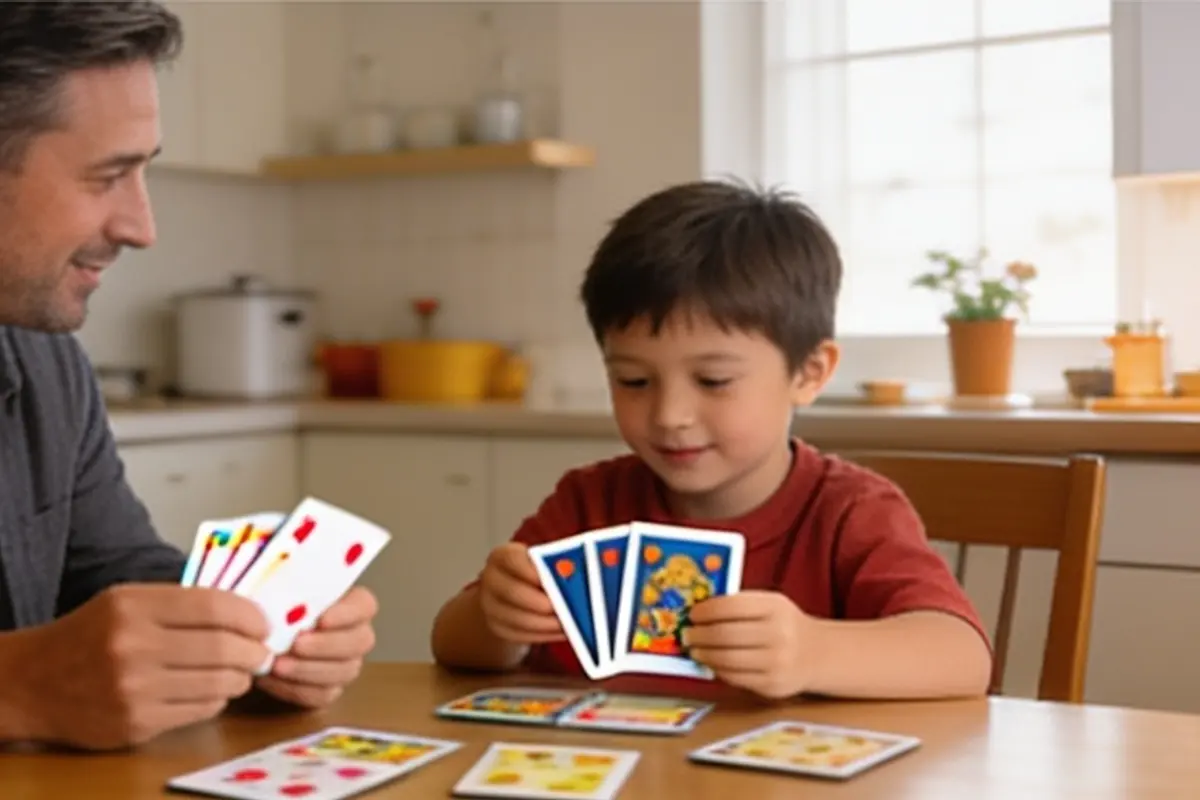
- Take the face cards out of a deck; aces count as 1.
- Lay 10 cards face up.
- Take turns finding two cards that add up to 10.
- When that's easy, flip one card and ask how many more make 10.
Evidence: Emerging. First-grade standards call for fluent adding within 10 and "making ten" to solve problems within 20 (Common Core); the game itself hasn't been studied.
Board game night
Emerging evidence- Time
- 20 to 30 minutes, once a week
- Builds
- Counting, turn-taking, losing gracefully
- Pick a game run by dice or a spinner, so luck evens things out.
- Agree on the rules, and what you'll say if you lose, before you start.
- Count spaces out loud as you move.
- End with "good game," whoever wins.
Make it work: Expect some tears at first. Stay calm and play again another day.
Evidence: Emerging. In experiments with preschoolers from low-income families, four 15-minute sessions of a simple numbered board game closed an income-related gap in estimating numbers (Siegler & Ramani, 2008); the AAP suggests games of chance to practice competing fairly (AAP).
Morning launch pad
Emerging evidence- Time
- 15 minutes to set up
- Builds
- Organization, independence
- Pick one spot by the door for the backpack, shoes, and jacket.
- Make a picture or word checklist of the morning steps.
- Have your child pack the backpack the night before.
- Check off steps together until the routine runs on its own.
Evidence: Emerging. The AAP suggests one "launch pad" spot for school things and a routine that's the same every day (AAP); this setup hasn't been studied.
Family job chart
Moderate evidence- Time
- 10 to 15 minutes a day
- Builds
- Responsibility, competence, belonging
- Choose two or three jobs, such as setting the table or sorting laundry.
- Show how, do it together, then watch your child do it alone.
- Post the chart where everyone can see it.
- Add one new job at a time.
Make it work: Praise the effort, not perfection. Lumpy towel folding still counts.
Evidence: Moderate. Observational studies link chores with later self-competence and self-control, though they can't prove cause (White et al., 2019; Tepper et al., 2022), and the AAP recommends chores and a chart at this age (AAP).
Save, spend, share jars
Emerging evidence- Time
- 10 minutes to set up, a few minutes each week
- Builds
- Saving, making choices, generosity
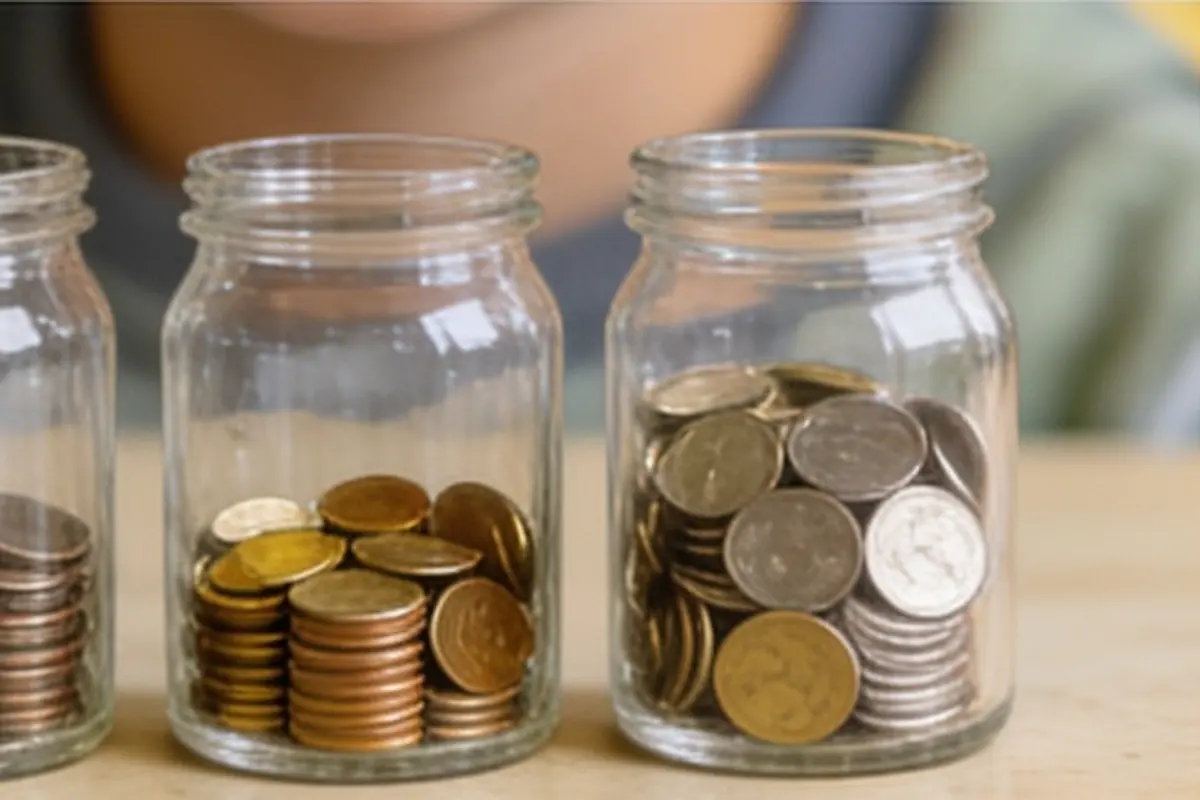
- Label three clear jars: Save, Spend, Share.
- Split any money your child gets, like gifts or an allowance, across the jars.
- Choose a savings goal and tape a picture of it to the Save jar.
- Count the jars together once a week.
Make it work: The CFPB suggests saving at least a dime of every dollar, and you might match savings, such as 25 cents per dollar saved (CFPB).
Evidence: Emerging. The AAP and CFPB suggest splitting money into goals and talking choices through (AAP; CFPB); whether jars change adult habits hasn't been tested.
Mistake of the week
Emerging evidence- Time
- 5 minutes at dinner
- Builds
- Resilience, a healthy view of failure
- Once a week, each person shares a mistake and what they learned.
- A parent goes first.
- Answer with curiosity: "What will you try next time?"
Evidence: Emerging. Parents' views of failure are linked to whether kids see intelligence as fixed (Haimovitz & Dweck, 2016), and the AAP suggests sharing your own mistakes (AAP); this ritual hasn't been tested.
Screens-off wind-down
Moderate evidence- Time
- The last hour before lights out
- Builds
- Sleep, calm
- Set a lights-out time that allows 9 to 12 hours of sleep.
- Park devices outside the bedroom an hour before.
- Keep the routine short: tidy up, bath, teeth, book.
- Keep the same wake-up time on school days and weekends when you can.
Evidence: Moderate. The AAP recommends keeping screens out of bedrooms and turning them off at least an hour before bed (AAP), and a small randomized trial found that a little more sleep improved behavior at school (Gruber et al., 2012).
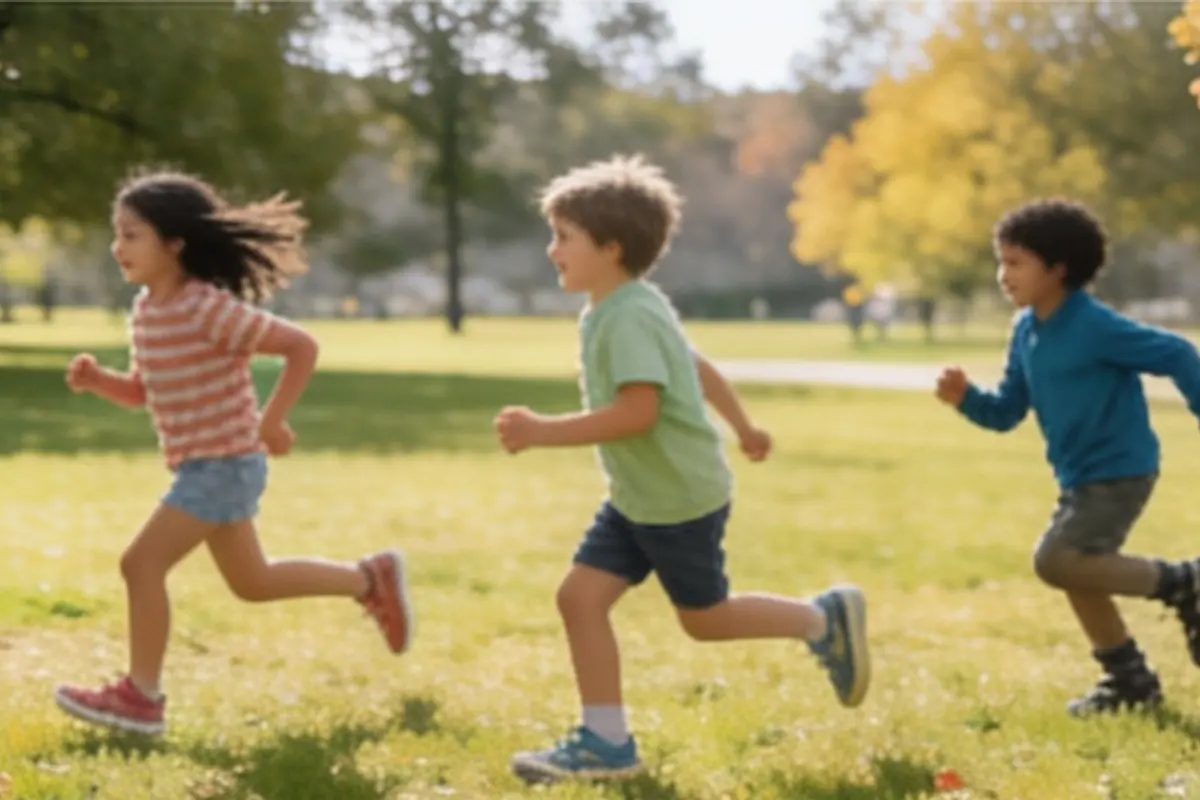
An hour of active play
Moderate evidence- Time
- 60 minutes a day, in any size chunks
- Builds
- Fitness, strong bones, focus
- Count walking to school, recess, and playground time.
- Play running games like tag a few days a week.
- Add climbing, swinging, hopping, or jumping rope for muscles and bones.
Make it work: Shorter blocks add up, like 20 minutes of walking, 10 of jumping rope, and 30 at the playground (AAP).
Evidence: Moderate. Federal guidelines recommend 60 minutes a day for ages 6 to 17, and their expert committee found strong or moderate evidence that activity improves thinking skills at ages 6 to 13 (HHS).
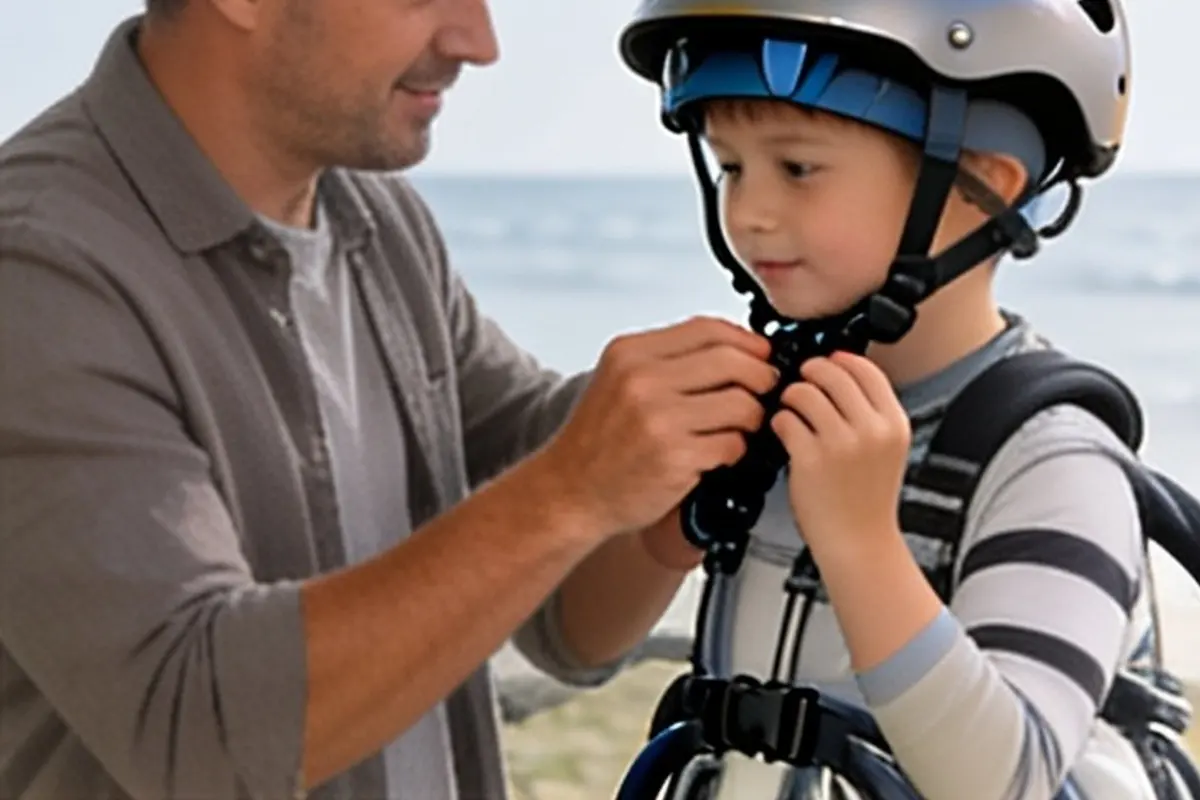
Bike skills with a helmet
Moderate evidence- Time
- 20 to 30 minutes
- Builds
- Balance, confidence, safety habits
- Choose a bike your child can sit on with hands on the bars and the balls of both feet on the ground (AAP).
- Fit the helmet and wear it on every ride, even short ones.
- Practice in a park, path, or empty lot, not the street (AAP).
Make it work: The AAP advises foot brakes on a first bike and no riding at dusk or after dark (AAP).
Evidence: Moderate. In a meta-analysis of 40 studies with more than 64,000 injured cyclists, helmet use was linked to about half the odds of head injury and about a third the odds of serious head injury (Olivier & Creighton, 2017).
Swim and water-safety lessons
Moderate evidence- Time
- A series of lessons, then regular practice
- Builds
- Water skills, confidence
- Choose a program that teaches water survival, not just strokes.
- Work toward getting back to the surface, swimming at least 25 yards, and climbing out.
- Practice asking permission before getting into any water.
Make it work: Lessons don't make kids "drown-proof." An adult should always watch closely (AAP).
Evidence: Moderate. The AAP recommends swim lessons as one layer of drowning protection (AAP, 2026); the research showing lessons lower drowning risk is in children 1 to 4 (AAP).
Street-smart walks
Emerging evidence- Time
- Any walk together
- Builds
- Traffic awareness
- Hold hands at every crossing and use crosswalks.
- Say each step out loud: stop at the curb, look left, right, and left again.
- Point out driveways, parked cars, and quiet electric cars.
- Let your child say when it looks safe, while you make the call.
Evidence: Emerging. The AAP says most kids aren't ready to cross alone until at least 10 and suggests teaching pedestrian skills on walks together (AAP); this way of teaching hasn't been tested.
Family media plan night
Moderate evidence- Time
- 30 minutes, then a check-in each season
- Builds
- Healthy screen habits, media smarts
- Open the AAP's free Family Media Plan together.
- Choose screen-free zones: meals, homework, and bedrooms.
- Pick shows and games together, and turn off autoplay.
- Write rules for every family member, parents included.
Make it work: Revisit the plan at the start of the school year and over breaks (AAP).
Evidence: Moderate. AAP policy based on research recommends a family media plan (Munzer et al., 2026; AAP); the plan tool itself hasn't been tested.
Common questions#
How much sleep does a 6-year-old need?
A 6-year-old needs 9 to 12 hours of sleep every 24 hours. That's the American Academy of Sleep Medicine's recommendation for ages 6 to 12 (Paruthi et al., 2016), which the AAP supports (AAP); AAP visit guidance for this age says at least 10 to 11 hours (Bright Futures). Too little sleep can show up as irritability and trouble concentrating. Mention snoring, loud breathing, or trouble falling asleep to your pediatrician (AAP).
How much homework should a first grader have?
There's no research-based amount, but a common guideline is about 10 minutes a night in first grade. The "10-minute rule" (10 minutes per grade) is a widely used practice, not a tested dose (Duke University, 2006), and research finds little link between homework and achievement in elementary school (Cooper et al., 2006). Harris Cooper, who led that review, says homework for young kids should be short, lead to success without much struggle, and can include high-interest reading (Duke University, 2006). If homework regularly takes much longer or ends in tears, talk with the teacher.
Is it normal for a 6-year-old to cheat at games or melt down after losing?
Yes, rule-bending and big reactions to losing are common in the early school years. The AAP says the wish to do well is especially strong at this age and that cheating at games is frequent. Games of chance help kids practice competing fairly, and too much pressure to win can make cheating worse. If cheating becomes a chronic problem as your child gets older, it may signal stress or peer problems worth talking about with a counselor (AAP).
How can I tell if my 6-year-old has ADHD or is just active?
Most 6-year-olds are active and distractible at times; ADHD means symptoms are frequent and severe enough to get in the way of daily life. The AAP suggests talking with your pediatrician if symptoms show up regularly for more than 6 months (AAP). Pediatricians evaluate children from age 4, and a diagnosis requires symptoms and problems in more than one setting, with reports from parents and teachers. For ages 6 to 11, the AAP recommends FDA-approved medication plus parent training and/or classroom behavior support, preferably both (Wolraich et al., 2019). If your child is among the youngest in the class, keep that in mind (Layton et al., 2018).
How do I know if my child is behind in reading?
Start by asking the teacher how your child's reading compares with grade-level expectations, especially if sounding out simple words is a daily struggle. Trouble reading, spelling, or sounding out words can be a sign of a learning difference (AAP), and acting early matters, especially with a family history of reading problems (AAP). You can ask your child's public school for an evaluation. If the school agrees an evaluation is needed, it's free, and it must usually happen within 60 days of your consent unless your state sets a different timeline (CPIR). The AAP cautions that repeating a grade can do more harm than good (AAP) and that eye exercises, special diets, and supplements haven't been shown to help (AAP).
When do kids start losing baby teeth?
Most children lose their first baby tooth around age 6, usually a front tooth (AAP). The ADA's chart lists the front teeth as falling out at about 6 to 7, with the back baby molars lasting until 9 to 12 (ADA). Timing varies, so ask the dentist at a regular checkup if you're unsure. If your child wants help with a tooth that's already loose, grasp it with tissue or gauze and give a quick twist. Losing baby teeth early to decay can make permanent teeth come in crooked (AAP).
Should my child get dental sealants?
For most children, yes: sealants on the permanent back molars prevent many cavities there. The CDC says sealants applied soon after the molars come in can prevent up to 80% of cavities for 2 years and 50% for up to 4 years. The first permanent molars usually arrive around age 6, and children 6 to 11 without sealants are almost three times as likely to have cavities in those teeth. Some schools run sealant programs, so ask whether yours does (CDC). Ask your child's dentist.
When can my child stop using a booster seat?
Keep your child in a booster seat until the adult seat belt fits, usually when they're about 4 feet 9 inches tall and 8 to 12 years old. The belt fits when the lap belt sits low across the upper thighs, the shoulder belt crosses the middle of the chest and shoulder, and your child can sit with knees bent at the seat edge for the whole ride. Children under 13 should ride in the back seat. If your 6-year-old still fits a forward-facing harness seat, the AAP advises using it up to its limits (AAP). In a study of 7,151 children aged 4 to 8, those in boosters had 45% lower injury risk than those in seat belts alone (Arbogast et al., 2009).
How much screen time is OK for a 6-year-old?
The AAP doesn't set a single daily limit for school-age kids; it recommends a family media plan that protects sleep, activity, homework, and family time. Its 2026 policy focuses on quality, context, and conversation (Munzer et al., 2026), and links misuse of digital media in ages 6 to 12 with unhealthy sleep, poorer school performance, and weaker attention control (AAP). Keep screens out of bedrooms and off for an hour before bed (AAP). Kids this age aren't ready for social media accounts (AAP).
Should I give my 6-year-old an allowance?
An allowance is optional; what matters most at this age is talking with your child about money choices. The CFPB says the most important part of an allowance is discussing your child's plans for the money (CFPB), and the AAP leaves the decision to each family, noting that chores can be one way to earn an allowance (AAP). Research on allowances is limited and mostly based on surveys (Sansone et al., 2019). One approach, if you tie money to work, is to keep everyday family jobs unpaid and pay only for extras. The 7-year guide goes further.
Is it bad to tell my child they're smart?
An occasional "you're smart" won't hurt, but praising effort and strategies tends to be more useful. In classic experiments, fifth graders praised for intelligence coped worse with failure than those praised for effort (Mueller & Dweck, 1998), though later replication studies found little effect (Li & Bates, 2019). Effort praise in the toddler years predicted kids' belief at 7 to 8 that ability can grow (Gunderson et al., 2013), and over-the-top praise backfired for kids with low self-esteem (Brummelman et al., 2014).
Is bedwetting normal at age 6?
Yes, bedwetting is common at 6 and usually isn't a medical problem. Studies show about 15% of 5- and 7-year-olds wet the bed, falling to under 1% by 15. Don't blame or punish; protect the mattress and set a no-teasing rule. Bedwetting alarms work 50% to 75% of the time, and medicines are available from age 6. Call your pediatrician if your child was dry for 6 months or more and starts wetting again, or has pain when peeing, daytime accidents, or pink or cloudy urine (AAP).
Safety and when to get help#
Six-year-olds want to prove they're grown up, but they still can't judge the speed and distance of cars, so you're still in charge of their safety (AAP).
Car seats and boosters
Use a forward-facing harness seat as long as your child fits it, then a booster until the seat belt fits, usually at about 4 feet 9 inches and 8 to 12 years. Most children don't fit an adult belt until 10 to 12, and all children under 13 should ride in back (AAP).
Bikes, scooters, and helmets
A properly fitted helmet goes on for every ride, and the same goes for scooters and skates (Bright Futures). At 6, your child is too young to ride in the street (AAP).
Streets and parking lots
Most children aren't ready to cross streets alone until at least age 10. Hold hands at crossings and model safe habits (AAP).
Pools, lakes, and beaches
Drowning is a leading cause of unintentional injury death in children. The AAP's 2026 policy calls for close, constant adult supervision, swim lessons, and Coast Guard-approved life jackets for young children near water, non-swimmers, and anyone on a boat (AAP, 2026). Never let your child swim alone (Bright Futures). At gatherings, name a "water watcher" (AAP).
Guns at home and at friends' homes
Firearms are now the leading cause of death for US children and teens. The safest home has no guns; if you keep one, store it unloaded and locked, with ammunition locked separately and keys or codes out of reach. More than a third of unintentional shootings of children happen in the homes of friends, neighbors, or relatives, so ask about unlocked guns before a playdate (AAP). In one study, three-quarters of the groups of 8- to 12-year-old boys who found a real handgun handled it, and more than 90% of those who handled it or pulled the trigger had had gun safety instruction (Jackman et al., 2001).
Poisoning
Keep medicines and cleaning products in their original containers, locked up and out of sight. For a possible poisoning, call Poison Help at 1-800-222-1222 (AAP). It's free, expert, and available 24/7 (America's Poison Centers).
Call 911 if your child
- Is struggling for each breath, can barely speak, or has bluish lips or face (AAP)
- Has sudden trouble breathing after a bee sting, a new medicine, or a food they're allergic to (AAP)
- Can't be woken, or is too weak to stand (AAP)
- Has a fever with purple or blood-colored spots on the skin (AAP)
- Had a seizure after a head injury, was knocked out for more than 1 minute, or is confused or unsteady now (AAP)
- Is unconscious, not breathing, or having seizures after a possible poisoning (AAP)
Get care right away if your child
- Has a stiff neck with a fever, or acts confused (AAP)
- Vomits 2 or more times, has a severe headache, or can't remember what happened after a head injury (AAP)
- Has trouble breathing with ribs pulling in or loud wheezing (AAP)
- Has a fever above 104°F (40°C), or signs of dehydration like no urine in more than 8 hours (AAP)
Talk with your pediatrician about
- Attention or behavior problems that have lasted more than 6 months (AAP)
- Struggles with reading, writing, or math, or trouble following directions (AAP)
- Signs of puberty before 8 in girls or 9 in boys (AAP)
- Snoring, loud breathing in sleep, or daytime sleepiness (AAP)
- New bedwetting after being dry for 6 months (AAP)
- Ongoing sadness, worry, or trouble with friends; for worries that look like anxiety, see the 7-year guide
If you or your child is in crisis, call or text 988, the Suicide & Crisis Lifeline (988 Lifeline). In an emergency, call 911.
The 6-year checkup
Expect height, weight, BMI, blood pressure, vision and hearing screening, and questions about behavior, feelings, and development (AAP periodicity schedule). Between 4 and 6, children need booster doses of DTaP, polio, MMR, and chickenpox vaccines, so ask whether any are still due (AAP). The AAP recommends a flu shot every year (AAP). US guidance has been changing: the AAP's 2026 schedule differs from the CDC's (AAP), and in March 2026 a federal judge paused the CDC's January 2026 schedule changes while the court fight continues (KFF, 2026). Ask your pediatrician which schedule they follow. Your child should also see the dentist at least twice a year (Bright Futures).
Sources#
- American Academy of Pediatrics and Bright Futures. "Bright Futures Parent Handout: 5 and 6 Year Visits." 2019. https://downloads.aap.org/AAP/PDF/BF/BF_PPH_5%20and%206%20Year_EN.pdf
- American Academy of Pediatrics and Bright Futures. "Recommendations for Preventive Pediatric Health Care" (Periodicity Schedule). 2025. https://downloads.aap.org/AAP/PDF/periodicity_schedule.pdf
- AAP Center of Excellence on Social Media and Youth Mental Health. "Kids & Screen Time: 5 C's Questions for School-Age Children." HealthyChildren.org, updated 2024. https://www.healthychildren.org/English/family-life/Media/Pages/kids-and-screen-time-5-cs-questions-for-school-age-children.aspx
- American Academy of Pediatrics Section on Endocrinology. "Physical Changes During Puberty." HealthyChildren.org, updated 2014. https://www.healthychildren.org/English/ages-stages/gradeschool/puberty/Pages/Physical-Development-of-School-Age-Children.aspx
- American Academy of Pediatrics. "When Children Begin to Lose their Baby Teeth." HealthyChildren.org, updated 2007. https://www.healthychildren.org/English/healthy-living/oral-health/Pages/When-Children-Begin-to-Lose-their-Baby-Teeth.aspx
- American Dental Association. "Eruption Charts." MouthHealthy, accessed 2026. https://www.mouthhealthy.org/all-topics-a-z/eruption-charts
- Centers for Disease Control and Prevention. "About Dental Sealants." 2024. https://www.cdc.gov/oral-health/prevention/about-dental-sealants.html
- Center on the Developing Child at Harvard University. "InBrief: Executive Function." 2012. https://developingchild.harvard.edu/resources/inbrief-executive-function/
- Stricker PR. "Sports Performance and Ability in School-Age Children." HealthyChildren.org, updated 2009. https://www.healthychildren.org/English/ages-stages/gradeschool/fitness/Pages/Sports-Performance-and-Ability-in-School-Age-Children.aspx
- Stricker PR. "Sports Goals and Applications for Gradeschoolers." HealthyChildren.org, updated 2009. https://www.healthychildren.org/English/ages-stages/gradeschool/fitness/Pages/Sports-Goals-and-Applications-Gradeschoolers.aspx
- Common Core State Standards Initiative. "Reading: Foundational Skills, Grade 1." Accessed 2026. https://www.thecorestandards.org/ELA-Literacy/RF/1/
- Common Core State Standards Initiative. "Grade 1 Mathematics: Introduction." Accessed 2026. https://www.thecorestandards.org/Math/Content/1/introduction/
- Common Core State Standards Initiative. "Grade 1: Operations and Algebraic Thinking." Accessed 2026. https://www.thecorestandards.org/Math/Content/1/OA/
- Common Core State Standards Initiative. "Grade 1: Measurement and Data." Accessed 2026. https://www.thecorestandards.org/Math/Content/1/MD/
- What Works Clearinghouse, Institute of Education Sciences. "Foundational Skills to Support Reading for Understanding in Kindergarten Through 3rd Grade." 2016. https://ies.ed.gov/ncee/wwc/PracticeGuide/21
- American Academy of Pediatrics. "What Parents Can Do to Support Friendships." HealthyChildren.org, updated 2022. https://www.healthychildren.org/English/family-life/power-of-play/Pages/what-parents-can-do-to-support-friendships.aspx
- American Academy of Pediatrics. "Problems With Peers: How to Help Your Child Navigate Social Challenges." HealthyChildren.org, updated 2024. https://www.healthychildren.org/English/ages-stages/gradeschool/school/Pages/Problems-With-Peers.aspx
- American Academy of Pediatrics. "Competition and Cheating." HealthyChildren.org, updated 2025. https://www.healthychildren.org/English/family-life/family-dynamics/communication-discipline/Pages/competition-and-cheating.aspx
- American Academy of Pediatrics. "Building Blocks for Healthy Self Esteem in Kids." HealthyChildren.org, updated 2024. https://www.healthychildren.org/English/ages-stages/gradeschool/Pages/Helping-Your-Child-Develop-A-Healthy-Sense-of-Self-Esteem.aspx
- American Academy of Pediatrics. "Healthy Sleep Habits: How Many Hours Does Your Child Need?" HealthyChildren.org, updated 2026. https://www.healthychildren.org/English/healthy-living/sleep/Pages/healthy-sleep-habits-how-many-hours-does-your-child-need.aspx
- American Academy of Pediatrics. "Energy Out: Daily Physical Activity Recommendations." HealthyChildren.org, updated 2014. https://www.healthychildren.org/English/healthy-living/fitness/Pages/Energy-Out-Daily-Physical-Activity-Recommendations.aspx
- US Department of Health and Human Services. "Physical Activity Guidelines for Americans, 2nd edition." 2018. https://odphp.health.gov/sites/default/files/2019-09/Physical_Activity_Guidelines_2nd_edition.pdf
- American Academy of Pediatrics. "What's the Best Way to Discipline My Child?" HealthyChildren.org, updated 2018. https://www.healthychildren.org/English/family-life/family-dynamics/communication-discipline/Pages/Disciplining-Your-Child.aspx
- American Academy of Pediatrics. "Ten Tips for Your Child's Success in School." HealthyChildren.org, updated 2019. https://www.healthychildren.org/English/ages-stages/gradeschool/school/Pages/Ten-Tips-for-Your-Childs-Success-in-School.aspx
- American Academy of Pediatrics Committee on Early Childhood. "Tips to Help Your Child Enjoy Reading Aloud." HealthyChildren.org, updated 2018. https://www.healthychildren.org/English/ages-stages/gradeschool/school/Pages/Help-Your-Child-Enjoy-Reading-Aloud-Tips-for-Parents.aspx
- American Academy of Pediatrics Council on Communications and Media. "How to Reinforce Your Child's Learning." HealthyChildren.org, updated 2016. https://www.healthychildren.org/English/ages-stages/gradeschool/school/Pages/how-to-reinforce-your-childs-learning.aspx
- Munzer T. "Helping Kids Thrive in a Digital World: AAP Policy Explained." HealthyChildren.org, updated 2026. https://www.healthychildren.org/English/family-life/Media/Pages/helping-kids-thrive-in-a-digital-world-AAP-policy-explained.aspx
- American Academy of Pediatrics Council on Communications and Media. "How to Make a Family Media Plan." HealthyChildren.org, updated 2026. https://www.healthychildren.org/English/family-life/Media/Pages/How-to-Make-a-Family-Media-Use-Plan.aspx
- American Academy of Pediatrics. "Age-Appropriate Chores for Children." HealthyChildren.org, updated 2024. https://www.healthychildren.org/English/family-life/family-dynamics/communication-discipline/Pages/Chores-and-Responsibility.aspx
- American Academy of Pediatrics. "Kids & Money: Help Your Child Learn Good Financial Habits." HealthyChildren.org, updated 2026. https://www.healthychildren.org/English/family-life/family-dynamics/communication-discipline/Pages/money-matters-helping-your-kids-create-good-habits.aspx
- Consumer Financial Protection Bureau. "Money as You Grow: School-Age Children to Preteens." Updated 2026. https://www.consumerfinance.gov/consumer-tools/money-as-you-grow/school-age-children-preteens/
- Consumer Financial Protection Bureau. "School-Age Children and Earning." Money as You Grow, updated 2024. https://www.consumerfinance.gov/consumer-tools/money-as-you-grow/school-age-children-preteens/explore-earning/
- Consumer Financial Protection Bureau. "School-Age Children and Saving." Money as You Grow, updated 2024. https://www.consumerfinance.gov/consumer-tools/money-as-you-grow/school-age-children-preteens/explore-saving/
- American Academy of Pediatrics. "Safety for Your Child: 6 Years." HealthyChildren.org, updated 2013. https://www.healthychildren.org/English/ages-stages/gradeschool/Pages/Safety-for-Your-Child-6-Years.aspx
- American Academy of Pediatrics. "Car Seats: Information for Families." HealthyChildren.org, updated 2026. https://www.healthychildren.org/English/safety-prevention/on-the-go/Pages/Car-Safety-Seats-Information-for-Families.aspx
- American Academy of Pediatrics. "Bicycle Safety for Children: Myths & Facts." HealthyChildren.org, updated 2026. https://www.healthychildren.org/English/safety-prevention/at-play/Pages/Bicycle-Safety-Myths-And-Facts.aspx
- Kendi S. "Pedestrian Safety Tips for Families." HealthyChildren.org, updated 2026. https://www.healthychildren.org/English/safety-prevention/all-around/Pages/pedestrian-safety-tips-for-families.aspx
- McCallin T, Shenoi R. "Swim Lessons for Children: When to Start & What to Consider." HealthyChildren.org, updated 2026. https://www.healthychildren.org/English/safety-prevention/at-play/Pages/Swim-Lessons.aspx
- American Academy of Pediatrics. "AAP Releases Updated Drowning Prevention Recommendations." HealthyChildren.org, 2026. https://www.healthychildren.org/English/news/Pages/AAP-releases-updated-drowning-prevention-recommendations.aspx
- Schaechter J. "Guns in the Home: How to Keep Kids Safe." HealthyChildren.org, updated 2026. https://www.healthychildren.org/English/safety-prevention/at-home/Pages/Handguns-in-the-Home.aspx
- American Academy of Pediatrics. "Poison Prevention & Treatment Tips for Parents." HealthyChildren.org, updated 2026. https://www.healthychildren.org/English/safety-prevention/all-around/Pages/Poison-Prevention.aspx
- America's Poison Centers. "Poison Help." Accessed 2026. https://poisoncenters.org/
- 988 Suicide & Crisis Lifeline. Accessed 2026. https://988lifeline.org/
- American Academy of Pediatrics. "Breathing Trouble" (symptom checker). HealthyChildren.org, accessed 2026. https://www.healthychildren.org/English/tips-tools/symptom-checker/Pages/symptomviewer.aspx?symptom=Breathing+Trouble
- American Academy of Pediatrics. "Fever" (symptom checker). HealthyChildren.org, accessed 2026. https://www.healthychildren.org/English/tips-tools/symptom-checker/Pages/symptomviewer.aspx?symptom=Fever
- American Academy of Pediatrics. "Head Injury" (symptom checker). HealthyChildren.org, accessed 2026. https://www.healthychildren.org/English/tips-tools/symptom-checker/Pages/symptomviewer.aspx?symptom=Head+Injury
- American Academy of Pediatrics. "Understanding ADHD: Information for Parents." HealthyChildren.org, updated 2019. https://www.healthychildren.org/English/health-issues/conditions/adhd/Pages/Understanding-ADHD.aspx
- Zubler J. "Learning Disabilities & Differences: What Parents Need To Know." HealthyChildren.org, updated 2024. https://www.healthychildren.org/English/health-issues/conditions/learning-disabilities/Pages/Learning-Disabilities-What-Parents-Need-To-Know.aspx
- American Academy of Pediatrics. "Reading Disorders: What Parents Need to Know." HealthyChildren.org, updated 2022. https://www.healthychildren.org/English/health-issues/conditions/learning-disabilities/Pages/reading-disorders-what-parents-need-to-know.aspx
- American Academy of Pediatrics. "New Report Helps Pediatricians Diagnose Causes Behind Stalled Academic Progress." HealthyChildren.org, 2019. https://www.healthychildren.org/English/news/Pages/School-Aged-Children-Who-Are-Not-Progressing-Academically.aspx
- Center for Parent Information and Resources. "Evaluating School-Aged Children for Disability." Accessed 2026. https://www.parentcenterhub.org/evaluation/
- American Academy of Pediatrics. "Bedwetting: 3 Common Reasons & What Families Can Do." HealthyChildren.org, updated 2021. https://www.healthychildren.org/English/ages-stages/toddler/toilet-training/Pages/Bedwetting.aspx
- American Academy of Pediatrics. "Your Checkup Checklist: 4 Years Old." HealthyChildren.org, updated 2023. https://www.healthychildren.org/English/ages-stages/Your-Childs-Checkups/Pages/your-checkup-checklist-4-years-old.aspx
- Bracho-Sánchez E. "AAP Guide: Vaccines Your Child Needs by Age 6." HealthyChildren.org, updated 2026. https://www.healthychildren.org/English/safety-prevention/immunizations/Pages/Your-Babys-First-Vaccines.aspx
- American Academy of Pediatrics. "AAP Releases Recommended Childhood and Adolescent Immunization Schedule for 2026." HealthyChildren.org, 2026. https://www.healthychildren.org/English/news/Pages/AAPs-recommended-childhood-and-adolescent-immunization-schedule-for-2026.aspx
- Kates J. "The Court's Opening Shot on Federal Vaccine Policy Changes." KFF, 2026. https://www.kff.org/quick-insights/the-courts-opening-shot-on-federal-vaccine-policy-changes/
- Duke Today. "Duke Study: Homework Helps Students Succeed in School, As Long as There Isn't Too Much." Duke University, 2006. https://today.duke.edu/2006/03/homework.html
- Cooper H, Robinson JC, Patall EA. "Does Homework Improve Academic Achievement? A Synthesis of Research, 1987–2003." Review of Educational Research, 2006. https://doi.org/10.3102/00346543076001001
- Sisk VF, Burgoyne AP, Sun J, Butler JL, Macnamara BN. "To What Extent and Under Which Circumstances Are Growth Mind-Sets Important to Academic Achievement? Two Meta-Analyses." Psychological Science, 2018. https://pubmed.ncbi.nlm.nih.gov/29505339/
- Yeager DS, Hanselman P, Walton GM, et al. "A national experiment reveals where a growth mindset improves achievement." Nature, 2019. https://pubmed.ncbi.nlm.nih.gov/31391586/
- Li Y, Bates TC. "You can't change your basic ability, but you work at things, and that's how we get hard things done: Testing the role of growth mindset on response to setbacks, educational attainment, and cognitive ability." Journal of Experimental Psychology: General, 2019. https://pubmed.ncbi.nlm.nih.gov/31464486/
- Mueller CM, Dweck CS. "Praise for intelligence can undermine children's motivation and performance." Journal of Personality and Social Psychology, 1998. https://pubmed.ncbi.nlm.nih.gov/9686450/
- Gunderson EA, Gripshover SJ, Romero C, et al. "Parent praise to 1- to 3-year-olds predicts children's motivational frameworks 5 years later." Child Development, 2013. https://pubmed.ncbi.nlm.nih.gov/23397904/
- Brummelman E, Thomaes S, Orobio de Castro B, Overbeek G, Bushman BJ. "'That's not just beautiful—that's incredibly beautiful!': the adverse impact of inflated praise on children with low self-esteem." Psychological Science, 2014. https://pubmed.ncbi.nlm.nih.gov/24434235/
- Brummelman E, Thomaes S, Nelemans SA, et al. "Origins of narcissism in children." Proceedings of the National Academy of Sciences, 2015. https://pubmed.ncbi.nlm.nih.gov/25775577/
- Haimovitz K, Dweck CS. "Parents' Views of Failure Predict Children's Fixed and Growth Intelligence Mind-Sets." Psychological Science, 2016. https://pubmed.ncbi.nlm.nih.gov/27113733/
- Layton TJ, Barnett ML, Hicks TR, Jena AB. "Attention Deficit-Hyperactivity Disorder and Month of School Enrollment." New England Journal of Medicine, 2018. https://pubmed.ncbi.nlm.nih.gov/30485780/
- Danielson ML, Claussen AH, Bitsko RH, et al. "ADHD Prevalence Among U.S. Children and Adolescents in 2022: Diagnosis, Severity, Co-Occurring Disorders, and Treatment." Journal of Clinical Child & Adolescent Psychology, 2024. https://pubmed.ncbi.nlm.nih.gov/38778436/
- Wolraich ML, Hagan JF, Allan C, et al. "Clinical Practice Guideline for the Diagnosis, Evaluation, and Treatment of Attention-Deficit/Hyperactivity Disorder in Children and Adolescents." Pediatrics, 2019. https://pubmed.ncbi.nlm.nih.gov/31570648/
- Pashler H, McDaniel M, Rohrer D, Bjork R. "Learning Styles: Concepts and Evidence." Psychological Science in the Public Interest, 2008. https://pubmed.ncbi.nlm.nih.gov/26162104/
- Paruthi S, Brooks LJ, D'Ambrosio C, et al. "Recommended Amount of Sleep for Pediatric Populations: A Consensus Statement of the American Academy of Sleep Medicine." Journal of Clinical Sleep Medicine, 2016. https://pubmed.ncbi.nlm.nih.gov/27250809/
- Gruber R, Cassoff J, Frenette S, Wiebe S, Carrier J. "Impact of sleep extension and restriction on children's emotional lability and impulsivity." Pediatrics, 2012. https://pubmed.ncbi.nlm.nih.gov/23071214/
- Blake PR, McAuliffe K. "'I had so much it didn't seem fair': Eight-year-olds reject two forms of inequity." Cognition, 2011. https://pubmed.ncbi.nlm.nih.gov/21616483/
- White EM, DeBoer MD, Scharf RJ. "Associations Between Household Chores and Childhood Self-Competency." Journal of Developmental & Behavioral Pediatrics, 2019. https://pubmed.ncbi.nlm.nih.gov/30507727/
- Tepper DL, Howell TJ, Bennett PC. "Executive functions and household chores: Does engagement in chores predict children's cognition?" Australian Occupational Therapy Journal, 2022. https://pubmed.ncbi.nlm.nih.gov/35640882/
- Sansone D, Rossi M, Fornero E. "'Four Bright Coins Shining at Me': Financial Education in Childhood, Financial Confidence in Adulthood." Journal of Consumer Affairs, 2019. https://doi.org/10.1111/joca.12207
- Deci EL, Koestner R, Ryan RM. "A meta-analytic review of experiments examining the effects of extrinsic rewards on intrinsic motivation." Psychological Bulletin, 1999. https://pubmed.ncbi.nlm.nih.gov/10589297/
- Sege RD, Siegel BS; AAP Council on Child Abuse and Neglect; Committee on Psychosocial Aspects of Child and Family Health. "Effective Discipline to Raise Healthy Children." Pediatrics, 2018. https://pubmed.ncbi.nlm.nih.gov/30397164/
- Munzer T, Parga-Belinkie J, Milkovich LM, et al.; AAP Council on Communications and Media. "Digital Ecosystems, Children, and Adolescents: Policy Statement." Pediatrics, 2026. https://pubmed.ncbi.nlm.nih.gov/41556917/
- Siegler RS, Ramani GB. "Playing linear numerical board games promotes low-income children's numerical development." Developmental Science, 2008. https://pubmed.ncbi.nlm.nih.gov/18801120/
- Olivier J, Creighton P. "Bicycle injuries and helmet use: a systematic review and meta-analysis." International Journal of Epidemiology, 2017. https://pubmed.ncbi.nlm.nih.gov/27450862/
- Arbogast KB, Jermakian JS, Kallan MJ, Durbin DR. "Effectiveness of belt positioning booster seats: an updated assessment." Pediatrics, 2009. https://pubmed.ncbi.nlm.nih.gov/19841126/
- Jackman GA, Farah MM, Kellermann AL, Simon HK. "Seeing is believing: what do boys do when they find a real gun?" Pediatrics, 2001. https://pubmed.ncbi.nlm.nih.gov/11389238/
This guide is general education that summarizes published research and guidance from groups like the American Academy of Pediatrics, the CDC, and the WHO. It isn’t medical advice, and every child develops on their own timeline. Your pediatrician knows your child; if something feels wrong, call them. In an emergency, call 911.
Raising capable kids with Chorevia
When your kids are ready for responsibility, Chorevia turns chores into a family economy, with points, proof, a reward ladder you design, and monthly costs kids work off. Adults always make the call. Free for families.
Create your household