Day 226 of 280 · 32 weeks + 2 days
The shorter route
Last reviewed · 3 min read · 7 sources · Plain-text version
Thirty-two weeks and two days. The bump may be changing how you walk. Today you plan a loop you can finish without strain, with a bench halfway round.
- Size this week
- about the length of a bunch of celery
- Length this week
- around 42.4 cm from head to heel
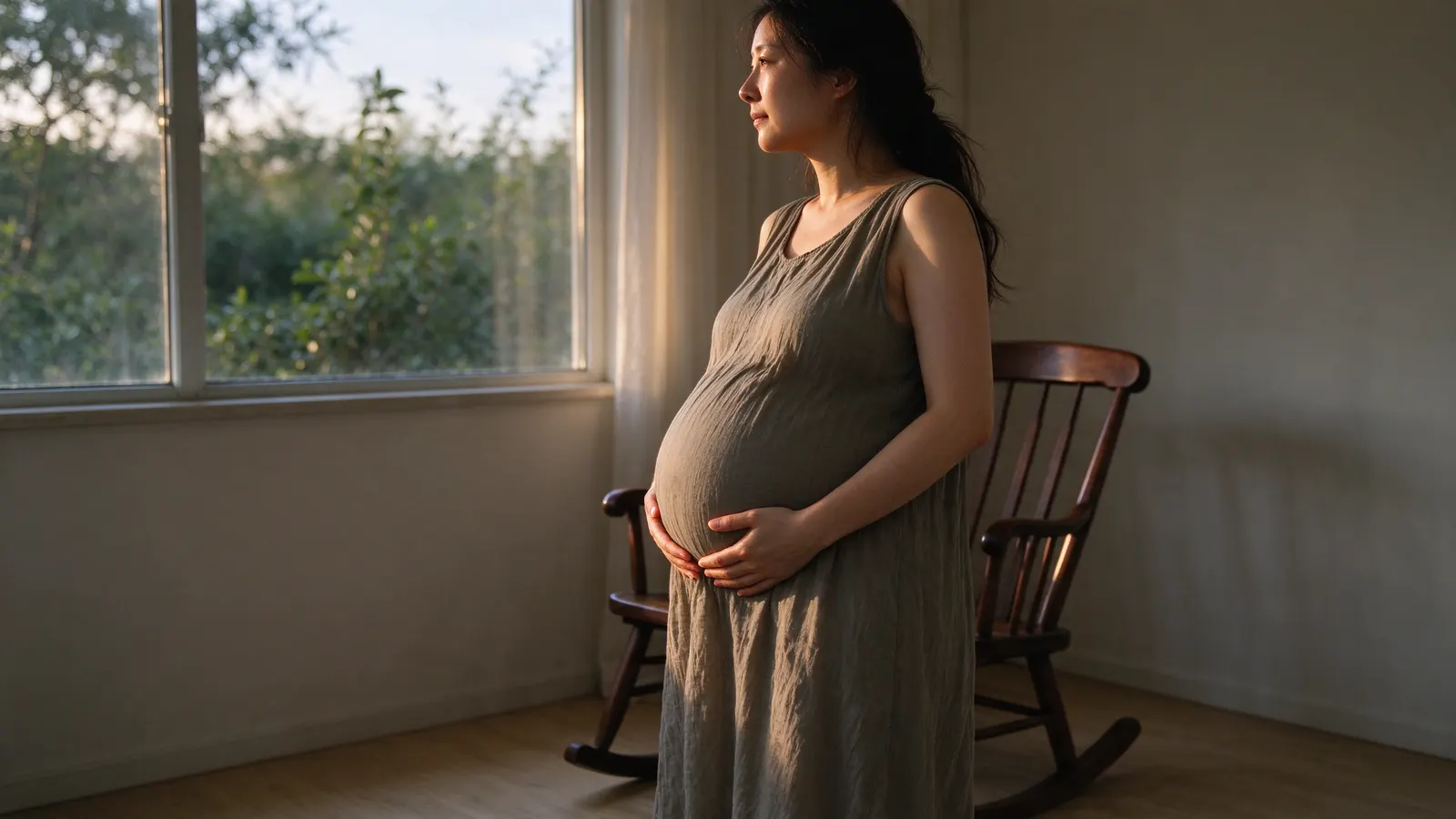
Thirty-two weeks and two days. If the walk you were doing a month ago now feels like a lot, that isn't a sign you should stop. It's a sign the route needs to change.
Your baby

Your body
The NHS says the bump may make walking harder now, and may even give you a "waddle" (NHS). Its exercise advice for this week hasn't changed, though: aim for 150 minutes a week, starting with about 10 minutes a day (NHS). The CDC adds that the 150 minutes can be split into smaller daily chunks, and that activity is healthy and safe for most pregnant women, with your provider the one to ask about any restrictions (CDC).
The AAP's version is gentler still: keep to your current level if you're already active, avoid jumping or jarring movements, and slow down when you need to (AAP). Slowing down is in the advice. It isn't a lapse from it.
Try today
The shorter route
Time: 10 to 20 minutes
Pick a loop from your front door that you can finish without strain. Shorter than your old one is fine.
Put a bench, a low wall, or a café chair somewhere around the halfway point.
Walk it at an easy, steady pace, and sit at the halfway spot for a minute whether you feel you need to or not.
Count it. Ten minutes a day is how the NHS suggests building toward 150 a week (NHS).
Make it work:On hot days, take water and go early or late. The CDC advises against very strenuous activity in the heat in pregnancy, and recommends plenty of rest (CDC).
Watch for
Normal
feeling warm and sweaty after a walk.
Call your provider
or get medical care right away for signs of heat-related illness; the CDC says heat illness can come on sooner in pregnancy (CDC).
Normal
needing to stop and catch your breath on a slope.
Call 911
or go to an emergency room for severe chest pain or shortness of breath that does not go away (MedlinePlus).
Normal
a wobble getting up from a low bench.
Call your provider
right away for dizziness or fainting, which the CDC lists among urgent maternal warning signs (CDC).
For you
Shorter isn't giving up. It's the same habit, sized for the body you have this month. Next month the loop may get shorter again, and that's still the habit.
There's a reason beyond the bump to keep going: for pregnant women, physical activity reduces the risk of postpartum depression (ODPHP). The walk is for the months after, too.
If you're the partner, walk it with her and carry the water. It's ten quiet minutes together that don't involve a list.
Sources
- NHS. "Week 32." Week-by-week guide to pregnancy, Best Start in Life. https://www.nhs.uk/best-start-in-life/pregnancy/week-by-week-guide-to-pregnancy/3rd-trimester/week-32/
- Centers for Disease Control and Prevention. "Weight Gain During Pregnancy." Maternal and Infant Health. https://www.cdc.gov/maternal-infant-health/pregnancy-weight/index.html
- American Academy of Pediatrics. "Nutrition and Exercise During Pregnancy." HealthyChildren.org. https://www.healthychildren.org/English/ages-stages/prenatal/Pages/Nutrition-and-Exercise-During-Pregnancy.aspx
- Centers for Disease Control and Prevention. "Heat and Pregnancy." Heat and Health, 2024. https://www.cdc.gov/heat-health/risk-factors/heat-and-pregnancy.html
- MedlinePlus. "Common symptoms during pregnancy." National Library of Medicine. https://medlineplus.gov/ency/patientinstructions/000583.htm
- Centers for Disease Control and Prevention. "Urgent Maternal Warning Signs and Symptoms." HEAR HER campaign, 2024. https://www.cdc.gov/hearher/maternal-warning-signs/index.html
- Office of Disease Prevention and Health Promotion. "Top 10 Things to Know About the Second Edition of the Physical Activity Guidelines for Americans." health.gov. https://odphp.health.gov/our-work/nutrition-physical-activity/physical-activity-guidelines/current-guidelines/top-10-things-know
This guide is general education that summarizes published research and guidance from groups like the American Academy of Pediatrics, the CDC, and the WHO. It isn’t medical advice, and every child develops on their own timeline. Your pediatrician knows your child; if something feels wrong, call them. In an emergency, call 911.
Get each day’s note the morning it applies
Add your due date to a free Chorevia household, and every morning until the birth the day's note arrives in the app and by email: what's forming, what your body is doing, one thing to try, what to watch for, and a word for you.
Create your household