Day 99 of 280 · 14 weeks + 1 day
How the placenta works
Last reviewed · 3 min read · 8 sources · Plain-text version
Fourteen weeks and one day. The organ you grew for this: what it passes to the baby, what it takes away, and why your blood and theirs never mix.
- Size this week
- about the size of a kiwi fruit
- Length this week
- around 8.5 cm from head to bottom

Fourteen weeks and one day. Today is about the organ nobody takes a photo of: the placenta, which you built from scratch and which is doing most of the work right now.
Your baby
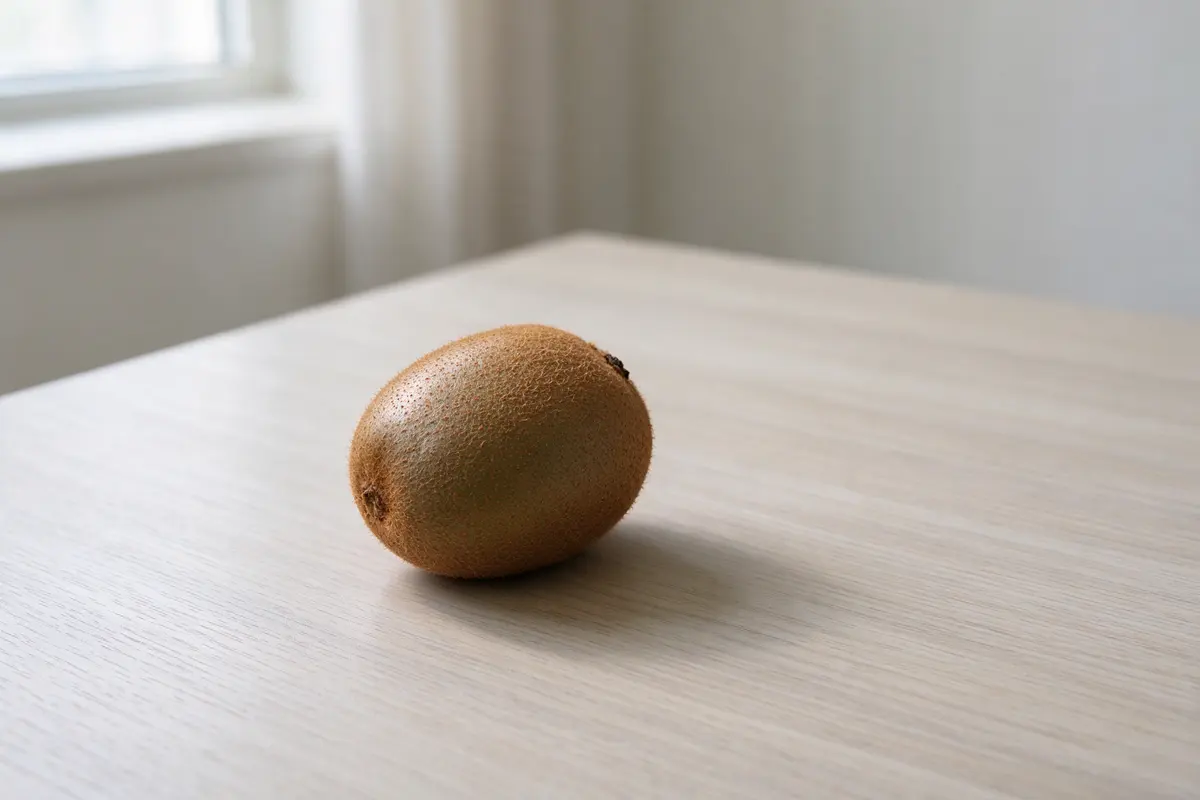
Around 8.5cm long from head to bottom, about the size of a kiwi fruit (NHS). The baby swallows small amounts of amniotic fluid, which the kidneys pass out as urine (NHS); so the plumbing is already running, in a small way. The baby grows quickly, protected by the amniotic sac and fluid, and fed by the placenta (NHS).
Your body
The placenta supplies nutrients, oxygen and hormones and removes waste such as carbon dioxide; it attaches to the womb and connects to the baby through the umbilical cord (NHS). Your blood and the baby's blood don't mix (NHS); the exchange happens across the placenta, not by sharing a circulation.
That exchange is why the rules about what you take in exist. There is no known amount of alcohol that is safe to drink during pregnancy (MedlinePlus), and the CDC's line on medicines is to talk to your healthcare providers before starting or stopping any (CDC). The placenta passes along what it's given.
Try today
The placenta sketch
Time: 10 minutes
Draw the wall of the womb as a curve, the placenta as a flat disc attached to it, the cord, and the baby floating in fluid. That's the arrangement the NHS describes: attached to the womb, connected by the umbilical cord (NHS).
Draw three arrows from your side into the placenta and label them: nutrients, oxygen, hormones (NHS).
Draw one arrow back out and label it waste, such as carbon dioxide (NHS).
Along the join, write: "the two bloods don't mix" (NHS).
Hand it to your partner and have them explain it back to you.
Make it work:It doesn't need to be accurate anatomy. It needs to be the picture you both see when someone says "placenta" at a visit.
Watch for
Normal
headaches, on the NHS's list of common symptoms around now (NHS).
Call your provider
for a headache that won't go away or gets worse over time (CDC), and ask whether a medicine is safe before you take one (MedlinePlus).
Normal
dizziness, on the same list (NHS).
Call your provider
for dizziness or fainting; it's on the CDC's list of urgent warning signs (CDC).
Normal
wanting to know exactly what crosses to the baby.
Call your provider
before you start or stop any medicine, prescription or over the counter (CDC).
For you
Think about where this organ came from. At 4 weeks, the embryo was about 2mm, and the NHS said then that its outer layer would later become the placenta (NHS). Ten weeks on, it's supplying oxygen and taking away carbon dioxide (NHS). You did that without a single conscious decision, while also doing your job and worrying about the dishes.
If you're the partner: the next time someone asks how she's doing, you can say she's running a life-support system. It's not a figure of speech.
Sources
- NHS. "Week 14." Week-by-week guide to pregnancy, Best Start in Life. https://www.nhs.uk/best-start-in-life/pregnancy/week-by-week-guide-to-pregnancy/2nd-trimester/week-14/
- NHS. "Week 15." Week-by-week guide to pregnancy, Best Start in Life. https://www.nhs.uk/best-start-in-life/pregnancy/week-by-week-guide-to-pregnancy/2nd-trimester/week-15/
- NHS. "Week 13." Week-by-week guide to pregnancy, Best Start in Life. https://www.nhs.uk/best-start-in-life/pregnancy/week-by-week-guide-to-pregnancy/2nd-trimester/week-13/
- NHS. "Week 4." Week-by-week guide to pregnancy, Best Start in Life. https://www.nhs.uk/best-start-in-life/pregnancy/week-by-week-guide-to-pregnancy/1st-trimester/week-4/
- MedlinePlus. "Pregnancy and Nutrition." National Library of Medicine. https://medlineplus.gov/pregnancyandnutrition.html
- MedlinePlus. "Aches and pains during pregnancy." National Library of Medicine. https://medlineplus.gov/ency/patientinstructions/000580.htm
- Centers for Disease Control and Prevention. "Medicine and Pregnancy: An Overview." https://www.cdc.gov/medicine-and-pregnancy/about/index.html
- Centers for Disease Control and Prevention. "Urgent Maternal Warning Signs and Symptoms." HEAR HER campaign, 2024. https://www.cdc.gov/hearher/maternal-warning-signs/index.html
This guide is general education that summarizes published research and guidance from groups like the American Academy of Pediatrics, the CDC, and the WHO. It isn’t medical advice, and every child develops on their own timeline. Your pediatrician knows your child; if something feels wrong, call them. In an emergency, call 911.
Get each day’s note the morning it applies
Add your due date to a free Chorevia household, and every morning until the birth the day's note arrives in the app and by email: what's forming, what your body is doing, one thing to try, what to watch for, and a word for you.
Create your household