Day 20 of 280 · 2 weeks + 6 days
Cannabis and the baby
Last reviewed · 3 min read · 8 sources · Plain-text version
THC passes through to the baby, in any form it's used. The CDC's advice is plain: don't, while pregnant. Today the household writes its clean-air rule and signs it.
- Size this week
- a single cell, then a ball of cells
Cannabis is legal in a lot of places now, and sold as calm. The CDC's page on it is dated this year and is not ambiguous. Today's note is the facts and a pact.
Your baby
Around now, the ball of cells is reaching the womb, and from week 5 the embryonic period begins, the stretch when the major systems start to form (MedlinePlus). THC passes through the mother's system to the baby and may harm the baby's development (CDC). Cannabis may harm a baby regardless of how it is used: smoking, vaping, dabbing, eating or drinking it, or applying creams or lotions (CDC). Some research links cannabis use in pregnancy to lower birth weight and abnormal neurological development in newborns, and studies suggest it may be linked to later problems with attention, memory, problem-solving, and behavior (CDC). The recommendation is one line: it is recommended that pregnant women do not use cannabis (CDC).
Your body
If you have used cannabis for sleep, nausea, or nerves, that need doesn't vanish with the test; it goes on the first-visit list, since the rule is to talk to your providers before starting or stopping anything (CDC). CBD is not the loophole it is sold as: the potential health effects of CBD products during pregnancy are currently unknown (CDC).
The air matters as much as the habit. Cannabis smoke contains many of the toxic and cancer-causing chemicals found in tobacco smoke, and THC may reach infants through secondhand cannabis smoke (CDC). Later, chemicals from cannabis can pass to a baby through breastmilk, and because THC is stored in body fat and released slowly, exposure can continue after stopping (CDC). Stopping now is the version with the most time on its side.
Try today
The clean-air pact
Time: 5 minutes, both of you
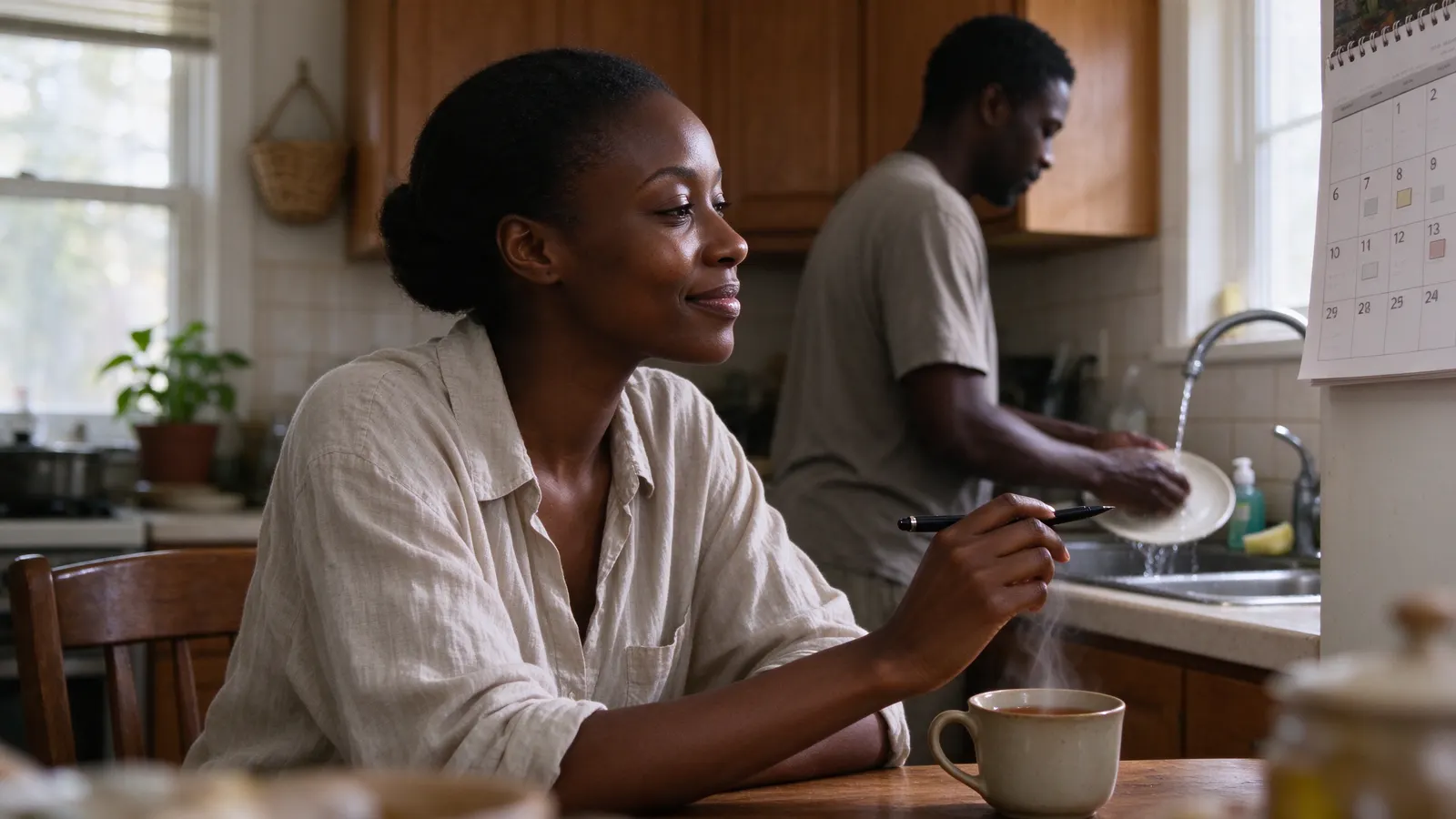
On one sheet, write the house rule for the next nine months: no smoking, no vaping, no cannabis in any form, indoors, in the car, or around her, by anyone.
Add the line for visitors, so nobody has to improvise at the door.
Both partners sign and date it; if you're on your own, sign it and tell one friend.
Stick it inside a kitchen cupboard door, where you'll see it and guests won't.
Watch for
Normal
a wave of sadness or snappishness that passes; mood swings from hormonal changes can begin a few weeks after conception (NICHD).
Call or text 988
, the Suicide and Crisis Lifeline, or call 911, for thoughts about harming yourself; don't leave someone alone in a crisis (CDC).
Normal
a dry, uneventful day with none of the symptoms on anyone's list (NICHD).
Call your provider
if vaginal discharge has a foul odor, a greenish color, itching, or pain (MedlinePlus).
Normal
tender or tingling breasts (NICHD).
Call your provider
before stopping or switching anything you take for sleep or mood, cannabis included (CDC).
For you
These early-week notes are about what to change from here, not about what was done before. The sources say the same thing in different words: it is never too late to stop alcohol (CDC), and the cannabis advice is written in the present tense, for pregnant women, now (CDC). Nobody is grading week 2.
If you're the partner: a pact signed by one person is a diary entry. Sign it, and mean the car.
Sources
- MedlinePlus. "Fetal development." National Library of Medicine, Medical Encyclopedia. https://medlineplus.gov/ency/article/002398.htm
- Centers for Disease Control and Prevention. "Cannabis and Pregnancy." 2025. https://www.cdc.gov/cannabis/health-effects/pregnancy.html
- Centers for Disease Control and Prevention. "Medicine and Pregnancy: An Overview." https://www.cdc.gov/medicine-and-pregnancy/about/index.html
- Centers for Disease Control and Prevention. "Health Effects of Cigarettes: Reproductive Health." https://www.cdc.gov/tobacco/about/cigarettes-and-reproductive-health.html
- Eunice Kennedy Shriver National Institute of Child Health and Human Development. "What are some common signs of pregnancy?" National Institutes of Health. https://www.nichd.nih.gov/health/topics/pregnancy/conditioninfo/signs
- Centers for Disease Control and Prevention. "Symptoms of Depression Among Women." Reproductive Health, 2024. https://www.cdc.gov/reproductive-health/depression/index.html
- MedlinePlus. "Common symptoms during pregnancy." National Library of Medicine. https://medlineplus.gov/ency/patientinstructions/000583.htm
- Centers for Disease Control and Prevention. "About Alcohol Use During Pregnancy." https://www.cdc.gov/alcohol-pregnancy/about/index.html
This guide is general education that summarizes published research and guidance from groups like the American Academy of Pediatrics, the CDC, and the WHO. It isn’t medical advice, and every child develops on their own timeline. Your pediatrician knows your child; if something feels wrong, call them. In an emergency, call 911.
Get each day’s note the morning it applies
Add your due date to a free Chorevia household, and every morning until the birth the day's note arrives in the app and by email: what's forming, what your body is doing, one thing to try, what to watch for, and a word for you.
Create your household