Day 85 of 280 · 12 weeks + 1 day
How much to gain
Last reviewed · 3 min read · 8 sources · Plain-text version
Most of the weight comes after week 20. Today you find your own range from your pre-pregnancy BMI, write one number to track with your provider, and rule out dieting.
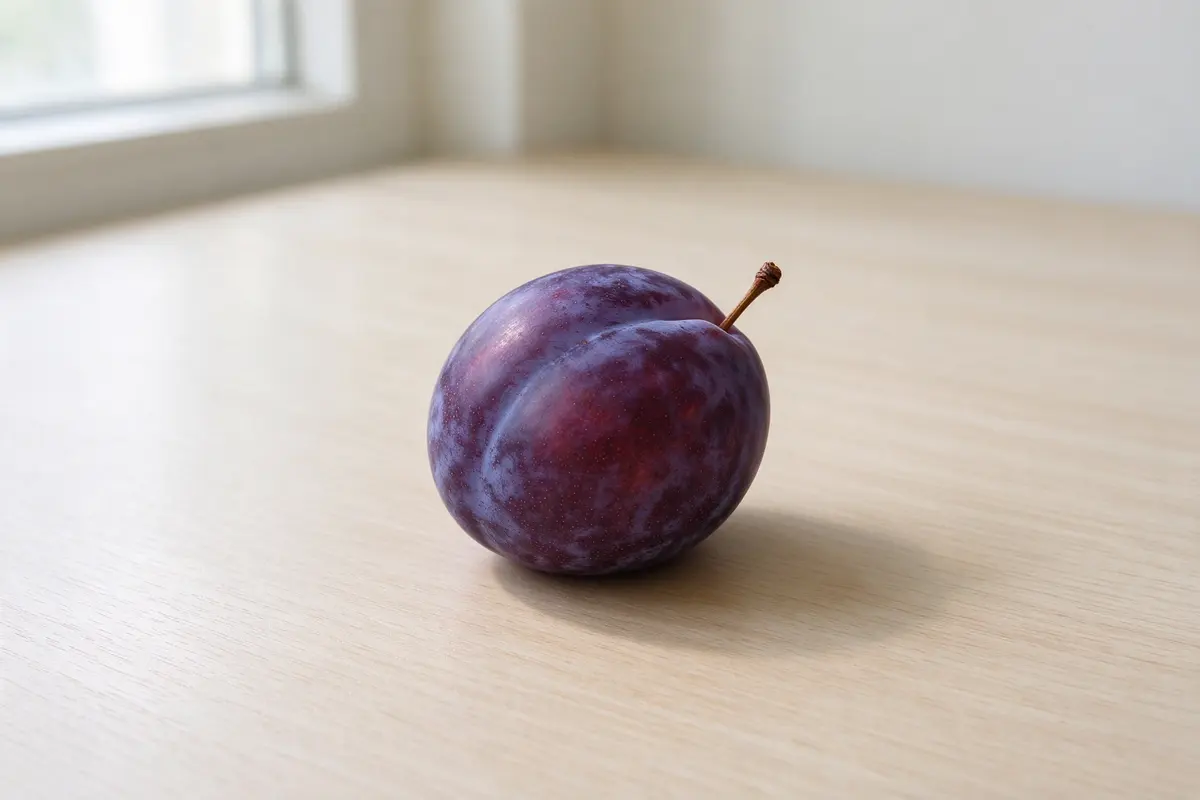
- Size this week
- about the size of a plum
- Length this week
- 5.4 cm from head to bottom

Twelve weeks and one day. The question everyone has an opinion on, answered with the two numbers the sources give: a range and a pace.
Your baby
Your body
The NHS puts it this way: "Most mums-to-be will put on between 10kg and 12.5kg (22lb to 26lb), and that's usually after week 20." And then: "But some may not put on any weight at all" (NHS). The US ranges depend on your pre-pregnancy BMI: 28 to 40 pounds if underweight (BMI below 18.5), 25 to 35 pounds at a normal weight (18.5 to 24.9), 15 to 25 pounds if overweight (25.0 to 29.9), and 11 to 20 pounds with obesity (30.0 to 39.9); for twins at a normal weight, 37 to 54 pounds (CDC).
The pace is slow at first. Most women gain 2 to 4 pounds in the first trimester, then about 1 pound a week for the rest of the pregnancy (MedlinePlus). The first trimester generally needs no extra calories; the second needs about 340 more a day and the third about 450 (CDC). And one rule with no exceptions: do not diet or try to lose weight during pregnancy (MedlinePlus).
Try today
The weight-gain range
Time: 5 minutes
Find your pre-pregnancy BMI category; the recommended range depends on it (CDC).
Write the matching range from the CDC's list on one line of the notebook (CDC).
Under it, write one number: your weight at the start. The CDC's advice is to track your gain from the beginning and compare it to the range as you go (CDC).
Cross out the word "diet" anywhere it appears in your head (MedlinePlus).
Bring the page to your next visit; the CDC says to work with your provider on the goal (CDC).
Make it work:If your situation isn't on the list, such as triplets or a BMI above 39.9, that's a conversation with your provider, not a guess (CDC).
Watch for
Normal
no weight gained yet, or a pound or two; the first-trimester pace is 2 to 4 pounds, and some gain nothing at all (MedlinePlus; NHS).
Call your provider
if you lose more than 2 pounds (1 kilogram) in a week (MedlinePlus).
Normal
appetite coming back as the sickness eases (NHS).
Call your provider
for sudden swelling in your hands or feet, or rapid weight gain (OWH).
Normal
unsure whether to keep exercising.
Call your provider
about any restrictions; activity is healthy and safe for most pregnant women (CDC).
For you
Track it with your provider, not alone (CDC). The number on the scale is one of several things checked at every visit (OWH). A previous study found only about 1 in 3 women gained the recommended amount (CDC); the range is a guide, not a grade.
If your starting weight is higher than you'd like, the CDC's line still stands: don't try to lose weight if you're already pregnant, because some gain is needed for a healthy baby (CDC).
If you're the partner: never be the scale. Cook the balanced plate the CDC describes, whole grains, vegetables, fruit, low-fat dairy and lean protein (CDC), and leave the number to her and the clinic.
Sources
- NHS. "Week 12." Week-by-week guide to pregnancy, Best Start in Life. https://www.nhs.uk/best-start-in-life/pregnancy/week-by-week-guide-to-pregnancy/1st-trimester/week-12/
- Office on Women's Health. "Stages of pregnancy." U.S. Department of Health and Human Services. https://womenshealth.gov/pregnancy/youre-pregnant-now-what/stages-pregnancy
- Centers for Disease Control and Prevention. "Weight Gain During Pregnancy." https://www.cdc.gov/maternal-infant-health/pregnancy-weight/index.html
- MedlinePlus. "Managing your weight gain during pregnancy." National Library of Medicine. https://medlineplus.gov/ency/patientinstructions/000603.htm
- MedlinePlus. "Morning sickness." National Library of Medicine. https://medlineplus.gov/ency/patientinstructions/000604.htm
- Office on Women's Health. "Body changes and discomforts." U.S. Department of Health and Human Services. https://womenshealth.gov/pregnancy/youre-pregnant-now-what/body-changes-and-discomforts
- Office on Women's Health. "Prenatal care and tests." U.S. Department of Health and Human Services. https://womenshealth.gov/pregnancy/youre-pregnant-now-what/prenatal-care-and-tests
- Centers for Disease Control and Prevention. "Gestational Diabetes." https://www.cdc.gov/diabetes/about/gestational-diabetes.html
This guide is general education that summarizes published research and guidance from groups like the American Academy of Pediatrics, the CDC, and the WHO. It isn’t medical advice, and every child develops on their own timeline. Your pediatrician knows your child; if something feels wrong, call them. In an emergency, call 911.
Get each day’s note the morning it applies
Add your due date to a free Chorevia household, and every morning until the birth the day's note arrives in the app and by email: what's forming, what your body is doing, one thing to try, what to watch for, and a word for you.
Create your household