Day 90 of 280 · 12 weeks + 6 days
A recheck
Last reviewed · 3 min read · 8 sources · Plain-text version
The last day of week 12. Today you redo the week-3 symptom scorecard, see what's changed, and circle what to raise at the next visit.
- Size this week
- about the size of a plum
- Length this week
- 5.4 cm from head to bottom

Twelve weeks and six days: the last day of your first trimester by the NHS's count, and the day to redo the scorecard you drew back in week 3. The point, this time, is the difference.
Your baby
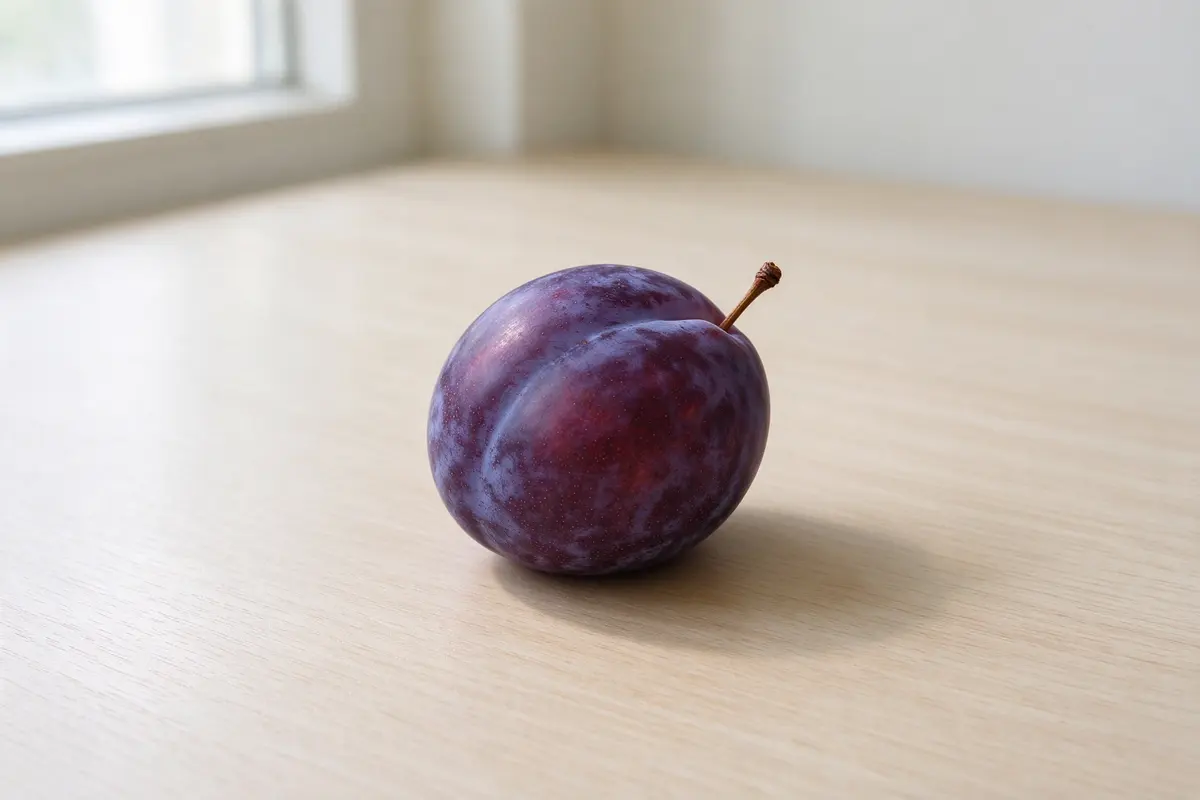
Around now your baby is 5.4cm long from head to bottom, about the size of a plum, and a heartbeat can be seen on an ultrasound (NHS). At 12 weeks the baby is about 3 inches long and can make a fist (OWH). Next week the NHS says the ovaries or testes will be fully developed inside, with final changes happening on the outside (NHS).
Your body
Hormone levels should begin to settle now that the placenta has taken over from the yolk sac (NHS). "Should begin" is honest: nausea, mood swings, headaches, heartburn, bloating and skin changes are all still on the NHS's list for this week (NHS). The early list was a different one: fatigue, breast tenderness, nausea, mood swings, and frequent urination, in whatever combination, or none (NICHD). Today you put the two lists side by side.
Try today
The symptom recheck
Time: 5 minutes, pen and paper
Draw the same five boxes you drew in week 3: fatigue, sore breasts, nausea, mood swings, peeing more (NICHD).
Add this week's four: headaches, heartburn, bloating, skin changes (NHS).
Tick what you have today, and only today.
If you kept the old card, lay it beside the new one and look at what moved.
Circle anything new or worse, and put it on the list for your next visit.
Make it work:One box may empty itself soon: needing to pee often should stop as the womb moves up and away from the bladder (NHS).
Watch for
Normal
skin changes and bloating (NHS).
Call your provider
about any bleeding; the NHS says to report it to your doctor (NHS).
Normal
feeling hot; it's on the NHS's list of common signs from next week (NHS).
Call your provider
for a fever of 100.4°F (38°C) or higher (CDC).
Normal
headaches, on this week's list (NHS).
Call your provider
for a headache that won't go away or gets worse over time, or one that comes with blurred vision or dizziness (CDC).
For you
One thing to say once, plainly, and then leave: the NHS notes that being overweight makes you more prone to conditions such as pre-eclampsia and high blood pressure (NHS). Preeclampsia occurs in about 2% to 8% of all pregnancies (CDC). That is not an instruction to lose weight; the CDC is explicit: "Don't try to lose weight if you're already pregnant" (CDC). What it is, is a reason your provider checks your blood pressure at every visit (OWH), and a reason to go to every appointment (CDC). Whatever your weight, that's the whole job.
If you're the partner: ask to see the two cards, and resist the urge to interpret them. The ticks are hers; the next visit is where they get read.
Sources
- NHS. "Week 12." Week-by-week guide to pregnancy, Best Start in Life. https://www.nhs.uk/best-start-in-life/pregnancy/week-by-week-guide-to-pregnancy/1st-trimester/week-12/
- NHS. "Week 13." Week-by-week guide to pregnancy, Best Start in Life. https://www.nhs.uk/best-start-in-life/pregnancy/week-by-week-guide-to-pregnancy/2nd-trimester/week-13/
- Office on Women's Health. "Stages of pregnancy." U.S. Department of Health and Human Services. https://womenshealth.gov/pregnancy/youre-pregnant-now-what/stages-pregnancy
- National Institute of Child Health and Human Development. "What are some common signs of pregnancy?" National Institutes of Health. https://www.nichd.nih.gov/health/topics/pregnancy/conditioninfo/signs
- Centers for Disease Control and Prevention. "Urgent Maternal Warning Signs and Symptoms." HEAR HER campaign, 2024. https://www.cdc.gov/hearher/maternal-warning-signs/index.html
- Centers for Disease Control and Prevention. "High Blood Pressure During Pregnancy." https://www.cdc.gov/high-blood-pressure/about/high-blood-pressure-during-pregnancy.html
- Centers for Disease Control and Prevention. "Gestational Diabetes." https://www.cdc.gov/diabetes/about/gestational-diabetes.html
- Office on Women's Health. "Prenatal care and tests." U.S. Department of Health and Human Services. https://womenshealth.gov/pregnancy/youre-pregnant-now-what/prenatal-care-and-tests
This guide is general education that summarizes published research and guidance from groups like the American Academy of Pediatrics, the CDC, and the WHO. It isn’t medical advice, and every child develops on their own timeline. Your pediatrician knows your child; if something feels wrong, call them. In an emergency, call 911.
Get each day’s note the morning it applies
Add your due date to a free Chorevia household, and every morning until the birth the day's note arrives in the app and by email: what's forming, what your body is doing, one thing to try, what to watch for, and a word for you.
Create your household