Day 36 of 280 · 5 weeks + 1 day
The first heartbeat
Last reviewed · 3 min read · 5 sources · Plain-text version
The heart starts to form around now. Today's small, unglamorous job is adding one line to your first-visit list: please test me for STIs.
- Size this week
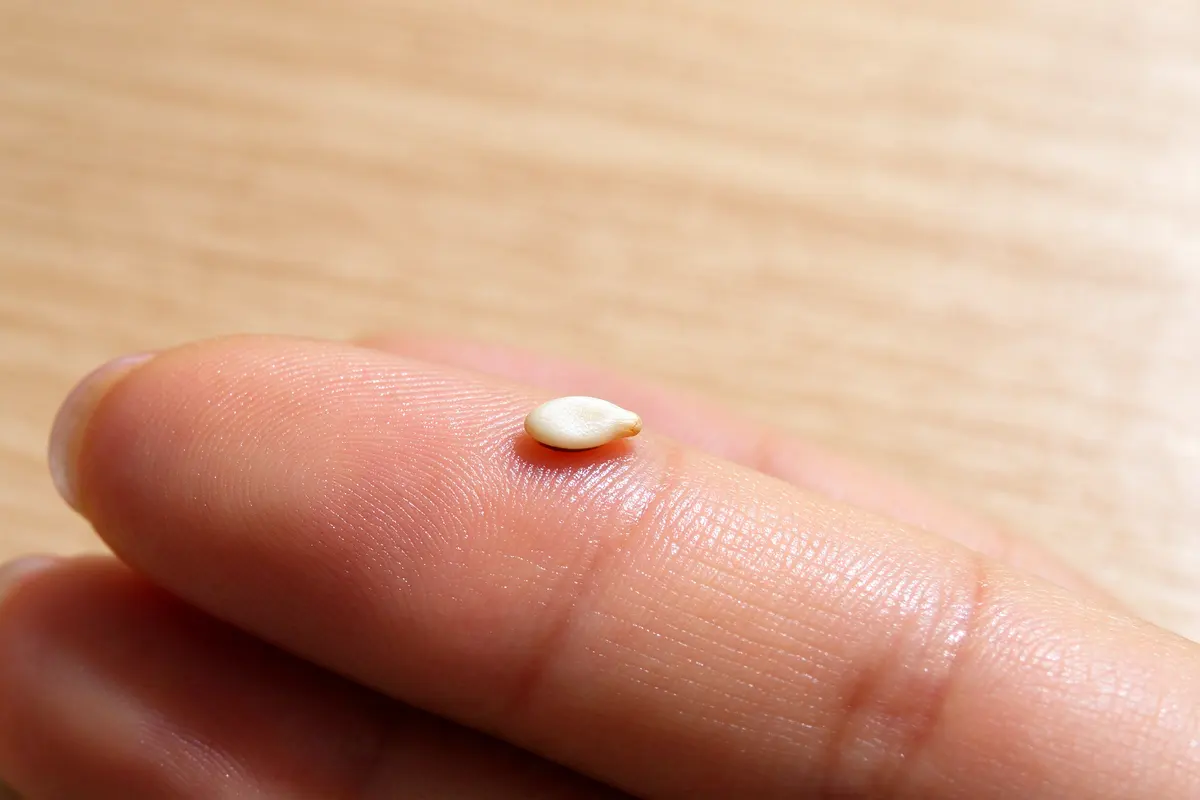
- about the size of a sesame seed
- Length this week
- around 2 mm from head to bottom

Five weeks and one day. Something begins around now that won't stop for a lifetime. The job for today is much smaller, and it's one most people skip out of embarrassment.
Your baby
The NHS puts it in one sentence: "The tiny heart is starting to form and will beat for the first time around now" (NHS). The heartbeat usually cannot be heard or seen on ultrasound until at least 6 to 7 weeks (MedlinePlus), so an early scan that shows nothing is not news.
The embryo already has its own blood vessels, which will become part of the umbilical cord (NHS).
Your body
Pregnancy does not protect you or your baby from sexually transmitted infections (CDC). Most STIs have no signs or symptoms at all, so the only way to know your status is to get tested, and the CDC says pregnant women should ask their doctors to test for STIs as part of routine care (CDC). Some of this happens without asking: NICHD says all pregnant women should be screened for syphilis at the first prenatal visit, with high-risk women screened again in the third trimester (NICHD). The NHS puts it on this week's to-do list as well: get checked for STIs if there's any chance of exposure (NHS).
Why now rather than later: STIs can be more serious, even life-threatening, during pregnancy, and can harm both you and the baby, and earlier starts to medical care are associated with better outcomes (CDC).
Try today
The testing ask
Time: 2 minutes
Open your first-visit list, or start one, and write: "Please test me for STIs."
Under it, note anything you'd want the provider to know: a past infection, a new partner, a partner's past. You can decide at the visit how much to say.
Add a line for your partner. If an STI is diagnosed during pregnancy, the CDC says sex partners should be tested and treated too (CDC).
Keep it where you'll find it on the day.
Make it work:You don't need symptoms to ask. Most STIs have none (CDC), and asking for a routine test is the ordinary thing, not the suspicious one.
Watch for
Normal
no symptoms at all; most STIs have none (CDC).
Call your provider
if vaginal discharge has a foul odor, a greenish color, itching, or pain; vaginal infections matter in pregnancy because they may cause preterm labor (MedlinePlus).
Normal
needing to pee more often, on the NHS's list for this week (NHS).
Call your provider
for pain when urinating or a change in urine odor or color, which may signal a bladder infection (MedlinePlus).
Normal
sore breasts and tiredness (NHS).
Call your provider
for fever or chills; they're on MedlinePlus's list of reasons to contact your doctor or midwife in the first trimester (MedlinePlus).
For you
No judgment lives on this page. Testing is routine care, and a positive result is a treatment plan, not a verdict: some STIs can be cured with antibiotics that are safe in pregnancy, and others can be treated with antivirals or other measures to reduce the risk of passing the infection to the baby (CDC).
If you're the partner: this line is for both of you. If anything is found, you get tested and treated as well (CDC). The lower-risk practices the CDC names are a long-term mutually monogamous relationship, partners who have tested negative, and condoms used correctly every time (CDC). Easier to talk about today than at the clinic.
Sources
- NHS. "Week 5." Week-by-week guide to pregnancy, Best Start in Life. https://www.nhs.uk/best-start-in-life/pregnancy/week-by-week-guide-to-pregnancy/1st-trimester/week-5/
- MedlinePlus. "Prenatal care in your first trimester." National Library of Medicine. https://medlineplus.gov/ency/patientinstructions/000544.htm
- Centers for Disease Control and Prevention. "About STIs and Pregnancy." 2025. https://www.cdc.gov/sti/about/about-stis-and-pregnancy.html
- National Institute of Child Health and Human Development. "What infections can affect pregnancy?" National Institutes of Health, 2021. https://www.nichd.nih.gov/health/topics/pregnancy/conditioninfo/infections
- MedlinePlus. "Common symptoms during pregnancy." National Library of Medicine. https://medlineplus.gov/ency/patientinstructions/000583.htm
This guide is general education that summarizes published research and guidance from groups like the American Academy of Pediatrics, the CDC, and the WHO. It isn’t medical advice, and every child develops on their own timeline. Your pediatrician knows your child; if something feels wrong, call them. In an emergency, call 911.
Get each day’s note the morning it applies
Add your due date to a free Chorevia household, and every morning until the birth the day's note arrives in the app and by email: what's forming, what your body is doing, one thing to try, what to watch for, and a word for you.
Create your household