Day 46 of 280 · 6 weeks + 4 days
When sickness is more than sickness
Last reviewed · 3 min read · 7 sources · Plain-text version
Most morning sickness is mild. Today: what hyperemesis gravidarum is, the numbers that mean a call, and a once-a-week habit that catches it early.
- Size this week
- about the size and shape of a pea
- Length this week
- around 6 mm from head to bottom

Six weeks and four days. Yesterday was rest. Today is the line between ordinary morning sickness and the kind that needs a provider, and a two-minute habit that keeps you on the right side of it.
Your baby
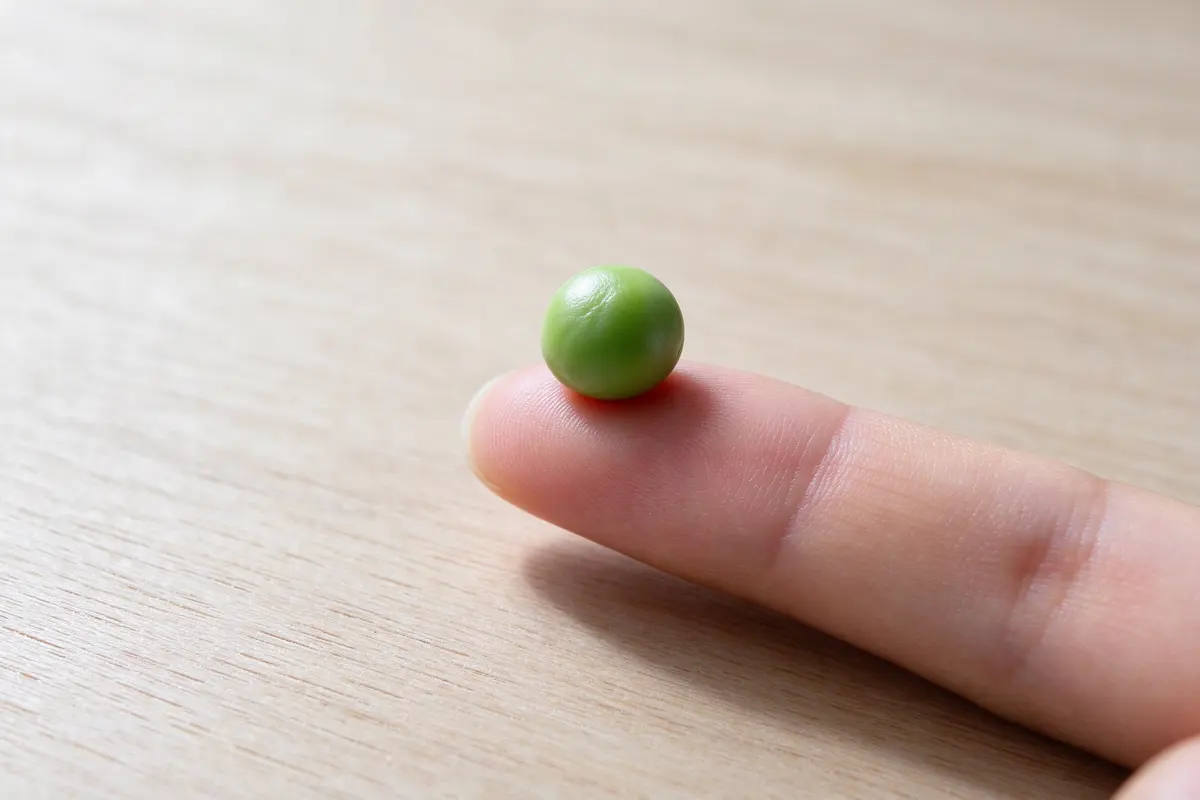
Around 6mm long, about the size and shape of a pea (NHS). During weeks 6 and 7 the heart beats at a regular rhythm, which can be seen on vaginal ultrasound (MedlinePlus); before that, the heartbeat usually cannot be heard or seen on ultrasound until at least 6 to 7 weeks (MedlinePlus). Around it, the liver, brain and musculoskeletal system are developing (NHS).
Your body
Morning sickness is common this week (NHS), and mild morning sickness does not harm the baby (MedlinePlus). Hyperemesis gravidarum is different: severe, ongoing nausea and vomiting that can lead to dehydration, weight loss and electrolyte imbalances, with weight loss that can exceed 5% of body weight (MedlinePlus).
The risk is higher with twins or multiples, a molar pregnancy, a tendency to motion sickness, a previous bout of it, or a female relative who had it (MedlinePlus). Researchers now identify GDF15, a hormone the placenta produces at high levels early in pregnancy, as the main cause, and people with lower GDF15 before pregnancy react more strongly to it (MedlinePlus). Severe nausea often improves by weeks 14 to 16, though some women have symptoms the whole pregnancy (MedlinePlus).
Try today
The weekly weigh-in
Time: 2 minutes, once a week
Pick a day and a time, first thing and after the bathroom, and the same scale every week.
Write the number and the date in your notes. MedlinePlus's instruction is to weigh yourself regularly to watch for excessive weight loss (MedlinePlus).
Compare it with last week. A loss of more than 2 pounds (1 kilogram) in a week is MedlinePlus's line for contacting a doctor (MedlinePlus).
Bring the list to the first visit.
Make it work:The point isn't the gain. The expected gain in the whole first trimester is only 2 to 4 pounds (OWH), so a flat line is fine; it's a falling one you're watching for.
Watch for
Normal
nausea, and vomiting now and then (NHS).
Call your provider
if you lose more than 2 pounds (1 kilogram) in a week, if vomiting doesn't improve with home remedies, or if you vomit blood or material that looks like coffee grounds (MedlinePlus).
Normal
a day when food is hard to face.
Call your provider today
if you can't tolerate any fluids for over 12 hours, lose more than 5 pounds (2.3 kilograms), feel lightheaded, or notice signs of dehydration (MedlinePlus).
Normal
needing to lie down after a bad morning.
Go to the ER
if you can't drink for more than 8 hours or eat for more than 24; the CDC lists severe nausea and throwing up among the urgent warning signs that need care immediately (CDC).
For you
If you're the one who can't keep anything down: it is not something you did. The current explanation is a placental hormone and how your body happened to react to it (MedlinePlus). And the other half of the same page is the part to hold on to: with proper identification and follow-up, serious complications for the baby or the mother are rare (MedlinePlus).
If you're the partner: the weigh-in is a job you can own. Remember the day, keep the notebook by the scale, and be the one who says the number out loud when it has dropped. Severe vomiting can require hospital IV fluids (MedlinePlus); the ride is yours.
Sources
- NHS. "Week 6." Week-by-week guide to pregnancy, Best Start in Life. https://www.nhs.uk/best-start-in-life/pregnancy/week-by-week-guide-to-pregnancy/1st-trimester/week-6/
- MedlinePlus. "Fetal development." Medical Encyclopedia, National Library of Medicine. https://medlineplus.gov/ency/article/002398.htm
- MedlinePlus. "Prenatal care in your first trimester." National Library of Medicine. https://medlineplus.gov/ency/patientinstructions/000544.htm
- MedlinePlus. "Morning sickness." National Library of Medicine. https://medlineplus.gov/ency/patientinstructions/000604.htm
- MedlinePlus. "Hyperemesis gravidarum." Medical Encyclopedia, National Library of Medicine. https://medlineplus.gov/ency/article/001499.htm
- Office on Women's Health. "Staying healthy and safe." U.S. Department of Health and Human Services. https://womenshealth.gov/pregnancy/youre-pregnant-now-what/staying-healthy-and-safe
- Centers for Disease Control and Prevention. "Urgent Maternal Warning Signs and Symptoms." HEAR HER campaign, 2024. https://www.cdc.gov/hearher/maternal-warning-signs/index.html
This guide is general education that summarizes published research and guidance from groups like the American Academy of Pediatrics, the CDC, and the WHO. It isn’t medical advice, and every child develops on their own timeline. Your pediatrician knows your child; if something feels wrong, call them. In an emergency, call 911.
Get each day’s note the morning it applies
Add your due date to a free Chorevia household, and every morning until the birth the day's note arrives in the app and by email: what's forming, what your body is doing, one thing to try, what to watch for, and a word for you.
Create your household