Day 61 of 280 · 8 weeks + 5 days
Money, relationships, the rest
Last reviewed · 3 min read · 6 sources · Plain-text version
The NHS says to ask for support with money and relationships this week. A fifteen-minute conversation about one worry, no fixing allowed.
- Size this week
- about the size of a raspberry
- Length this week
- around 16 mm from head to bottom
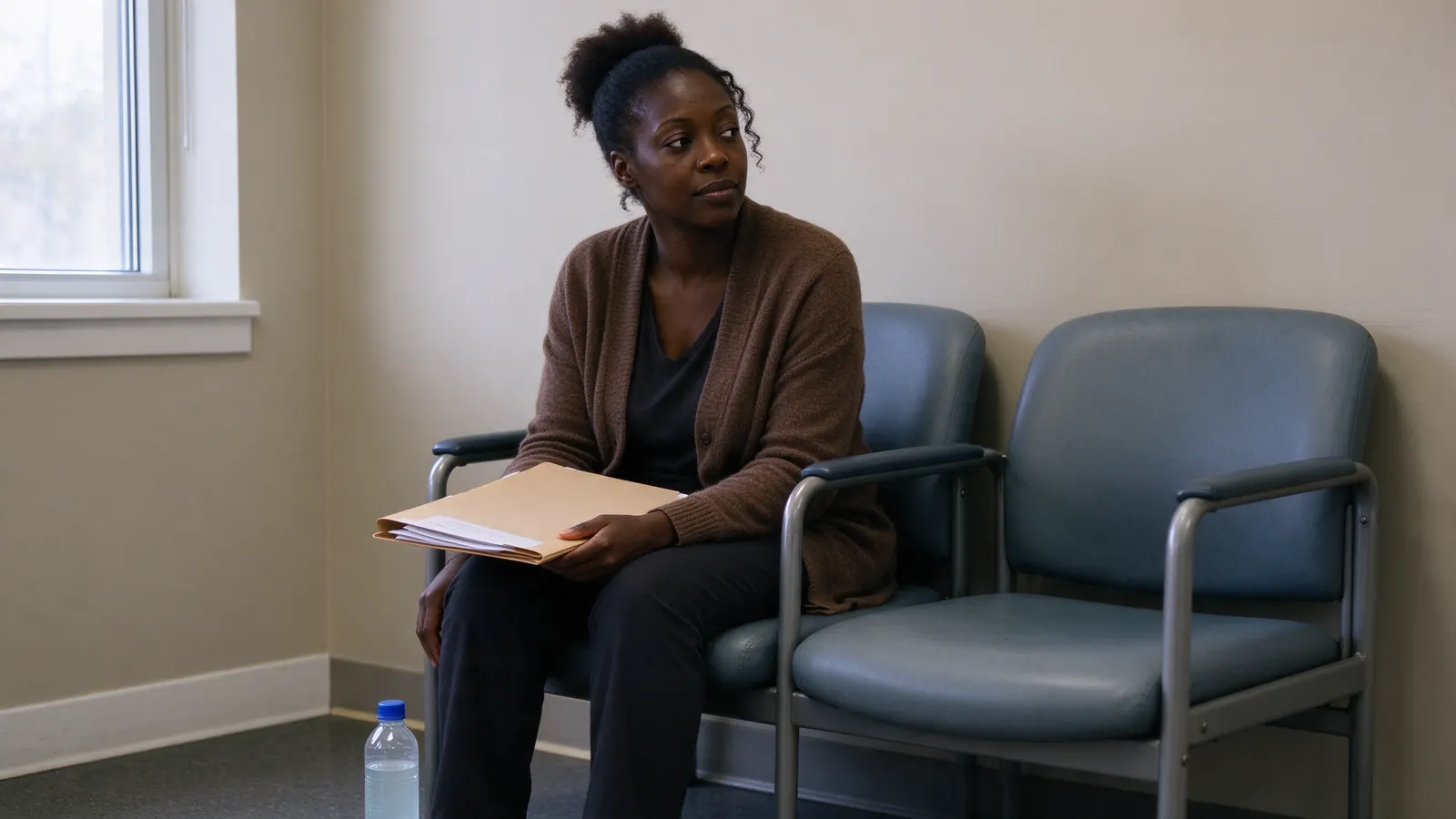
Eight weeks and five days. Today is not about your body. It's about the other things the NHS lists for this week: your mental wellbeing, your relationships, and money.
Your baby

Around 16mm, about the size of a raspberry (NHS). Last week the brain, face and eyelids were developing and the arm buds were lengthening (NHS); this week the head is starting to uncurl, the arms are bigger than the legs, and the placenta is growing the branches that will attach it to the wall of the womb (NHS).
Your body
The NHS's to-do list for week 8 includes a line most pregnancy guides leave out: ask for support with your mental wellbeing, relationships or money (NHS). It's there because those things shape the pregnancy. The AAP lists relationship or financial problems, little support, and an unplanned pregnancy among the risk factors for depression and anxiety during and after pregnancy (AAP), and the CDC names little or no social support as something that may raise the risk (CDC).
Stress itself has a plain remedy list from MedlinePlus: talk with a partner or friend, keep your prenatal care, eat well, stay active, sleep enough, and raise persistent stress with your provider (MedlinePlus). Today's activity is the first item on that list.
Try today
The one-worry conversation
Time: 15 minutes
Each of you writes the single practical worry that's loudest right now: money, housing, work, who will help.
Pick one. Set a timer for fifteen minutes.
The person whose worry it is talks. The other asks questions and does not fix anything.
End with one question to take outside the room: to HR, the bank, a parent, the midwife. Asking for support with relationships or money is on the NHS's list for this week (NHS).
Make it work:Nothing gets solved today. Little support is on the AAP's list of risk factors (AAP); a shared worry is the smallest unit of support there is.
Watch for
Normal
a tense conversation that ends better than it started.
Call your provider
if stress persists; MedlinePlus says to raise persistent stress with your provider (MedlinePlus).
Normal
tears over nothing; mood swings are on the NHS's list this week (NHS).
Call your provider
for extreme sadness or anger, guilt about failing as a parent, or lost interest in things you enjoy (AAP).
Normal
a partner who goes quiet after a hard talk.
For you
You don't have to decide anything about leave or money today. Start the questions instead: what your workplace offers, when you'd have to tell them, what your partner's workplace offers, what the first visit and the scan will cost you. Most pregnant women can keep working, some until delivery (MedlinePlus), so the timing is yours to set.
There is no known way to prevent depression or anxiety in pregnancy, but early treatment works, and the sooner you start, the sooner you feel better (AAP). Naming a worry out loud is where that starts.
If you're the partner: the relationships line on the NHS page is for you as much as for her (NHS). Bring your own worry to the table, and let yours be the one you talk through next time.
Sources
- NHS. "Week 8." Week-by-week guide to pregnancy, Best Start in Life. https://www.nhs.uk/best-start-in-life/pregnancy/week-by-week-guide-to-pregnancy/1st-trimester/week-8/
- NHS. "Week 7." Week-by-week guide to pregnancy, Best Start in Life. https://www.nhs.uk/best-start-in-life/pregnancy/week-by-week-guide-to-pregnancy/1st-trimester/week-7/
- American Academy of Pediatrics. "Depression and Anxiety During Pregnancy and After Birth: FAQs." HealthyChildren.org, 2019. https://www.healthychildren.org/English/ages-stages/prenatal/Pages/Depression-and-Anxiety-During-Pregnancy-and-After-Birth-FAQs.aspx
- Centers for Disease Control and Prevention. "Symptoms of Depression Among Women." Reproductive Health, 2024. https://www.cdc.gov/reproductive-health/depression/index.html
- MedlinePlus. "Pregnancy and work." National Library of Medicine. https://medlineplus.gov/ency/patientinstructions/000609.htm
- National Institute of Child Health and Human Development. "What should I know about postpartum depression?" National Institutes of Health. https://www.nichd.nih.gov/health/topics/pregnancy/conditioninfo/postpartum
This guide is general education that summarizes published research and guidance from groups like the American Academy of Pediatrics, the CDC, and the WHO. It isn’t medical advice, and every child develops on their own timeline. Your pediatrician knows your child; if something feels wrong, call them. In an emergency, call 911.
Get each day’s note the morning it applies
Add your due date to a free Chorevia household, and every morning until the birth the day's note arrives in the app and by email: what's forming, what your body is doing, one thing to try, what to watch for, and a word for you.
Create your household