Day 19 of 60 · Week 3
Cues and serve-and-return
Last reviewed · 3 min read · 13 sources · Plain-text version
Your baby has been talking to you for nineteen days. How to read hungry, full, tired, and had-enough, and the five-step back-and-forth that builds a brain.

Your baby has been talking to you for nineteen days, in gazes, squirms, and cries. Today is about reading it, and about the simplest back-and-forth there is.
Heart
When a baby coos, cries, or gazes and an adult responds with eye contact, words, or a hug, those exchanges help build neural connections. Consistently missing responses can disrupt development (Harvard Center on the Developing Child). Much of that research is with older babies and children, but the habit starts now, during a stretch when more than 1 million new neural connections form every second (Harvard Center on the Developing Child). Responding quickly to your baby's signals lets them know they can trust you (AAP).
Head
The cues, in the order you'll meet them today:
- Hungry: lip smacking, sucking motions, rooting, squirming. Crying is a late hunger sign (AAP).
- Full, on a bottle: getting fidgety or easily distracted during the feed (AAP).
- Tired: yawning, droopy eyelids, staring into the distance, fussiness (Cleveland Clinic).
- Had enough: looking away or starting to fuss (Harvard Center on the Developing Child).
You will misread some. Everyone does. The baby isn't grading you; they just send the cue again.
Body
Harvard's five serve-and-return steps, adapted for a newborn (Harvard Center on the Developing Child): notice the serve, return it, name it, take turns and wait, notice endings. Newborns respond slowly, so the waiting is the skill. The "notice endings" step is the one most of us skip: looking away or fussing can mean "done for now," and stopping there is a return too.
Try today
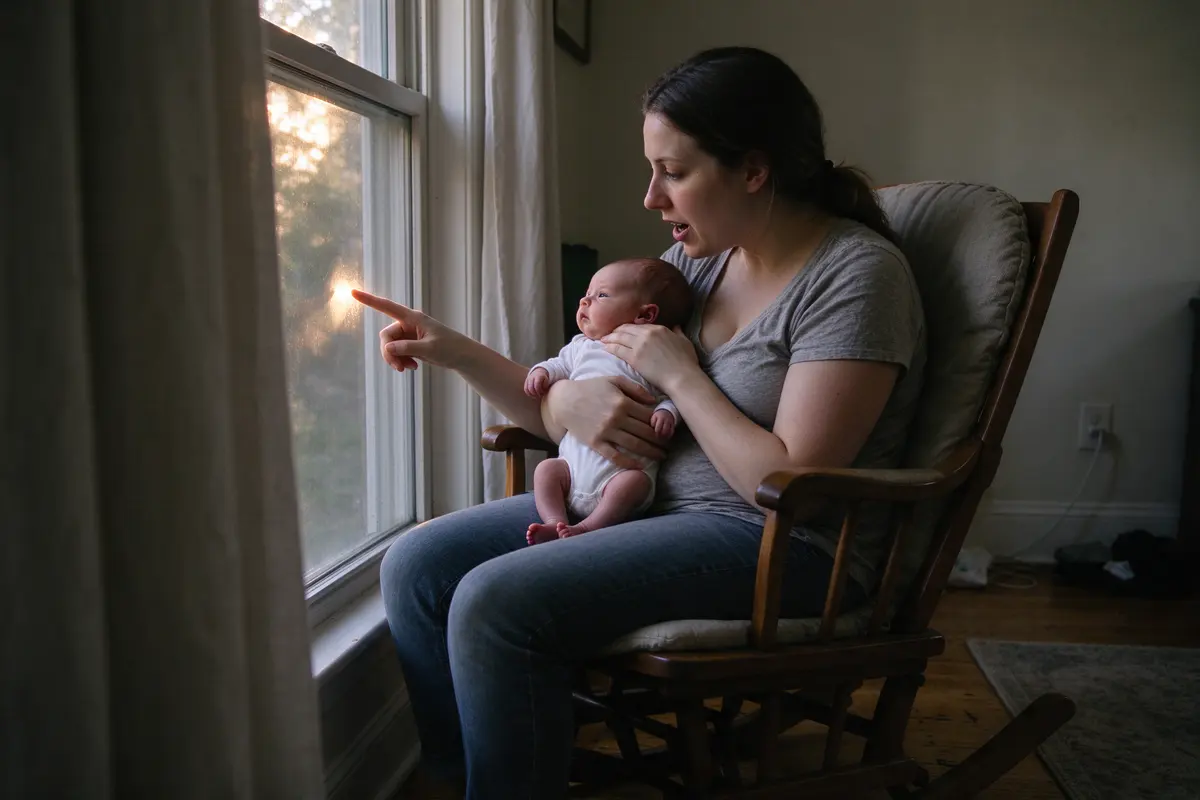
The serve-and-return game
Time: A few minutes, a few times a day
Notice the serve: a gaze, a coo, a cry, a wiggle.
Return it: a smile, a touch, a soft "I see you."
Name it: "You're looking at the window. That's the light."
Wait. Count to five in your head before you say anything else.
Notice the ending: looking away or fussing means "done for now" (Harvard Center on the Developing Child).
Make it work:When your baby turns away mid-chat and squirms, try, "Okay, you're done. Let's rest," and hold them quietly. That's the whole game.
Watch for
Normal
fussing that means "had enough," which eases when you stop and hold them.
Call your pediatrician right away
if your baby cries and can't be comforted in a way that's new or worries you (Nationwide Children's).
Normal
seeming satisfied for 1 to 3 hours between feeds (AAP).
Call your pediatrician right away
if your baby is feeding poorly or has a weak suck (Nationwide Children's).
Normal
no reaction on some tries when you speak; by about one month, a baby may look or turn toward familiar voices (AAP).
Tell your pediatrician
if your baby never seems to react to sounds (CDC).
For you
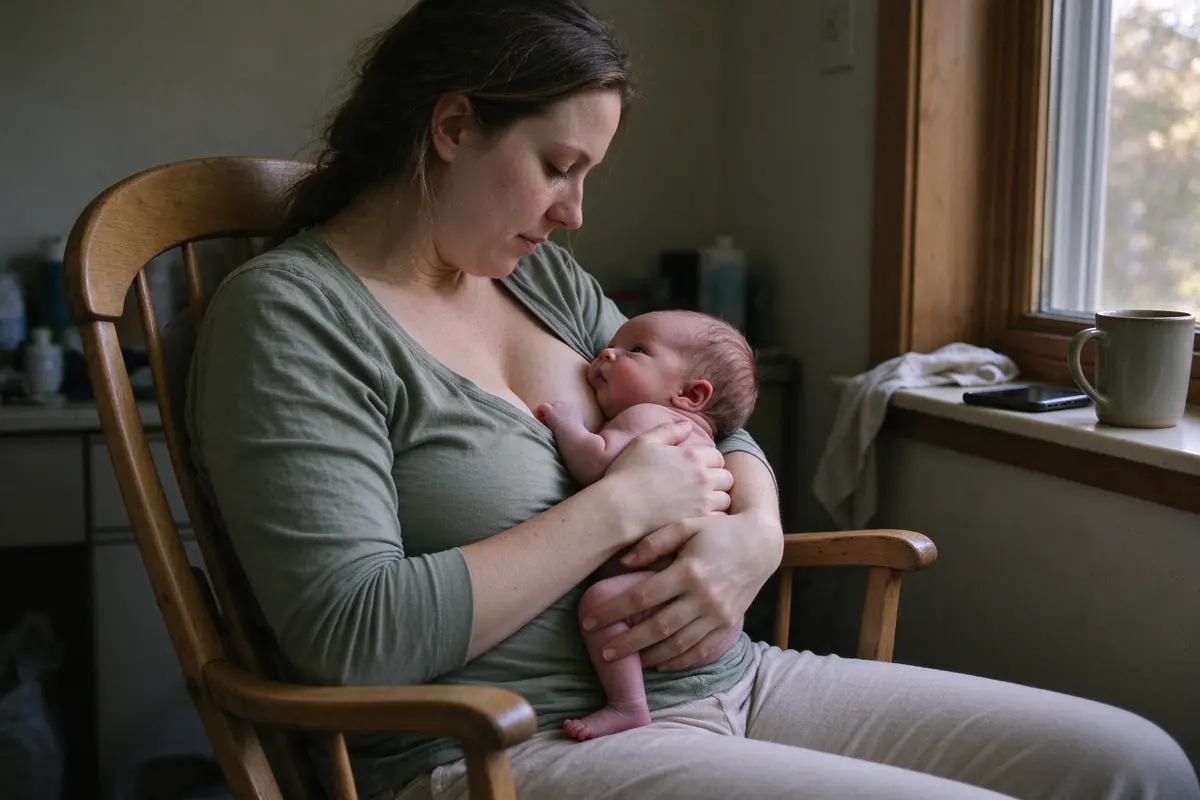
You are the curriculum. Responding to your baby is the activity; no special gear is needed (Harvard Center on the Developing Child). If a catalog or a feed has made you feel you should be buying something, you can put the phone down. Everything your baby needs to learn this month, they learn from your face.
Your cues count too. Dizziness or fainting, changes in your vision, a fever of 100.4°F or higher, or severe belly pain that doesn't go away are urgent maternal warning signs: seek care immediately, and tell any provider you see that you were pregnant within the last year (CDC).
If you're the partner: learn the cues yourself, so "is he hungry or tired?" isn't a question only one of you can answer. The non-feeding partner owns settling after feeds (Yogman & Garfield, 2016).
Sources
- Center on the Developing Child at Harvard University. "Serve and Return." https://developingchild.harvard.edu/key-concept/serve-and-return/
- Center on the Developing Child at Harvard University. "InBrief: The Science of Early Childhood Development." https://developingchild.harvard.edu/wp-content/uploads/2024/10/InBrief-The-Science-of-Early-Childhood-Development2.pdf
- American Academy of Pediatrics. "Emotional & Social Development in Babies: Birth Through 3 Months." HealthyChildren.org, 2026. https://www.healthychildren.org/English/ages-stages/baby/Pages/Emotional-and-Social-Development-Birth-to-3-Months.aspx
- American Academy of Pediatrics. "How Often to Breastfeed." HealthyChildren.org, 2015. https://www.healthychildren.org/English/ages-stages/baby/breastfeeding/Pages/How-Often-to-Breastfeed.aspx
- American Academy of Pediatrics. "Amount and Schedule of Baby Formula Feedings." HealthyChildren.org, 2022. https://www.healthychildren.org/English/ages-stages/baby/formula-feeding/Pages/amount-and-schedule-of-formula-feedings.aspx
- Cleveland Clinic. "How Can I Tell When My Baby Is Tired?" 2024. https://health.clevelandclinic.org/how-can-i-tell-when-my-baby-is-tired
- Center on the Developing Child at Harvard University. "5 Steps for Brain-Building Serve and Return." 2019. https://developingchild.harvard.edu/wp-content/uploads/2024/10/HCDC_ServeReturn_for_Parents_Caregivers_2019.pdf
- Nationwide Children's Hospital. "Newborn Warning Signs." 2023. https://www.nationwidechildrens.org/conditions/health-library/newborn-warning-signs
- American Academy of Pediatrics Section on Breastfeeding. "How to Tell if Your Breastfed Baby is Getting Enough Milk." HealthyChildren.org, 2025. https://www.healthychildren.org/English/ages-stages/baby/breastfeeding/Pages/How-to-Tell-if-Baby-is-Getting-Enough-Milk.aspx
- American Academy of Pediatrics. "Developmental Milestones at 1 Month Old." HealthyChildren.org, 2026. https://www.healthychildren.org/English/ages-stages/baby/Pages/Developmental-Milestones-1-Month.aspx
- Centers for Disease Control and Prevention. "Hearing Loss in Children: Screening." 2024. https://www.cdc.gov/hearing-loss-children/screening/index.html
- Centers for Disease Control and Prevention. "Urgent Maternal Warning Signs and Symptoms." HEAR HER campaign. https://www.cdc.gov/hearher/maternal-warning-signs/index.html
- Yogman M, Garfield CF; AAP Committee on Psychosocial Aspects of Child and Family Health. "Fathers' Roles in the Care and Development of Their Children: The Role of Pediatricians." Pediatrics, 2016. https://pubmed.ncbi.nlm.nih.gov/27296867/
This guide is general education that summarizes published research and guidance from groups like the American Academy of Pediatrics, the CDC, and the WHO. It isn’t medical advice, and every child develops on their own timeline. Your pediatrician knows your child; if something feels wrong, call them. In an emergency, call 911.
Get each day’s note the morning it applies
Add your baby to a free Chorevia household with their date of birth, and every morning for 60 days the day’s note arrives in the app and by email: what’s developing, one thing to try, what to watch for, and a word for you.
Create your household