Day 25 of 60 · Week 4
The whole family
Last reviewed · 3 min read · 15 sources · Plain-text version
Siblings, grandparents, and partners all have a job: how to share the load specifically, keep germs away, and let people help.
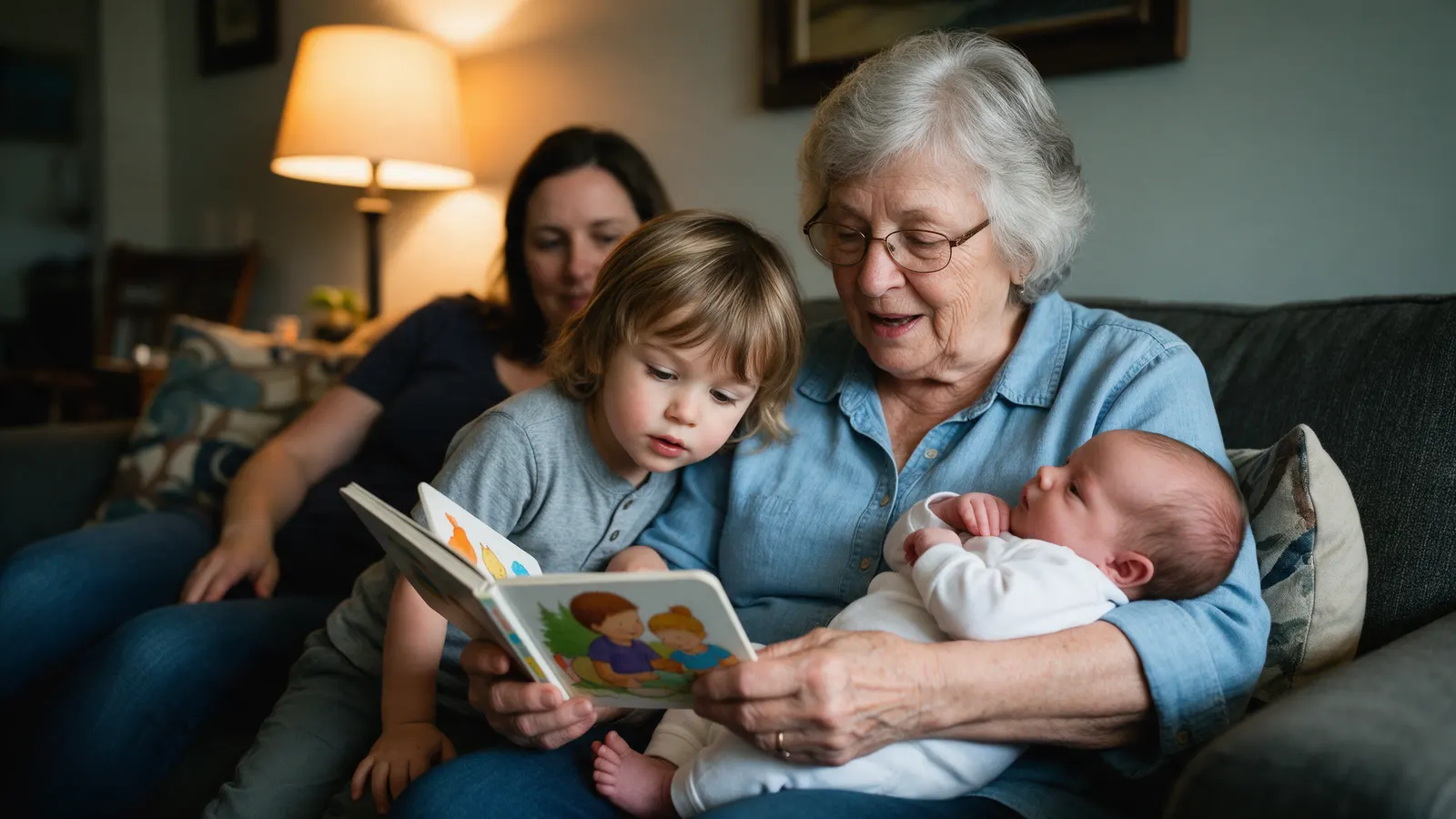
A newborn is a whole-family project, even when it feels like everything runs through you. Today is about the other people in the house and what they can do.
Heart
Anyone who responds to your baby is building their brain. When a baby coos, cries, or gazes and an adult answers with eye contact, words, or a hug, those exchanges help build neural connections (Harvard Center on the Developing Child). That adult doesn't have to be you; a grandparent saying "I see you" counts.
Partners have evidence too. In a small trial of 29 fathers after cesarean births, babies held skin-to-skin cried less and calmed sooner than babies in a cot (Erlandsson et al., 2007), and the AAP urges pediatricians to support fathers' involvement (Yogman & Garfield, 2016).
Head
The rule for visitors: wash hands before holding the baby, and stay away while sick (KidsHealth). The AAP also suggests that relatives be up to date on vaccines, with Tdap finished at least 2 weeks before visiting (AAP). That's called cocooning, and it's reasonable to ask of people who love your baby.
Body
Siblings want to touch everything, including the soft spot. That's fine: a thick, durable membrane protects the brain. There are two, a diamond-shaped one on top that usually closes between 12 and 18 months and a smaller one at the back that closes between 2 and 3 months (AAP). Show the sibling one gentle finger, then offer a hand to hold.
Share the holding with partners, grandparents, and friends; it won't spoil your baby (AAP). Then split the night so each adult gets one longer stretch of sleep, and let the non-feeding partner own diapers, burping, and settling. The script: "I've got everything until 2 a.m. You sleep. Then we switch."
Try today
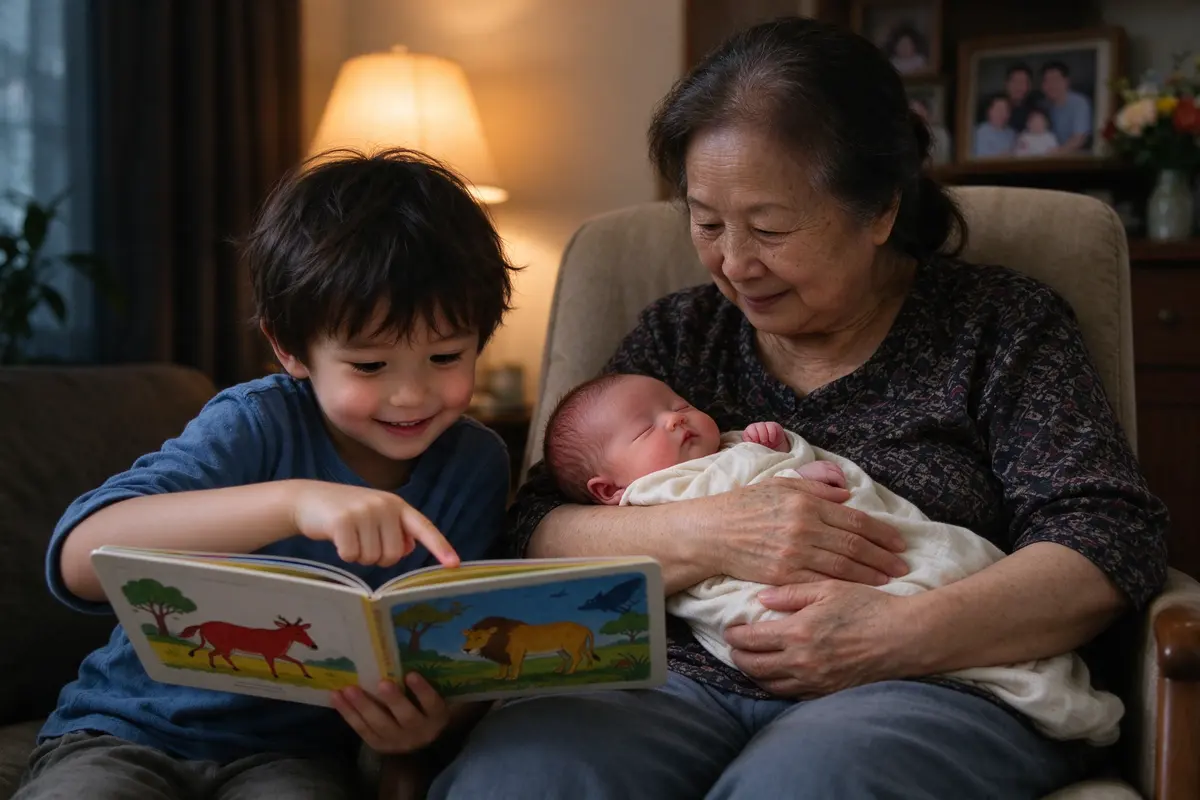
Someone else reads aloud
Time: A few minutes · Read anything aloud in the guide
Hand the baby to a seated partner, grandparent, or sibling, head supported.
They pick anything: a picture book, the sports page, a cereal box.
They read slowly, with expression, for a few minutes; a picture book goes about 8 to 12 inches from the baby's face (AAP).
You lie down and don't help.
They stop when the baby fusses or turns away.
Make it work:The AAP recommends shared reading beginning at birth (Klass et al., 2024). A sibling who can't read yet can "read" the pictures.
Watch for
Normal
a soft spot that looks flat or a little sunken and pulses with each heartbeat.
Call your pediatrician right away
for a bulging soft spot, or a deeply sunken one in a baby who isn't acting well (AAP).
Normal
a scaly scalp rash starting around now; cradle cap usually begins between 3 weeks and 2 months, and washing every other day with a mild baby shampoo helps (AAP).
Call your pediatrician right away
about tiny blisters, purple or blood-colored spots, infected-looking skin, or a rash with a fever (AAP).
Normal
a full house, with any sniffles kept at a distance.
Call your pediatrician immediately
if your baby has a rectal temperature of 100.4°F (38°C) or higher, even if they seem fine (AAP).
For you
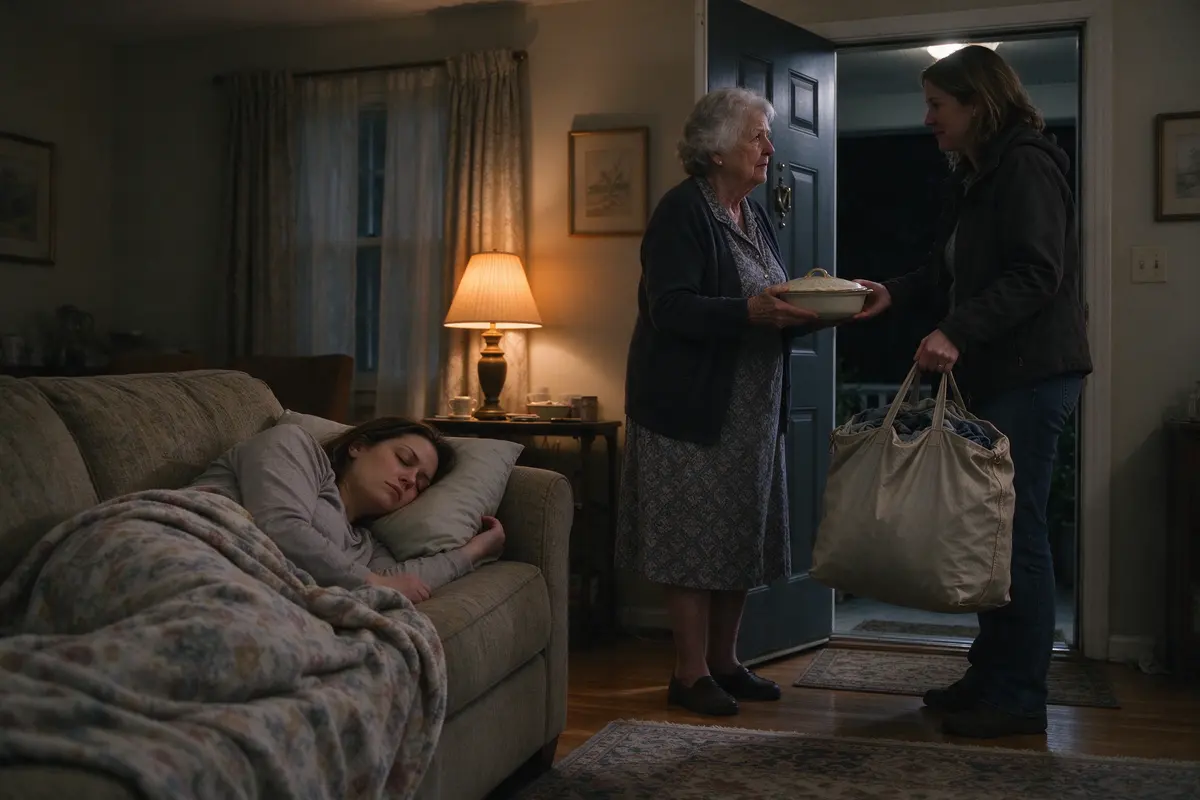
Accept specific help. "Let me know if you need anything" is kind and useless; "Can you bring dinner Thursday and take the laundry home?" works. Meals, laundry, and a stroller walk while you nap: ask for those first.
If you're the partner: check in with yourself too. In a meta-analysis of 43 studies, about 10% of fathers had depression during pregnancy or the year after birth, with higher rates 3 to 6 months after birth (Paulson & Bazemore, 2010). If you're not okay, say so. Call or text 988 any time (CDC).
Sources
- Center on the Developing Child at Harvard University. "Serve and Return." https://developingchild.harvard.edu/key-concept/serve-and-return/
- Erlandsson K, et al. "Skin-to-skin care with the father after cesarean birth and its effect on newborn crying and prefeeding behavior." Birth, 2007. https://pubmed.ncbi.nlm.nih.gov/17542814/
- Yogman M, Garfield CF. "Fathers' Roles in the Care and Development of Their Children: The Role of Pediatricians." Pediatrics, 2016. https://pubmed.ncbi.nlm.nih.gov/27296867/
- Nemours KidsHealth. "When Can I Take My Newborn Out in Public?" Reviewed 2024. https://kidshealth.org/en/parents/newborn-out.html
- American Academy of Pediatrics. "How to Cocoon a Newborn: Family & Friends Can Protect Baby From Germs." HealthyChildren.org. https://www.healthychildren.org/English/safety-prevention/immunizations/Pages/How-to-Cocoon-a-Newborn-Only-an-E-Mail-Away.aspx
- American Academy of Pediatrics. "How Your Newborn Looks." HealthyChildren.org. https://www.healthychildren.org/English/ages-stages/baby/Pages/How-Your-Newborn-Looks.aspx
- American Academy of Pediatrics. "Responding to Your Baby's Cries." HealthyChildren.org. https://www.healthychildren.org/English/ages-stages/baby/crying-colic/Pages/Responding-to-Your-Babys-Cries.aspx
- American Academy of Pediatrics. "Baby's Vision Development." HealthyChildren.org. https://www.healthychildren.org/English/ages-stages/baby/Pages/Babys-Vision-Development.aspx
- Klass P, et al. "Literacy Promotion: An Essential Component of Primary Care Pediatric Practice: Policy Statement." Pediatrics, 2024. https://pubmed.ncbi.nlm.nih.gov/39342414/
- American Academy of Pediatrics. "Newborn Appearance Questions" (symptom checker). HealthyChildren.org. https://www.healthychildren.org/English/tips-tools/symptom-checker/Pages/symptomviewer.aspx?symptom=Newborn+Appearance+Questions
- American Academy of Pediatrics. "What is Cradle Cap?" HealthyChildren.org. https://www.healthychildren.org/English/ages-stages/baby/bathing-skin-care/Pages/Cradle-Cap.aspx
- American Academy of Pediatrics. "Newborn Rashes and Birthmarks" (symptom checker). HealthyChildren.org. https://www.healthychildren.org/English/tips-tools/symptom-checker/Pages/symptomviewer.aspx?symptom=Newborn+Rashes+and+Birthmarks
- American Academy of Pediatrics. "Fever and Your Baby." HealthyChildren.org. https://www.healthychildren.org/English/health-issues/conditions/fever/Pages/Fever-and-Your-Baby.aspx
- Paulson JF, Bazemore SD. "Prenatal and postpartum depression in fathers and its association with maternal depression: a meta-analysis." JAMA, 2010. https://pubmed.ncbi.nlm.nih.gov/20483973/
- Centers for Disease Control and Prevention. "Symptoms of Depression Among Women." 2024. https://www.cdc.gov/reproductive-health/depression/index.html
This guide is general education that summarizes published research and guidance from groups like the American Academy of Pediatrics, the CDC, and the WHO. It isn’t medical advice, and every child develops on their own timeline. Your pediatrician knows your child; if something feels wrong, call them. In an emergency, call 911.
Get each day’s note the morning it applies
Add your baby to a free Chorevia household with their date of birth, and every morning for 60 days the day’s note arrives in the app and by email: what’s developing, one thing to try, what to watch for, and a word for you.
Create your household