Day 8 of 60 · Week 2
Reflexes
Last reviewed · 3 min read · 11 sources · Plain-text version
The five built-in reflexes your newborn arrived with, what each one is for, when it fades, and two small games that use them.

Put a finger in your baby's palm and they'll grab it. Stroke a cheek and they'll turn toward it. None of that is learned yet. Today is about the reflexes your baby was born with, and what they're for.
Heart
That grip around your finger is a reflex, and it still does something to you. It's fine to let it. What's being built is the habit of noticing them, and of being noticed back. Everyday back-and-forth moments like that help build neural connections (Harvard Center on the Developing Child).
Head
Five reflexes to spot this week (AAP):
- Rooting: turns toward a touch on the cheek to find the nipple. Fades around 4 months.
- Sucking: starts automatically when a nipple is deep in the mouth.
- Moro (startle): flings out arms and legs at a loud sound or sudden movement, then pulls them in. Fades around 2 months.
- Grasp: grips a finger placed in the palm. Fades around 5 to 6 months.
- Stepping: "steps" when held upright with feet on a flat surface. Fades around 2 months.
Body
Beyond the reflexes, expect jerky arm movements, tight fists, hands drifting to the mouth, and a head that flops without support (AAP). Keep the head well supported whenever you lift or carry them.
Try today
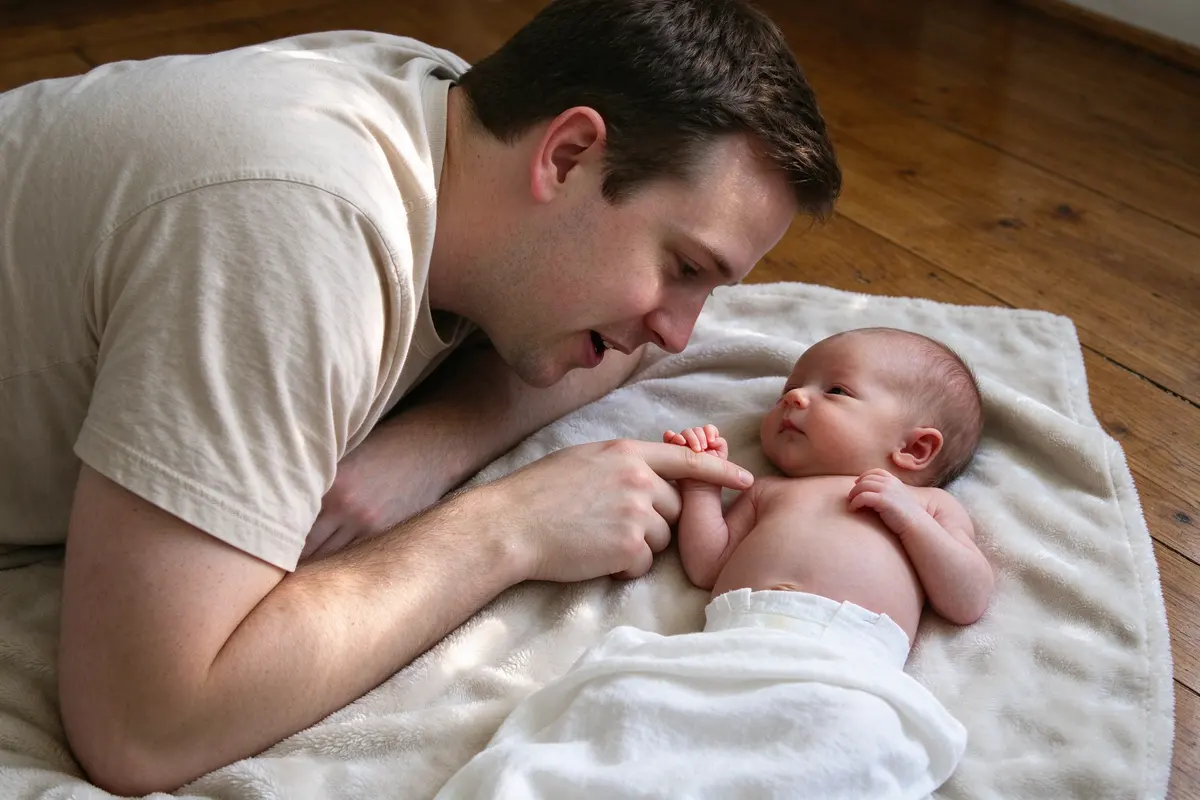
The finger-grip game
Time: A minute, when your baby is calm and alert
Lay your baby on their back on a soft towel or blanket.
Gently open one palm and rest your finger across it; wait for the grip, a reflex newborns are born with (AAP).
Say what's happening: "You've got my finger." Then try the other hand.
Side-lying play, first try
Time: A few minutes at a time during awake play · Side-lying play in the guide
Lay your baby on their side on a blanket on the floor while they're awake.
If they roll onto their back, tuck a rolled-up towel behind them for support (AAP).
Lie down facing them so they can see your face and their own hands.
After a few minutes, switch to the other side.
Make it work:Side-lying is for awake play only, with you right there. For sleep, always on their back on a bare, flat surface, towel put away (AAP).
Watch for
Normal
tight fists, jerky thrusts, a startle at a bang.
Call 911
if your baby is limp, floppy, or not moving (Nationwide Children's).
Normal
swollen breasts or genitals, sometimes leaking a few drops of milk, from the birthing parent's estrogen; don't squeeze them (AAP).
Call your pediatrician right away
if a swollen breast turns red, streaky, or tender (AAP).
Normal
peeling skin (AAP).
Call right away
about tiny blisters, purple or blood-colored spots, infected-looking skin, or a rash with a fever (AAP).
For you

Your body is doing a lot of lifting, holding, and hunching this week. Bend at the knees, not the waist, when you pick things up (AAP). When you feed, get your back against something and your arms resting on a cushion before the baby latches, not after. Change which side you carry on.
Some aches are not just aches. Seek care immediately for severe swelling, redness, or pain in a leg or arm, or for overwhelming tiredness that goes beyond new-parent tired (CDC). After a C-section, walking helps healing and helps prevent clots (MedlinePlus).
If you're the partner: take the floor shift today. Lie down beside the baby for side-lying play while she lies down somewhere else.
Sources
- Center on the Developing Child at Harvard University. "Serve and Return." https://developingchild.harvard.edu/key-concept/serve-and-return/
- American Academy of Pediatrics. "Newborn Reflexes." HealthyChildren.org. https://www.healthychildren.org/English/ages-stages/baby/Pages/newborn-reflexes.aspx
- American Academy of Pediatrics. "Developmental Milestones: 1 Month." HealthyChildren.org. https://www.healthychildren.org/English/ages-stages/baby/Pages/Developmental-Milestones-1-Month.aspx
- American Academy of Pediatrics. "3 Tummy Time Activities to Try With Your Baby." HealthyChildren.org. https://www.healthychildren.org/English/ages-stages/baby/sleep/Pages/The-Importance-of-Tummy-Time.aspx
- Nationwide Children's Hospital. "Newborn Warning Signs." https://www.nationwidechildrens.org/conditions/health-library/newborn-warning-signs
- American Academy of Pediatrics. "How Your Newborn Looks." HealthyChildren.org. https://www.healthychildren.org/English/ages-stages/baby/Pages/How-Your-Newborn-Looks.aspx
- American Academy of Pediatrics. "Newborn Appearance Questions" (symptom checker). HealthyChildren.org. https://www.healthychildren.org/English/tips-tools/symptom-checker/Pages/symptomviewer.aspx?symptom=Newborn+Appearance+Questions
- American Academy of Pediatrics. "Newborn Rashes and Birthmarks" (symptom checker). HealthyChildren.org. https://www.healthychildren.org/English/tips-tools/symptom-checker/Pages/symptomviewer.aspx?symptom=Newborn+Rashes+and+Birthmarks
- American Academy of Pediatrics. "Baby Carriers: Backpacks, Front Packs & Slings." HealthyChildren.org. https://www.healthychildren.org/English/safety-prevention/on-the-go/Pages/Baby-Carriers.aspx
- Centers for Disease Control and Prevention. "Urgent Maternal Warning Signs and Symptoms." HEAR HER campaign. https://www.cdc.gov/hearher/maternal-warning-signs/index.html
- MedlinePlus. "Going home after a C-section." National Library of Medicine. https://medlineplus.gov/ency/patientinstructions/000624.htm
This guide is general education that summarizes published research and guidance from groups like the American Academy of Pediatrics, the CDC, and the WHO. It isn’t medical advice, and every child develops on their own timeline. Your pediatrician knows your child; if something feels wrong, call them. In an emergency, call 911.
Get each day’s note the morning it applies
Add your baby to a free Chorevia household with their date of birth, and every morning for 60 days the day’s note arrives in the app and by email: what’s developing, one thing to try, what to watch for, and a word for you.
Create your household