Day 28 of 60 · Week 4
Four weeks
Last reviewed · 3 min read · 13 sources · Plain-text version
The 1-month checkup is close: what it covers, the depression screen you'll be asked, the questions to bring, and a gentle look at what your baby can do.
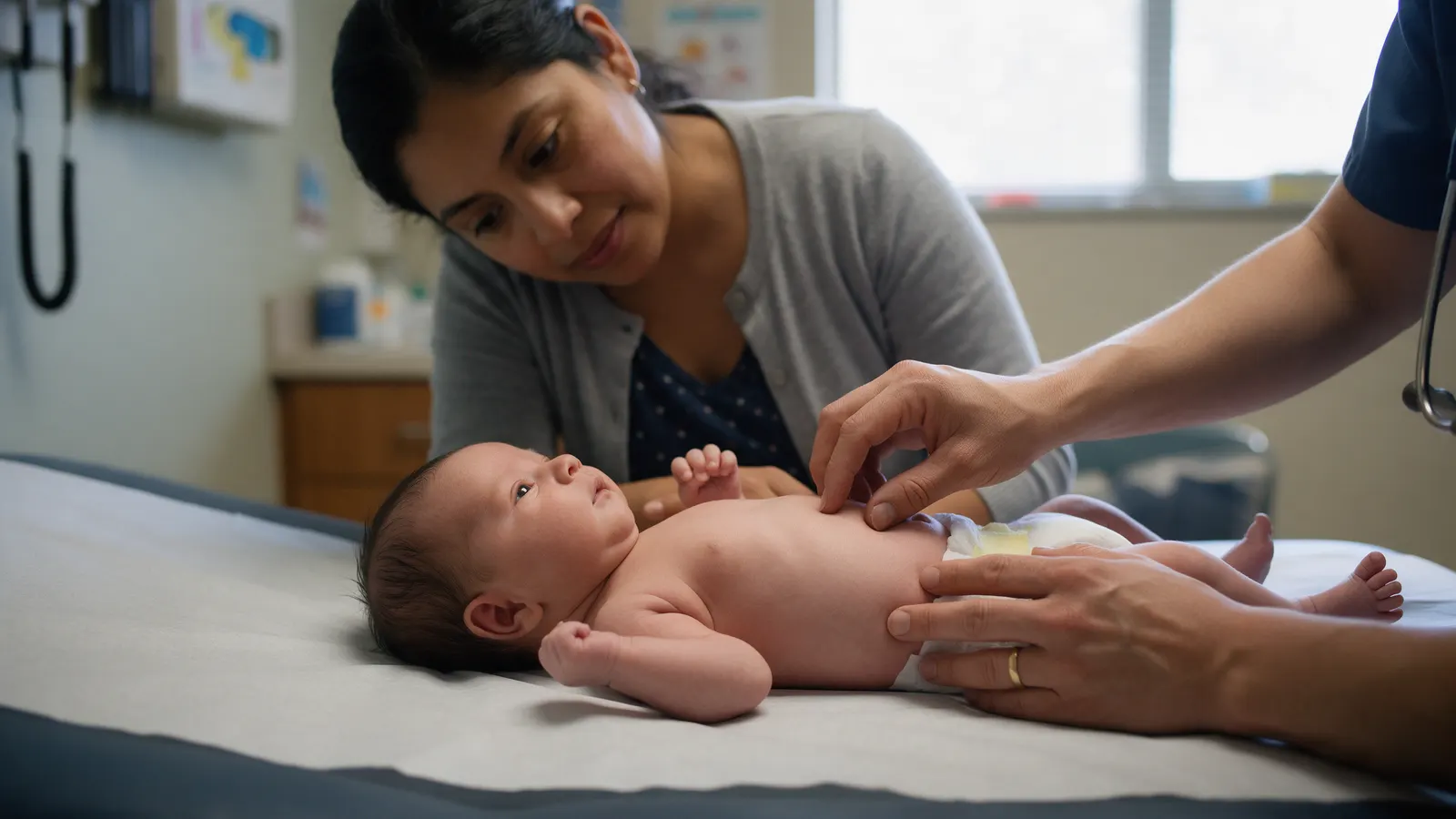
Four weeks. The 1-month checkup is on the calendar, or should be. Today: what happens there, including the part about you, and a low-stakes look at what your baby can do now.
Heart
This visit includes you by design. The AAP and Bright Futures schedule lists, for the 1-month visit, growth, feeding, development, and a depression screen for the birthing parent (AAP, 2025). The AAP recommends that pediatricians screen mothers at the 1-, 2-, 4-, and 6-month visits because perinatal depression can be treated effectively (Earls et al., 2019). The questions aren't a test of you as a mother. They're how the help finds you.
Head
What else to expect: immunizations are reviewed at each visit. The AAP recommends a first dose of hepatitis B vaccine within 24 hours of birth, with different timing for some very small preterm babies (AAP). Ask your pediatrician which shots your baby needs.
Every baby should have had a hearing screen by 1 month (CDC). If yours didn't pass, they need a full test by an audiologist before 3 months of age (CDC); bring it up. Then bring your running list of questions. The 3 a.m. ones count.
Body
By about one month, many babies have jerky arm movements, tight fists, hands that drift to the mouth, and a head that flops without support; on the tummy they may turn their head side to side (AAP). They react to loud sounds, may look or turn toward familiar voices, and prefer the human face (AAP). True social smiles usually arrive in the second month (AAP), so don't worry if they haven't yet.
Try today

A "what we can do now" look
Time: A few minutes, when your baby is alert · What's developing in the guide
Lay your baby tummy-down on your chest and watch whether they turn their head from side to side (AAP).
Put a finger in their palm and feel the grip (AAP).
From one side, say their name softly, then wait several seconds (Muir & Field, 1979).
Jot down what you saw, and anything you wondered about, for the visit.
Make it work:This isn't a test, and no baby does everything on cue. Every baby is different; your pediatrician's read beats any chart.
Watch for
Normal
jerky arms, a wobbly head, and hands in fists.
Call 911
if your baby is limp, floppy, or not moving (Nationwide Children's).
Normal
a baby who passed the hearing screen and startles at the vacuum.
Book the full hearing test before 3 months
if your baby didn't pass the screen; if hearing loss is found, starting support before 6 months helps babies communicate better (CDC).
Normal
a worry you can't quite name.
Call anyway
if your baby just doesn't seem right to you. Trust your instincts (Lurie Children's).
For you
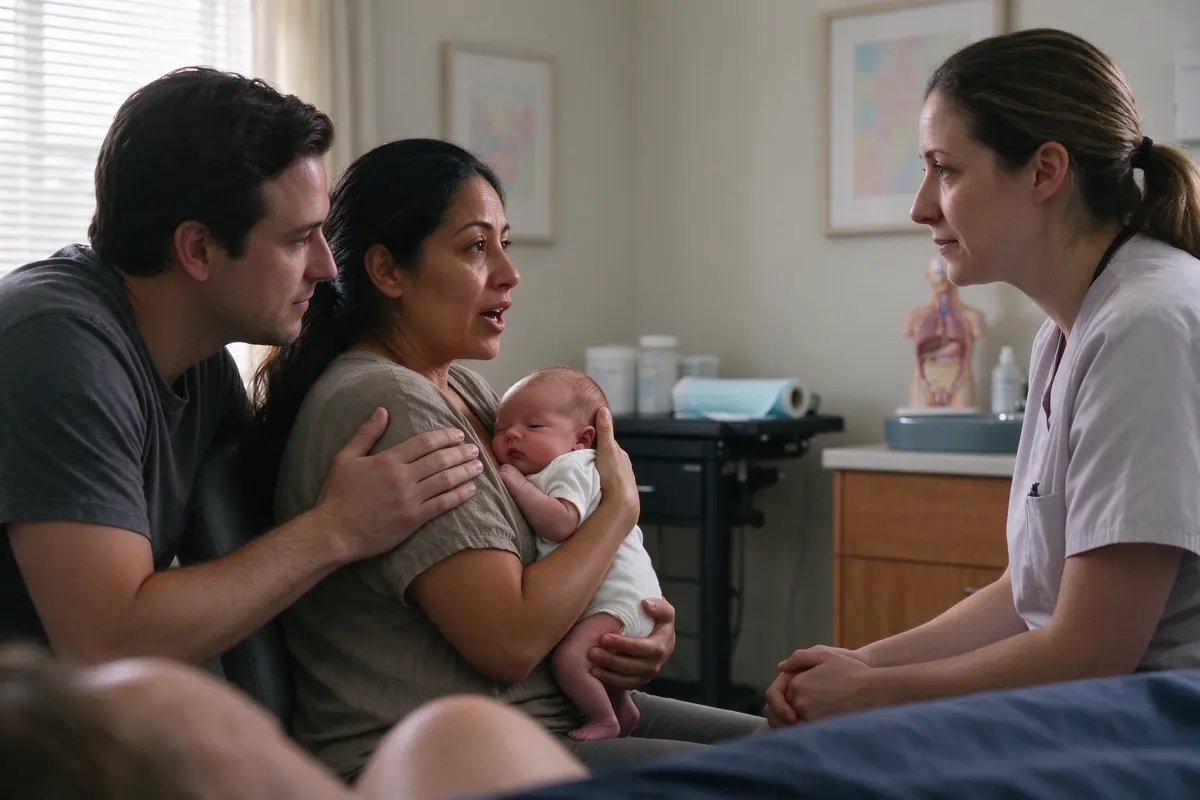
Answer the screen honestly. If it helps, have a sentence ready: "I'm not sleeping even when the baby sleeps, and I feel numb. Is that normal?" (Earls et al., 2019). About 1 in 8 women report symptoms of postpartum depression after a birth (CDC), and feelings that are severe or last longer than 2 weeks may be postpartum depression rather than the blues (NIMH). Saying so at this visit is the fastest route to feeling better.
You don't have to wait for the appointment. Call or text the National Maternal Mental Health Hotline at 1-833-TLC-MAMA (1-833-852-6262), or call or text 988 (CDC).
If you're the partner: the screen is for the birthing parent, but you're in the room. If she's been honest and you've seen more than she said, say it kindly. And tell the pediatrician how you're doing too.
Sources
- American Academy of Pediatrics and Bright Futures. "Recommendations for Preventive Pediatric Health Care" (Periodicity Schedule). 2025. https://downloads.aap.org/AAP/PDF/periodicity_schedule.pdf
- Earls MF, et al. "Incorporating Recognition and Management of Perinatal Depression Into Pediatric Practice." Pediatrics, 2019. https://pubmed.ncbi.nlm.nih.gov/30559120/
- American Academy of Pediatrics. "AAP Immunization FAQs." AAP.org. https://www.aap.org/en/patient-care/immunizations/aap-immunization-faq/
- Centers for Disease Control and Prevention. "Hearing Loss in Children: Screening." 2024. https://www.cdc.gov/hearing-loss-children/screening/index.html
- Centers for Disease Control and Prevention. "Newborn Hearing Screening." 2024. https://www.cdc.gov/hearing-loss-children-guide/parents-guide/newborn-hearing-screening.html
- American Academy of Pediatrics. "Developmental Milestones: 1 Month." HealthyChildren.org. https://www.healthychildren.org/English/ages-stages/baby/Pages/Developmental-Milestones-1-Month.aspx
- American Academy of Pediatrics. "Emotional and Social Development: Birth to 3 Months." HealthyChildren.org. https://www.healthychildren.org/English/ages-stages/baby/Pages/Emotional-and-Social-Development-Birth-to-3-Months.aspx
- American Academy of Pediatrics. "Newborn Reflexes." HealthyChildren.org. https://www.healthychildren.org/English/ages-stages/baby/Pages/newborn-reflexes.aspx
- Muir D, Field J. "Newborn infants orient to sounds." Child Development, 1979. https://pubmed.ncbi.nlm.nih.gov/487883/
- Nationwide Children's Hospital. "Newborn Warning Signs." https://www.nationwidechildrens.org/conditions/health-library/newborn-warning-signs
- Lurie Children's Hospital of Chicago. "When to Call the Pediatrician for Your Newborn." 2022. https://www.luriechildrens.org/en/blog/when-to-call-the-pediatrician-for-your-newborn/
- Centers for Disease Control and Prevention. "Symptoms of Depression Among Women." 2024. https://www.cdc.gov/reproductive-health/depression/index.html
- National Institute of Mental Health. "Perinatal Depression." 2023. https://www.nimh.nih.gov/health/publications/perinatal-depression
This guide is general education that summarizes published research and guidance from groups like the American Academy of Pediatrics, the CDC, and the WHO. It isn’t medical advice, and every child develops on their own timeline. Your pediatrician knows your child; if something feels wrong, call them. In an emergency, call 911.
Get each day’s note the morning it applies
Add your baby to a free Chorevia household with their date of birth, and every morning for 60 days the day’s note arrives in the app and by email: what’s developing, one thing to try, what to watch for, and a word for you.
Create your household