Day 17 of 60 · Week 3
Touch
Last reviewed · 3 min read · 14 sources · Plain-text version
Skin-to-skin at home, done safely, and why it's the partner's turn today: what a small trial of fathers found, and the split-night script.

Today is about skin, yours and theirs. And it's the partner's turn.
Heart
Partners count. In a small trial of 29 fathers after cesarean births, babies held skin-to-skin cried less and calmed sooner than babies in a cot (Erlandsson et al., 2007). Newborns prefer soft touch (AAP), and a touch is one way to answer a baby's gaze or coo; those exchanges help build neural connections (Harvard Center on the Developing Child).
Head
The strongest evidence for skin-to-skin is for the hours right after birth: a 2025 Cochrane review of 69 trials (7,290 mother-baby pairs) found that immediate or early skin-to-skin contact probably increases exclusive breastfeeding and raises babies' blood sugar, with moderate certainty (Moore et al., 2025). Skin-to-skin at home in the weeks after is much less studied. What you have is a free way to be close. That's enough.
Body
How to do it safely: lay your diaper-only baby on your bare chest under a blanket. Keep their face visible and nose and mouth uncovered, head turned to one side, with the blanket below the ears (Feldman-Winter & Goldsmith, 2016). Do it while you're awake; if you get drowsy, move your baby to their back in their own sleep space.
A finger laid in the palm gets gripped, the grasp reflex, which fades around 5 to 6 months (AAP). Holding your baby won't spoil them; responding to their signals is how they learn to trust you (AAP).
Try today
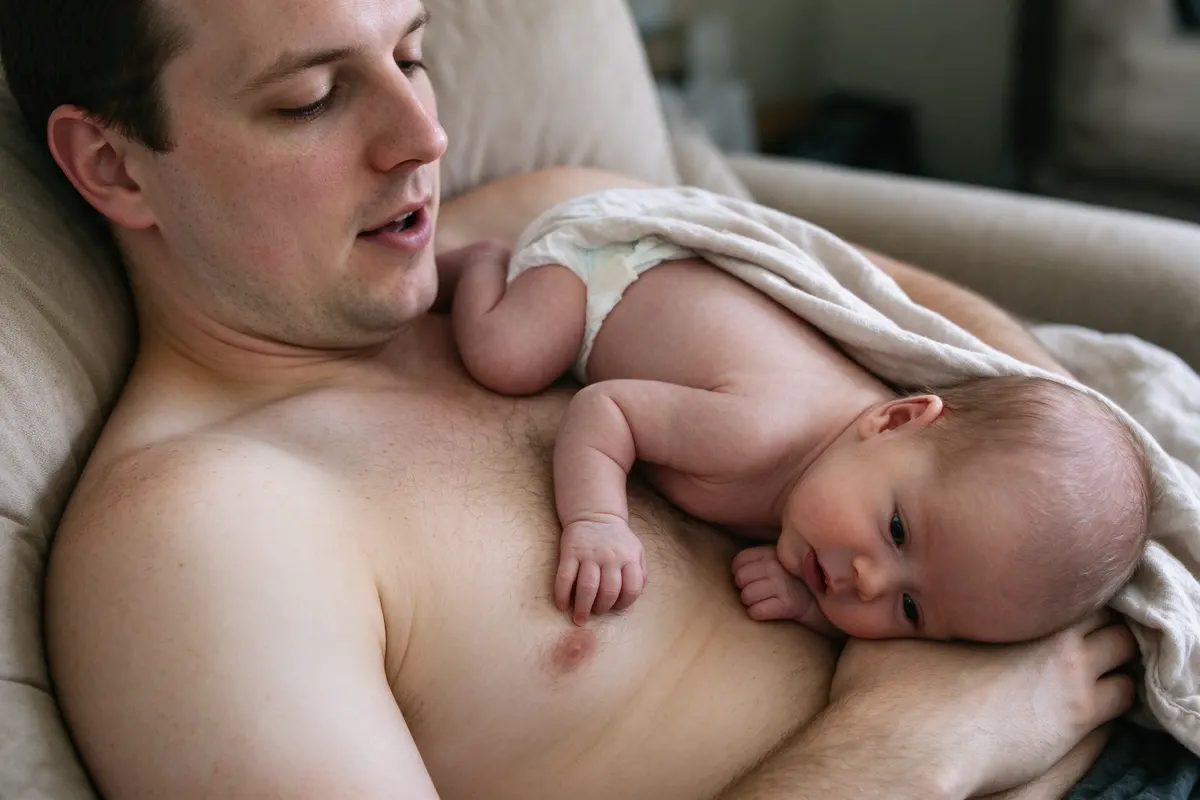
Skin-to-skin, the partner's turn
Time: As long as you're both comfortable and you're wide awake · Skin-to-skin snuggles in the guide
Partner: shirt off, sit propped up somewhere you won't nod off.
Undress the baby to the diaper and lay them tummy-down on your chest, head to one side.
Cover their back with a blanket, kept below the ears, face visible, nose and mouth uncovered (Feldman-Winter & Goldsmith, 2016).
Breathe slowly, talk or hum. Let the other parent sleep.
Drowsy? Baby goes on their back in their own sleep space.
Make it work:Your chest works too (Erlandsson et al., 2007). If the baby falls asleep on you and you're wide awake, that's fine; the bassinet is for when you aren't.
Watch for
Normal
a baby who's warm against your chest. Watch for sweating, a hot chest, or flushed skin, which mean too many layers; one more than you'd wear is the rule (AAP).
Call your pediatrician immediately
for a rectal temperature of 100.4°F (38°C) or higher (AAP).
Normal
a soft spot that looks flat or a little sunken and may pulse with each heartbeat; touching it gently is safe (AAP).
Call your pediatrician right away
for a bulging soft spot, or a deeply sunken one in a baby who isn't acting well (AAP).
Normal
a stool pattern that starts to change after the first few weeks.
Call your pediatrician right away
if fewer stools come with poor feeding or fewer wet diapers (AAP).
For you

If you're the partner, today's note is mostly yours. The AAP urges pediatricians to support fathers' involvement (Yogman & Garfield, 2016), and involvement is concrete: split the night so each adult gets one longer stretch of sleep, and own diapers, burping, and settling after feeds. The script: "I've got everything until 2 a.m. You sleep. Then we switch."
For the mother: when the baby is on someone else's chest, go to sleep. Not the dishes. Rest isn't the reward for finishing the list; it's how the list gets done.
Tell each other how you're doing. Partners get low too; in a meta-analysis of 43 studies, about 10% of fathers had depression during pregnancy or the year after birth (Paulson & Bazemore, 2010).
Sources
- Erlandsson K, Dsilna A, Fagerberg I, Christensson K. "Skin-to-skin care with the father after cesarean birth and its effect on newborn crying and prefeeding behavior." Birth, 2007. https://pubmed.ncbi.nlm.nih.gov/17542814/
- American Academy of Pediatrics. "Developmental Milestones at 1 Month Old." HealthyChildren.org, 2026. https://www.healthychildren.org/English/ages-stages/baby/Pages/Developmental-Milestones-1-Month.aspx
- Center on the Developing Child at Harvard University. "Serve and Return." https://developingchild.harvard.edu/key-concept/serve-and-return/
- Moore ER, Brimdyr K, Blair A, et al. "Immediate or early skin-to-skin contact for mothers and their healthy newborn infants." Cochrane Database of Systematic Reviews, 2025. https://pubmed.ncbi.nlm.nih.gov/41120189/
- Feldman-Winter L, Goldsmith JP; AAP Committee on Fetus and Newborn, Task Force on Sudden Infant Death Syndrome. "Safe Sleep and Skin-to-Skin Care in the Neonatal Period for Healthy Term Newborns." Pediatrics, 2016. https://pubmed.ncbi.nlm.nih.gov/27550975/
- American Academy of Pediatrics. "Newborn Reflexes." HealthyChildren.org, 2022. https://www.healthychildren.org/English/ages-stages/baby/Pages/newborn-reflexes.aspx
- American Academy of Pediatrics. "Emotional & Social Development in Babies: Birth Through 3 Months." HealthyChildren.org, 2026. https://www.healthychildren.org/English/ages-stages/baby/Pages/Emotional-and-Social-Development-Birth-to-3-Months.aspx
- Moon RY. "How to Keep Your Sleeping Baby Safe: AAP Policy Explained." HealthyChildren.org, 2026. https://www.healthychildren.org/English/ages-stages/baby/sleep/Pages/a-parents-guide-to-safe-sleep.aspx
- American Academy of Pediatrics. "Fever and Your Baby." HealthyChildren.org, 2025. https://www.healthychildren.org/English/health-issues/conditions/fever/Pages/Fever-and-Your-Baby.aspx
- American Academy of Pediatrics. "How Your Newborn Looks." HealthyChildren.org, 2021. https://www.healthychildren.org/English/ages-stages/baby/Pages/How-Your-Newborn-Looks.aspx
- American Academy of Pediatrics. "Newborn Appearance Questions" (symptom checker). HealthyChildren.org, 2026. https://www.healthychildren.org/English/tips-tools/symptom-checker/Pages/symptomviewer.aspx?symptom=Newborn+Appearance+Questions
- American Academy of Pediatrics. "Baby's First Days: Bowel Movements & Urination." HealthyChildren.org, 2024. https://www.healthychildren.org/English/ages-stages/baby/Pages/babys-first-days-bowel-movements-and-urination.aspx
- Yogman M, Garfield CF; AAP Committee on Psychosocial Aspects of Child and Family Health. "Fathers' Roles in the Care and Development of Their Children: The Role of Pediatricians." Pediatrics, 2016. https://pubmed.ncbi.nlm.nih.gov/27296867/
- Paulson JF, Bazemore SD. "Prenatal and postpartum depression in fathers and its association with maternal depression: a meta-analysis." JAMA, 2010. https://pubmed.ncbi.nlm.nih.gov/20483973/
This guide is general education that summarizes published research and guidance from groups like the American Academy of Pediatrics, the CDC, and the WHO. It isn’t medical advice, and every child develops on their own timeline. Your pediatrician knows your child; if something feels wrong, call them. In an emergency, call 911.
Get each day’s note the morning it applies
Add your baby to a free Chorevia household with their date of birth, and every morning for 60 days the day’s note arrives in the app and by email: what’s developing, one thing to try, what to watch for, and a word for you.
Create your household