Day 6 of 60 · Week 1
What your baby sees
Last reviewed · 3 min read · 12 sources · Plain-text version
How far your newborn can focus, why your face beats any toy, and what wandering eyes mean right now. Plus the visitor rules.
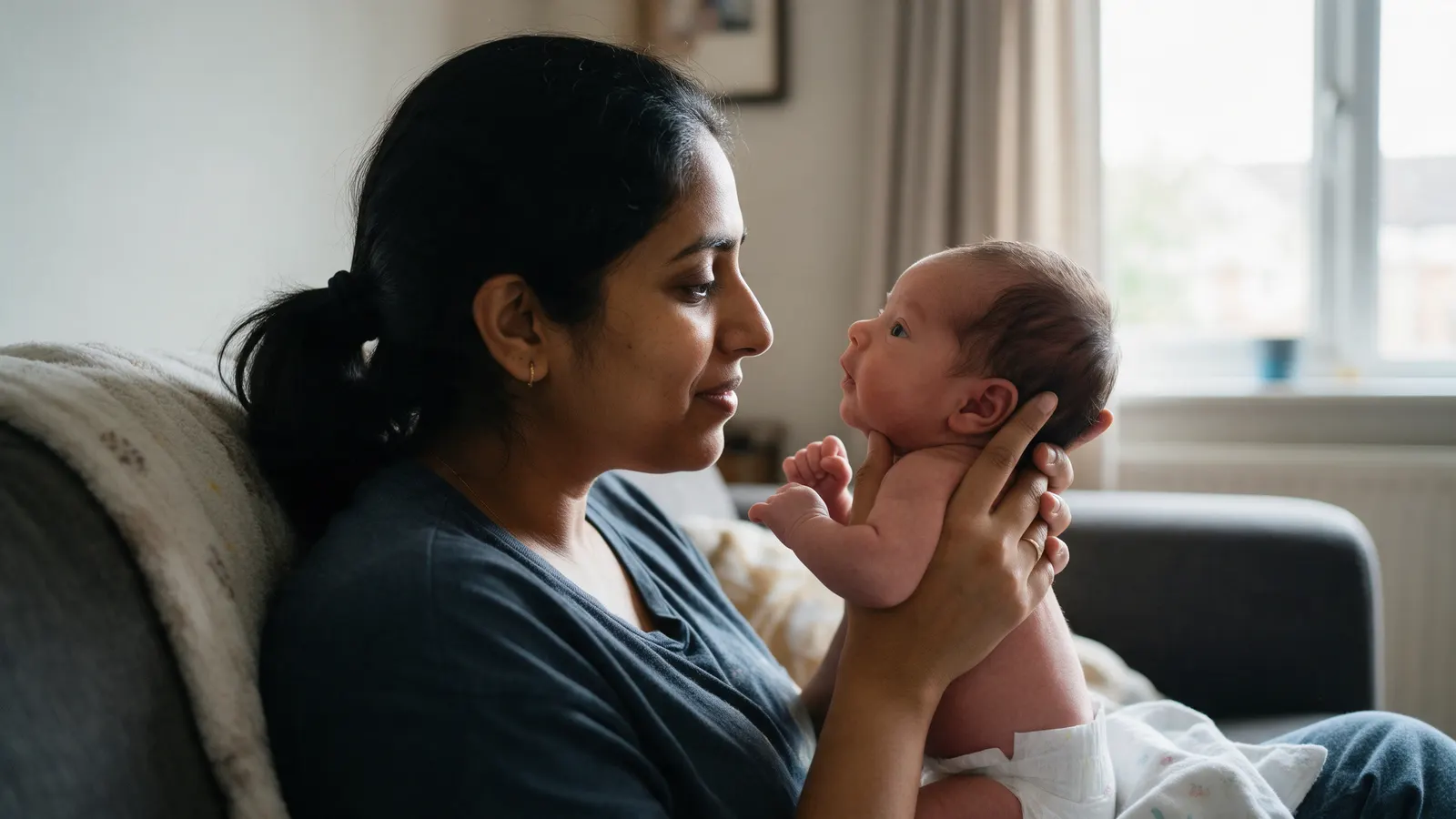
Your baby's world is small and blurry, and you're the sharpest thing in it. Today is about what they can see, and what they'd rather look at than anything else.
Heart
Within an hour of birth, newborns followed a moving face-like pattern farther than scrambled versions; the preference faded during the second month (Johnson et al., 1991). Babies come primed for faces, and this month yours is the one in range. No mobile, card, or screen competes with it.
Head
Your newborn sees best at 8 to 12 inches, about the distance to your face during a feed (AAP). They prefer high-contrast patterns and human faces (AAP). Infants under 5 days old looked longer at black-and-white patterns than at plain colored surfaces (Fantz, 1963).
That's a preference, not proof that special products make babies smarter. A striped shirt and your face cover it.
Body
Try today

Follow my face
Time: A minute or two when your baby is alert · Follow my face in the guide
Hold your baby facing you, about 8 to 12 inches away.
Catch their gaze, then slowly move your face a little to one side.
Pause and watch whether their eyes or head follow.
Come back to center, then try the other side.
Make it work:Go slowly and stop after a few tries. If they look away, they're done; looking away or fussing means "done for now" (Harvard Center on the Developing Child).
Watch for
Normal
eyes that drift or cross now and then.
Tell your pediatrician
if your baby isn't following a moving object by 3 months (AAP).
Normal
a startle at loud noises (AAP).
Mention any worry about hearing
at checkups, since hearing loss can also show up later (CDC).
Normal
green stools on their own (AAP).
Call your pediatrician
about red poop, or black poop after the first few days, which can mean blood (AAP).
For you
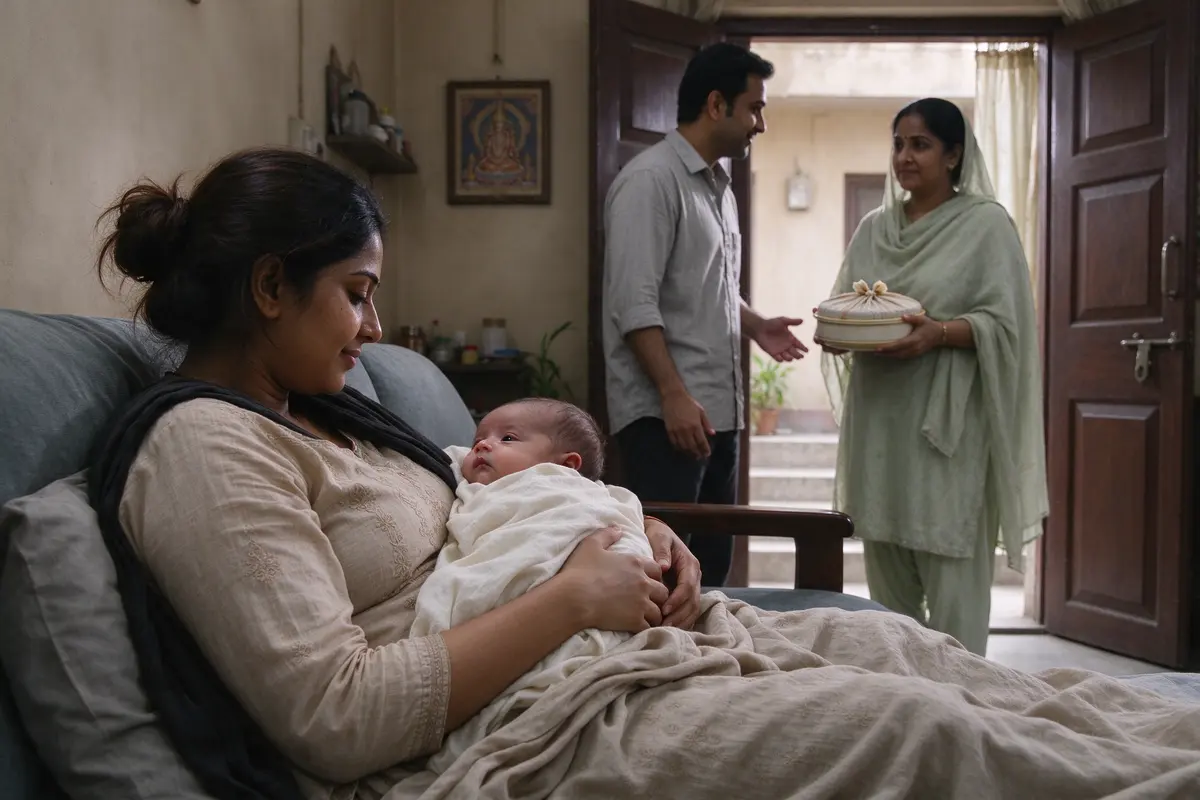
Visitors will want to see those eyes. The rules: anyone who holds your baby washes their hands first and stays away while sick (KidsHealth; AAP). The AAP also suggests relatives be up to date on vaccines, with Tdap finished at least 2 weeks before visiting (AAP). It's fine to say "not this week." It's fine to say it twice.
Your own eyes matter too. Changes in vision, along with a headache that won't go away or swelling of the hands or face, are urgent maternal warning signs: seek care immediately (CDC).
If you're the partner: be the one who says no at the door, so she doesn't have to.
Sources
- Johnson MH, et al. "Newborns' preferential tracking of face-like stimuli and its subsequent decline." Cognition, 1991. https://pubmed.ncbi.nlm.nih.gov/1786670/
- American Academy of Pediatrics. "Baby's Vision Development." HealthyChildren.org. https://www.healthychildren.org/English/ages-stages/baby/Pages/Babys-Vision-Development.aspx
- American Academy of Pediatrics. "Developmental Milestones: 1 Month." HealthyChildren.org. https://www.healthychildren.org/English/ages-stages/baby/Pages/Developmental-Milestones-1-Month.aspx
- Fantz RL. "Pattern Vision in Newborn Infants." Science, 1963. https://pubmed.ncbi.nlm.nih.gov/17788054/
- Center on the Developing Child at Harvard University. "5 Steps for Brain-Building Serve and Return." 2019. https://developingchild.harvard.edu/wp-content/uploads/2024/10/HCDC_ServeReturn_for_Parents_Caregivers_2019.pdf
- American Academy of Pediatrics. "Newborn Reflexes." HealthyChildren.org. https://www.healthychildren.org/English/ages-stages/baby/Pages/newborn-reflexes.aspx
- Centers for Disease Control and Prevention. "Hearing Loss in Children: Screening." 2024. https://www.cdc.gov/hearing-loss-children/screening/index.html
- American Academy of Pediatrics. "Baby's First Days: Bowel Movements & Urination." HealthyChildren.org. https://www.healthychildren.org/English/ages-stages/baby/Pages/babys-first-days-bowel-movements-and-urination.aspx
- Jana L, Shu J. "The Many Colors of Baby Poop." HealthyChildren.org. https://www.healthychildren.org/English/ages-stages/baby/Pages/The-Many-Colors-of-Poop.aspx
- Nemours KidsHealth. "When Can I Take My Newborn Out in Public?" Reviewed 2024. https://kidshealth.org/en/parents/newborn-out.html
- American Academy of Pediatrics Section on Infectious Diseases. "How to Cocoon a Newborn: Family & Friends Can Protect Baby From Germs." HealthyChildren.org. https://www.healthychildren.org/English/safety-prevention/immunizations/Pages/How-to-Cocoon-a-Newborn-Only-an-E-Mail-Away.aspx
- Centers for Disease Control and Prevention. "Urgent Maternal Warning Signs and Symptoms." HEAR HER campaign. https://www.cdc.gov/hearher/maternal-warning-signs/index.html
This guide is general education that summarizes published research and guidance from groups like the American Academy of Pediatrics, the CDC, and the WHO. It isn’t medical advice, and every child develops on their own timeline. Your pediatrician knows your child; if something feels wrong, call them. In an emergency, call 911.
Get each day’s note the morning it applies
Add your baby to a free Chorevia household with their date of birth, and every morning for 60 days the day’s note arrives in the app and by email: what’s developing, one thing to try, what to watch for, and a word for you.
Create your household