Day 24 of 60 · Week 4
Outside
Last reviewed · 3 min read · 15 sources · Plain-text version
A walk is fine whenever you feel up to it. How to dress your baby for the weather, carry them safely, and keep germs and sun away.
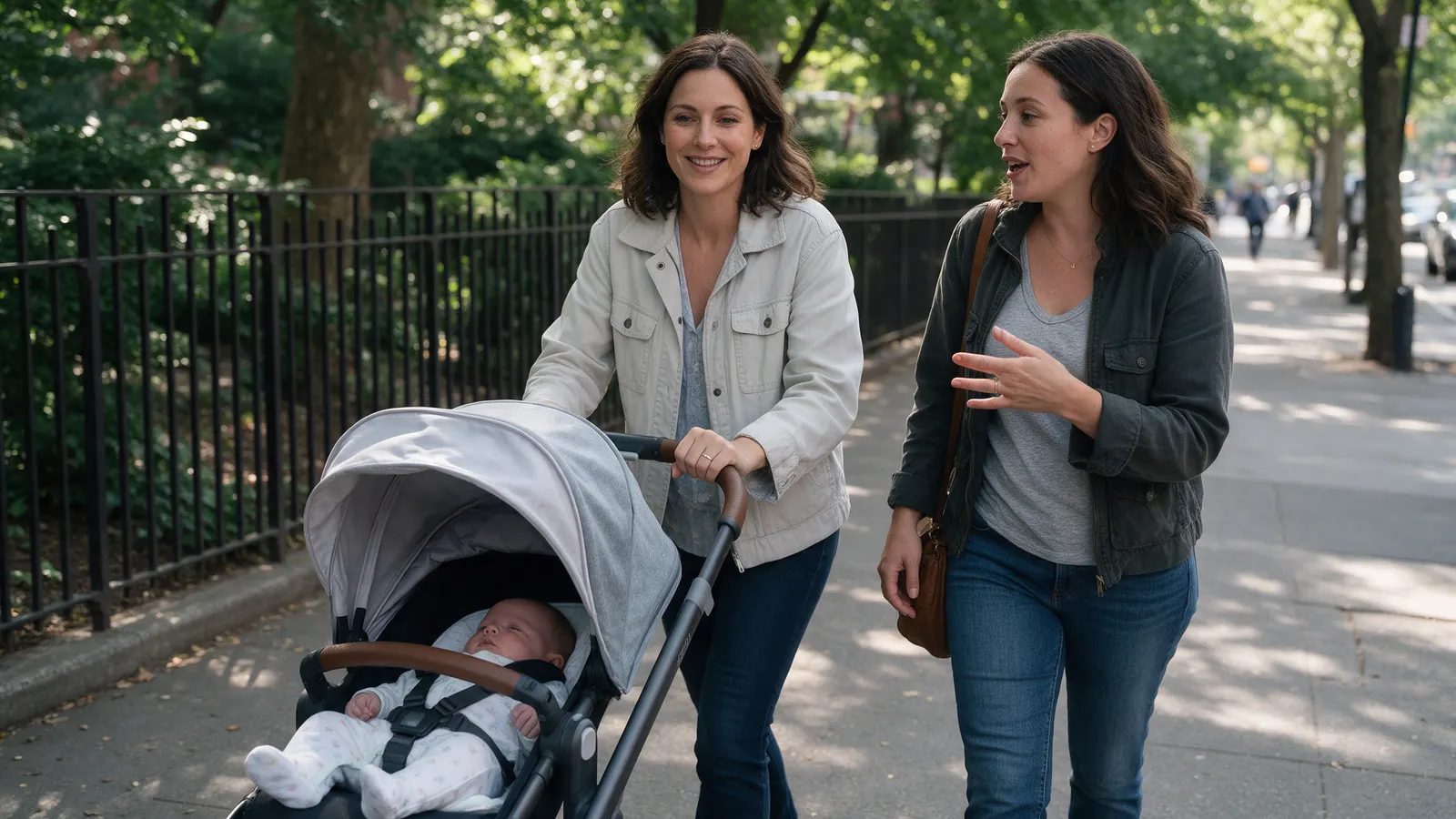
If you haven't been out much, try today. A walk changes your day more than the baby's: air, different walls, a person who isn't a newborn.
Heart
Nobody told you how small the house gets. Hold your baby upright against your chest, walk, and describe what you see; holding more won't spoil them (AAP). Bring a friend if you can.
Head
If the weather is nice, a stroll is fine whenever you feel up to it, though some doctors suggest waiting a few months before crowded places like malls and airplanes (KidsHealth). Anyone who holds your baby washes their hands first and stays away while they're sick (KidsHealth).
Daylight may help too. In a study of 56 babies at 6 to 12 weeks old, those who slept better at night had been exposed to more light in the early afternoon (Harrison, 2004): a link, not proof, in babies older than yours. An early morning or late afternoon walk is free to try (KidsHealth).
Body
Dress your baby in only one more layer than you'd wear to be comfortable, and watch for overheating: sweating, a hot chest, flushed skin (AAP). Keep babies under 6 months out of the sun: a stroller sunshade, lightweight long sleeves and pants, and no outings from 10 a.m. to 4 p.m. (AAP).
In a sling or carrier, keep their face visible, nose and mouth clear, and chin off their chest; bend at the knees to pick things up (AAP). The CPSC urges extra care with slings for babies under 4 months, and says to reposition your baby after nursing so their face is at or above the rim (CPSC). If you drive: rear-facing, back seat, snug harness, chest clip at armpit level, no bulky coat under the straps (AAP).
Try today
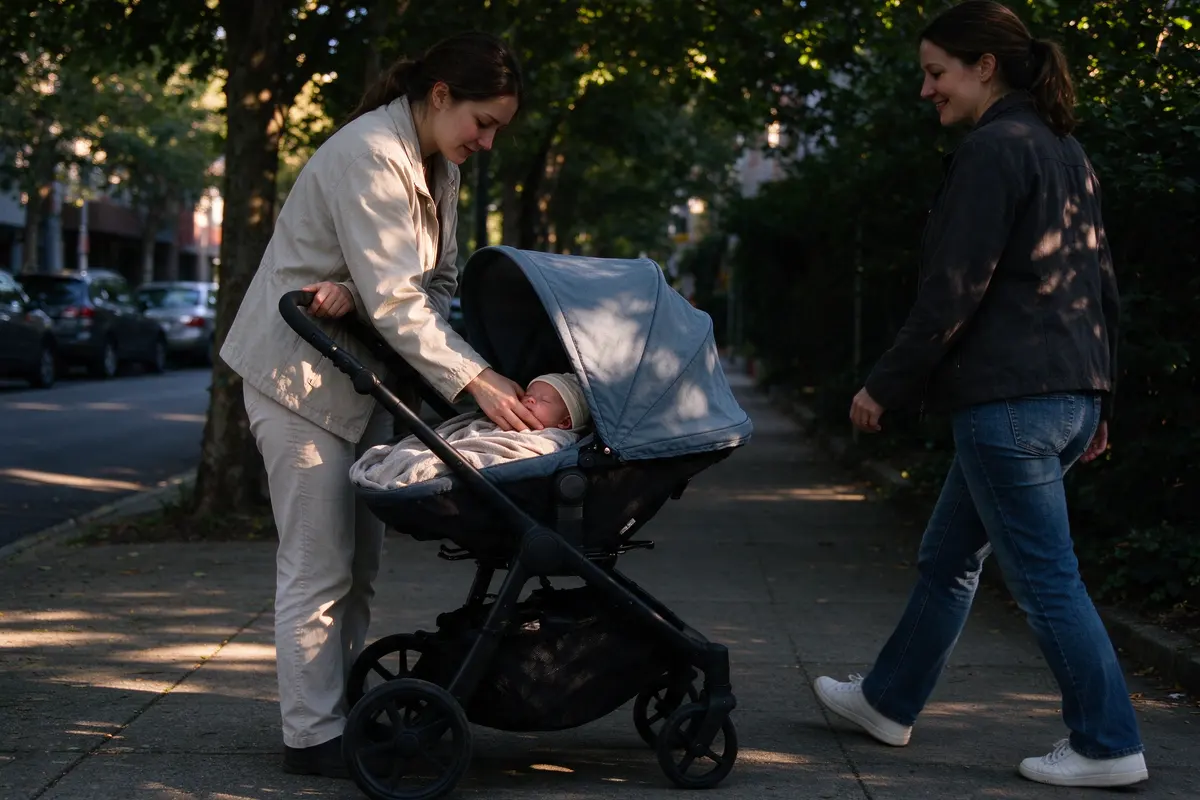
A slow walk with narration
Time: A short stroll, as long as you feel up to it · Bright days, dim nights in the guide
Pick the early morning or late afternoon, and put the sunshade up (AAP).
Dress your baby in one more layer than you're wearing (AAP).
Say what you see: "That's a red door. Wind on your cheeks."
Partway, feel the back of their neck: warm is right, sweaty is too much (NHS).
If they fall asleep on the way, move them to their back on a firm, flat surface as soon as you're home (AAP).
Make it work:Expect slow change: babies don't have regular sleep cycles until about 4 months (AAP).
Watch for
Normal
a baby who feels comfortably warm on the chest or back of the neck after a walk (NHS).
Call your pediatrician right away
if a rectal temperature is below 96.8°F (36.0°C) and doesn't come up with warming (Seattle Children's).
Normal
sneezing, which clears dust, fuzz, smoke, and strong smells and isn't an allergy.
Call your pediatrician
if sneezing comes with fever, trouble breathing, or poor feeding (AAP).
Normal
dozing off in the stroller or carrier, face visible, moved to a flat surface soon after.
Call 911
if your baby is struggling to breathe (Nationwide Children's).
For you
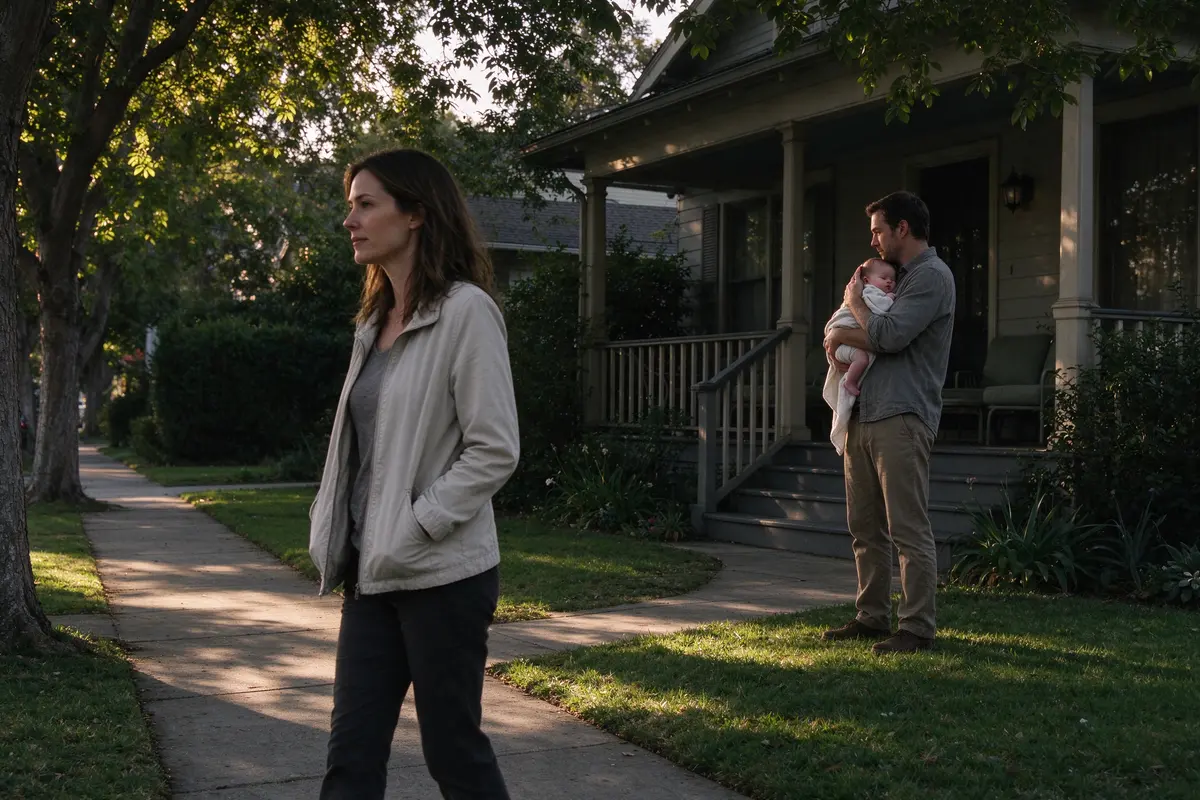
Walking is medicine for you too: after a C-section it helps healing and helps prevent blood clots (MedlinePlus). Driving is different: not for at least 2 weeks after a C-section, and never on narcotic pain medicine (MedlinePlus).
Seek care right away for severe swelling, redness, or pain in a leg or arm, trouble breathing, or chest pain, and tell any provider that you gave birth within the last year (CDC).
Pick a route you like and a friend who walks slowly. If you're the partner: come along, or take the baby so she can walk alone.
Sources
- American Academy of Pediatrics. "Responding to Your Baby's Cries." HealthyChildren.org. https://www.healthychildren.org/English/ages-stages/baby/crying-colic/Pages/Responding-to-Your-Babys-Cries.aspx
- Nemours KidsHealth. "When Can I Take My Newborn Out in Public?" Reviewed 2024. https://kidshealth.org/en/parents/newborn-out.html
- Harrison Y. "The relationship between daytime exposure to light and night-time sleep in 6-12-week-old infants." Journal of Sleep Research, 2004. https://pubmed.ncbi.nlm.nih.gov/15560769/
- Moon RY. "How to Keep Your Sleeping Baby Safe: AAP Policy Explained." HealthyChildren.org. https://www.healthychildren.org/English/ages-stages/baby/sleep/Pages/a-parents-guide-to-safe-sleep.aspx
- American Academy of Pediatrics. "Baby Sunburn Prevention Tips." HealthyChildren.org. https://www.healthychildren.org/English/ages-stages/baby/bathing-skin-care/Pages/Baby-Sunburn-Prevention.aspx
- American Academy of Pediatrics. "Baby Carriers: Backpacks, Front Packs & Slings." HealthyChildren.org. https://www.healthychildren.org/English/safety-prevention/on-the-go/Pages/Baby-Carriers.aspx
- US Consumer Product Safety Commission. "CPSC Educates New Parents on Safe Babywearing." 2010. https://www.cpsc.gov/Newsroom/News-Releases/2011/CPSC-Educates-New-Parents-on-Safe-BabywearingInfant-suffocation-deaths-in-slings-prompt-renewed-effort-to-warn-moms-and-dads
- American Academy of Pediatrics. "Car Seats: Information for Families." HealthyChildren.org. https://www.healthychildren.org/English/safety-prevention/on-the-go/Pages/Car-Safety-Seats-Information-for-Families.aspx
- National Health Service (UK). "Sudden infant death syndrome (SIDS)." 2025. https://www.nhs.uk/conditions/sudden-infant-death-syndrome-sids/
- American Academy of Pediatrics. "Getting Your Baby to Sleep." HealthyChildren.org. https://www.healthychildren.org/English/ages-stages/baby/sleep/Pages/getting-your-baby-to-sleep.aspx
- Seattle Children's Hospital. "Newborn Illness - How to Recognize." https://www.seattlechildrens.org/conditions/a-z/newborn-illness---how-to-recognize/
- American Academy of Pediatrics. "Newborn Reflexes and Behavior" (symptom checker). HealthyChildren.org. https://www.healthychildren.org/English/tips-tools/symptom-checker/Pages/symptomviewer.aspx?symptom=Newborn+Reflexes+and+Behavior
- Nationwide Children's Hospital. "Newborn Warning Signs." https://www.nationwidechildrens.org/conditions/health-library/newborn-warning-signs
- MedlinePlus. "Going home after a C-section." National Library of Medicine. https://medlineplus.gov/ency/patientinstructions/000624.htm
- Centers for Disease Control and Prevention. "Urgent Maternal Warning Signs and Symptoms." HEAR HER campaign. https://www.cdc.gov/hearher/maternal-warning-signs/index.html
This guide is general education that summarizes published research and guidance from groups like the American Academy of Pediatrics, the CDC, and the WHO. It isn’t medical advice, and every child develops on their own timeline. Your pediatrician knows your child; if something feels wrong, call them. In an emergency, call 911.
Get each day’s note the morning it applies
Add your baby to a free Chorevia household with their date of birth, and every morning for 60 days the day’s note arrives in the app and by email: what’s developing, one thing to try, what to watch for, and a word for you.
Create your household