Day 4 of 60 · Week 1
Day and night are not a thing yet
Last reviewed · 3 min read · 14 sources · Plain-text version
Why your newborn sleeps in short bursts around the clock, how to swaddle safely if the startle wakes them, and a sleep plan for you.
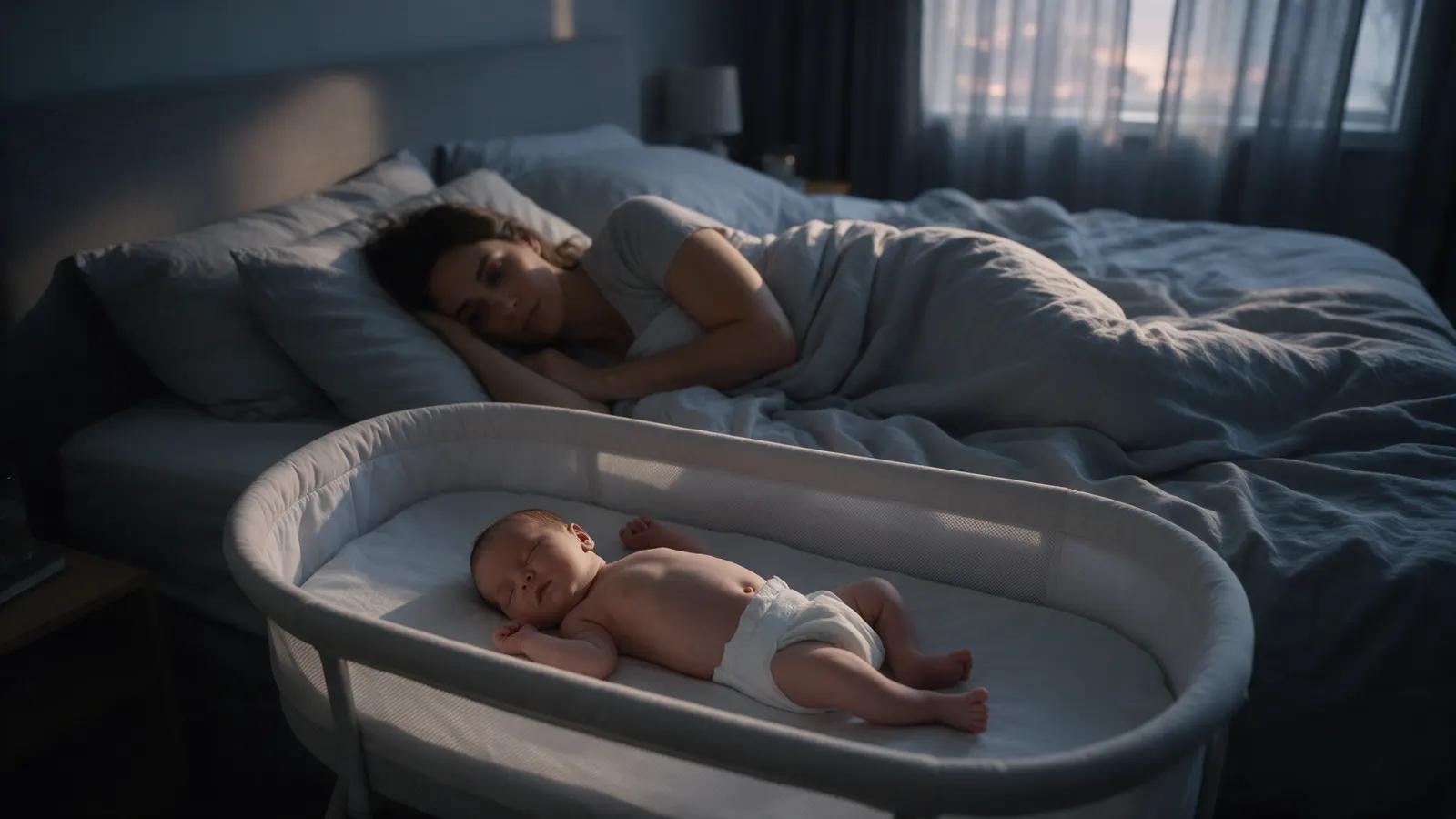
If it feels like your baby has no idea whether it's 3 p.m. or 3 a.m., that's because they don't. Today is about what newborn sleep actually looks like, so you stop measuring against a schedule that doesn't exist yet.
Heart
Night waking isn't a habit you're creating; it's how newborns are built. Every pick-up in the dark teaches the same thing as by daylight: someone comes. You cannot spoil a newborn with attention (AAP).
Head
Newborns sleep about 16 to 17 hours a day, often just 1 or 2 hours at a time, and regular sleep cycles don't arrive until about 4 months (AAP). Breastfed babies go no more than about 2 to 3 hours between feeds by day, or 4 at night (AAP), so short stretches are the design, not a glitch.
You can still start the day-night pattern now: bright, normal days and dim, quiet nights (NHS). Just don't expect results this week.
Body
When your baby jerks awake, arms flung wide, then pulls them back in, that's the Moro reflex, set off by a loud sound or sudden movement; it fades around 2 months (AAP). A swaddle can keep those arms from waking them, if it's done safely: always on the back, hips loose, and stopped as soon as your baby shows any sign of trying to roll (AAP).
The rest of safe sleep, every sleep: a firm, flat surface (nothing inclined more than 10 degrees), a bare crib with a fitted sheet only, room-sharing without bed-sharing, and no weighted sleep products (Moon et al., 2022). Home monitors have no evidence of lowering SIDS risk (AAP).
Try today
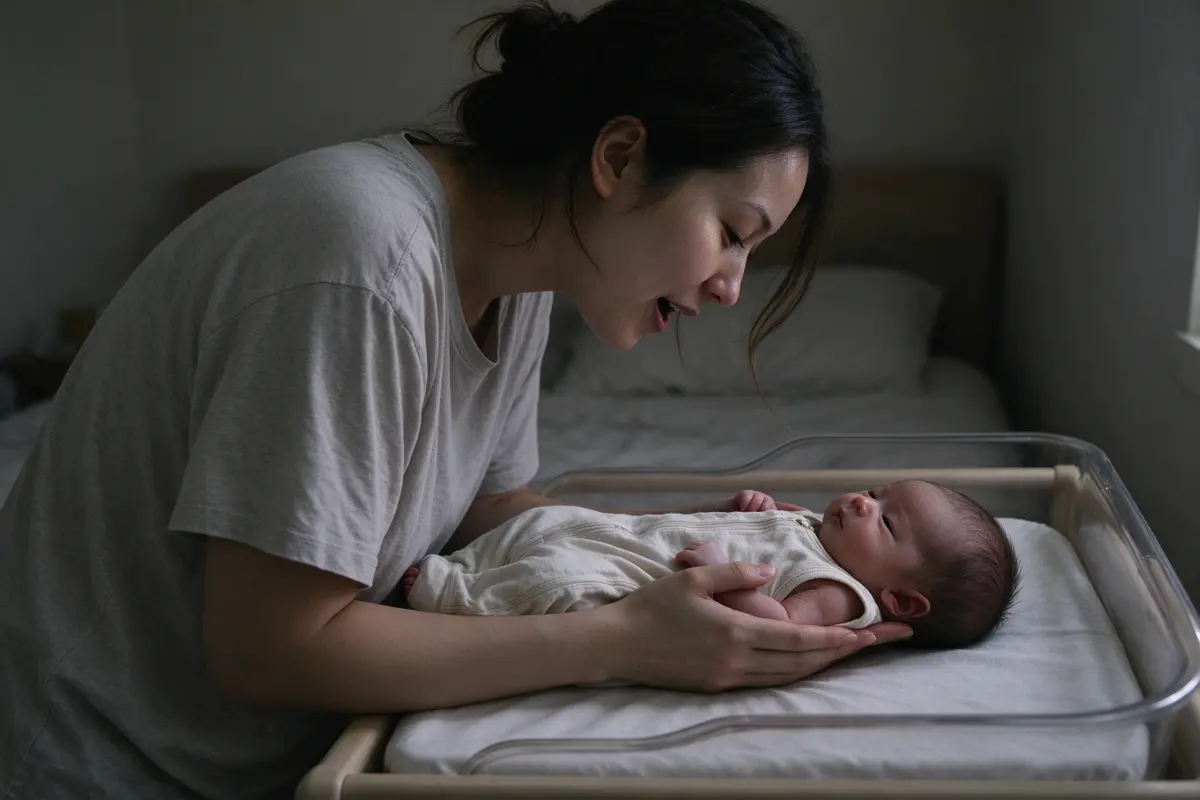
A three-step wind-down
Time: A few minutes before night sleep · A short wind-down routine in the guide
Pick 2 or 3 calm steps you can repeat every night, such as a fresh diaper, a feed, and a quiet song.
Dim the lights and lower your voice.
Do the steps in the same order.
Lay your baby on their back in their own sleep space, ideally drowsy but still awake (AAP).
Make it work:A consistent bedtime routine reduced night wakings and improved mothers' mood in a randomized trial of babies and toddlers 7 to 36 months old (Mindell et al., 2009); in newborns it's barely studied. Think of tonight as the first rehearsal.
Watch for
Normal
startling at a noise, arms out and back in.
Call 911
if your baby is struggling to breathe or has new grunting, wheezing, or whistling sounds (Nationwide Children's).
Normal
frequent sneezing; it clears dust and fuzz from the nose and isn't an allergy.
Call your pediatrician
if sneezing comes with trouble breathing or poor feeding (AAP).
Normal
a baby dressed in one more layer than you're wearing. Sweating, a hot chest, or flushed skin means too warm; take a layer off (AAP).
Call your pediatrician immediately
for a rectal temperature of 100.4°F (38°C) or higher, even if they seem fine (AAP).
For you
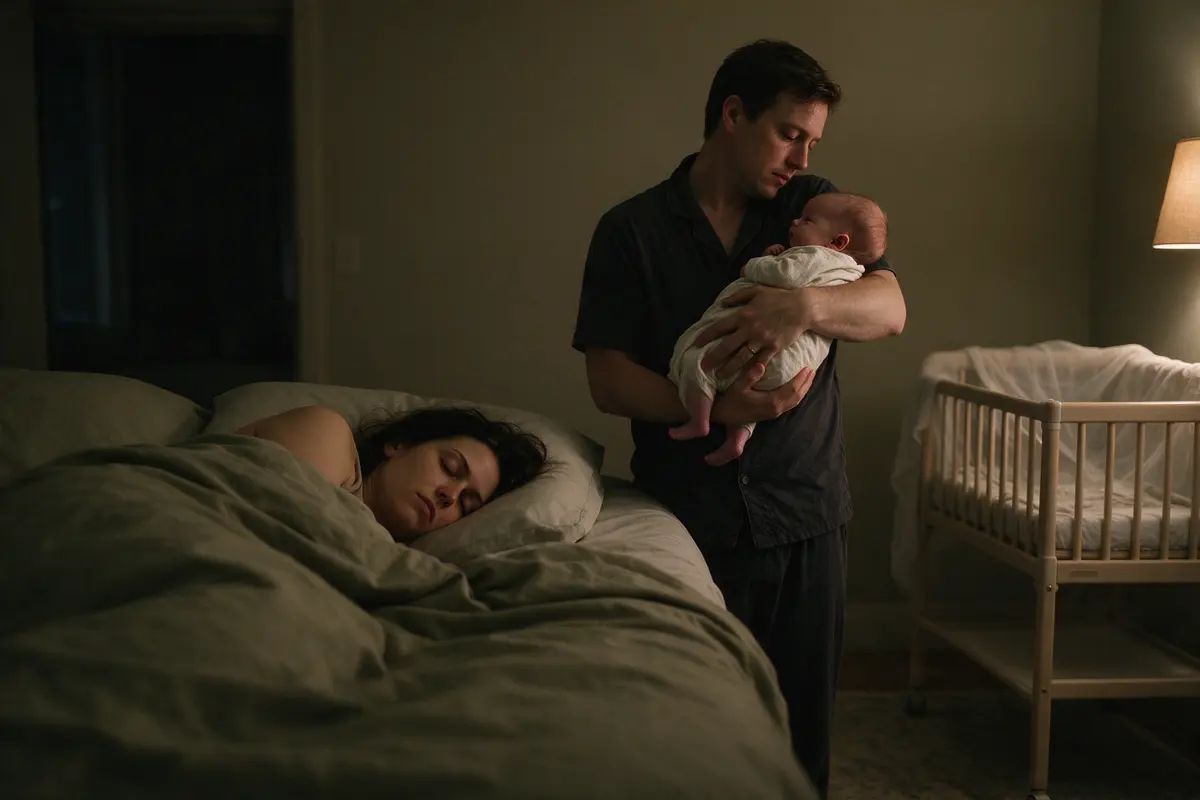
"Sleep when the baby sleeps" is half true. A 1-to-2-hour stretch is a nap, not a night. What works better is a plan: split the night so each adult gets one longer stretch, with the non-feeding partner owning diapers, burping, and settling. The AAP urges pediatricians to support fathers' involvement for exactly this kind of sharing (Yogman & Garfield, 2016).
Avoid feeding on a couch or armchair at night; if you do doze off while feeding, put your baby on their back in their own space as soon as you wake (AAP).
If you're the partner: say the words tonight. "I've got everything until 2 a.m. You sleep. Then we switch."
Sources
- American Academy of Pediatrics. "Responding to Your Baby's Cries." HealthyChildren.org. https://www.healthychildren.org/English/ages-stages/baby/crying-colic/Pages/Responding-to-Your-Babys-Cries.aspx
- American Academy of Pediatrics. "Getting Your Baby to Sleep." HealthyChildren.org. https://www.healthychildren.org/English/ages-stages/baby/sleep/Pages/getting-your-baby-to-sleep.aspx
- American Academy of Pediatrics. "How Often to Breastfeed." HealthyChildren.org. https://www.healthychildren.org/English/ages-stages/baby/breastfeeding/Pages/How-Often-to-Breastfeed.aspx
- National Health Service (UK). "Helping your baby to sleep." 2025. https://www.nhs.uk/baby/caring-for-a-newborn/helping-your-baby-to-sleep/
- American Academy of Pediatrics. "Newborn Reflexes." HealthyChildren.org. https://www.healthychildren.org/English/ages-stages/baby/Pages/newborn-reflexes.aspx
- American Academy of Pediatrics. "Swaddling: Is it Safe?" HealthyChildren.org. https://www.healthychildren.org/English/ages-stages/baby/diapers-clothing/Pages/Swaddling-Is-it-Safe.aspx
- Moon RY, Carlin RF, Hand I; AAP Task Force on SIDS and Committee on Fetus and Newborn. "Sleep-Related Infant Deaths: Updated 2022 Recommendations for Reducing Infant Deaths in the Sleep Environment." Pediatrics, 2022. https://pubmed.ncbi.nlm.nih.gov/35726558/
- Moon RY. "How to Keep Your Sleeping Baby Safe: AAP Policy Explained." HealthyChildren.org. https://www.healthychildren.org/English/ages-stages/baby/sleep/Pages/a-parents-guide-to-safe-sleep.aspx
- Mindell JA, Telofski LS, Wiegand B, Kurtz ES. "A nightly bedtime routine: impact on sleep in young children and maternal mood." Sleep, 2009. https://pubmed.ncbi.nlm.nih.gov/19480226/
- Nationwide Children's Hospital. "Newborn Warning Signs." https://www.nationwidechildrens.org/conditions/health-library/newborn-warning-signs
- American Academy of Pediatrics. "Newborn Reflexes and Behavior" (symptom checker). HealthyChildren.org. https://www.healthychildren.org/English/tips-tools/symptom-checker/Pages/symptomviewer.aspx?symptom=Newborn+Reflexes+and+Behavior
- American Academy of Pediatrics. "Fever and Your Baby." HealthyChildren.org. https://www.healthychildren.org/English/health-issues/conditions/fever/Pages/Fever-and-Your-Baby.aspx
- Yogman M, Garfield CF. "Fathers' Roles in the Care and Development of Their Children: The Role of Pediatricians." Pediatrics, 2016. https://pubmed.ncbi.nlm.nih.gov/27296867/
- Moon RY. "Safe Sleep Tips for Sleep-Deprived New Parents." HealthyChildren.org. https://www.healthychildren.org/English/ages-stages/baby/sleep/Pages/safe-sleep-tips-for-sleep-deprived-parents.aspx
This guide is general education that summarizes published research and guidance from groups like the American Academy of Pediatrics, the CDC, and the WHO. It isn’t medical advice, and every child develops on their own timeline. Your pediatrician knows your child; if something feels wrong, call them. In an emergency, call 911.
Get each day’s note the morning it applies
Add your baby to a free Chorevia household with their date of birth, and every morning for 60 days the day’s note arrives in the app and by email: what’s developing, one thing to try, what to watch for, and a word for you.
Create your household