Day 26 of 60 · Week 4
The soothing toolkit
Last reviewed · 3 min read · 13 sources · Plain-text version
The AAP's soothing list, what research shows about white noise and the 5 S's, and the break rule every caregiver should know.

By now you have moves that usually work and some that never do. Today: the full toolkit, an honest word on the evidence, and the rule that matters more than any technique.
Heart
The AAP is clear: you cannot spoil a young baby with attention, and babies whose calls for help are answered cry less overall (AAP). Newborns routinely cry 1 to 4 hours a day (AAP), and some of that crying "resists soothing," the R in PURPLE, no matter what you try (Seattle Children's). That isn't your failure.
Head
The AAP's soothing list: rocking, stroking or patting, safe swaddling, singing, soft music, walking, rhythmic noise or vibration, burping, and a warm bath (AAP). Try them one at a time, slowly.
The research on specific methods is thin but real. In a 1990 trial of 40 newborns, 80% fell asleep within 5 minutes with white noise, versus 25% without (Spencer et al., 1990). In 230 babies getting 2- and 4-month shots, the "5 S's" (swaddling, side or stomach position, shushing, swinging, sucking) lowered pain scores and crying (Harrington et al., 2012). Side and stomach positions are only for a baby you're holding, never for sleep. Keep sound machines quiet and away from the crib; at full volume, some exceed safe noise levels (Hugh et al., 2014).
Body
A swaddle can be in the kit if done safely: always on the back, hips loose, and stop as soon as your baby shows signs of trying to roll (AAP).
What is never in the kit: shaking. It is never safe to shake, throw, hit, slam, or jerk a child (AAP), and shaking often happens in response to crying (Barr et al., 2009). Hence the break rule below.
Try today

Sing to your baby
Time: A song or two, any time · Sing to your baby in the guide
Pick any song: a lullaby, a pop song, one you make up.
Sing softly while rocking, walking, or changing a diaper.
Repeat the same song at the same times, like before sleep.
Get quieter if your baby seems overwhelmed.
Make it work:You don't need a good voice; babies can recognize a parent's voice within the first month (AAP). One non-randomized study of about 170 mothers linked singing lullabies, during pregnancy and after birth, to stronger bonding at 3 months (Persico et al., 2017).
Watch for
Normal
crying that takes a long time to settle.
Call your pediatrician right away
if your baby cries and can't be comforted in a way that's new or worries you (Nationwide Children's).
Normal
feeling frustrated by crying.
If you feel yourself losing control,
lay your baby on their back in the crib, leave the room for 10 to 15 minutes, and call someone; pick your baby up again once you're calm (AAP).
Normal
a baby who sleeps hard after a long cry.
Call your pediatrician right away
if your baby is hard to wake, or if yellow skin is deepening or spreading to the belly, arms, or legs (AAP).
For you
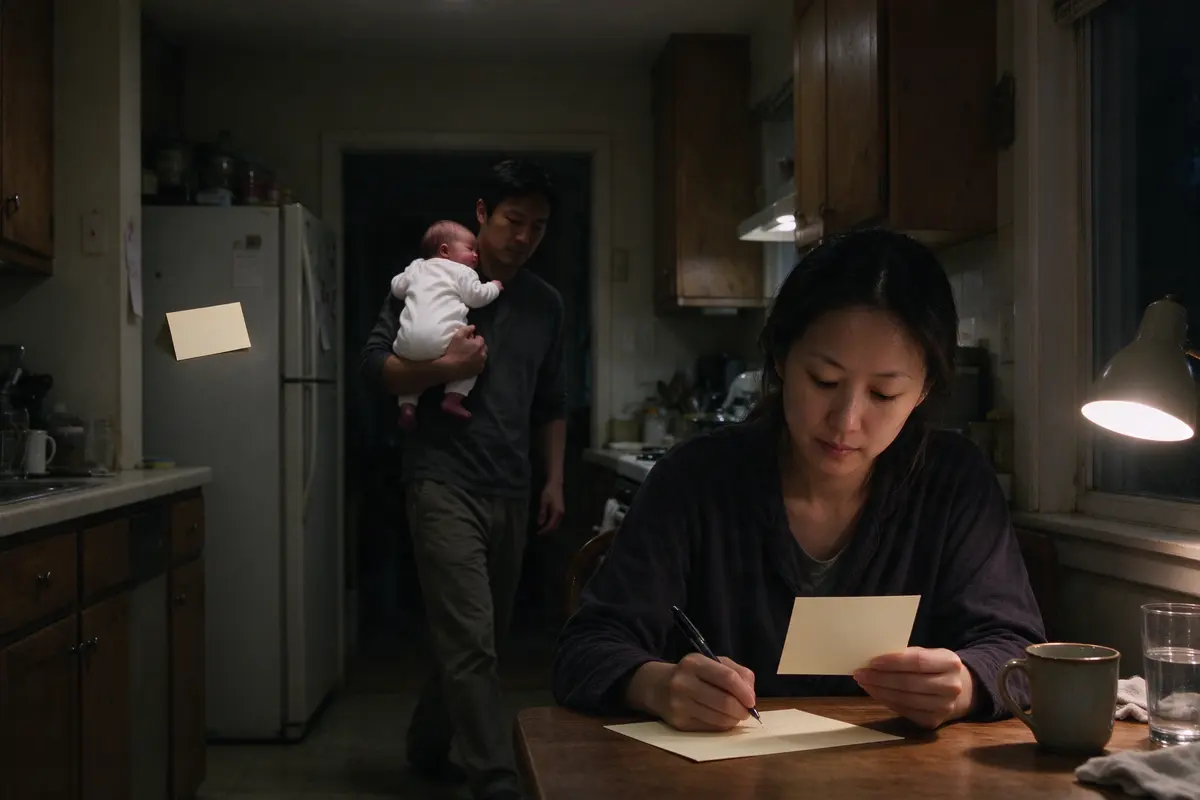
Write the break rule down today and give it to everyone who will ever be alone with your baby: partner, grandparent, sitter. "If the crying gets to you: baby on their back in the crib, leave the room for 10 to 15 minutes, call someone. Pick the baby up when you're calm" (AAP). The script for your own head: "My baby is safe in the crib. I can take a break."
Saying it out loud doesn't mean you expect anyone to lose it; it means nobody improvises at 3 a.m.
If you're the partner: take the evening walking shift, the hardest hour. If her mood or yours is sinking rather than tired, call or text 1-833-TLC-MAMA (1-833-852-6262) or 988 (CDC).
Sources
- American Academy of Pediatrics. "Responding to Your Baby's Cries." HealthyChildren.org. https://www.healthychildren.org/English/ages-stages/baby/crying-colic/Pages/Responding-to-Your-Babys-Cries.aspx
- Seattle Children's Hospital. "Period of PURPLE Crying." https://www.seattlechildrens.org/health-safety/parenting/purple-education-crying/
- Spencer JA, et al. "White noise and sleep induction." Archives of Disease in Childhood, 1990. https://pubmed.ncbi.nlm.nih.gov/2405784/
- Harrington JW, et al. "Effective analgesia using physical interventions for infant immunizations." Pediatrics, 2012. https://pubmed.ncbi.nlm.nih.gov/22508924/
- Hugh SC, et al. "Infant sleep machines and hazardous sound pressure levels." Pediatrics, 2014. https://pubmed.ncbi.nlm.nih.gov/24590753/
- American Academy of Pediatrics. "Swaddling: Is it Safe?" HealthyChildren.org. https://www.healthychildren.org/English/ages-stages/baby/diapers-clothing/Pages/Swaddling-Is-it-Safe.aspx
- American Academy of Pediatrics. "Shaken Baby Syndrome: Protect Your Infant from Abusive Head Trauma." HealthyChildren.org. https://www.healthychildren.org/English/safety-prevention/at-home/Pages/Abusive-Head-Trauma-Shaken-Baby-Syndrome.aspx
- Barr RG, et al. "Do educational materials change knowledge and behaviour about crying and shaken baby syndrome? A randomized controlled trial." CMAJ, 2009. https://pubmed.ncbi.nlm.nih.gov/19255065/
- American Academy of Pediatrics. "Hearing & Making Sounds: Your Baby's Milestones." HealthyChildren.org. https://www.healthychildren.org/English/ages-stages/baby/pages/Hearing-and-Making-Sounds.aspx
- Persico G, et al. "Maternal singing of lullabies during pregnancy and after birth: Effects on mother-infant bonding and on newborns' behaviour." Women and Birth, 2017. https://pubmed.ncbi.nlm.nih.gov/28169158/
- Nationwide Children's Hospital. "Newborn Warning Signs." https://www.nationwidechildrens.org/conditions/health-library/newborn-warning-signs
- American Academy of Pediatrics. "Jaundice in Newborns." HealthyChildren.org. https://www.healthychildren.org/English/ages-stages/baby/Pages/jaundice.aspx
- Centers for Disease Control and Prevention. "Symptoms of Depression Among Women." 2024. https://www.cdc.gov/reproductive-health/depression/index.html
This guide is general education that summarizes published research and guidance from groups like the American Academy of Pediatrics, the CDC, and the WHO. It isn’t medical advice, and every child develops on their own timeline. Your pediatrician knows your child; if something feels wrong, call them. In an emergency, call 911.
Get each day’s note the morning it applies
Add your baby to a free Chorevia household with their date of birth, and every morning for 60 days the day’s note arrives in the app and by email: what’s developing, one thing to try, what to watch for, and a word for you.
Create your household