Day 3 of 60 · Week 1
Going home
Last reviewed · 3 min read · 14 sources · Plain-text version
The car seat, the sleep space, your milk coming in, the first checkup to book, and the feelings that often arrive on day three.

Today is about the two pieces of gear that matter, the first appointment, and the changes that often land on day three.
Heart
Your baby doesn't need a nursery. They need your face at close range, your voice, and feeds when they ask. Responding quickly to their signals lets them know they can trust you (AAP).
Head
The car seat. Rear-facing from the first ride, in the back seat, never in front of an active airbag. Snug harness, chest clip at armpit level, and no bulky coat under the straps (AAP). At home, move a sleeping baby out of the seat onto a firm, flat surface on their back as soon as you can (Moon et al., 2022).
The sleep space. A crib or bassinet in your room, not your bed, for at least the first 6 months. Back to sleep for every nap and every night, on a firm, flat surface with a fitted sheet only: no bumpers, pillows, blankets, toys, or weighted products (Moon et al., 2022). No hat indoors once you're home (AAP).
Book the 3-to-5-day checkup if it isn't booked: within 48 to 72 hours of going home, or within 48 hours if your baby left the hospital before 48 hours old (AAP, 2025).
Body
Milk comes in within three to six days after delivery (Office on Women's Health), so swallows may get louder soon. Stools change too, from black and tarry to greenish-yellow around days 3 to 4 (AAP).
A yellow tint to the skin is common after day 1 (AAP). Look at your baby in daylight today and notice where the yellow is; the list below says when it's a call.
Try today
Bright days, dim nights, from day one home
Time: All day · Bright days, dim nights in the guide
This morning, open the curtains and let normal household noise carry on (NHS).
Feed and change in the light, talking normally.
Make it work:Expect nothing yet; regular sleep cycles don't arrive until about 4 months (AAP). It's a habit for you, not a schedule for them.
Watch for
Normal
a yellow tint on the face after day 1.
Call your pediatrician right away
if the yellow deepens or spreads to the belly, arms, or legs, the whites of the eyes look yellow, or your baby is hard to wake (AAP).
Normal
greenish-yellow stools around now.
Call as soon as possible
about white or very pale poop, which can be a sign of a liver problem (AAP).
Normal
a little spit-up with a burp.
Go to the ER now
if your baby vomits green (bile), even once (AAP).
For you

Day three is often the day the feelings come. The AAP says 50% to 80% of people who give birth get the "baby blues," mild, short-lived mood changes in the first 2 weeks (AAP). Crying over nothing today isn't a verdict on you.
Your breasts may feel full, tender, or uncomfortable as milk comes in, even if you aren't breastfeeding (Office on Women's Health).
If you had a C-section: wash the incision with mild soap and water, and don't soak in a tub, hot tub, or pool until your provider says so, usually about 3 weeks. Steri-Strips fall off in about a week. Pain should ease after 2 or 3 days, though the incision can stay tender for 3 weeks or more (MedlinePlus).
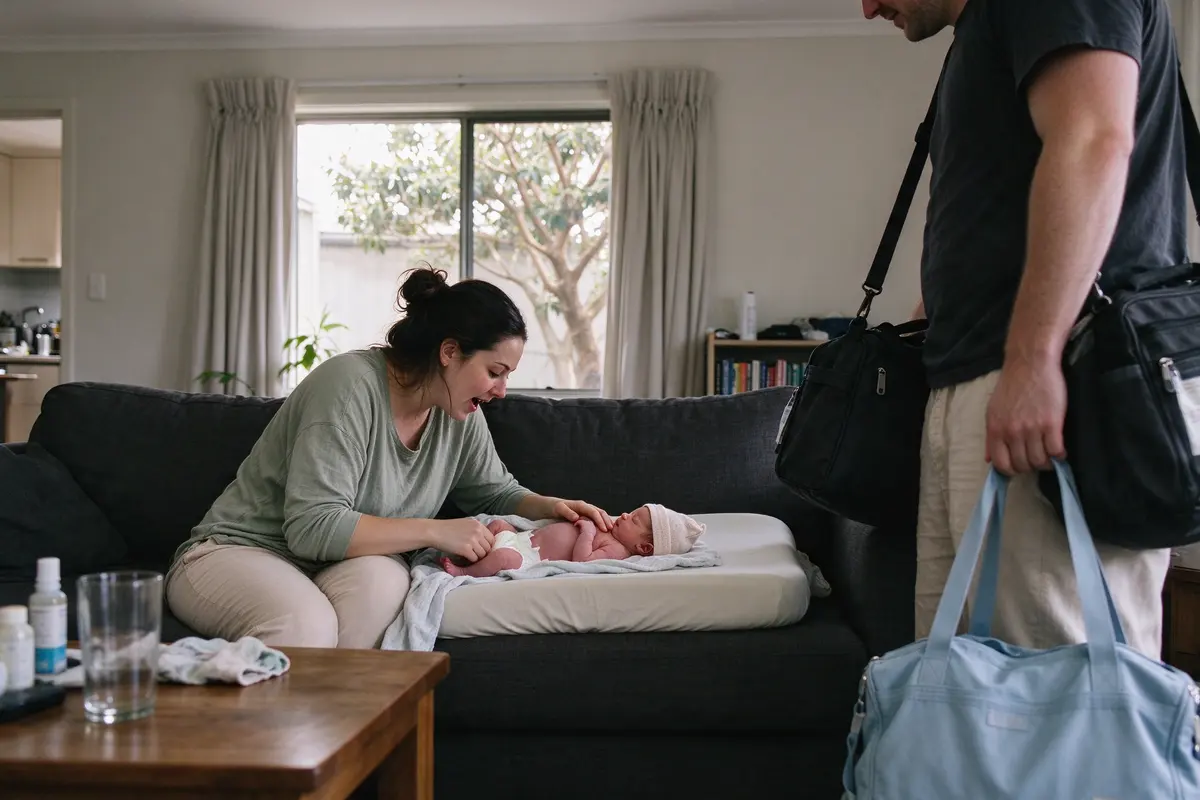
If you're the partner: you install the seat, carry the bags, and field the visitors. She rides home and rests.
Sources
- American Academy of Pediatrics. "Emotional and Social Development: Birth to 3 Months." HealthyChildren.org. https://www.healthychildren.org/English/ages-stages/baby/Pages/Emotional-and-Social-Development-Birth-to-3-Months.aspx
- American Academy of Pediatrics. "Car Seats: Information for Families." HealthyChildren.org. https://www.healthychildren.org/English/safety-prevention/on-the-go/Pages/Car-Safety-Seats-Information-for-Families.aspx
- Moon RY, Carlin RF, Hand I; AAP Task Force on SIDS and Committee on Fetus and Newborn. "Sleep-Related Infant Deaths: Updated 2022 Recommendations for Reducing Infant Deaths in the Sleep Environment." Pediatrics, 2022. https://pubmed.ncbi.nlm.nih.gov/35726558/
- Moon RY. "How to Keep Your Sleeping Baby Safe: AAP Policy Explained." HealthyChildren.org. https://www.healthychildren.org/English/ages-stages/baby/sleep/Pages/a-parents-guide-to-safe-sleep.aspx
- American Academy of Pediatrics and Bright Futures. "Recommendations for Preventive Pediatric Health Care" (Periodicity Schedule). 2025. https://downloads.aap.org/AAP/PDF/periodicity_schedule.pdf
- Office on Women's Health. "Recovering from birth." U.S. Department of Health and Human Services. https://womenshealth.gov/pregnancy/childbirth-and-beyond/recovering-birth
- American Academy of Pediatrics. "How to Tell if Your Breastfed Baby is Getting Enough Milk." HealthyChildren.org. https://www.healthychildren.org/English/ages-stages/baby/breastfeeding/Pages/How-to-Tell-if-Baby-is-Getting-Enough-Milk.aspx
- American Academy of Pediatrics. "Jaundice in Newborns." HealthyChildren.org. https://www.healthychildren.org/English/ages-stages/baby/Pages/jaundice.aspx
- National Health Service (UK). "Helping your baby to sleep." 2025. https://www.nhs.uk/baby/caring-for-a-newborn/helping-your-baby-to-sleep/
- American Academy of Pediatrics. "Getting Your Baby to Sleep." HealthyChildren.org. https://www.healthychildren.org/English/ages-stages/baby/sleep/Pages/getting-your-baby-to-sleep.aspx
- Jana L, Shu J. "The Many Colors of Baby Poop." HealthyChildren.org. https://www.healthychildren.org/English/ages-stages/baby/Pages/The-Many-Colors-of-Poop.aspx
- American Academy of Pediatrics. "Vomiting Without Diarrhea" (symptom checker). HealthyChildren.org. https://www.healthychildren.org/English/tips-tools/symptom-checker/Pages/symptomviewer.aspx?symptom=Vomiting+Without+Diarrhea
- Sriraman NK. "Depression During & After Pregnancy: You Are Not Alone." HealthyChildren.org. https://www.healthychildren.org/English/ages-stages/prenatal/delivery-beyond/Pages/understanding-motherhood-and-mood-baby-blues-and-beyond.aspx
- MedlinePlus. "Going home after a C-section." National Library of Medicine. https://medlineplus.gov/ency/patientinstructions/000624.htm
This guide is general education that summarizes published research and guidance from groups like the American Academy of Pediatrics, the CDC, and the WHO. It isn’t medical advice, and every child develops on their own timeline. Your pediatrician knows your child; if something feels wrong, call them. In an emergency, call 911.
Get each day’s note the morning it applies
Add your baby to a free Chorevia household with their date of birth, and every morning for 60 days the day’s note arrives in the app and by email: what’s developing, one thing to try, what to watch for, and a word for you.
Create your household