Day 11 of 60 · Week 2
Your voice
Last reviewed · 3 min read · 16 sources · Plain-text version
Your baby has known your voice since before birth. Today is about using it: parentese, reading aloud, and saying the hard things out loud too.

Eleven days in: feed, change, sleep, repeat. Today's note is about the one tool you carry everywhere and never have to charge: your voice.
Heart
Your voice was the first familiar thing. In a tiny, influential study, ten newborns under 3 days old learned to suck in a rhythm that played their own mother, rather than another woman, reading Dr. Seuss; the authors suggested hearing her before birth may play a role (DeCasper & Fifer, 1980). Babies can recognize a parent's voice within the first month (AAP), so every narrated feed adds to that.
When you answer a coo or a cry with words, that's serve and return, the back-and-forth that helps build neural connections (Harvard Center on the Developing Child).
Head
That sing-song voice you slip into has a name: parentese. In a small lab study, 16 babies just 2 days old preferred infant-directed speech to adult-style speech (Cooper & Aslin, 1990), and the AAP notes that babies like high-pitched voices in general (AAP). The outcome research is with older babies: in a randomized trial, coaching parents on parentese and back-and-forth talk at 6 and 10 months led to more babbling and more words at 14 months (Ferjan Ramírez et al., 2019). For a newborn, the benefit is inferred.
The AAP also recommends shared reading beginning at birth, based on research with young children (Klass et al., 2024).
Body
Sometime in the next few weeks you may notice your baby go quiet, or look or turn, when you speak; the AAP lists looking or turning toward familiar sounds and voices as something a 1-month-old may do (AAP). If it hasn't happened yet, nothing is wrong.
Try today
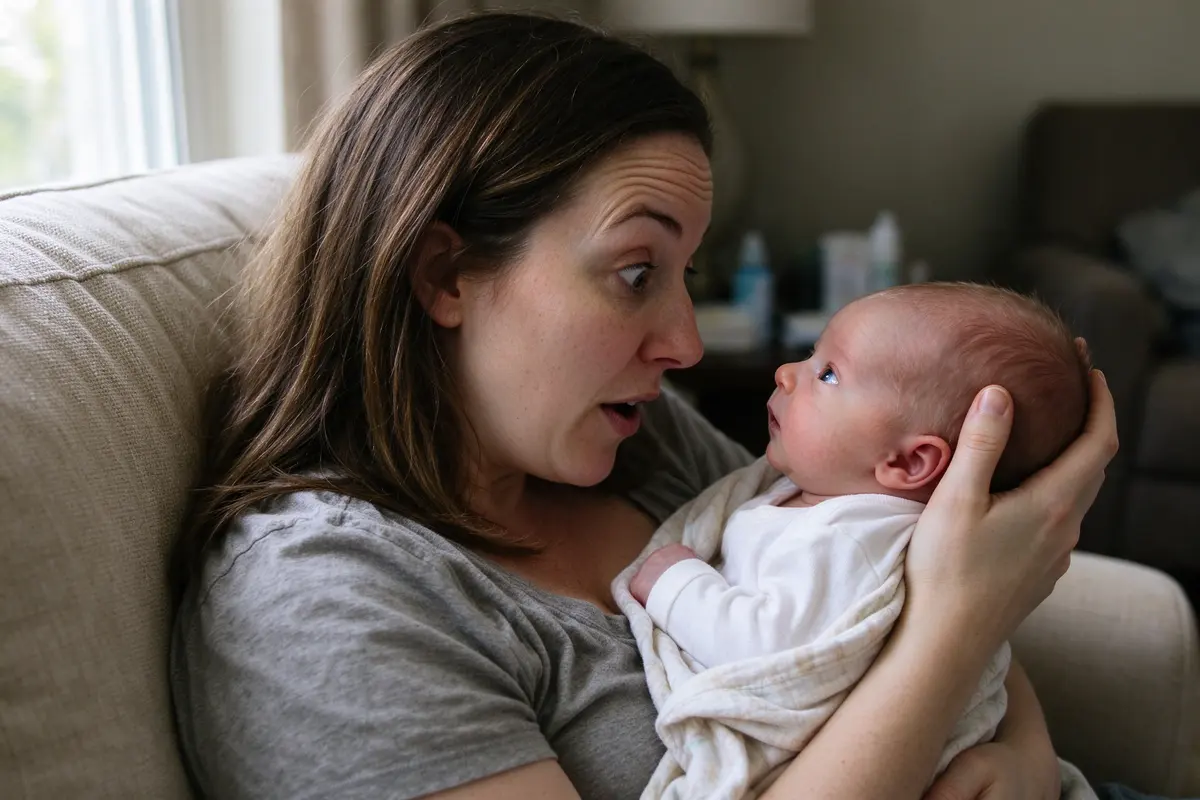
Talk in parentese
Time: A few minutes, whenever your baby is alert · Talk in parentese in the guide
Get face to face, about 8 to 12 inches away, where your baby sees best (AAP).
Raise your pitch, slow down, and stretch out your words: "Hiii, sweeet baaaby" (AAP).
Widen your eyes and smile as you talk.
Pause to give your baby a turn, then respond to whatever they do.
Make it work:Use real words, just warmer and slower. If your baby looks away or fusses, that's "done for now."
Watch for
Normal
irregular breathing with short pauses, plus squeaks and sighs.
Go to the ER now
if breathing stays faster than 60 breaths a minute, pauses last longer than about 10 seconds, or the ribs pull in with each breath (AAP).
Normal
8 to 12 feeds in 24 hours if breastfed (AAP).
Call your pediatrician right away
if your baby is feeding poorly, has a weak suck, or vomits more than once (Nationwide Children's).
Normal
a run of short, close-together feeds in the evening, called cluster feeding.
Call your pediatrician
if your baby is more than a week old and feeding constantly, or if you're worried about latch or milk supply (Cleveland Clinic).
For you

Your voice has one more job today: saying the hard thoughts out loud. "I don't feel like myself." "I'm scared I'm doing this wrong." Said out loud to someone, they get smaller.
The AAP says 50% to 80% of people who give birth get the "baby blues," mild, short-lived mood changes in the first 2 weeks (AAP). Feelings that are severe, or that last longer than 2 weeks, may be postpartum depression, which can be treated (NIMH). You don't have to wait for a visit: call or text the National Maternal Mental Health Hotline at 1-833-TLC-MAMA (1-833-852-6262), or call or text 988. In an emergency, call 911 (CDC). Thoughts about harming yourself or your baby mean get care right away (CDC).
If you're the partner: ask how she's really doing, then stop talking and listen.
Sources
- DeCasper AJ, Fifer WP. "Of human bonding: newborns prefer their mothers' voices." Science, 1980. https://pubmed.ncbi.nlm.nih.gov/7375928/
- American Academy of Pediatrics. "Hearing & Making Sounds: Your Baby's Milestones." HealthyChildren.org, 2021. https://www.healthychildren.org/English/ages-stages/baby/pages/Hearing-and-Making-Sounds.aspx
- Center on the Developing Child at Harvard University. "Serve and Return." https://developingchild.harvard.edu/key-concept/serve-and-return/
- Cooper RP, Aslin RN. "Preference for infant-directed speech in the first month after birth." Child Development, 1990. https://pubmed.ncbi.nlm.nih.gov/2245748/
- Ferjan Ramírez N, Lytle SR, Fish M, Kuhl PK. "Parent coaching at 6 and 10 months improves language outcomes at 14 months: A randomized controlled trial." Developmental Science, 2019. https://pubmed.ncbi.nlm.nih.gov/30318708/
- Klass P, Miller-Fitzwater A, High PC; AAP Council on Early Childhood. "Literacy Promotion: An Essential Component of Primary Care Pediatric Practice: Policy Statement." Pediatrics, 2024. https://pubmed.ncbi.nlm.nih.gov/39342414/
- American Academy of Pediatrics. "Developmental Milestones at 1 Month Old." HealthyChildren.org, 2026. https://www.healthychildren.org/English/ages-stages/baby/Pages/Developmental-Milestones-1-Month.aspx
- American Academy of Pediatrics. "Infant Vision Development: What Can Babies See?" HealthyChildren.org, 2024. https://www.healthychildren.org/English/ages-stages/baby/Pages/Babys-Vision-Development.aspx
- American Academy of Pediatrics. "Breathing Trouble" (symptom checker). HealthyChildren.org, 2026. https://www.healthychildren.org/English/tips-tools/symptom-checker/Pages/symptomviewer.aspx?symptom=Breathing+Trouble
- American Academy of Pediatrics. "How Often to Breastfeed." HealthyChildren.org, 2015. https://www.healthychildren.org/English/ages-stages/baby/breastfeeding/Pages/How-Often-to-Breastfeed.aspx
- Nationwide Children's Hospital. "Newborn Warning Signs." 2023. https://www.nationwidechildrens.org/conditions/health-library/newborn-warning-signs
- Cleveland Clinic. "Cluster Feeding." 2024. https://my.clevelandclinic.org/health/articles/cluster-feeding
- Sriraman NK. "Depression During & After Pregnancy: You Are Not Alone." HealthyChildren.org, 2022. https://www.healthychildren.org/English/ages-stages/prenatal/delivery-beyond/Pages/understanding-motherhood-and-mood-baby-blues-and-beyond.aspx
- National Institute of Mental Health. "Perinatal Depression." 2023. https://www.nimh.nih.gov/health/publications/perinatal-depression
- Centers for Disease Control and Prevention. "Symptoms of Depression Among Women." 2024. https://www.cdc.gov/reproductive-health/depression/index.html
- Centers for Disease Control and Prevention. "Urgent Maternal Warning Signs and Symptoms." HEAR HER campaign. https://www.cdc.gov/hearher/maternal-warning-signs/index.html
This guide is general education that summarizes published research and guidance from groups like the American Academy of Pediatrics, the CDC, and the WHO. It isn’t medical advice, and every child develops on their own timeline. Your pediatrician knows your child; if something feels wrong, call them. In an emergency, call 911.
Get each day’s note the morning it applies
Add your baby to a free Chorevia household with their date of birth, and every morning for 60 days the day’s note arrives in the app and by email: what’s developing, one thing to try, what to watch for, and a word for you.
Create your household