Day 18 of 60 · Week 3
Head and neck
Last reviewed · 3 min read · 11 sources · Plain-text version
Why everyone says 'watch the head,' what the neck is quietly working on, two floor positions to rotate, and the lifting rules for your own body.

Everyone who hands you the baby says "watch the head." Today is about why, and about what that wobbly neck is quietly working on.
Heart
By about one month, many babies move their head side to side on the stomach, keep their hands in tight fists, make jerky arm thrusts, and still have a head that flops back if unsupported (AAP). "About one month" is a range, not a deadline.
The practice is time on the tummy with your face nearby. The reward for lifting is you.
Head
A systematic review of 16 mostly observational studies linked tummy time to better gross motor development (Hewitt et al., 2020). The AAP's target is 3 to 5 minutes, 2 to 3 times a day, working up to 15 to 30 minutes a day in total by 7 weeks (AAP). The AAP also suggests changing your baby's position every 10 to 15 minutes during playtime, and staying with them the whole time (AAP). Side-lying is one of those positions, and a good one when tummy time ends in tears.
Body
Carrying: hold your baby upright against your chest with a hand behind the head. In a sling or carrier, keep their face visible, nose and mouth clear, and chin off their chest, and bend at the knees, not the waist, to pick things up (AAP). A sudden drop of the head sets off the Moro reflex, arms and legs flung out and pulled back in; it fades around 2 months (AAP).
Try today
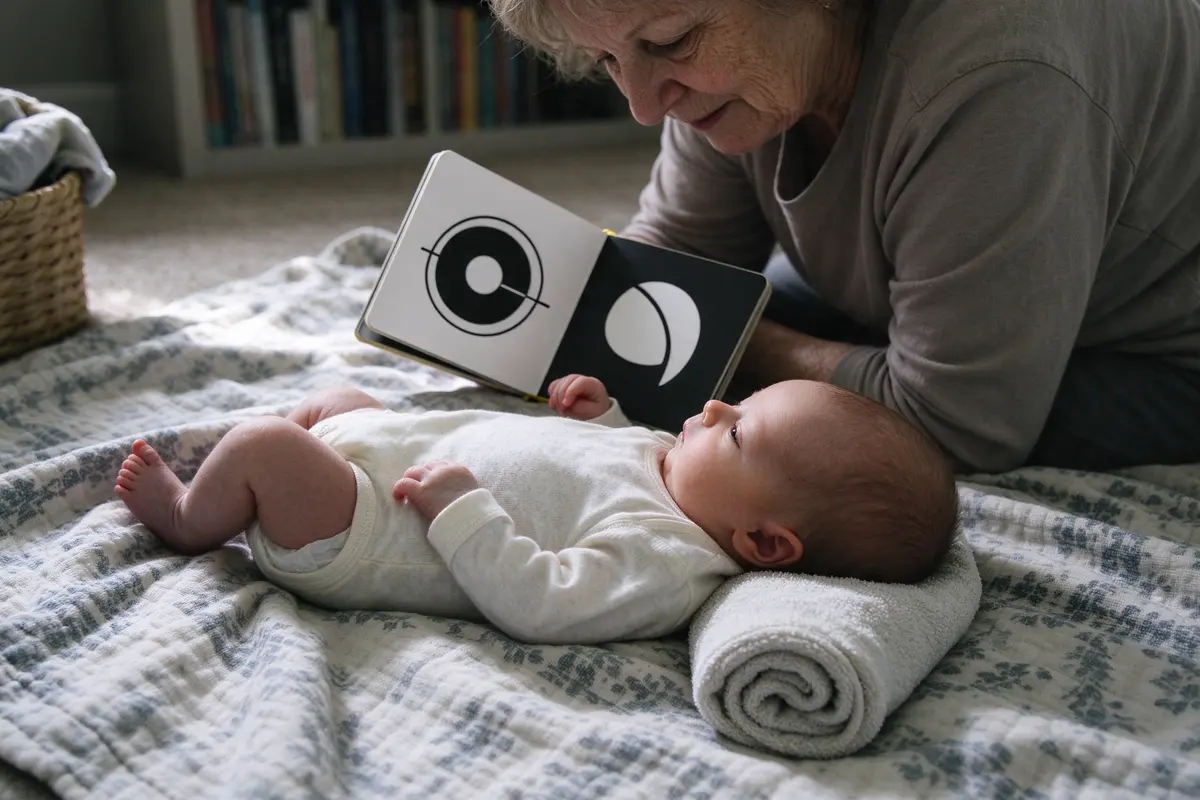
Side-lying play
Time: A few minutes a side · Side-lying play in the guide
Lay your baby on their side on a blanket on the floor while they're awake.
If they roll onto their back, tuck a rolled-up towel behind them (AAP).
Lie down facing them, or set a book where they can see it.
After a few minutes, switch to the other side.
Make it work:Awake play only. For sleep, it's their back on a bare, flat surface, towel put away.
Tummy time on a floor blanket
Time: 3 to 5 minutes · Chest-to-chest tummy time in the guide
Watch for
Normal
a wobbly head and jerky arms.
Call 911
if your baby is limp, floppy, or not moving (Nationwide Children's).
Normal
squeaks and sighs, even in sleep (AAP).
Call 911
if your baby is struggling to breathe, or has new grunting, wheezing, or whistling sounds (Nationwide Children's).
Normal
steady wet diapers in weeks 3 to 4.
Call your pediatrician right away
if there are fewer than expected (AAP).
For you

Your own lifting rules. After a C-section, don't lift anything heavier than your baby for the first 6 to 8 weeks; most regular activities come back in 4 to 8 weeks; and walking helps healing and helps prevent clots (MedlinePlus). After any birth, severe swelling, redness, or pain in a leg or arm is an urgent warning sign; seek care immediately (CDC).
Your neck has spent eighteen days looking down. Bring the baby up to you with a pillow during feeds rather than curling down to them, and bend at the knees, not the waist, when you pick things up (AAP).
If you're the partner: the heavy lifting is literally yours. Laundry, the car seat, the stroller. Don't wait to be asked.
Sources
- American Academy of Pediatrics. "Developmental Milestones at 1 Month Old." HealthyChildren.org, 2026. https://www.healthychildren.org/English/ages-stages/baby/Pages/Developmental-Milestones-1-Month.aspx
- Hewitt L, Kerr E, Stanley RM, Okely AD. "Tummy Time and Infant Health Outcomes: A Systematic Review." Pediatrics, 2020. https://pubmed.ncbi.nlm.nih.gov/32371428/
- American Academy of Pediatrics. "Back to Sleep, Tummy to Play." HealthyChildren.org, 2026. https://www.healthychildren.org/English/ages-stages/baby/sleep/Pages/back-to-sleep-tummy-to-play.aspx
- American Academy of Pediatrics. "3 Tummy Time Activities to Try With Your Baby." HealthyChildren.org, 2023. https://www.healthychildren.org/English/ages-stages/baby/sleep/Pages/The-Importance-of-Tummy-Time.aspx
- American Academy of Pediatrics. "Baby Carriers: Backpacks, Front Packs & Slings." HealthyChildren.org, 2025. https://www.healthychildren.org/English/safety-prevention/on-the-go/Pages/Baby-Carriers.aspx
- American Academy of Pediatrics. "Newborn Reflexes." HealthyChildren.org, 2022. https://www.healthychildren.org/English/ages-stages/baby/Pages/newborn-reflexes.aspx
- Nationwide Children's Hospital. "Newborn Warning Signs." 2023. https://www.nationwidechildrens.org/conditions/health-library/newborn-warning-signs
- American Academy of Pediatrics. "How Your Newborn Behaves." HealthyChildren.org, 2021. https://www.healthychildren.org/English/ages-stages/baby/Pages/How-Your-Newborn-Behaves.aspx
- American Academy of Pediatrics Section on Breastfeeding. "How to Tell if Your Breastfed Baby is Getting Enough Milk." HealthyChildren.org, 2025. https://www.healthychildren.org/English/ages-stages/baby/breastfeeding/Pages/How-to-Tell-if-Baby-is-Getting-Enough-Milk.aspx
- MedlinePlus. "Going home after a C-section." National Library of Medicine. https://medlineplus.gov/ency/patientinstructions/000624.htm
- Centers for Disease Control and Prevention. "Urgent Maternal Warning Signs and Symptoms." HEAR HER campaign. https://www.cdc.gov/hearher/maternal-warning-signs/index.html
This guide is general education that summarizes published research and guidance from groups like the American Academy of Pediatrics, the CDC, and the WHO. It isn’t medical advice, and every child develops on their own timeline. Your pediatrician knows your child; if something feels wrong, call them. In an emergency, call 911.
Get each day’s note the morning it applies
Add your baby to a free Chorevia household with their date of birth, and every morning for 60 days the day’s note arrives in the app and by email: what’s developing, one thing to try, what to watch for, and a word for you.
Create your household