Day 217 of 300 · Week 29
Twenty-nine weeks: thicker textures
Last reviewed · 4 min read · 14 sources · Plain-text version
Smooth purees give way to mashed and lumpy this month, then finely chopped. Why a fork beats the blender now, and what a UK cohort of 7,821 children found about lumps that came after 9 months.
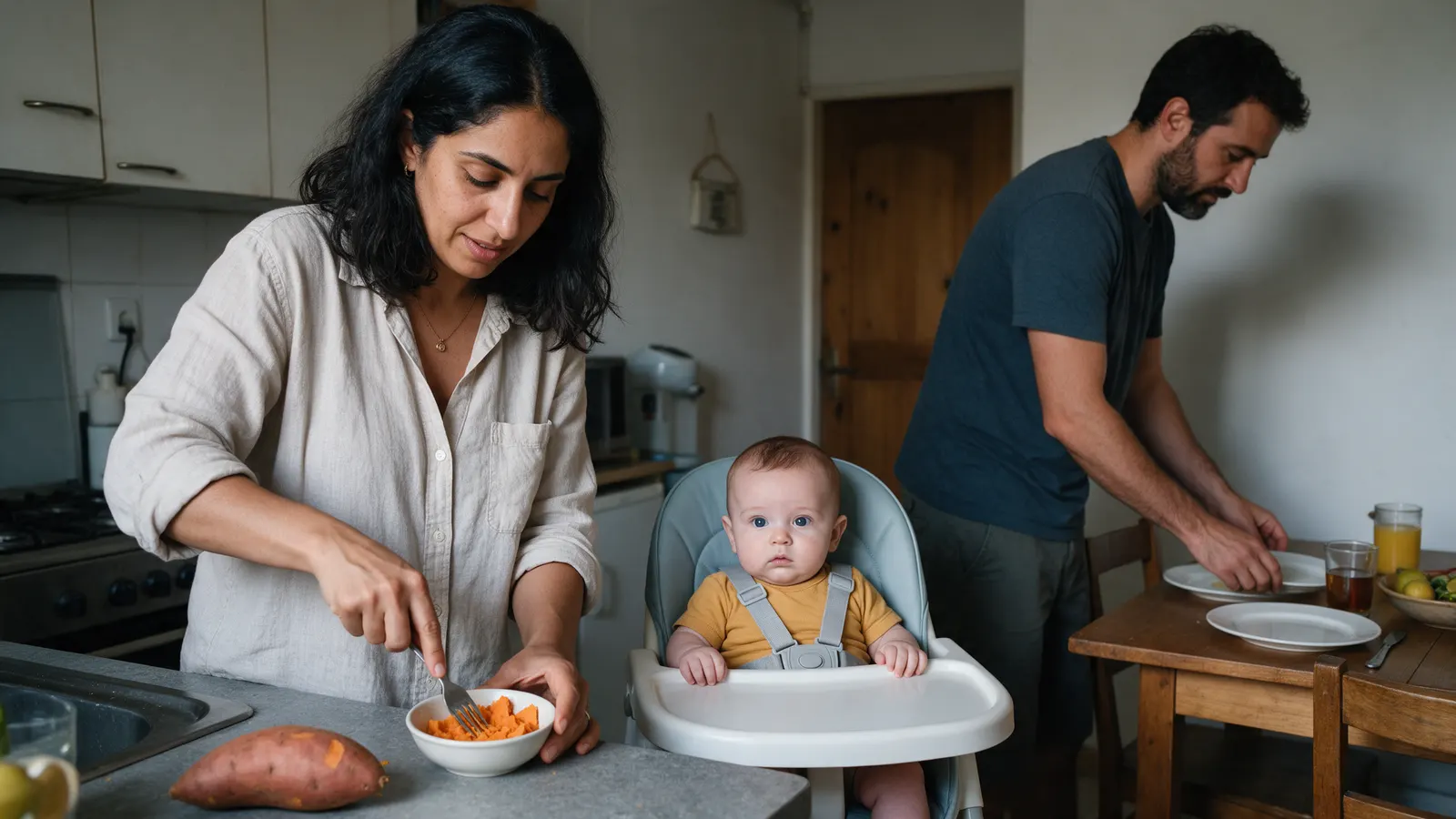
Twenty-nine weeks. The blender has done its job. Today is the first move away from smooth, and the reason it's worth doing sooner rather than later.
Heart
Thicken textures as your baby is ready, from smooth to mashed and lumpy, then finely chopped (CDC). By 7 to 8 months, babies can eat vegetables, fruits, meats and other proteins, plain yogurt and cheese, and grains (CDC). "As your baby is ready" means a sit that holds through a meal and a tongue that moves food around rather than pushing it straight out; it doesn't mean a date.
Head
In a UK cohort of 7,821 children, those first given lumpy foods after 9 months ate less fruit and vegetables and had more feeding problems at age 7, a link that doesn't prove cause (Coulthard et al., 2009). Families who waited may have differed in other ways. But it's the best reason there is not to leave the lumps until the first birthday. The other finding to keep: a systematic review of 21 studies found moderate evidence that tasting a vegetable or fruit daily for 8 to 10 or more days makes babies and toddlers more willing to eat it (Spill et al., 2019). Keep offering foods your baby refused before (CDC); a lump spat out on Monday is Tuesday's lump.
Body
Lumps bring the gag back, and that's expected. At 6 months the gag reflex sits farther forward in the mouth and moves back as babies grow, so coughing, gagging, and pushing food out are normal in the first months of solids; give your baby a moment, and don't sweep food out with your finger (Children's Wisconsin). Soft finger foods, cut into small pieces, can join once your baby sits up and brings things to their mouth (AAP). Upright and buckled (AAP), watched at all times (CDC), and the meal ends at the fullness cue: pushing food away, closing the mouth, turning the head (CDC).
Try today
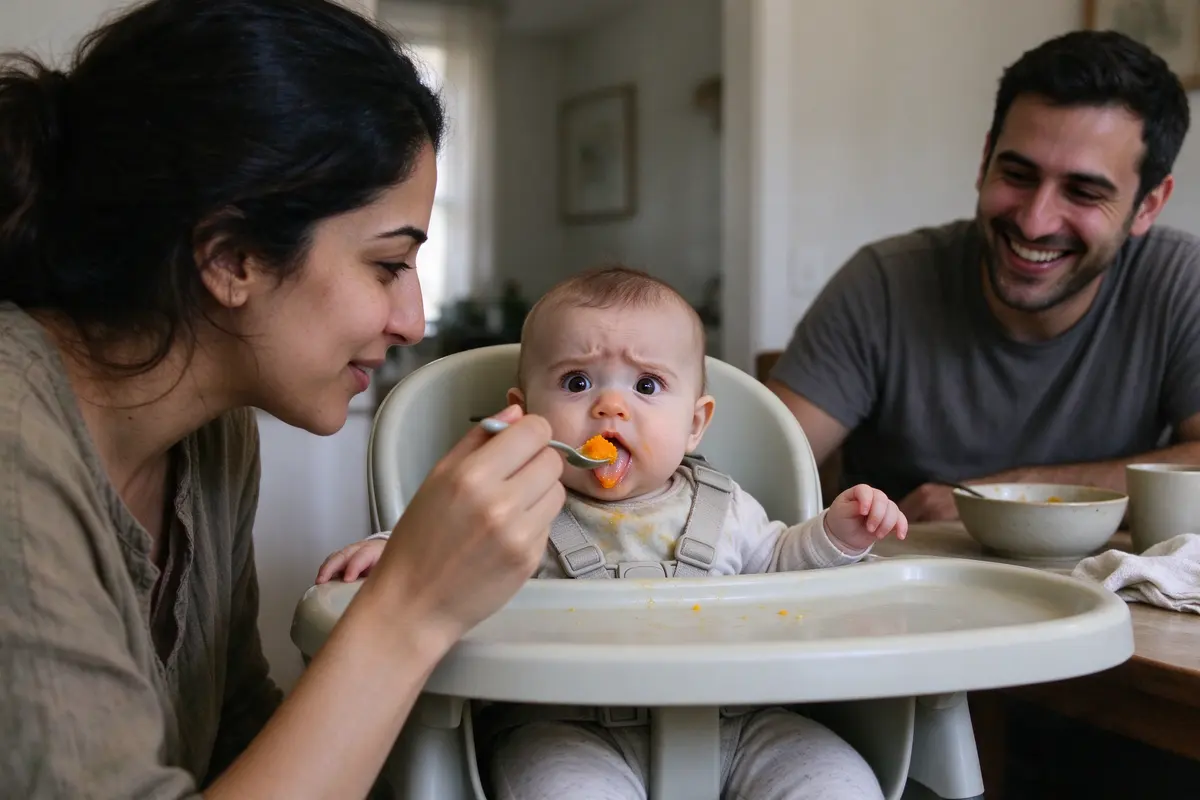
The lumpy mash
Time: One meal
Pick one food your baby already eats smooth: sweet potato, banana, or a well-cooked carrot.
Mash it with a fork instead of the blender, leaving soft lumps you can squash flat between two fingers.
Buckle your baby upright and offer it from the spoon, or a little on the tray, and watch (AAP).
Expect a gag or two and a lump pushed back out. Give them a moment, finger out of the mouth (Children's Wisconsin).
Same food, same way, tomorrow.
Make it work:Thicker is the direction: smooth to mashed and lumpy, then finely chopped (CDC). One step at a time.
Watch for
Normal
a loud gag on the first lump, with coughing and a red face (Children's Wisconsin).
Call 911
if your baby goes silent or squeaky, can't cry or cough, or turns pale or blue, and start back blows and chest thrusts (Red Cross).
Normal
a lump pushed out with the tongue and a frown, then the next spoon taken.
Tell your pediatrician
if your baby struggles to swallow soft foods; the AAP says it's better to wait and ask (AAP).
Normal
a bigger milk feed after a lumpy meal; breast milk or formula is still the main drink (Muth, AAP).
Call your pediatrician right away
for signs of dehydration: no urine in more than 8 hours, dark urine, a very dry mouth, or no tears (AAP).
For you
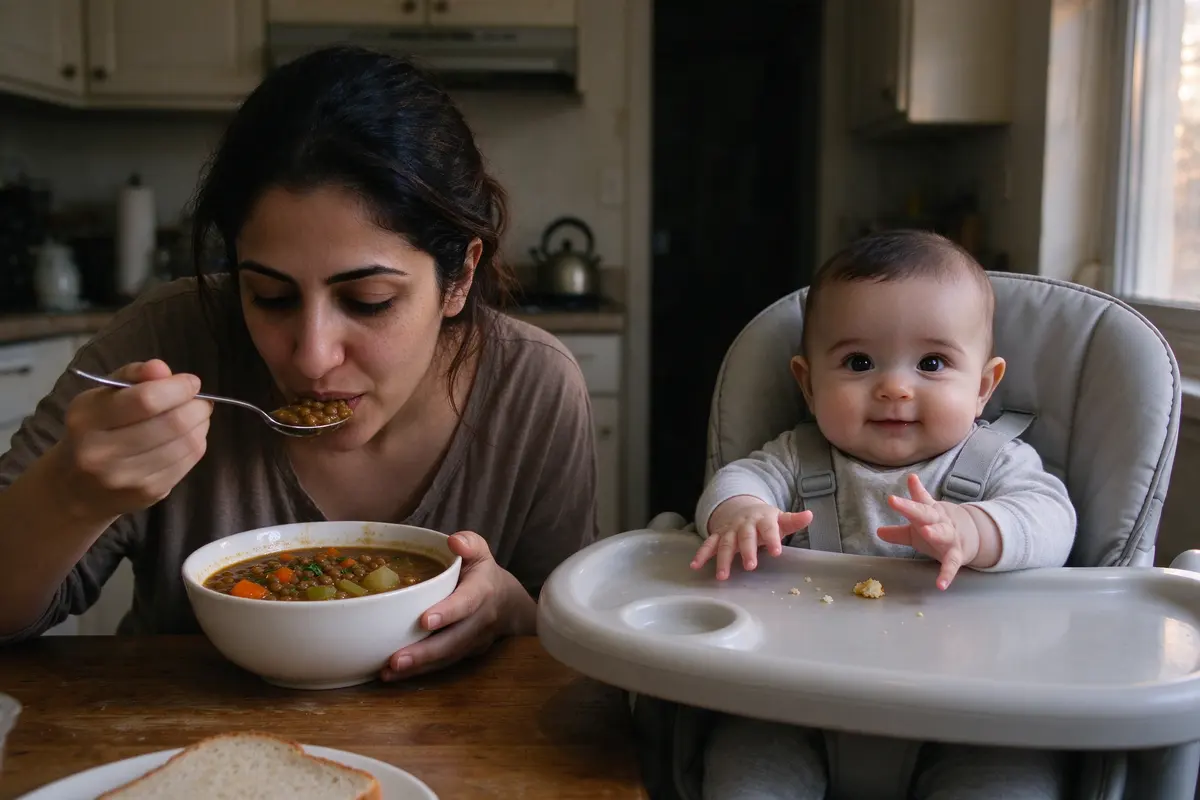
Your own lunch, lumpy and all. The AAP's advice for the baby is to eat together (AAP), which only works if there's a plate in front of you too, and the Office on Women's Health's advice for your own recovery was never complicated: plenty of water and fresh fruits and vegetables (OWH). A bowl of something with chunks in it, eaten sitting down while the baby works on the mash, is the whole of today's nutrition plan for you. The baby is watching how you eat; that's a reason to eat, not a performance.
If you're the partner: two bowls on the table at the baby's lunch, not one. Hers is the one with the bread.
Sources
- Centers for Disease Control and Prevention. "Tastes and Textures." 2026. https://www.cdc.gov/infant-toddler-nutrition/foods-and-drinks/tastes-and-textures.html
- Centers for Disease Control and Prevention. "When, What, and How to Introduce Solid Foods." 2026. https://www.cdc.gov/infant-toddler-nutrition/foods-and-drinks/when-what-and-how-to-introduce-solid-foods.html
- Coulthard H, Harris G, Emmett P. "Delayed introduction of lumpy foods to children during the complementary feeding period affects child's food acceptance and feeding at 7 years of age." Maternal & Child Nutrition, 2009. https://pubmed.ncbi.nlm.nih.gov/19161546/
- Spill MK, Johns K, Callahan EH, et al. "Repeated exposure to food and food acceptability in infants and toddlers: a systematic review." American Journal of Clinical Nutrition, 2019. https://pubmed.ncbi.nlm.nih.gov/30982874/
- Centers for Disease Control and Prevention. "Milestones by 9 Months." Learn the Signs. Act Early. program, updated 2026. https://www.cdc.gov/act-early/milestones/9-months.html
- Lehman P. "Choking vs. gagging: What parents need to know when introducing solid foods to children." Children's Wisconsin, 2024. https://childrenswi.org/at-every-turn/stories/2024/03/choking-vs-gagging-what-parents-need-to-know-when-introducing-solid-foods-to-children
- American Academy of Pediatrics. "When Can Babies Start Solid Foods? Readiness & Feeding Tips." HealthyChildren.org, updated 2026. https://www.healthychildren.org/English/ages-stages/baby/feeding-nutrition/Pages/Starting-Solid-Foods.aspx
- Agbim IA, Hurtado CW. "Baby-Led Weaning: Is It Safe?" HealthyChildren.org, updated 2024. https://www.healthychildren.org/English/ages-stages/baby/feeding-nutrition/Pages/baby-led-weaning-is-it-safe.aspx
- Centers for Disease Control and Prevention. "Choking Hazards." 2026. https://www.cdc.gov/infant-toddler-nutrition/foods-and-drinks/choking-hazards.html
- Centers for Disease Control and Prevention. "Signs Your Child Is Hungry or Full." 2026. https://www.cdc.gov/infant-toddler-nutrition/mealtime/signs-your-child-is-hungry-or-full.html
- American Red Cross. "Infant Choking: How To Help." Accessed 2026. https://www.redcross.org/take-a-class/resources/learn-first-aid/infant-choking
- Muth ND. "Recommended Drinks for Children Age 5 & Younger." HealthyChildren.org, updated 2023. https://www.healthychildren.org/English/healthy-living/nutrition/Pages/Recommended-Drinks-for-Young-Children-Ages-0-5.aspx
- American Academy of Pediatrics. "Fever" (symptom checker). HealthyChildren.org, accessed 2026. https://www.healthychildren.org/English/tips-tools/symptom-checker/Pages/symptomviewer.aspx?symptom=Fever
- Office on Women's Health. "Recovering from birth." US Department of Health and Human Services, 2021. https://womenshealth.gov/pregnancy/childbirth-and-beyond/recovering-birth
This guide is general education that summarizes published research and guidance from groups like the American Academy of Pediatrics, the CDC, and the WHO. It isn’t medical advice, and every child develops on their own timeline. Your pediatrician knows your child; if something feels wrong, call them. In an emergency, call 911.
Get each day’s note the morning it applies
Add your baby to a free Chorevia household with their date of birth, and every morning for 300 days the day’s note arrives in the app and by email: what’s developing, one thing to try, what to watch for, and a word for you.
Create your household