Day 240 of 300 · Eight months
Eight months
Last reviewed · 4 min read · 18 sources · Plain-text version
Eight months. The 9-month list as a celebration, not a test; the sitting, scooting, or crawling video with no claims attached; the hotlines once more, lightly; and where the notes go next.

Eight months. Here is the list once more, for celebrating rather than scoring, and then where the notes go next.
Heart
By 9 months, most babies are shy, clingy, or fearful around strangers; show several facial expressions; look when you call their name; react when you leave; smile or laugh at peekaboo; make lots of different sounds like "mamamama"; lift their arms to be picked up; look for things dropped out of sight; bang two things together; get into a sit and sit without support; move things from hand to hand; and rake food toward themselves (CDC). Your baby is eight months, and that list is for a month from now, set at skills at least 75% of babies show by then (Zubler et al., 2022). Read it for the ones you've already seen, and smile at them.
Head
What you did this month, in the research's terms: you answered babble right away, which is what reshaped the sounds of 9.5-month-olds in the lab (Goldstein & Schwade, 2008); you kept offering the foods that got refused, because it can take 8 to 10 or more tastes (Spill et al., 2019); you said a quick, cheerful goodbye instead of sneaking out (CDC); and you anchored the furniture (CPSC). None of it needed equipment.
Body
The ninth month is the moving month. Pulling up to stand and walking while holding on to furniture are the 12-month milestones ahead (CDC), and pulling up often arrives before a baby knows how to get back down (AAP). So the mattress goes to its lowest setting before they can stand (AAP), and the walker stays in the store; they don't help and they send thousands of children to hospitals each year (AAP). The 9-month visit, with its screening questionnaire, is next month too.
Try today
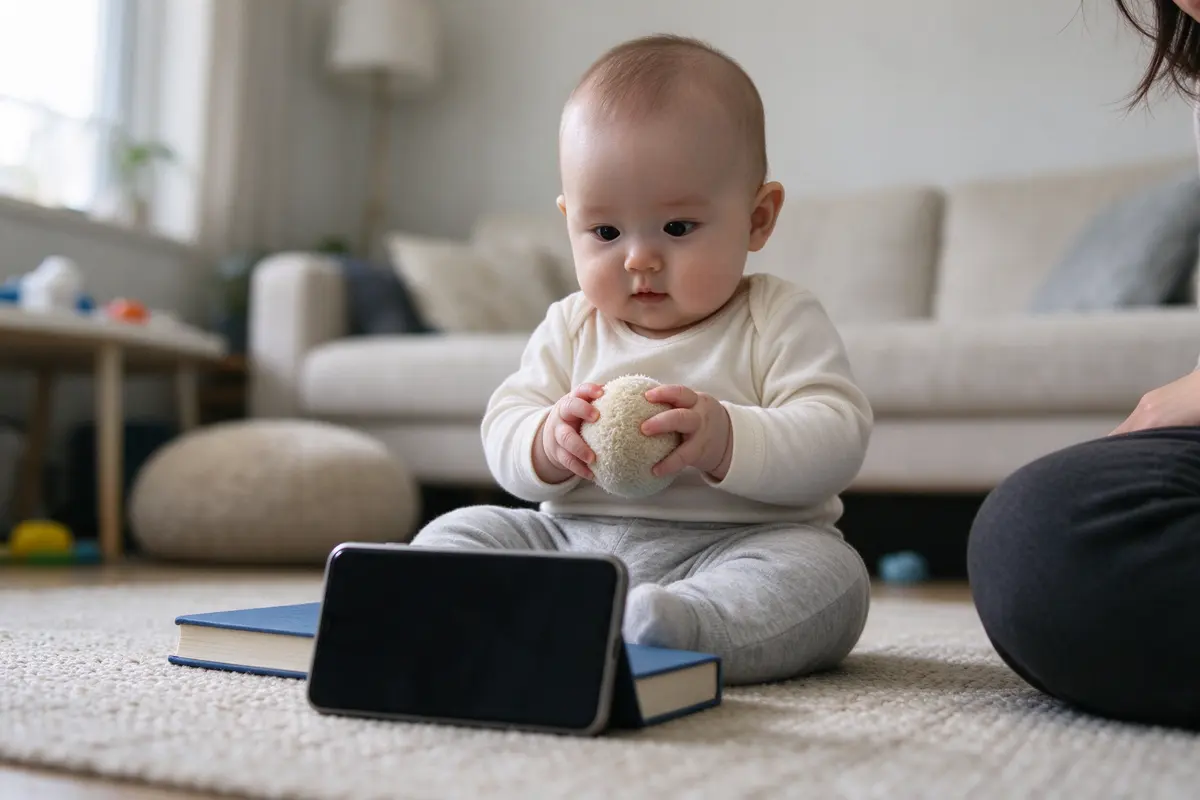
The sitting-alone video
Time: 2 minutes, baby rested, floor cleared
Prop the phone against a book on the rug and sit the baby in front of it with a favorite toy, you right beside them.
Say the date and "eight months" out loud at the start, and nothing else about what they can or can't do.
Record a minute: a sit, a reach, a scoot or a crawl if there is one, a topple caught in your hands.
Send it to the person who hasn't seen them since the seven-month one; the video call with family is the AAP's one screen exception (Hill, AAP).
Make it work:If the baby scoots instead of crawling, film the scoot. Crawling isn't on any checklist (Kretch et al., 2022), and 4.3% of healthy babies never do it on hands and knees (WHO Multicentre Growth Reference Study Group, 2006).
Watch for
Normal
a baby who cries when you leave the room and stops within minutes of your going; that's attachment, not spoiling (AAP).
Bring it up with your pediatrician
if by 9 months your baby doesn't sit without support, look when called, or babble lots of different sounds (CDC).
Normal
a first fever during a cold, under 104°F, in a baby who still drinks and plays.
Normal
knowing this baby better than anyone alive.
Call anyway
if your baby just doesn't seem right to you. Trust your instincts; eight months have built them (Lurie Children's).
For you
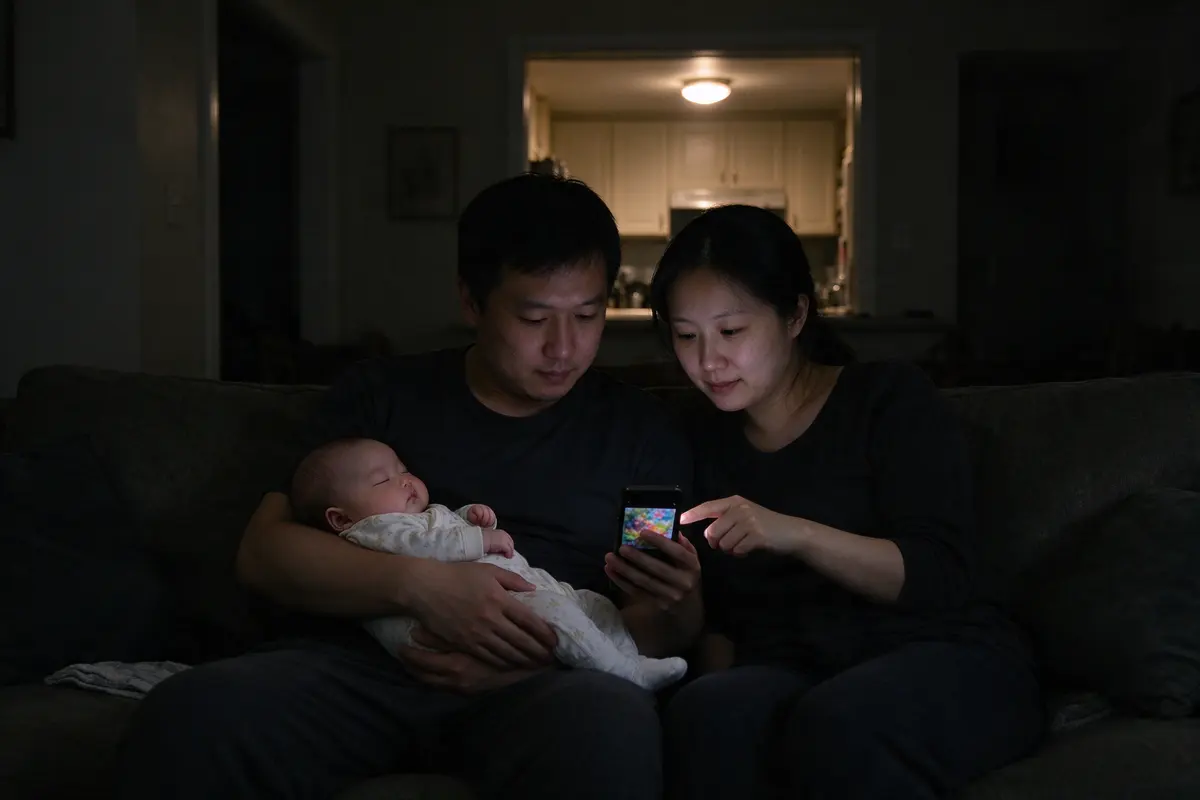
Eight months of you. Once more, lightly: the National Maternal Mental Health Hotline is 1-833-TLC-MAMA (1-833-852-6262), call or text; 988 is for anyone; in an emergency, 911 (CDC). Partners too: about 10% of fathers have depression around a birth, with higher rates reported at 3 to 6 months after (Paulson & Bazemore, 2010), which is now. Ask each other the real question tonight, and listen to the answer.
If you're the partner: say the thing she did this month that you'll remember. Then keep reading together: the 7-to-12-month guide has the whole stretch to the first birthday, and the notes continue tomorrow at your ninth month.
Sources
- Centers for Disease Control and Prevention. "Milestones by 9 Months." Learn the Signs. Act Early. program, updated 2026. https://www.cdc.gov/act-early/milestones/9-months.html
- Zubler JM, Wiggins LD, Macias MM, et al. "Evidence-Informed Milestones for Developmental Surveillance Tools." Pediatrics, 2022. https://pubmed.ncbi.nlm.nih.gov/35132439/
- Goldstein MH, Schwade JA. "Social feedback to infants' babbling facilitates rapid phonological learning." Psychological Science, 2008. https://pubmed.ncbi.nlm.nih.gov/18466414/
- Spill MK, Johns K, Callahan EH, et al. "Repeated exposure to food and food acceptability in infants and toddlers: a systematic review." American Journal of Clinical Nutrition, 2019. https://pubmed.ncbi.nlm.nih.gov/30982874/
- US Consumer Product Safety Commission. "CPSC Adopts Final Consumer Product Safety Standard to Prevent Tip-overs of Dressers and Other Clothing Storage Units." 2023. https://www.cpsc.gov/Newsroom/News-Releases/2023/CPSC-Adopts-Final-Consumer-Product-Safety-Standard-to-Prevent-Tip-overs-of-Dressers-and-Other-Clothing-Storage-Units
- Centers for Disease Control and Prevention. "Milestones by 1 Year." Learn the Signs. Act Early. program, updated 2026. https://www.cdc.gov/act-early/milestones/1-year.html
- American Academy of Pediatrics. "Movement Milestones in Babies 8 to 12 Months Old." HealthyChildren.org, updated 2021. https://www.healthychildren.org/English/ages-stages/baby/Pages/Movement-8-to-12-Months.aspx
- American Academy of Pediatrics. "Make Baby's Room Safe: Parent Checklist." HealthyChildren.org, updated 2020. https://www.healthychildren.org/English/safety-prevention/at-home/Pages/Make-Babys-Room-Safe.aspx
- American Academy of Pediatrics. "Baby Walkers: A Dangerous Choice." HealthyChildren.org, updated 2022. https://www.healthychildren.org/English/safety-prevention/at-home/Pages/Baby-Walkers-A-Dangerous-Choice.aspx
- Hill DL. "Why to Avoid TV for Infants & Toddlers." HealthyChildren.org, updated 2016. https://www.healthychildren.org/English/family-life/Media/Pages/Why-to-Avoid-TV-Before-Age-2.aspx
- Kretch KS, Willett SL, Hsu LY, et al. "'Learn the Signs. Act Early.': Updates and Implications for Physical Therapists." Pediatric Physical Therapy, 2022. https://pubmed.ncbi.nlm.nih.gov/35876833/
- WHO Multicentre Growth Reference Study Group. "WHO Motor Development Study: windows of achievement for six gross motor development milestones." Acta Paediatrica Supplement, 2006. https://pubmed.ncbi.nlm.nih.gov/16817682/
- American Academy of Pediatrics. "Emotional and Social Development: 8 to 12 Months." HealthyChildren.org, updated 2009. https://www.healthychildren.org/English/ages-stages/baby/Pages/Emotional-and-Social-Development-8-12-Months.aspx
- Di Giovine M, Catenaccio E. "Febrile Seizures in Children." HealthyChildren.org, updated 2025. https://www.healthychildren.org/English/health-issues/conditions/fever/Pages/Febrile-Seizures.aspx
- American Academy of Pediatrics. "Fever" (symptom checker). HealthyChildren.org, accessed 2026. https://www.healthychildren.org/English/tips-tools/symptom-checker/Pages/symptomviewer.aspx?symptom=Fever
- Lurie Children's Hospital of Chicago. "When to Call the Pediatrician for Your Newborn." 2024. https://www.luriechildrens.org/en/blog/when-to-call-the-pediatrician-for-your-newborn/
- Centers for Disease Control and Prevention. "Symptoms of Depression Among Women." 2024. https://www.cdc.gov/reproductive-health/depression/index.html
- Paulson JF, Bazemore SD. "Prenatal and postpartum depression in fathers and its association with maternal depression: a meta-analysis." JAMA, 2010. https://pubmed.ncbi.nlm.nih.gov/20483973/
This guide is general education that summarizes published research and guidance from groups like the American Academy of Pediatrics, the CDC, and the WHO. It isn’t medical advice, and every child develops on their own timeline. Your pediatrician knows your child; if something feels wrong, call them. In an emergency, call 911.
Get each day’s note the morning it applies
Add your baby to a free Chorevia household with their date of birth, and every morning for 300 days the day’s note arrives in the app and by email: what’s developing, one thing to try, what to watch for, and a word for you.
Create your household