Day 213 of 300 · Week 29
Crawling, or not
Last reviewed · 4 min read · 8 sources · Plain-text version
Crawling is usually mastered between 7 and 10 months by the babies who crawl, 4.3% never crawl on hands and knees, and CDC took it off the checklists. A cushion course for any kind of mover.
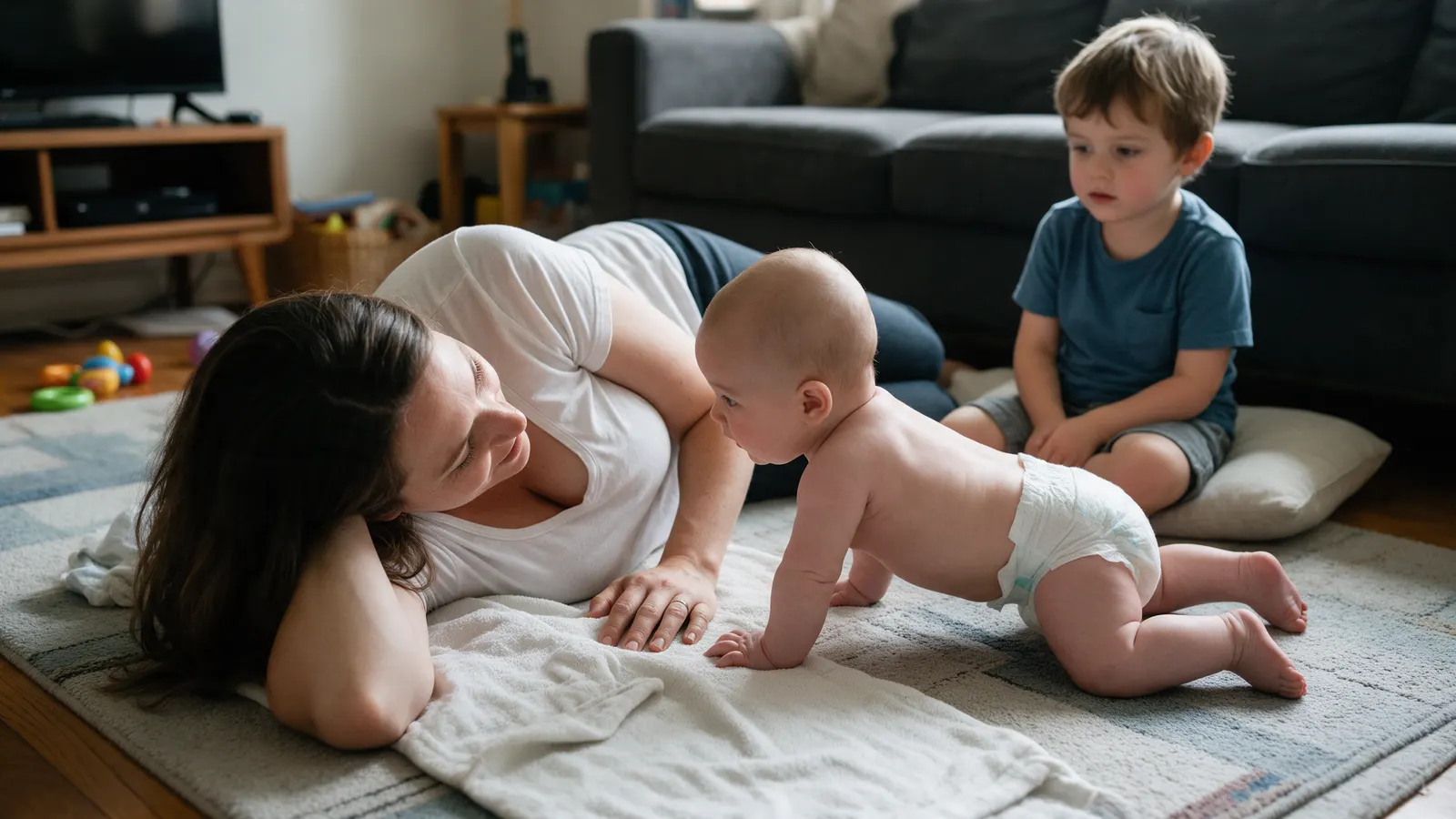
Someone will ask this month whether the baby is crawling yet. Today is the honest answer, including the part where the question matters less than it sounds.
Heart
Crawling is usually mastered between 7 and 10 months, though a few babies scoot on their bottoms or slither on their bellies instead, and the AAP says that's no cause for concern as long as they use each arm and leg equally (AAP). The range is wider than the average. In the WHO's study of 816 healthy children in five countries, hands-and-knees crawling started anywhere from 5.2 to 13.5 months, and 4.3% of the children never crawled on hands and knees at all (WHO Multicentre Growth Reference Study Group, 2006). So a 7-month-old who rocks and goes backward is early in the window, and a baby who skips crawling entirely has company.
Head
CDC removed crawling from its checklists in 2022. A review for physical therapists found no good evidence that crawling itself is essential; the benefits linked to it seem to come from moving around independently in any form. The authors found only three studies comparing crawlers with non-crawlers, all of questionable quality, and said plainly that the question isn't settled. Many therapists disagree (Kretch et al., 2022). The two takeaways from the guide: scooting and slithering count, and mention it if your baby favors one side (Kretch et al., 2022; AAP).
Body
Moving is learned through practice, in huge amounts: filmed during free play, 12- to 19-month-olds averaged 2,368 steps and 17 falls per hour (Adolph et al., 2012). Safe floor space beats any gadget; baby walkers don't help, can delay walking, and cause injuries (AAP). The AAP's suggestion for a baby who's starting to move is a mini obstacle course of pillows, boxes, and sofa cushions (AAP). One more thing changes once they can cover ground: everything still goes in the mouth, so check the floor often (AAP).
Try today

Cushion crawl course
Time: 5 to 10 minutes · Cushion crawl course in the guide
Lay two or three sofa cushions and a pillow on the floor in a low, bumpy path. Clear the floor around it first (AAP).
Put a favorite toy at the far end, just out of reach.
Cheer your baby on as they roll, scoot, slither, or climb toward it. Any way across counts.
Hide behind the last cushion and pop up with "Peekaboo!"
Make it work:Stay right beside your baby the whole time. A baby who falls between pillows or under a box may not be able to get out and could smother (AAP). Put the cushions back when you're done.
Watch for
Normal
rocking on hands and knees and going backward, or no crawling at all yet; 4.3% of healthy babies never crawl on hands and knees (WHO Multicentre Growth Reference Study Group, 2006).
Bring it up
if your baby uses one arm or leg much more than the other (AAP).
Normal
a bottom scoot or a belly slither instead of a crawl (AAP).
Talk with your pediatrician
if your baby has lost skills they used to have (CDC).
Normal
a crumb found on the floor and headed for the mouth (AAP).
Call 911
if your baby is choking and can't breathe, cry, or make noise, turns bluish, or goes limp (AAP).
For you
Compare to the range, not to the baby down the street (WHO Multicentre Growth Reference Study Group, 2006). The baby down the street who crawled at 6 months is one point inside a window that runs to 13.5; yours is another. The same study is the one that found 4.3% never crawled, and the review that followed couldn't find good evidence it matters (Kretch et al., 2022). When the question comes at the park, "not yet, and the pediatrician isn't worried" is a complete answer.
The rule works for the mother down the street too. Her baby's sleep, her flat stomach, her return to work: one point in a range you can't see.
If you're the partner: you field the crawling question this week. The answer is in the second paragraph.
Sources
- American Academy of Pediatrics. "Movement Milestones in Babies 8 to 12 Months Old." HealthyChildren.org, updated 2021. https://www.healthychildren.org/English/ages-stages/baby/Pages/Movement-8-to-12-Months.aspx
- WHO Multicentre Growth Reference Study Group. "WHO Motor Development Study: windows of achievement for six gross motor development milestones." Acta Paediatrica Supplement, 2006. https://pubmed.ncbi.nlm.nih.gov/16817682/
- Kretch KS, Willett SL, Hsu LY, et al. "'Learn the Signs. Act Early.': Updates and Implications for Physical Therapists." Pediatric Physical Therapy, 2022. https://pubmed.ncbi.nlm.nih.gov/35876833/
- Adolph KE, Cole WG, Komati M, et al. "How do you learn to walk? Thousands of steps and dozens of falls per day." Psychological Science, 2012. https://pubmed.ncbi.nlm.nih.gov/23085640/
- American Academy of Pediatrics. "Baby Walkers: A Dangerous Choice." HealthyChildren.org, updated 2022. https://www.healthychildren.org/English/safety-prevention/at-home/Pages/Baby-Walkers-A-Dangerous-Choice.aspx
- American Academy of Pediatrics. "Cognitive Development in Infants: 8 to 12 Months." HealthyChildren.org, updated 2023. https://www.healthychildren.org/English/ages-stages/baby/Pages/Cognitive-Development-8-to-12-Months.aspx
- Centers for Disease Control and Prevention. "Milestones by 9 Months." Learn the Signs. Act Early. program, updated 2026. https://www.cdc.gov/act-early/milestones/9-months.html
- Bradin S. "Choking Prevention for Babies & Children: What Every Parent Needs to Know." HealthyChildren.org, updated 2026. https://www.healthychildren.org/English/health-issues/injuries-emergencies/Pages/Choking-Prevention.aspx
This guide is general education that summarizes published research and guidance from groups like the American Academy of Pediatrics, the CDC, and the WHO. It isn’t medical advice, and every child develops on their own timeline. Your pediatrician knows your child; if something feels wrong, call them. In an emergency, call 911.
Get each day’s note the morning it applies
Add your baby to a free Chorevia household with their date of birth, and every morning for 300 days the day’s note arrives in the app and by email: what’s developing, one thing to try, what to watch for, and a word for you.
Create your household