Day 218 of 300 · Week 30
Three meals, two snacks, by nine months
Last reviewed · 3 min read · 13 sources · Plain-text version
At 9 months the AAP suggests 3 meals and 2 to 3 snacks a day, with breast milk or formula still the main drink and 4 to 8 ounces of water. The direction of travel, mapped around tomorrow's naps.
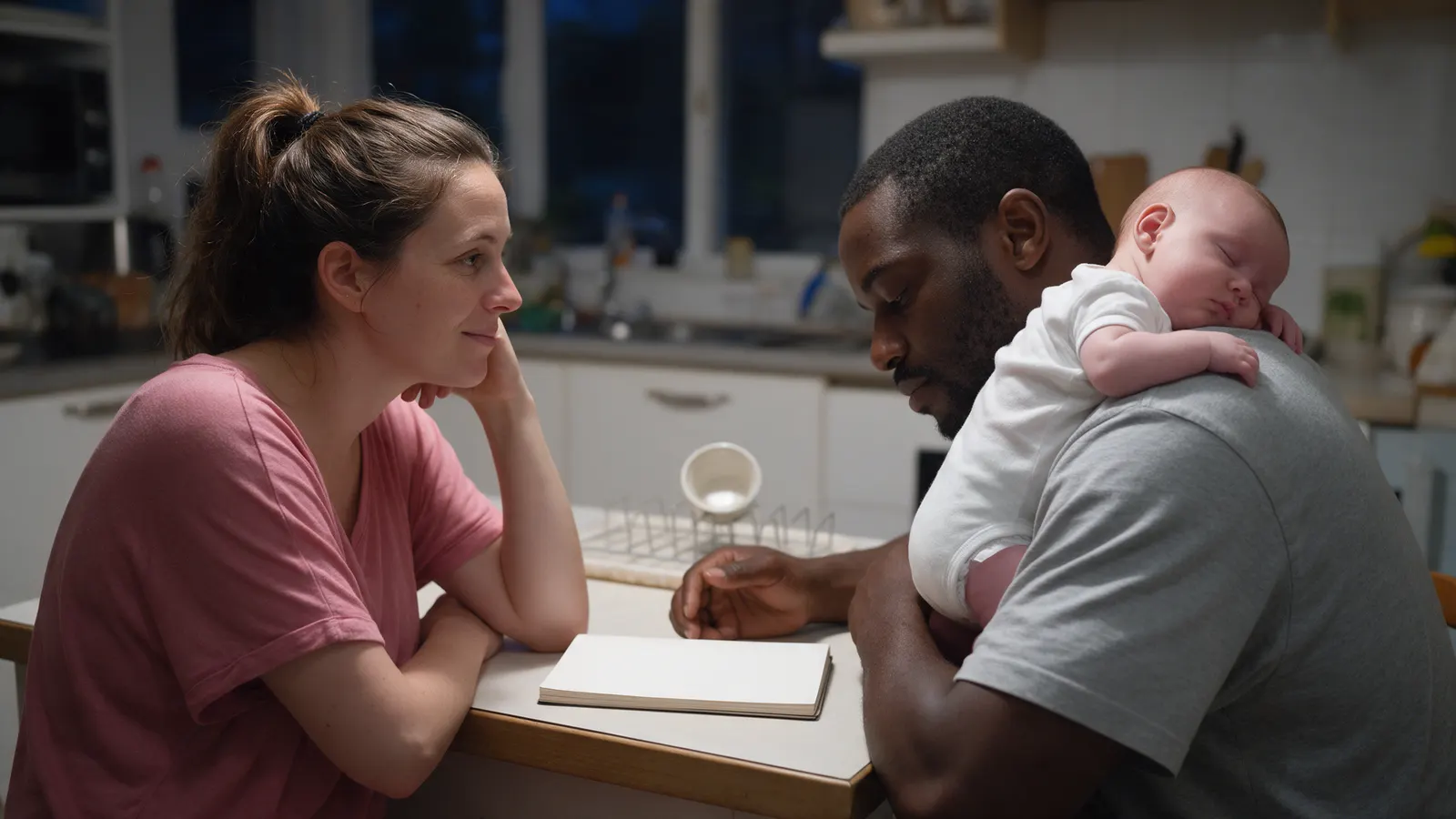
Someone will ask whether the baby is "on three meals yet." Today is the number behind that question, and why it's a direction rather than a deadline.
Heart
At 9 months, the AAP suggests 3 meals and 2 to 3 snacks a day (AAP). That's the shape six or seven weeks from now, and a 7-month-old on one or two small meals is on the road to it, not behind. Breast milk or formula is still the main drink, plus 4 to 8 ounces of water a day (Muth, AAP). Even as solids grow, breast milk or formula is still the most important source of nutrition (CDC); the meals are learning, not yet the fuel.
Head
The meal ends at a cue, not at an empty bowl. Hunger looks like reaching for food, opening up for the spoon, or getting excited when food appears; fullness looks like pushing food away, closing the mouth, or turning the head. Let your baby decide how much; they don't need to finish the jar, and food shouldn't be a reward or punishment (CDC). If your baby cries or turns away, stop and try again another time (AAP). Three meals with three bites each is three meals.
Body
The drink. Water goes in an open, sippy, or straw cup, up to 4 to 8 ounces a day, and fluoridated tap water helps protect teeth (Muth, AAP). Offer a cup at meals now; the move off bottles finishes between 12 and 18 months (Shu, AAP). No juice before 12 months (AAP), no cow's milk as a drink, and no honey, not even on a pacifier (CDC). The snacks are small, soft, and at the table, under the same rules as the meals: upright, buckled, watched (AAP; CDC).
Try today

The meal map
Time: 10 minutes tonight, with a pen
Write tomorrow's naps and milk feeds down the left side of a page, as they usually fall.
Fit three small meals into the awake stretches, at the family's own mealtimes where you can, since the AAP's advice is to eat together (AAP).
Pencil one or two snacks between them. The AAP's 9-month shape is 3 meals and 2 to 3 snacks; you're sketching toward it, not grading tomorrow (AAP).
Next to each one, write "stop at the cue": a pushed-away spoon, a closed mouth, or a turned head ends it (CDC).
Make it work:Milk is still the main drink, so a meal lost to a long nap is nothing to make up (Muth, AAP).
Watch for
Normal
three bites, then a closed mouth and a turned head (CDC).
Talk with your pediatrician
if your baby struggles to swallow soft foods, or was born early and has trouble sitting up for meals (AAP).
Normal
water down the chin and most of the cup on the tray (Muth, AAP).
Call 911
for swelling of the lips, face, or tongue, widespread hives, trouble breathing, or sudden floppiness after a food (NIAID).
Normal
smaller meals for a few days with a cold.
For you
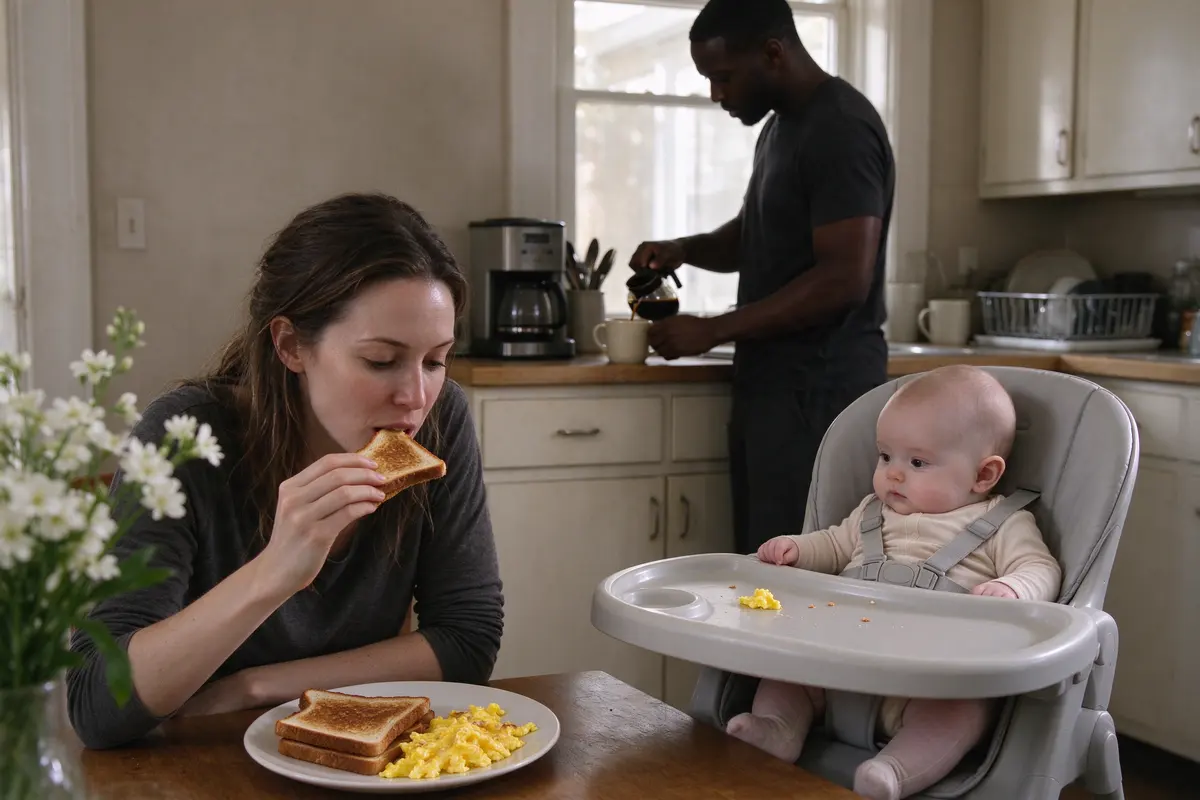
Eat at the same times. The map you drew tonight has three meals and a snack or two on it for the baby (AAP); write your own name next to each one. The point of eating together is that there are two plates, and you've spent seven months eating standing up at odd hours. Overwhelming tiredness is on the CDC's list of urgent maternal warning signs (CDC); ordinary tiredness that lifts after a sandwich isn't, but you only find out which one you have by eating the sandwich.
If you're the partner: your name goes on the map too, at least for dinner. Three plates, one table, one time.
Sources
- American Academy of Pediatrics. "Checkup Checklist: 9 Months Old." HealthyChildren.org, updated 2021. https://www.healthychildren.org/English/ages-stages/Your-Childs-Checkups/Pages/Your-Checkup-Checklist-9-Months-Old.aspx
- Muth ND. "Recommended Drinks for Children Age 5 & Younger." HealthyChildren.org, updated 2023. https://www.healthychildren.org/English/healthy-living/nutrition/Pages/Recommended-Drinks-for-Young-Children-Ages-0-5.aspx
- Centers for Disease Control and Prevention. "Milestones by 6 Months." Learn the Signs. Act Early. program, updated 2026. https://www.cdc.gov/act-early/milestones/6-months.html
- Centers for Disease Control and Prevention. "Signs Your Child Is Hungry or Full." 2026. https://www.cdc.gov/infant-toddler-nutrition/mealtime/signs-your-child-is-hungry-or-full.html
- American Academy of Pediatrics. "When Can Babies Start Solid Foods? Readiness & Feeding Tips." HealthyChildren.org, updated 2026. https://www.healthychildren.org/English/ages-stages/baby/feeding-nutrition/Pages/Starting-Solid-Foods.aspx
- Shu J. "From Bottle to Cup: Helping Your Child Make a Healthy Transition." HealthyChildren.org, updated 2023. https://www.healthychildren.org/English/ages-stages/baby/feeding-nutrition/Pages/Discontinuing-the-Bottle.aspx
- Centers for Disease Control and Prevention. "Foods and Drinks to Avoid or Limit." 2026. https://www.cdc.gov/infant-toddler-nutrition/foods-and-drinks/foods-and-drinks-to-avoid-or-limit.html
- Agbim IA, Hurtado CW. "Baby-Led Weaning: Is It Safe?" HealthyChildren.org, updated 2024. https://www.healthychildren.org/English/ages-stages/baby/feeding-nutrition/Pages/baby-led-weaning-is-it-safe.aspx
- Centers for Disease Control and Prevention. "Choking Hazards." 2026. https://www.cdc.gov/infant-toddler-nutrition/foods-and-drinks/choking-hazards.html
- National Institute of Allergy and Infectious Diseases. "Instructions for Home Feeding of Peanut Protein for Infants at Low Risk of an Allergic Reaction to Peanut" (Appendix D). 2017. https://www.niaid.nih.gov/sites/default/files/addendum_guidelines_peanut_appx_d.pdf
- American Academy of Pediatrics. "Fever" (symptom checker). HealthyChildren.org, accessed 2026. https://www.healthychildren.org/English/tips-tools/symptom-checker/Pages/symptomviewer.aspx?symptom=Fever
- American Academy of Pediatrics. "Fever and Your Baby." HealthyChildren.org, updated 2025. https://www.healthychildren.org/English/health-issues/conditions/fever/Pages/Fever-and-Your-Baby.aspx
- Centers for Disease Control and Prevention. "Urgent Maternal Warning Signs and Symptoms." HEAR HER, 2024. https://www.cdc.gov/hearher/maternal-warning-signs/index.html
This guide is general education that summarizes published research and guidance from groups like the American Academy of Pediatrics, the CDC, and the WHO. It isn’t medical advice, and every child develops on their own timeline. Your pediatrician knows your child; if something feels wrong, call them. In an emergency, call 911.
Get each day’s note the morning it applies
Add your baby to a free Chorevia household with their date of birth, and every morning for 300 days the day’s note arrives in the app and by email: what’s developing, one thing to try, what to watch for, and a word for you.
Create your household