Day 237 of 300 · Week 32
Follow the point, before the point
Last reviewed · 3 min read · 9 sources · Plain-text version
Pointing to ask for things is a 15-month milestone, but the looking has started. Name what your baby stares at, ten things a day, the same name each time: the study behind it.
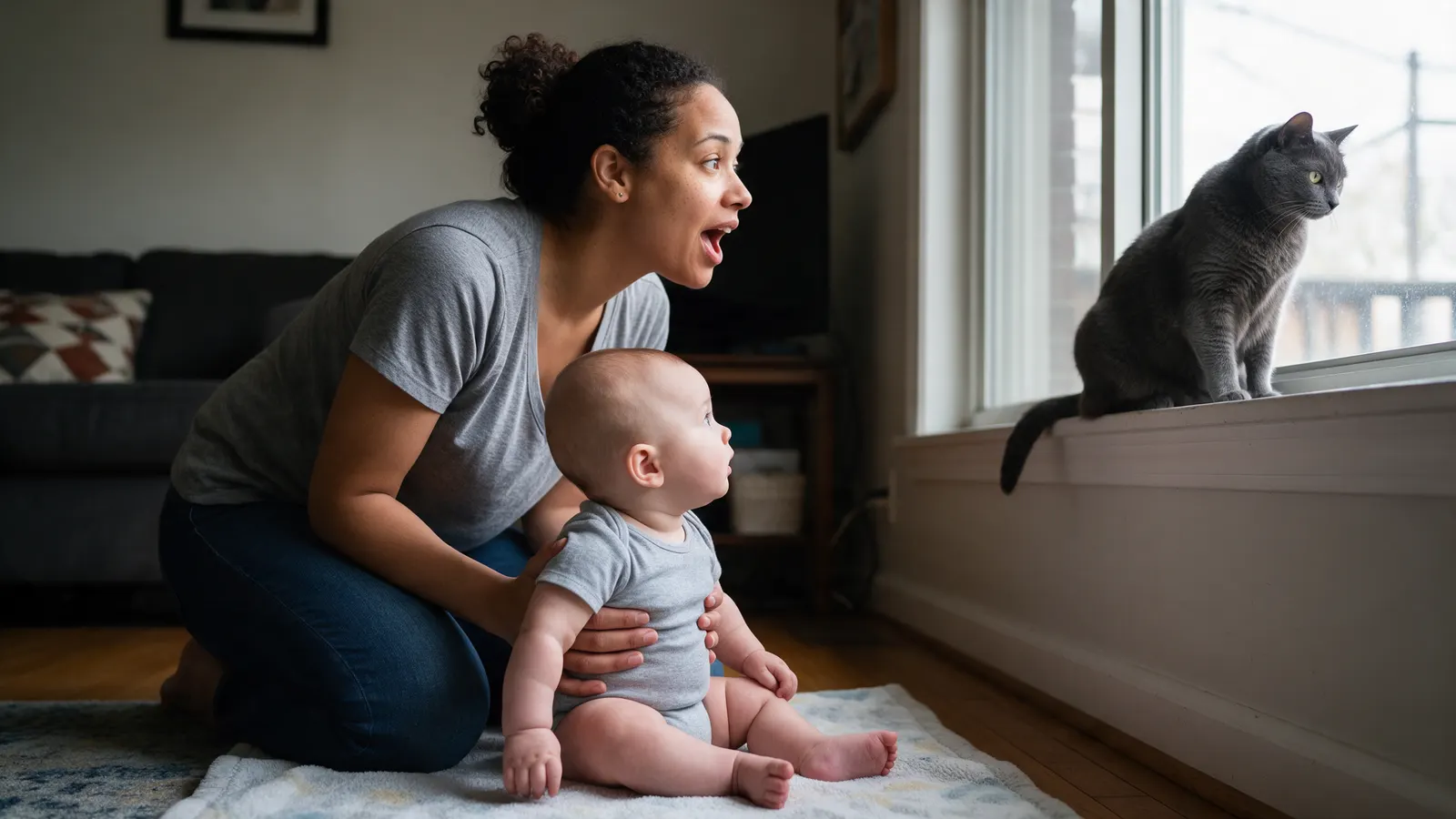
Your baby stares at things now, hard, for long seconds at a time. That stare is where pointing comes from, and today you answer it as if it were one.
Heart
In 24 babies followed monthly from 9 to 15 months, time spent sharing attention with their mothers, and mothers' talk about what the baby was already looking at, predicted the earliest gestures and words (Carpenter et al., 1998). In a study of 10 toddlers, many things children first pointed at later became words (Iverson & Goldin-Meadow, 2005). Both studies show links, not cause, and both are small. The practical reading is still worth having: talk about what the baby is already looking at, rather than steering them to what you want to show.
Head
Pointing to ask for things is a 15-month milestone (CDC), and waving bye-bye is a 12-month one (CDC), so a seven-month-old isn't there yet and isn't supposed to be. What they have is the look, and one gesture already: by 9 months, most babies lift their arms to be picked up (CDC). CDC's advice for this age is to describe what your baby sees (CDC); the AAP adds consistent names, "cat" today and not "kitty" tomorrow, and reminds you that a "word," to a baby, is any sound used the same way each time (AAP).
Body
The move is three beats. Look where they look. Name it, plainly. Add one more sentence, then pause for their turn (AAP). The pause is the hard part, because the baby's reply is a syllable or a stare, and it comes slowly. Answering those syllables right away is what reshaped the babble of 9.5-month-olds in the lab (Goldstein & Schwade, 2008), so the stare and the sound get the same treatment: you answer both.
Try today
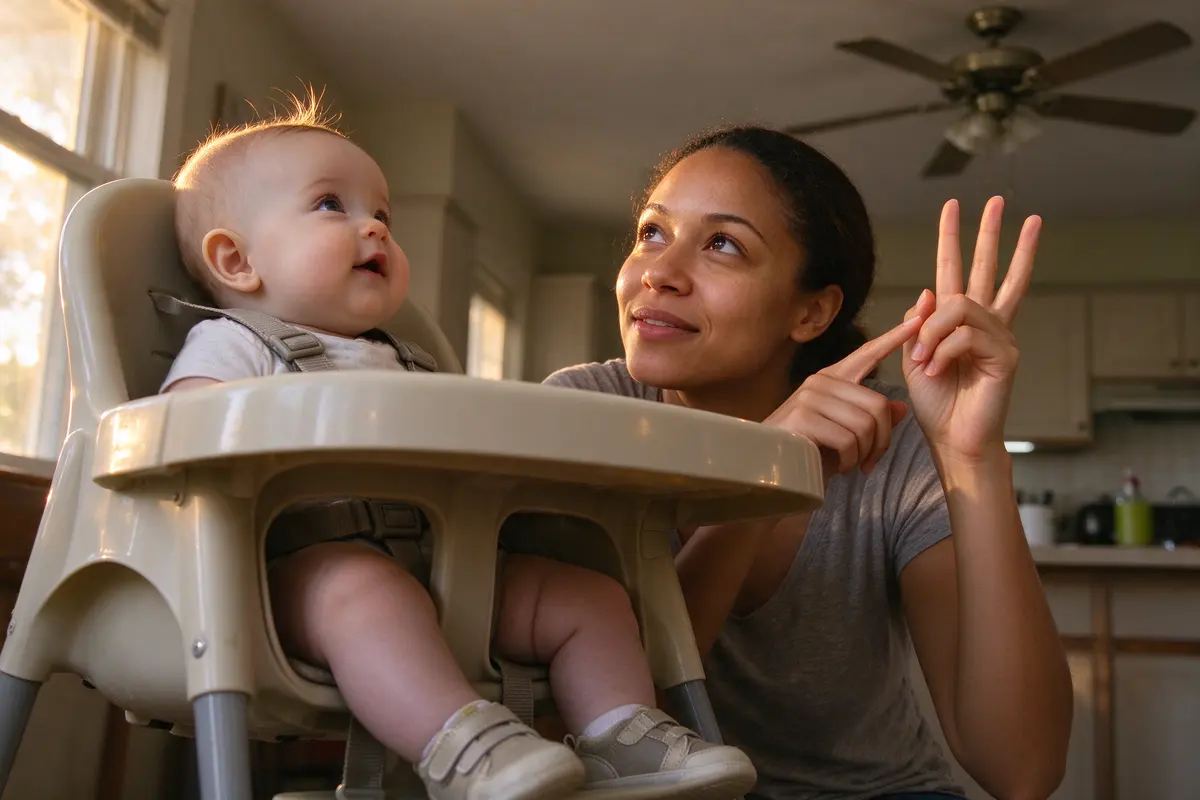
Name what they see
Time: All day, ten times · Follow the point in the guide
Through the day, catch ten stares: the ceiling fan, the cat, the spoon, the bus going by.
Look where they look, and name it once, plainly: "Fan."
Add one sentence, "The fan goes round," then stop and wait for their turn (Carpenter et al., 1998).
Use the same name tomorrow; "fan" stays "fan" (AAP).
Count to ten on your fingers, then stop counting but not naming.
Make it work:Their stare picks the subject. If you name the fan and they're looking at the cat, name the cat.
Watch for
Normal
a stare at the fan that lasts a full minute, and no sound at all while it does.
Bring it up with your pediatrician
if by 9 months your baby doesn't babble lots of different sounds (CDC).
Normal
Bring it up
if your baby has lost skills they used to have (CDC).
Normal
a baby who looks at your mouth while you name things.
Don't wait
if something worries you: ask about developmental screening, or call your state's early intervention program for a free evaluation without a referral (CDC).
For you
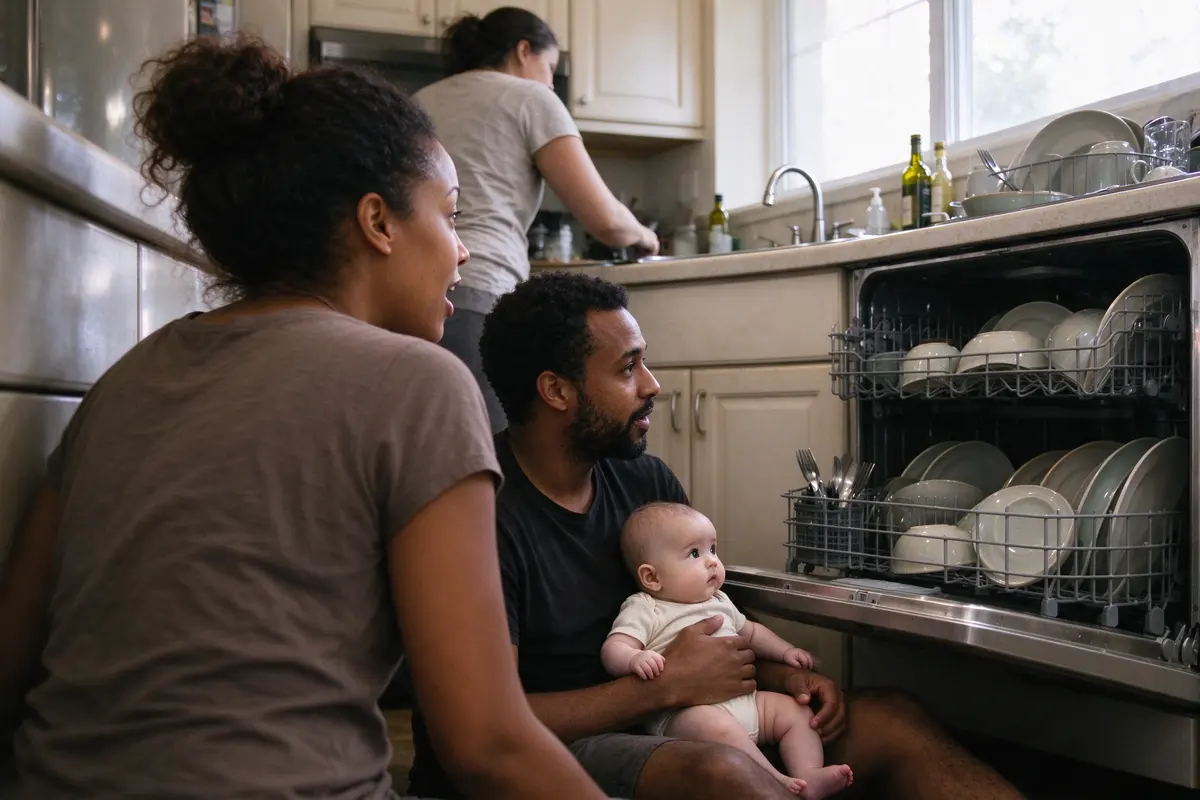
The narration is the curriculum. There is no card set, app, or class in the Carpenter study, only mothers talking about the thing their baby was already looking at (Carpenter et al., 1998), and the one coaching trial that changed anything coached parents to take turns, not to buy something (Ferjan Ramírez et al., 2020). You've been doing this since the narrated diaper changes in the first month. The stare just makes it easier to know what to say.
If you're the partner: your ten stares count the same as hers. Name what the baby sees while she eats sitting down.
Sources
- Carpenter M, Nagell K, Tomasello M. "Social cognition, joint attention, and communicative competence from 9 to 15 months of age." Monographs of the Society for Research in Child Development, 1998. https://pubmed.ncbi.nlm.nih.gov/9835078/
- Iverson JM, Goldin-Meadow S. "Gesture paves the way for language development." Psychological Science, 2005. https://pubmed.ncbi.nlm.nih.gov/15869695/
- Centers for Disease Control and Prevention. "Milestones by 15 Months." Learn the Signs. Act Early. program, accessed 2026. https://www.cdc.gov/act-early/milestones/15-months.html
- Centers for Disease Control and Prevention. "Milestones by 1 Year." Learn the Signs. Act Early. program, updated 2026. https://www.cdc.gov/act-early/milestones/1-year.html
- Centers for Disease Control and Prevention. "Milestones by 9 Months." Learn the Signs. Act Early. program, updated 2026. https://www.cdc.gov/act-early/milestones/9-months.html
- American Academy of Pediatrics. "Language Development: 8 to 12 Months." HealthyChildren.org, updated 2009. https://www.healthychildren.org/English/ages-stages/baby/Pages/Language-Development-8-to-12-Months.aspx
- Goldstein MH, Schwade JA. "Social feedback to infants' babbling facilitates rapid phonological learning." Psychological Science, 2008. https://pubmed.ncbi.nlm.nih.gov/18466414/
- Centers for Disease Control and Prevention. "Concerned About Your Child's Development?" Updated 2026. https://www.cdc.gov/act-early/families/concerned.html
- Ferjan Ramírez N, Lytle SR, Kuhl PK. "Parent coaching increases conversational turns and advances infant language development." Proceedings of the National Academy of Sciences, 2020. https://pubmed.ncbi.nlm.nih.gov/32015127/
This guide is general education that summarizes published research and guidance from groups like the American Academy of Pediatrics, the CDC, and the WHO. It isn’t medical advice, and every child develops on their own timeline. Your pediatrician knows your child; if something feels wrong, call them. In an emergency, call 911.
Get each day’s note the morning it applies
Add your baby to a free Chorevia household with their date of birth, and every morning for 300 days the day’s note arrives in the app and by email: what’s developing, one thing to try, what to watch for, and a word for you.
Create your household