Day 223 of 300 · Week 30
The yes space
Last reviewed · 4 min read · 9 sources · Plain-text version
Put tempting and dangerous things out of reach so you need "no" less often, say what to do instead of what not to, and save "no" for safety. The AAP's discipline advice, in one cabinet.

Yesterday's bowl of lids was the first shelf. Today is the whole idea: a home arranged so that "no" is rare, because almost everything within reach is allowed.
Heart
The AAP's first piece of discipline advice for a baby isn't about the baby at all. Put tempting and dangerous things out of reach so you need "no" less often (AAP). Then stock a low cabinet with wooden spoons, pots, and plastic containers, because at this age ordinary household objects are the most fascinating toys (AAP). A baby who can reach only yes things hears "yes" all day; that's not spoiling, it's the setup doing the work your voice would otherwise do. The guide calls it making a yes space.
Head
The rest of the AAP's list is about words. Model what you want. Use positive words, "Time to sit" instead of "Don't stand." Save "no" for safety. When your baby grabs something forbidden, swap it for something that's okay (AAP). The reason to ration "no" shows up on the 12-month list: by then most babies pause briefly or stop when they hear it (CDC), and a word that means "stop, danger" only works if it hasn't meant "stop touching the remote" forty times a day. The guide's script is the whole technique in two sentences: "Phones aren't for chewing. Here's your cup to bang." Then move the phone (AAP).
Body
One more line from the AAP matters more than the cabinet: get every caregiver to agree on the same few rules (AAP). Three is plenty: outlets, cords, and the stairs are the "no" list (AAP); the pots cabinet is the "yes" list; and the phone gets swapped, not scolded. Write them on a sticky note so the grandparent who babysits Thursday runs the same house you do.
Try today
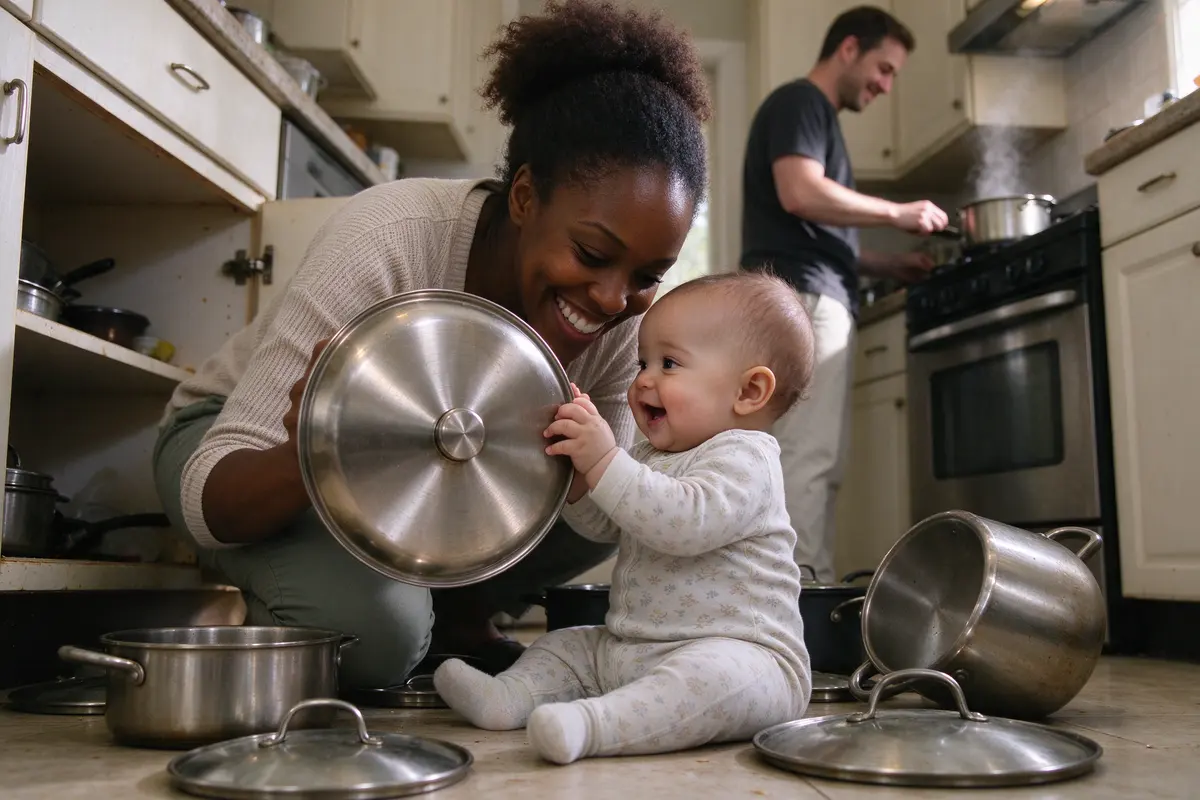
The yes cabinet
Time: 15 minutes to set up, then a few minutes of play · Make a yes space in the guide
Pick the lowest cabinet your baby can reach from the floor and empty it. Anything sharp, breakable, or small enough to fit entirely in their mouth goes up high (AAP).
Restock it with wooden spoons, a couple of pots, and big plastic containers with their lids (AAP).
Sit your baby on the floor in front of it, open the door, and say "yes, that's yours." Let them pull everything out; that's the game.
When they reach for something that isn't theirs, swap it for a spoon from the cabinet with a smile, and move the other thing out of reach (AAP).
Make it work:Cleaners and alcohol don't move to a higher shelf in the same cabinet; they move to a locked one (AAP).
Watch for
Normal
the same forbidden phone reached for ten times in a row; testing is how a baby learns what the rules are (AAP).
Call Poison Help, 1-800-222-1222,
if your baby gets into anything you think could be poisonous, and call 911 if they collapse, have a seizure, have trouble breathing, or can't be woken (Poison Control).
Normal
a baby who pulls every pot out and then cries because the cabinet is empty.
Call your pediatrician right away
if your baby cries nonstop, or cries when touched or moved (AAP).
Normal
a baby who seems not to hear "no" at all; pausing at the word is a 12-month skill, not a 7-month one (CDC).
For you
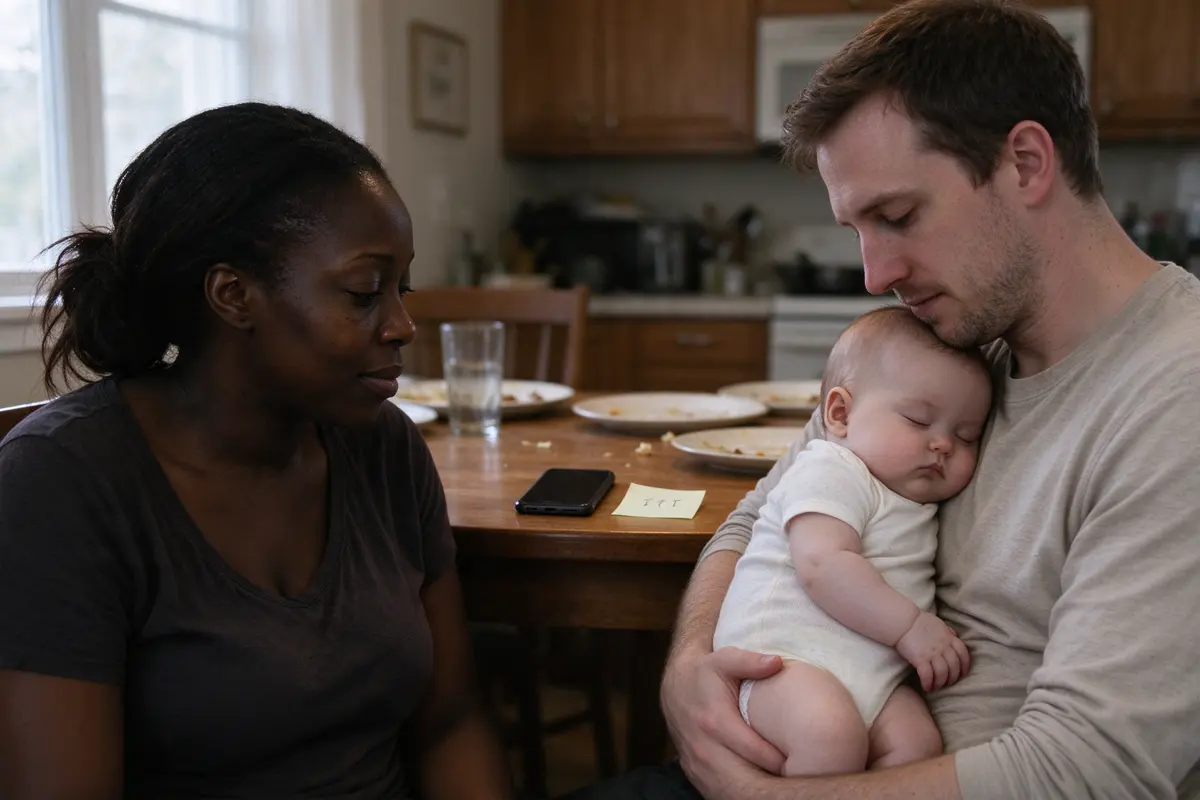
Fewer no's is less work for you. That's the part of the AAP's advice nobody says out loud: rearranging the room is a one-time job, and saying "no" is a job you'd otherwise do all day, every day, for the next two years (AAP). A yes space is also a space you can sit down in. If the floor your baby plays on has nothing on it you'd have to lunge for, you get to stay on the sofa.
If you're the partner: the sticky note with the three rules is yours to write tonight, and yours to read to whoever babysits next. The AAP's line is that every caregiver agrees on the same few rules (AAP); the person who makes that happen is usually the one who isn't holding the baby.
Sources
- American Academy of Pediatrics. "What's the Best Way to Discipline My Child?" HealthyChildren.org, updated 2018. https://www.healthychildren.org/English/family-life/family-dynamics/communication-discipline/Pages/Disciplining-Your-Child.aspx
- American Academy of Pediatrics. "Cognitive Development in Infants: 8 to 12 Months." HealthyChildren.org, updated 2023. https://www.healthychildren.org/English/ages-stages/baby/Pages/Cognitive-Development-8-to-12-Months.aspx
- Centers for Disease Control and Prevention. "Milestones by 1 Year." Learn the Signs. Act Early. program, updated 2026. https://www.cdc.gov/act-early/milestones/1-year.html
- American Academy of Pediatrics. "Home Safety: Tips for Families With Young Children." HealthyChildren.org, updated 2022. https://www.healthychildren.org/English/safety-prevention/at-home/Pages/Home-Safety-Heres-How.aspx
- Bradin S. "Choking Prevention for Babies & Children: What Every Parent Needs to Know." HealthyChildren.org, updated 2026. https://www.healthychildren.org/English/health-issues/injuries-emergencies/Pages/Choking-Prevention.aspx
- National Capital Poison Center. "Poison Control." Accessed 2026. https://www.poison.org/
- American Academy of Pediatrics. "Fever" (symptom checker). HealthyChildren.org, accessed 2026. https://www.healthychildren.org/English/tips-tools/symptom-checker/Pages/symptomviewer.aspx?symptom=Fever
- American Academy of Pediatrics. "Checkup Checklist: 9 Months Old." HealthyChildren.org, updated 2021. https://www.healthychildren.org/English/ages-stages/Your-Childs-Checkups/Pages/Your-Checkup-Checklist-9-Months-Old.aspx
- Centers for Disease Control and Prevention. "Milestones by 9 Months." Learn the Signs. Act Early. program, updated 2026. https://www.cdc.gov/act-early/milestones/9-months.html
This guide is general education that summarizes published research and guidance from groups like the American Academy of Pediatrics, the CDC, and the WHO. It isn’t medical advice, and every child develops on their own timeline. Your pediatrician knows your child; if something feels wrong, call them. In an emergency, call 911.
Get each day’s note the morning it applies
Add your baby to a free Chorevia household with their date of birth, and every morning for 300 days the day’s note arrives in the app and by email: what’s developing, one thing to try, what to watch for, and a word for you.
Create your household