Day 228 of 300 · Week 31
Night waking returns
Last reviewed · 4 min read · 11 sources · Plain-text version
Babies this age need 12 to 16 hours of sleep, usually 9 to 12 at night plus two naps, and separation anxiety can bring night waking back. The quiet reassurance: one sentence, one hand, then out.
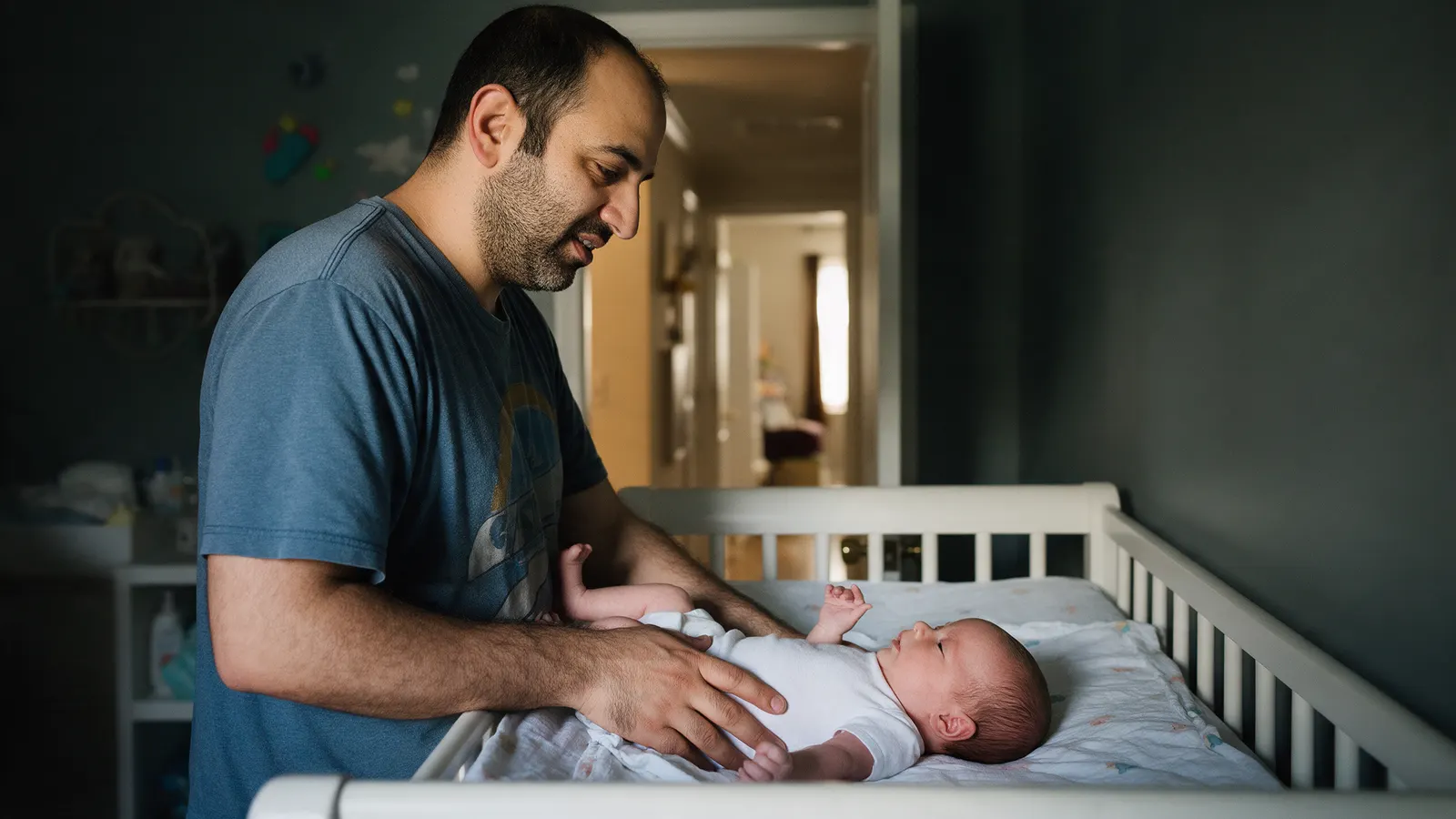
A baby who slept six hours straight last month is up at 2 a.m. calling for you, and nothing is wrong. This is the month that happens.
Heart
Babies 4 to 12 months need 12 to 16 hours of sleep a day, naps included (CDC; WHO), usually 9 to 12 hours at night plus two naps (Nemours KidsHealth). Separation anxiety can bring back night waking (AAP): a baby who now knows you exist out of sight (AAP) wakes between sleep cycles, notices you aren't there, and says so. It's the same milestone as the tears at the kitchen doorway, after dark.
Head
KidsHealth's advice for this kind of waking is short: reassure your baby quietly, then leave (Nemours KidsHealth). The AAP's general advice for babies over 4 months still stands too, to put them down drowsy but awake and give them a few minutes to resettle after waking, with feeding, changing, or comforting still allowed when they're needed (AAP). The balance is the hard part: enough presence that your baby learns you come, little enough that 2 a.m. doesn't become a visit. Cuddling, feeding, or talking at every waking can prompt a baby to wake for that attention (Nemours KidsHealth).
Body
The routine is the other half. Keep a short bedtime routine, like a bath, then stories or songs, and put your baby down drowsy but awake (Nemours KidsHealth). The same three steps every night are what your baby recognizes at midnight when they wake and look around: the room, the dark, the sound of the hall. And the crib stays the crib. If your baby rolls both ways on their own you don't need to flip them back, but the mattress is flat and bare, with no pillows, blankets, bumpers, or stuffed toys, until the first birthday (Moon, AAP). Lower it to the bottom setting now if you haven't, before standing arrives (AAP).
Try today
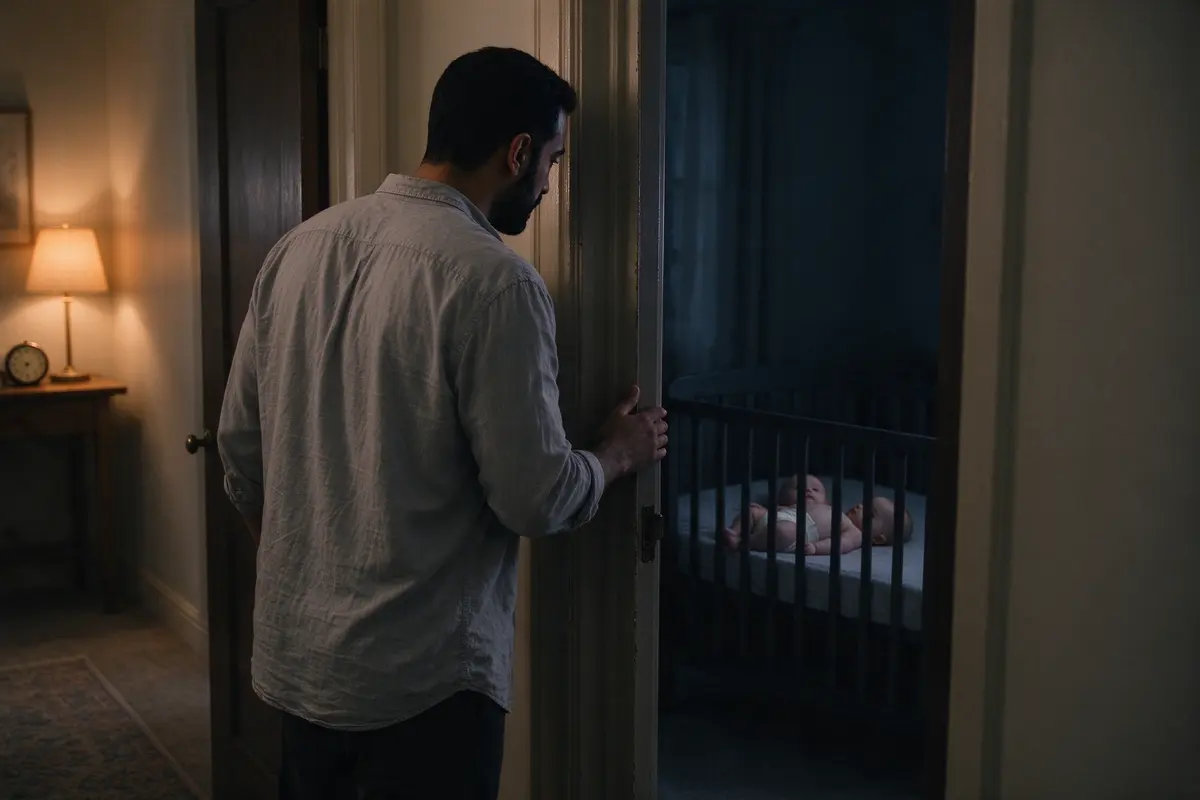
The quiet reassurance
Time: Under a minute, at the next night waking
Wait a few minutes first; many babies grumble and resettle on their own (AAP).
If the crying builds, go in without turning on the light. One calm sentence, the same one every time: "I'm here. It's sleep time."
One hand on their chest or back for a few breaths. No pick-up, no play, no chat (Nemours KidsHealth).
Leave while they're still awake. If they cry again, repeat the same sentence and the same hand after another few minutes.
Make it work:A baby who is sick, soaked, or clearly hungry gets what they need; the reassurance is for the wake-ups that are about company (AAP).
Watch for
Normal
a 2 a.m. wake that ends with a grumble and a hand on the back, in a baby who was sleeping longer last month (AAP).
Call your pediatrician within a day
if your baby has had a fever with no other symptoms for more than 2 days, or any fever lasting more than 3 days (AAP).
Normal
a baby found on their tummy in the crib, asleep, after rolling there on their own (Moon, AAP).
Go to the ER now
if your baby has had a seizure with a fever, has a stiff neck, or has a bulging soft spot (AAP).
Normal
a baby who is hard to settle at 2 a.m. and bright at 7.
Call 911
if your baby can't be woken, isn't moving, or is very weak (AAP).
For you
This phase is a phase. Night waking from separation anxiety is normal, and the AAP's word for it is a stage (AAP); it isn't a slide back to the newborn weeks, and it isn't something you caused by answering the doorway tears. Bank what sleep you can the way the AAP suggests, a nap when the baby naps and bed right after the last feed (Moon, AAP), and split the wake-ups so one of you gets a whole night.
If the nights are breaking you, say so out loud to someone today. Nights like these wear on anyone, and the National Maternal Mental Health Hotline is 1-833-TLC-MAMA (1-833-852-6262), call or text, any hour; 988 is for anyone (CDC).
If you're the partner: the 2 a.m. reassurance is a one-sentence job, which means it's yours tonight. Same sentence, same hand, out.
Sources
- Centers for Disease Control and Prevention. "Milestones by 9 Months." Learn the Signs. Act Early. program, updated 2026. https://www.cdc.gov/act-early/milestones/9-months.html
- World Health Organization. "To grow up healthy, children need to sit less and play more." 2019. https://www.who.int/news/item/24-04-2019-to-grow-up-healthy-children-need-to-sit-less-and-play-more
- Nemours KidsHealth. "Baby Sleep: 8- to 12-Month-Olds." Reviewed 2025. https://kidshealth.org/en/parents/sleep812m.html
- American Academy of Pediatrics. "Separation Anxiety & Sleeping Trouble in Young Children." HealthyChildren.org, updated 2022. https://www.healthychildren.org/English/healthy-living/sleep/Pages/separation-anxiety-and-sleeping.aspx
- American Academy of Pediatrics. "Cognitive Development in Infants: 8 to 12 Months." HealthyChildren.org, updated 2023. https://www.healthychildren.org/English/ages-stages/baby/Pages/Cognitive-Development-8-to-12-Months.aspx
- American Academy of Pediatrics. "Getting Your Baby to Sleep." HealthyChildren.org, updated 2024. https://www.healthychildren.org/English/ages-stages/baby/sleep/Pages/getting-your-baby-to-sleep.aspx
- Moon RY. "How to Keep Your Sleeping Baby Safe: AAP Policy Explained." HealthyChildren.org, updated 2026. https://www.healthychildren.org/English/ages-stages/baby/sleep/Pages/a-parents-guide-to-safe-sleep.aspx
- American Academy of Pediatrics. "Make Baby's Room Safe: Parent Checklist." HealthyChildren.org, updated 2020. https://www.healthychildren.org/English/safety-prevention/at-home/Pages/Make-Babys-Room-Safe.aspx
- American Academy of Pediatrics. "Fever" (symptom checker). HealthyChildren.org, accessed 2026. https://www.healthychildren.org/English/tips-tools/symptom-checker/Pages/symptomviewer.aspx?symptom=Fever
- Moon RY. "Safe Sleep Tips for Sleep-Deprived New Parents." HealthyChildren.org, updated 2026. https://www.healthychildren.org/English/ages-stages/baby/sleep/Pages/safe-sleep-tips-for-sleep-deprived-parents.aspx
- Centers for Disease Control and Prevention. "Symptoms of Depression Among Women." 2024. https://www.cdc.gov/reproductive-health/depression/index.html
This guide is general education that summarizes published research and guidance from groups like the American Academy of Pediatrics, the CDC, and the WHO. It isn’t medical advice, and every child develops on their own timeline. Your pediatrician knows your child; if something feels wrong, call them. In an emergency, call 911.
Get each day’s note the morning it applies
Add your baby to a free Chorevia household with their date of birth, and every morning for 300 days the day’s note arrives in the app and by email: what’s developing, one thing to try, what to watch for, and a word for you.
Create your household