Day 236 of 300 · Week 32
Screens before one
Last reviewed · 3 min read · 9 sources · Plain-text version
The WHO recommends no screen time under 1, and the AAP calls TV and apps a bad idea before 18 months. A TV on in the background cuts how much you talk. One hour off, with the sentences counted.
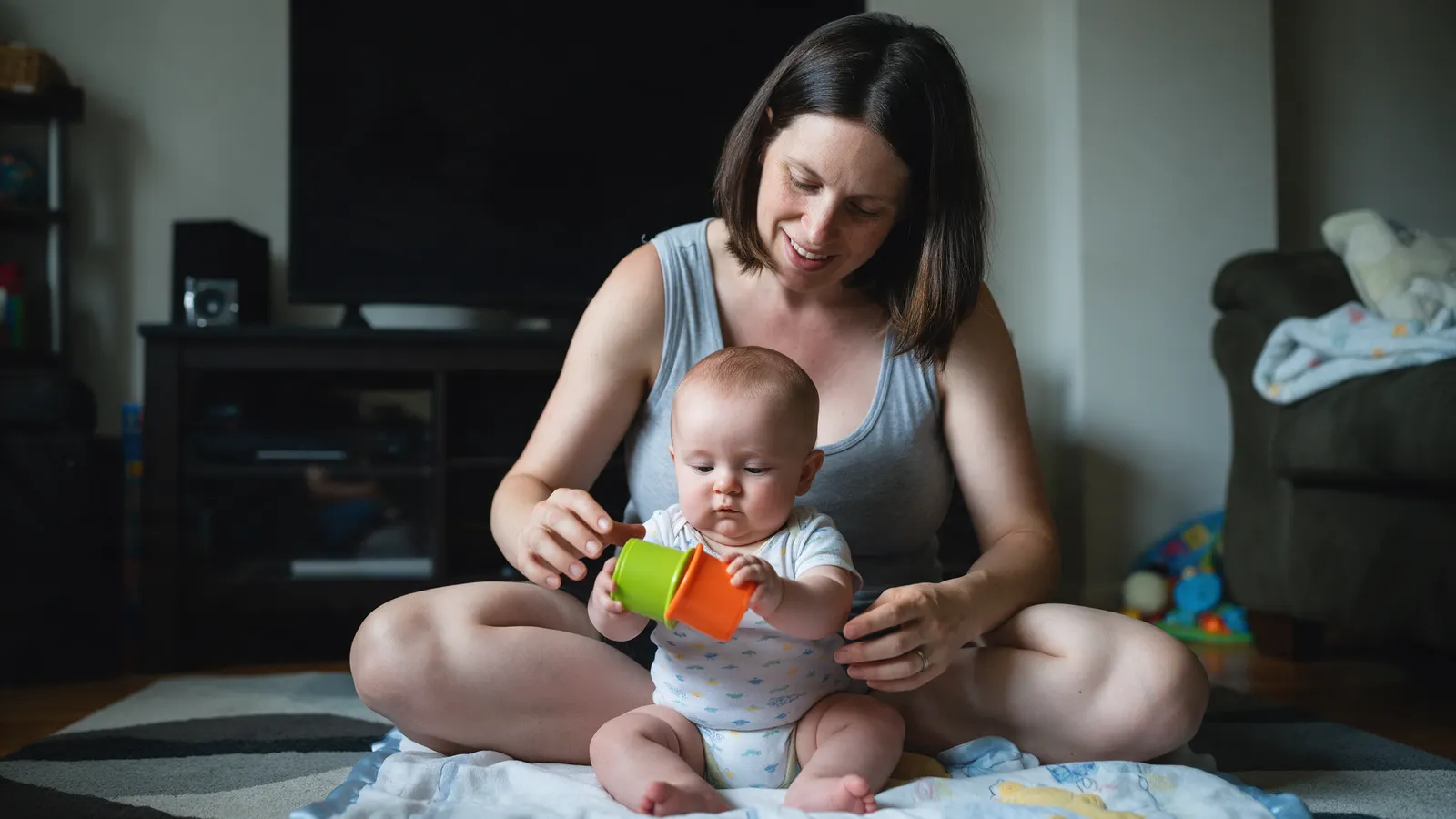
The TV has been on in the background more than you'd admit this month. Today is one hour of it off, honestly counted.
Heart
The WHO doesn't recommend any screen time for babies under 1 (WHO). The AAP calls TV and apps a bad idea before 18 months, with video chats with faraway family as the exception, and warns that a TV on in the background cuts down how much parents talk (Hill, AAP). Babies this age learn best from real-world interactions (Munzer, AAP). The problem with the background TV isn't what the baby watches. It's what you stop saying.
Head
Why your sentences are the thing. In a lab experiment, 9.5-month-olds whose mothers answered their babble right away quickly reshaped it using sounds from their mothers' speech; babies answered at random times didn't (Goldstein & Schwade, 2008). In a randomized trial of 71 families, coaching parents at 6, 10, and 14 months increased parentese and back-and-forth turns (Ferjan Ramírez et al., 2020), and in a follow-up of 59 children, the coached group had larger vocabularies through 30 months (Huber et al., 2023). The trial and its follow-up are small and from one lab group. But the mechanism they point at is cheap: answer, then pause.
Body
The hour is the one the TV is usually on with the baby in the room: breakfast, or the long stretch before dinner. The WHO's alternative for babies under 1 is floor play, and not more than 1 hour at a time strapped into a seat or carrier (WHO). By 9 months, most babies make lots of different sounds like "mamamama" and "bababababa" (CDC); with the room quiet, you'll hear how many of them there are, and every one is a turn you can take.
Try today
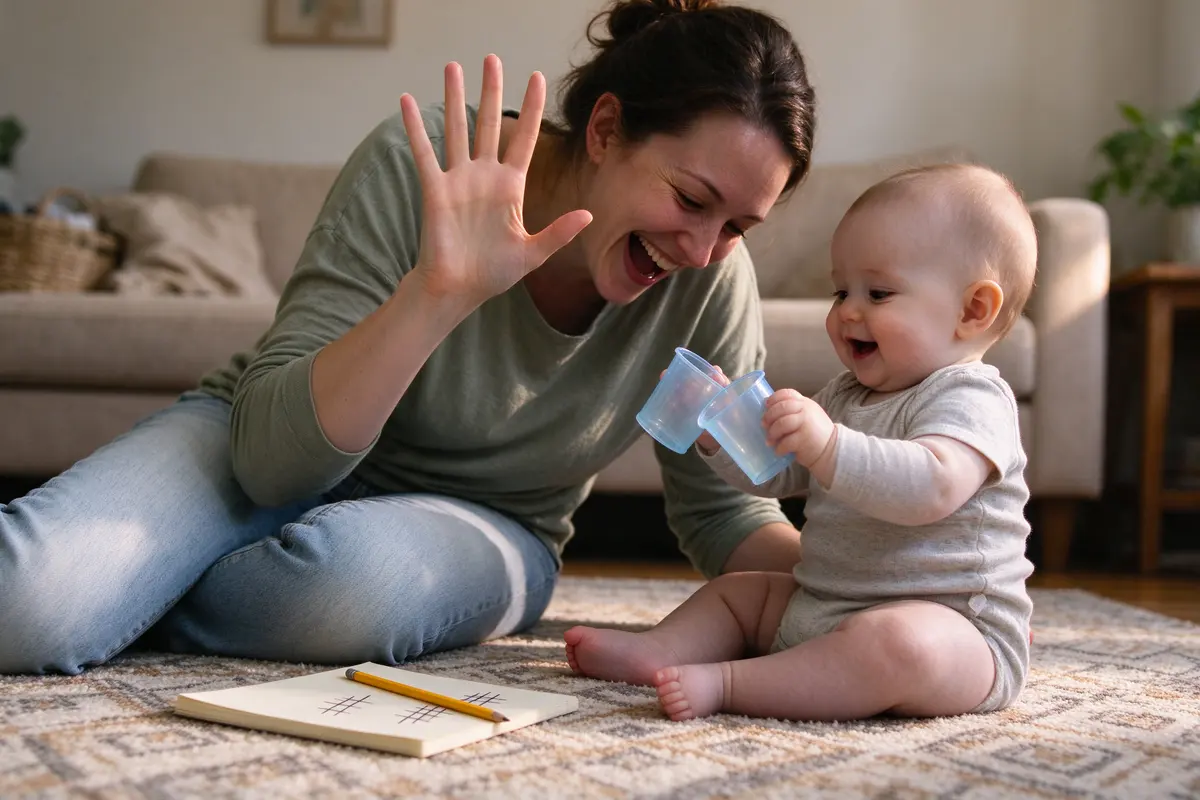
The TV-off hour
Time: 1 hour, with 10 minutes of counting inside it
Pick the hour the TV is usually on while the baby plays, and turn it off; put your phone face-down on the counter.
Sit on the floor with the toys. For 10 minutes, count your sentences on your fingers or as tally marks on a notepad: the ones aimed at the baby.
Name what they look at, and answer each babble right away with the same sound and a word (Goldstein & Schwade, 2008).
Compare the count with your honest guess for the same hour yesterday, TV on.
Keep the hour tomorrow. The video call with the grandparents is the one screen that stays (Hill, AAP).
Make it work:Ten minutes of counting is enough. The point is the number, not a new chore.
Watch for
Normal
a baby who turns to the screen whenever it's on; the AAP's concern is what the background TV does to your talk, not their stare (Hill, AAP).
Bring it up with your pediatrician
if by 9 months your baby doesn't look when you call their name (CDC).
Normal
a baby who babbles at Grandma's face on the video call and tries to grab the phone.
Ask about a screening
if your baby seems not to see or hear well (AAP).
Normal
a quieter hour than you expected once the TV is off; the sounds come in bursts (CDC).
Don't wait
if you're worried about development: ask about screening, or call your state's early intervention program for a free evaluation without a referral (CDC).
For you
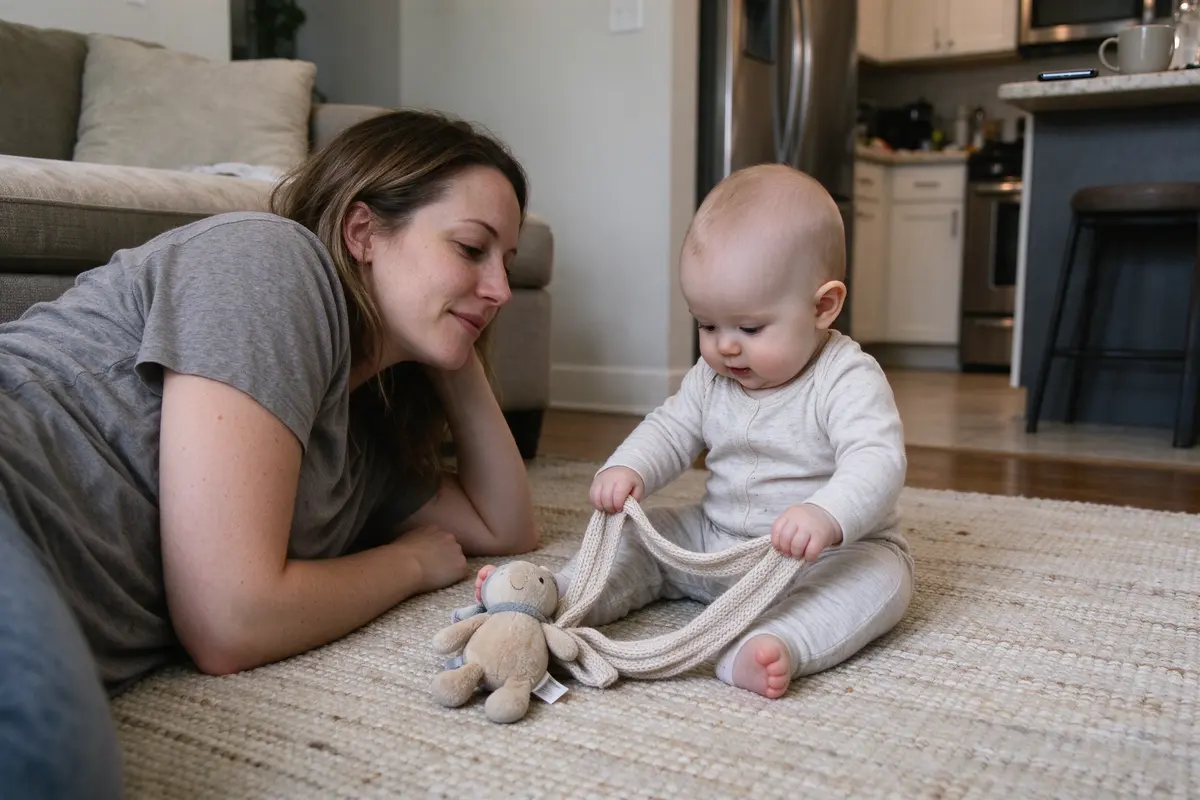
Your own screen, honestly. The AAP's finding is about the TV in the background and what it does to how much you talk (Hill, AAP); the phone in your hand during a feed is the same mechanism in a smaller frame. Scrolling with the baby in your lap is not a failure, and nobody is counting your minutes. The count today is of sentences, and it's for you to see, not to confess. If the number surprised you, the hour was worth it.
If you're the partner: take the second hour tonight, TV off, and tell her your count.
Sources
- World Health Organization. "To grow up healthy, children need to sit less and play more." 2019. https://www.who.int/news/item/24-04-2019-to-grow-up-healthy-children-need-to-sit-less-and-play-more
- Hill DL. "Why to Avoid TV for Infants & Toddlers." HealthyChildren.org, updated 2016. https://www.healthychildren.org/English/family-life/Media/Pages/Why-to-Avoid-TV-Before-Age-2.aspx
- Munzer T. "Helping Kids Thrive in a Digital World: AAP Policy Explained." HealthyChildren.org, updated 2026. https://www.healthychildren.org/English/family-life/Media/Pages/helping-kids-thrive-in-a-digital-world-AAP-policy-explained.aspx
- Goldstein MH, Schwade JA. "Social feedback to infants' babbling facilitates rapid phonological learning." Psychological Science, 2008. https://pubmed.ncbi.nlm.nih.gov/18466414/
- Ferjan Ramírez N, Lytle SR, Kuhl PK. "Parent coaching increases conversational turns and advances infant language development." Proceedings of the National Academy of Sciences, 2020. https://pubmed.ncbi.nlm.nih.gov/32015127/
- Huber E, Ferjan Ramírez N, Corrigan NM, Kuhl PK. "Parent coaching from 6 to 18 months improves child language outcomes through 30 months of age." Developmental Science, 2023. https://pubmed.ncbi.nlm.nih.gov/36999222/
- Centers for Disease Control and Prevention. "Milestones by 9 Months." Learn the Signs. Act Early. program, updated 2026. https://www.cdc.gov/act-early/milestones/9-months.html
- American Academy of Pediatrics. "Checkup Checklist: 9 Months Old." HealthyChildren.org, updated 2021. https://www.healthychildren.org/English/ages-stages/Your-Childs-Checkups/Pages/Your-Checkup-Checklist-9-Months-Old.aspx
- Centers for Disease Control and Prevention. "Concerned About Your Child's Development?" Updated 2026. https://www.cdc.gov/act-early/families/concerned.html
This guide is general education that summarizes published research and guidance from groups like the American Academy of Pediatrics, the CDC, and the WHO. It isn’t medical advice, and every child develops on their own timeline. Your pediatrician knows your child; if something feels wrong, call them. In an emergency, call 911.
Get each day’s note the morning it applies
Add your baby to a free Chorevia household with their date of birth, and every morning for 300 days the day’s note arrives in the app and by email: what’s developing, one thing to try, what to watch for, and a word for you.
Create your household