Day 222 of 300 · Week 30
In and out
Last reviewed · 4 min read · 9 sources · Plain-text version
Putting a block in a cup is a 12-month milestone, so this month is the warm-up: dumping, refilling, and the low cabinet of pots and lids that beats any toy you can buy.
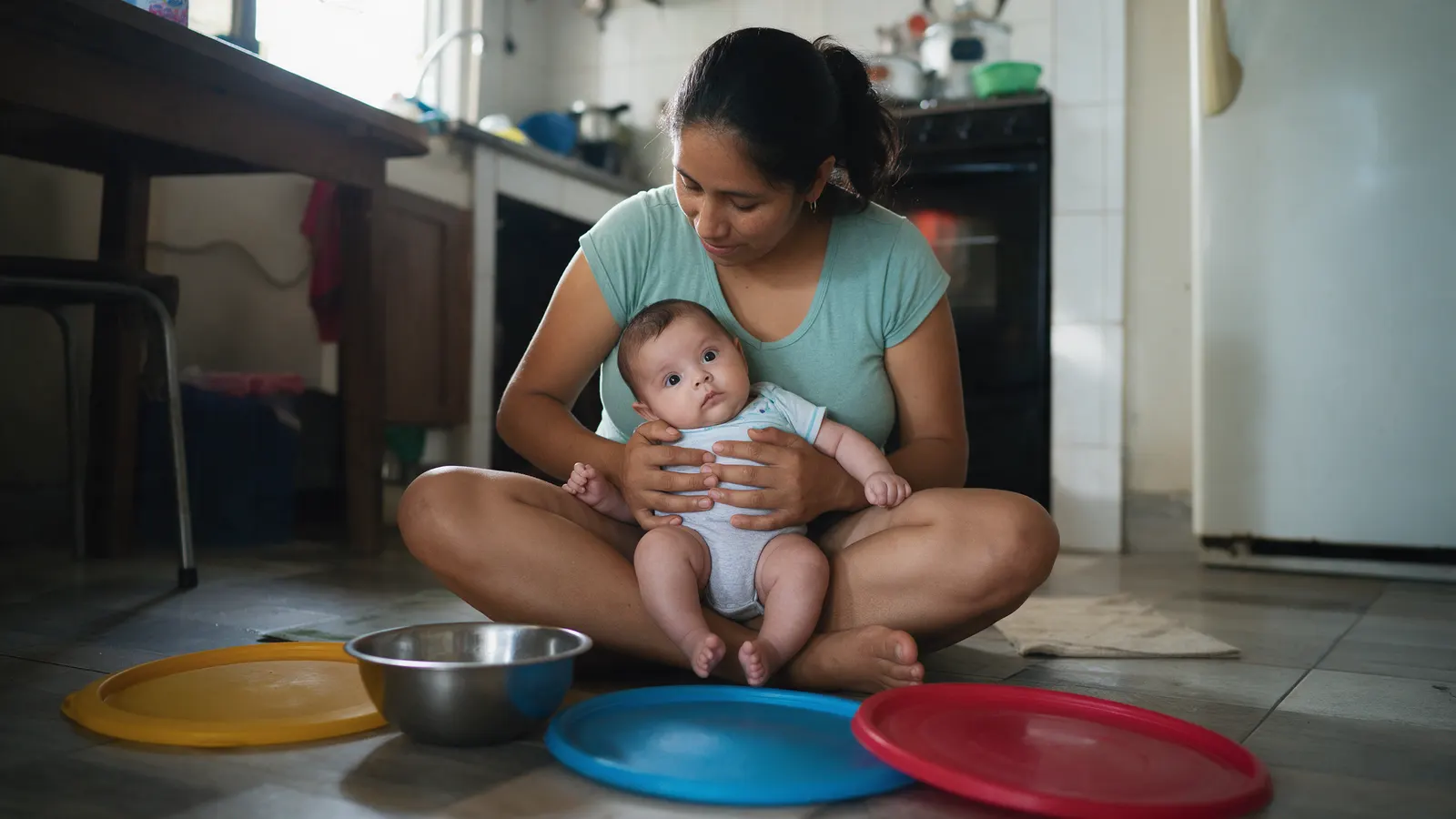
A bowl and three lids. That's the whole toy today, and it will outlast most of the ones with batteries.
Heart
Putting something in a container, like a block in a cup, is a 12-month milestone on CDC's list (CDC), which means it's months away for most babies and the perfect thing to play at now, with no expectation. What's on the 9-month list is the pieces of it: moving things from one hand to the other and banging two things together (CDC). Dumping, banging, and dropping are experiments in how things work (AAP), and a bowl of lids runs all three at once.
Head
The hard part isn't the putting in. It's the letting go. Early in this stage your baby rakes things in with the whole hand, and once they can release on purpose, dropping and throwing become favorite games (AAP). So a lid that gets carried to the bowl and then just held there is a baby who has solved the first half. CDC's suggestion for this age is to practice dumping and refilling together (CDC), and "together" means your hand tipping the bowl while their hand grips the lid.
Body
At this age, ordinary household objects are the most fascinating toys: the AAP's list is wooden spoons, pots, and plastic containers, stocked in a low cabinet (AAP). Two rules keep it a game. Everything in the bowl is too big to fit entirely in your baby's mouth (AAP), so large lids and wooden spoons, never bottle caps. And your baby sits on the floor for it, on a rug or a mat, not on the counter or a bed.
Try today
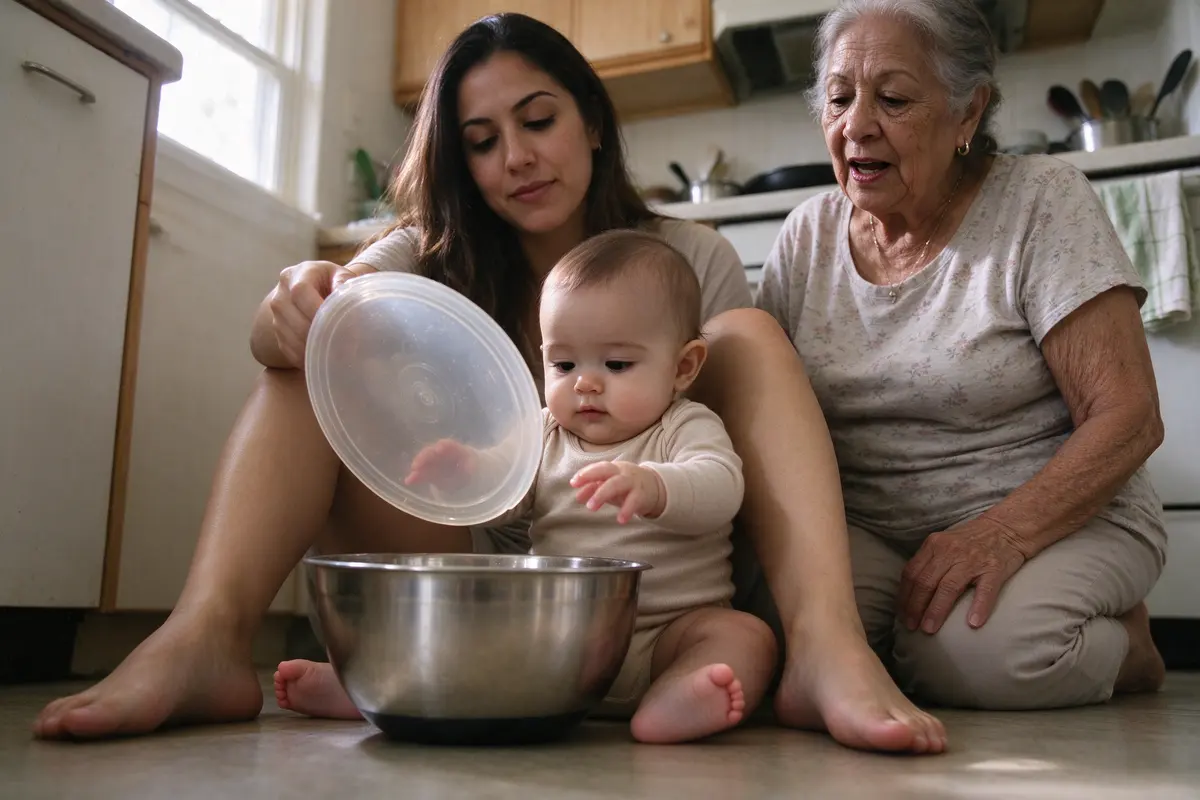
In and out
Time: About 5 minutes · In and out in the guide
Give your baby a mixing bowl or bucket and three or four big plastic lids, blocks, or wooden spoons, each too big to fit entirely in their mouth (AAP).
Tip the bowl and dump everything out together, saying "out!"
Drop the pieces back in one at a time, saying "in!" each time; guide their hand over the bowl and wait for the letting go (CDC).
Hand them a lid and hold out the bowl. If it goes in, cheer; if it goes in the mouth or on the floor, that's today's version.
Make it work:A metal bowl is loud and a plastic one is quiet; pick by your headache, not theirs.
Watch for
Normal
a lid banged on the bowl for a full minute, then on the floor, then on your knee (CDC).
Normal
every lid mouthed before it goes in the bowl (AAP).
Go to the ER now
if your baby may have swallowed a button battery or magnets, and call the National Battery Ingestion Hotline, 1-800-498-8666, on the way (CPSC).
Normal
a baby who sits for the game and then tips over reaching for the far lid.
Call your pediatrician right away
if your baby won't move an arm or leg normally, or cries when touched or moved (AAP).
For you
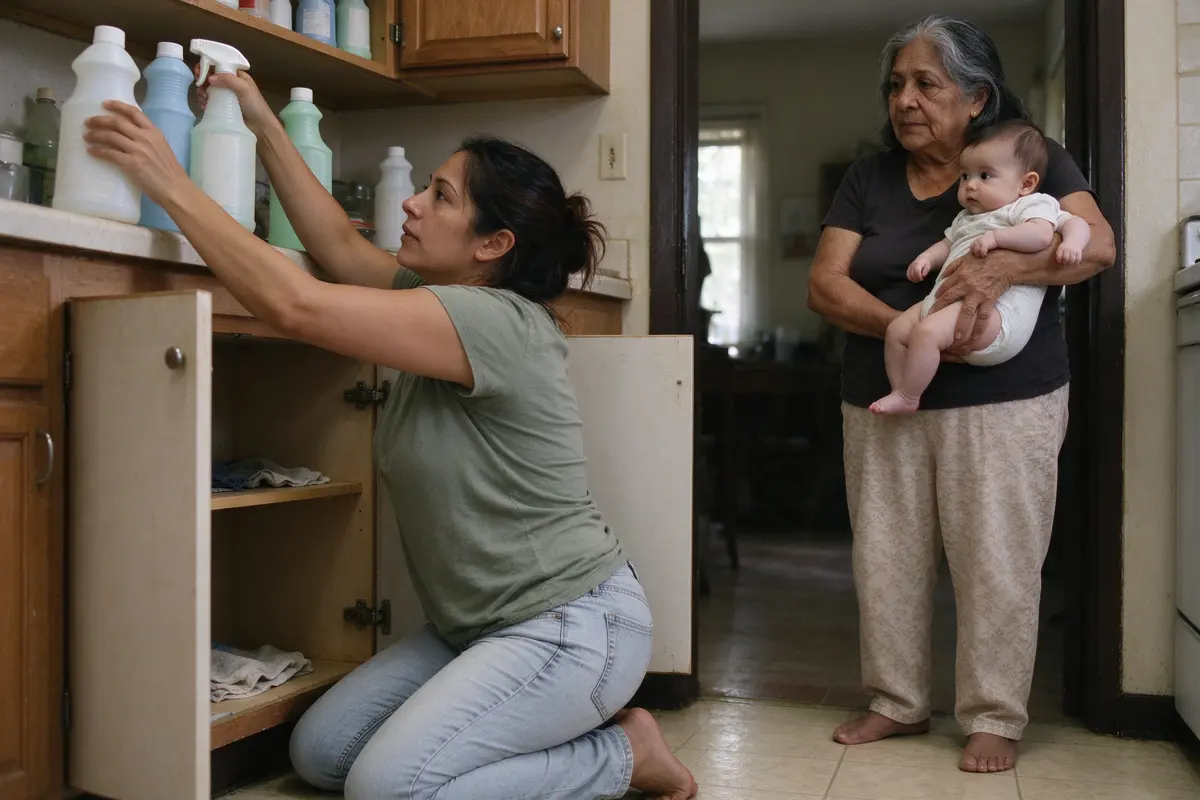
The low cabinet is the yes space. Tomorrow's note is the whole idea; today is the first shelf of it. The AAP's advice is to stock a low cabinet with wooden spoons, pots, and plastic containers (AAP), and the quiet point of that advice is that it's a cabinet your baby is allowed to empty. Every kitchen has one cabinet that holds the cleaning sprays and one that holds the pots; if they're both low, swap them. Then the crawling, scooting, or rolling baby who gets there before you do finds lids, not bleach (AAP).
If you're the partner: you do the swap. Cleaners and alcohol locked up high, and the pots and lids down where the baby can reach (AAP). It takes ten minutes and it's the single most useful thing you'll do in the kitchen this month.
Sources
- Centers for Disease Control and Prevention. "Milestones by 1 Year." Learn the Signs. Act Early. program, updated 2026. https://www.cdc.gov/act-early/milestones/1-year.html
- Centers for Disease Control and Prevention. "Milestones by 9 Months." Learn the Signs. Act Early. program, updated 2026. https://www.cdc.gov/act-early/milestones/9-months.html
- American Academy of Pediatrics. "Cognitive Development in Infants: 8 to 12 Months." HealthyChildren.org, updated 2023. https://www.healthychildren.org/English/ages-stages/baby/Pages/Cognitive-Development-8-to-12-Months.aspx
- American Academy of Pediatrics. "Hand and Finger Skills." HealthyChildren.org, updated 2009. https://www.healthychildren.org/English/ages-stages/baby/Pages/Hand-and-Finger-Skills.aspx
- Bradin S. "Choking Prevention for Babies & Children: What Every Parent Needs to Know." HealthyChildren.org, updated 2026. https://www.healthychildren.org/English/health-issues/injuries-emergencies/Pages/Choking-Prevention.aspx
- American Academy of Pediatrics. "Fever" (symptom checker). HealthyChildren.org, accessed 2026. https://www.healthychildren.org/English/tips-tools/symptom-checker/Pages/symptomviewer.aspx?symptom=Fever
- American Academy of Pediatrics. "Fever and Your Baby." HealthyChildren.org, updated 2025. https://www.healthychildren.org/English/health-issues/conditions/fever/Pages/Fever-and-Your-Baby.aspx
- US Consumer Product Safety Commission. "Making Families Safer from Button Cell or Coin Battery Dangers; Reese's Law Leads to New Federal Mandatory Safety Standard." 2023. https://www.cpsc.gov/Newsroom/News-Releases/2023/Making-Families-Safer-from-Button-Cell-or-Coin-Battery-Dangers-Reeses-Law-Leads-to-New-Federal-Mandatory-Safety-Standard
- American Academy of Pediatrics. "Home Safety: Tips for Families With Young Children." HealthyChildren.org, updated 2022. https://www.healthychildren.org/English/safety-prevention/at-home/Pages/Home-Safety-Heres-How.aspx
This guide is general education that summarizes published research and guidance from groups like the American Academy of Pediatrics, the CDC, and the WHO. It isn’t medical advice, and every child develops on their own timeline. Your pediatrician knows your child; if something feels wrong, call them. In an emergency, call 911.
Get each day’s note the morning it applies
Add your baby to a free Chorevia household with their date of birth, and every morning for 300 days the day’s note arrives in the app and by email: what’s developing, one thing to try, what to watch for, and a word for you.
Create your household