Day 225 of 300 · Week 31
Thirty-one weeks: mirror faces
Last reviewed · 4 min read · 9 sources · Plain-text version
By 9 months, most babies show several facial expressions: happy, sad, angry, surprised. A mirror, a nose, and a name for each face, from the AAP's own list of games for this stage.

Thirty-one weeks. Your baby has a face for pleased, a face for furious, and a face for "what was that?", and a mirror lets them see all three.
Heart
By 9 months, most babies show several facial expressions, like happy, sad, angry, and surprised (CDC). You've probably been reading those faces for weeks; what's new is that your baby is starting to be interested in their own. Liking to look in a mirror was already on the 6-month list (CDC), and the AAP's suggestion for this stage is mirror games that name body parts and label emotions as babies begin to recognize themselves (AAP). Whether they know the baby in the glass is them isn't the point yet; for now, it's a fascinating friend who copies everything.
Head
Naming feelings out loud is a CDC tip for this age (CDC), and the mirror makes it concrete. "You're surprised!" said to a surprised face in the glass links the word, the feeling, and the look in one moment. It's the same move as naming what your baby sees (AAP), pointed inward. Keep the names consistent, the way the guide suggests for everything else: "happy" today, not "cheerful" tomorrow (AAP).
Body
The mirror has to be the safe kind. A wall-mounted mirror with your baby on your lap, or an unbreakable one on the floor; never a free-standing mirror a sitting baby can pull over, which belongs with the bookcases and dressers you anchor to the wall (AAP). Your baby sits between your knees for it, on the floor, hands free to pat the glass. The whole game is two to five minutes, and it ends when they'd rather chew your sleeve.
Try today
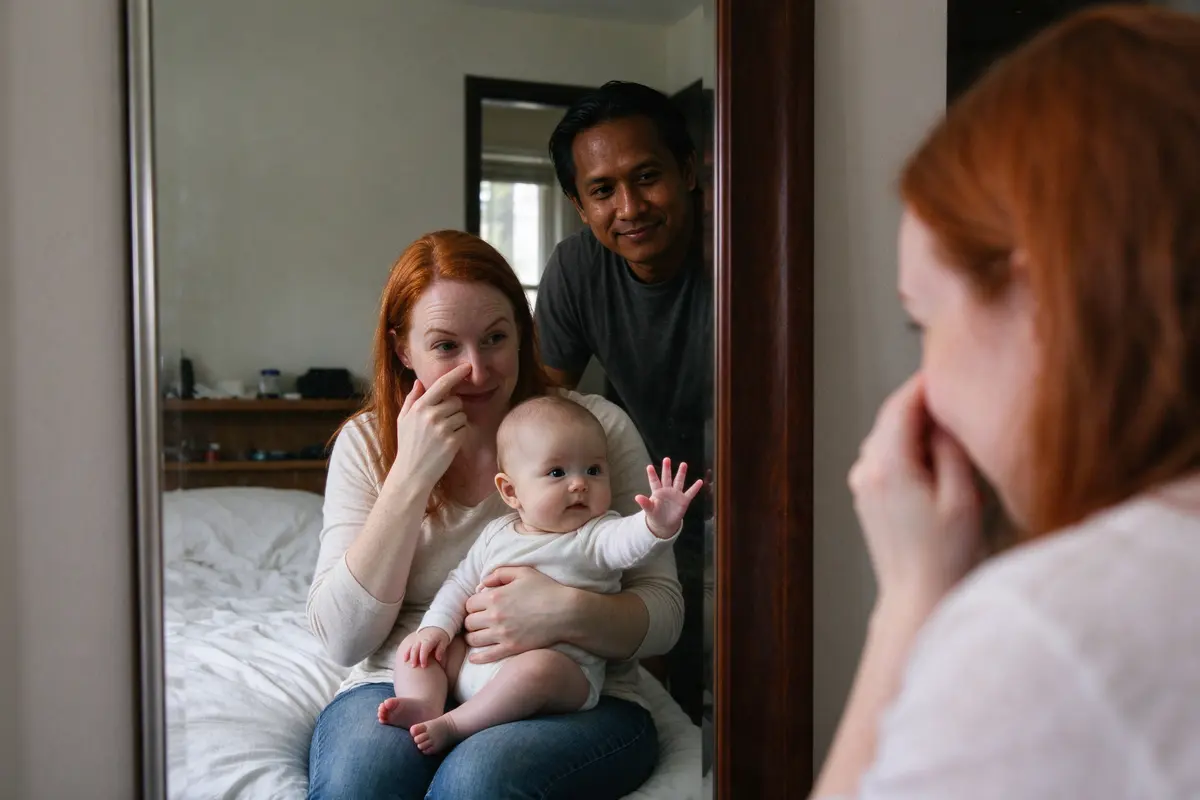
Mirror faces
Time: 2 to 5 minutes · Mirror faces in the guide
Sit on the floor in front of a wall mirror with your baby on your lap, both of you facing the glass (AAP).
Touch and name: "Here's your nose. Here's my nose." Then ears, then hands, tapping each one in the reflection.
Make a happy face and say "happy." Make a sad face, then a surprised one, naming each; wait a beat to see if your baby's face changes with yours (CDC).
When your baby makes a face of their own, name that one too: "You're surprised!"
Make it work:Angry is a face you can make on purpose and name kindly; your baby will see the real one soon enough, and the word will already be there.
Watch for
Normal
a baby who pats the mirror, smiles at the baby in it, and then looks behind the glass for them.
Normal
eyes that cross for a second while focusing on something close, then straighten.
Talk with your pediatrician
if your baby's eyes consistently turn in or out (AAP).
Normal
an angry face at the end of the game that's gone before you've stood up.
Go to the ER now
if your baby is hard to wake, isn't alert when awake, or seems confused (AAP).
For you
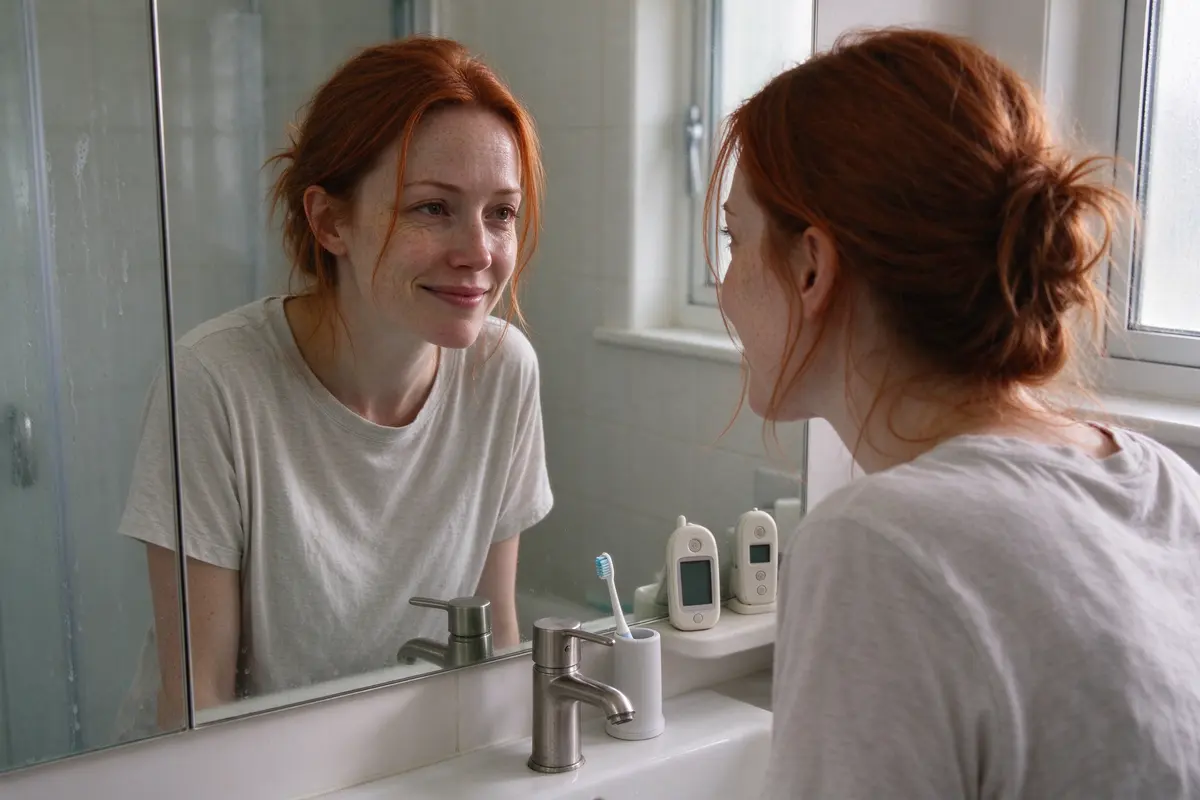
Your own face in the mirror, named kindly. You've spent seven months reading a baby's expressions and almost none reading yours, and the face in the bathroom mirror this morning is tired, and real, and fine. Try the game on yourself: one honest word for how you look today, said the way you'd say it to your baby. If the word that comes is "sad," and it has been the word for more than 2 weeks, that's not a mirror problem. Low mood, anxiety, or emptiness that is severe or lasts more than 2 weeks may be postpartum depression, which usually doesn't improve without treatment but does respond to therapy, medication, or both (NIMH). Say the word to someone who can do something with it.
If you're the partner: take a turn at the mirror with the baby, faces and all. And when she says her word, don't argue with it; just ask what would help today.
Sources
- Centers for Disease Control and Prevention. "Milestones by 9 Months." Learn the Signs. Act Early. program, updated 2026. https://www.cdc.gov/act-early/milestones/9-months.html
- Centers for Disease Control and Prevention. "Milestones by 6 Months." Learn the Signs. Act Early. program, updated 2026. https://www.cdc.gov/act-early/milestones/6-months.html
- American Academy of Pediatrics. "Emotional and Social Development: 8 to 12 Months." HealthyChildren.org, updated 2009. https://www.healthychildren.org/English/ages-stages/baby/Pages/Emotional-and-Social-Development-8-12-Months.aspx
- American Academy of Pediatrics. "Language Development: 8 to 12 Months." HealthyChildren.org, updated 2009. https://www.healthychildren.org/English/ages-stages/baby/Pages/Language-Development-8-to-12-Months.aspx
- American Academy of Pediatrics. "Home Safety: Tips for Families With Young Children." HealthyChildren.org, updated 2022. https://www.healthychildren.org/English/safety-prevention/at-home/Pages/Home-Safety-Heres-How.aspx
- American Academy of Pediatrics. "Checkup Checklist: 9 Months Old." HealthyChildren.org, updated 2021. https://www.healthychildren.org/English/ages-stages/Your-Childs-Checkups/Pages/Your-Checkup-Checklist-9-Months-Old.aspx
- American Academy of Pediatrics. "Developmental Milestones: 7 Months." HealthyChildren.org, updated 2009. https://www.healthychildren.org/English/ages-stages/baby/Pages/Developmental-Milestones-7-Months.aspx
- American Academy of Pediatrics. "Fever" (symptom checker). HealthyChildren.org, accessed 2026. https://www.healthychildren.org/English/tips-tools/symptom-checker/Pages/symptomviewer.aspx?symptom=Fever
- National Institute of Mental Health. "Perinatal Depression." Accessed 2026. https://www.nimh.nih.gov/health/publications/perinatal-depression
This guide is general education that summarizes published research and guidance from groups like the American Academy of Pediatrics, the CDC, and the WHO. It isn’t medical advice, and every child develops on their own timeline. Your pediatrician knows your child; if something feels wrong, call them. In an emergency, call 911.
Get each day’s note the morning it applies
Add your baby to a free Chorevia household with their date of birth, and every morning for 300 days the day’s note arrives in the app and by email: what’s developing, one thing to try, what to watch for, and a word for you.
Create your household