Day 226 of 300 · Week 31
Stranger wariness begins
Last reviewed · 4 min read · 4 sources · Plain-text version
Shy, clingy, or fearful around strangers is on the 9-month list, and it isn't caused by spoiling. What a study of 1,285 twins found about how fear usually rises, and the slow way to let a visitor in.
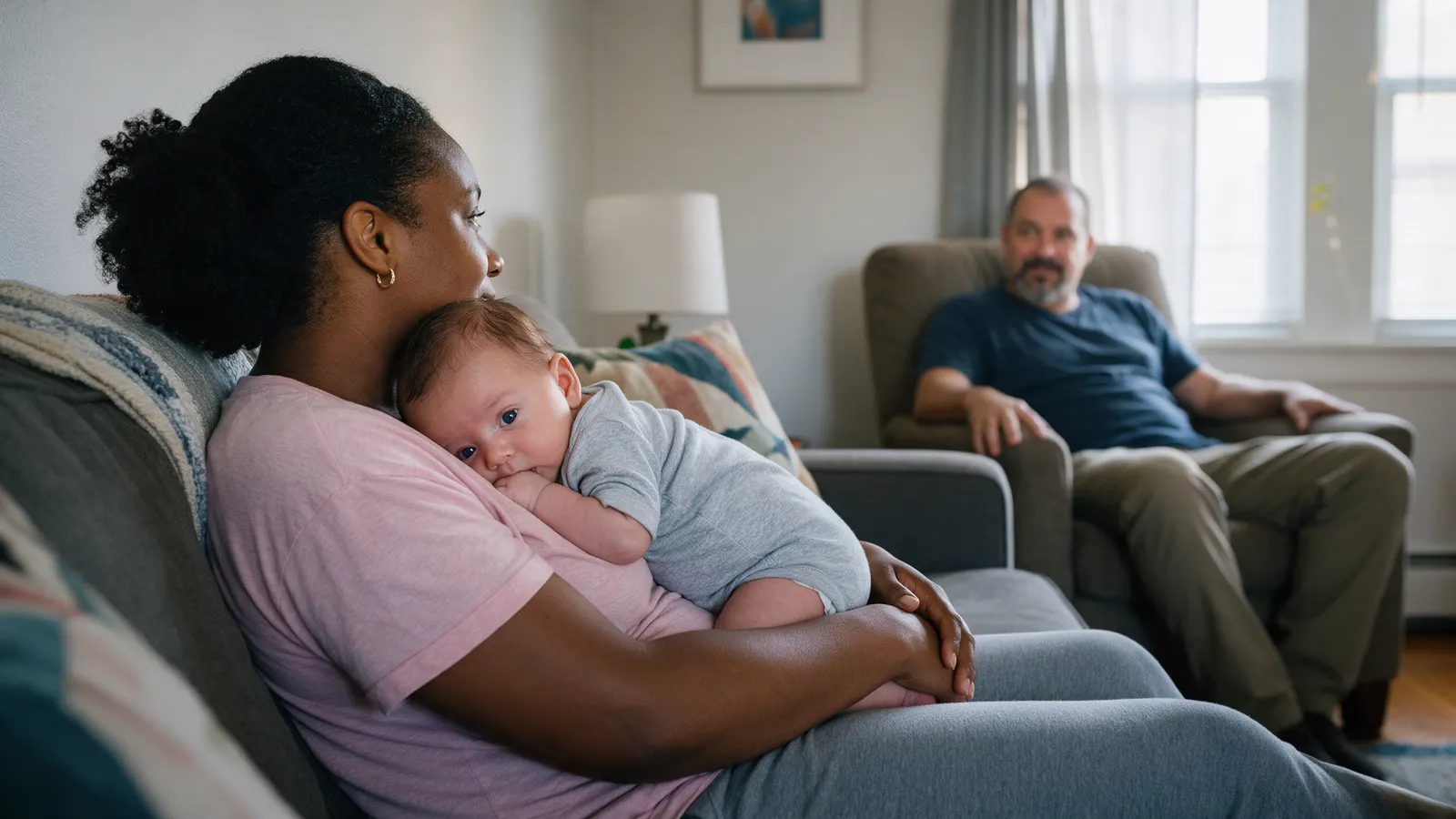
Your mother walks in, holds out her arms the way she has since the hospital, and your baby turns into your neck and cries. Nothing is wrong with your baby, and nothing is wrong with your mother.
Heart
Being shy, clingy, or fearful around strangers is on CDC's list of what most babies do by 9 months (CDC). Wariness of strangers is often one of the first emotional milestones, and it isn't caused by "spoiling"; your baby can now tell familiar from unfamiliar (AAP). To a thirty-one-week-old, a grandparent who visits once a month is a stranger with a familiar voice. The crying is the sorting system working.
Head
Fear usually rises, and babies differ. In 1,285 twins followed from 6 to 36 months, the most common patterns started with little fear at 6 months that rose over time (Brooker et al., 2013). A baby who was fine with everyone last month and isn't now is on the common path. Children whose fear was high and steady from the start, or rose sharply, were more inhibited at age 3 (Brooker et al., 2013). That's a link, not a verdict: some wariness is expected, and very intense fear is worth mentioning at checkups.
Body
The AAP's advice for new faces is slow. Even favorite relatives can make a baby cry if they swoop in fast (AAP), so the visitor talks to you first, from across the room, while the baby watches from your arms. The guide's section is Ease goodbyes and new faces, and the script for the relative is short: sit down, don't reach, let the baby come to you. Timing counts too, because separations and new faces are harder when a baby is tired, hungry, or sick (AAP); a visit after the nap goes better than one at the end of the day.
Try today

The slow visitor
Time: The first 10 minutes of the next visit · Ease goodbyes and new faces in the guide
Before the relative arrives, tell them the plan: "She's at the shy stage. Talk to me first and let her come to you." Saying so ahead of time keeps it from feeling personal (AAP).
Hold your baby and chat with the visitor from a few feet away for a couple of minutes. Let your baby stare.
Have the visitor sit on the floor and roll a ball or offer a toy at arm's length, without reaching for the baby.
When your baby reaches, leans, or smiles, that's the handover, and it's theirs to start. If it doesn't come today, the visit was still a success.
Make it work:Schedule the arrival for after a nap and a feed, when fear is lowest (AAP).
Watch for
Normal
a long, serious stare at the visitor from your shoulder, then a turn away and back again; that's the sorting (AAP).
Mention it at the 9-month visit
if your baby's fear of new people is very intense, or seems high all the time rather than rising and settling (Brooker et al., 2013).
Normal
a baby who cries at a new face and stops the moment the face moves away.
Call your pediatrician within a day
if a fever comes back after a day without one, or any fever lasts more than 3 days (AAP).
Normal
clinging harder at the end of a long day with visitors, when tired and hungry make everything worse (AAP).
Call your pediatrician right away
if your baby seems dehydrated: no urine in more than 8 hours, dark urine, a very dry mouth, or no tears (AAP).
For you

It's attachment, not a verdict on your socializing. The baby who screams at your best friend isn't telling you that you've kept them home too much, and the AAP is explicit that wariness isn't caused by spoiling (AAP). It's the other way around: your baby has learned exactly who their people are, and that's the work of seven months of showing up. Let the friend be a little hurt for a minute. Then stand on the back step with her and have the conversation anyway, while the baby watches through the window and decides.
If you're the partner: you're the one who says "give him a minute, he's just looking at you" to the relative, before she does. It lands better from the person who isn't holding the crying baby.
Sources
- Centers for Disease Control and Prevention. "Milestones by 9 Months." Learn the Signs. Act Early. program, updated 2026. https://www.cdc.gov/act-early/milestones/9-months.html
- American Academy of Pediatrics. "Emotional and Social Development: 8 to 12 Months." HealthyChildren.org, updated 2009. https://www.healthychildren.org/English/ages-stages/baby/Pages/Emotional-and-Social-Development-8-12-Months.aspx
- Brooker RJ, Buss KA, Lemery-Chalfant K, et al. "The development of stranger fear in infancy and toddlerhood: normative development, individual differences, antecedents, and outcomes." Developmental Science, 2013. https://pubmed.ncbi.nlm.nih.gov/24118713/
- American Academy of Pediatrics. "Fever" (symptom checker). HealthyChildren.org, accessed 2026. https://www.healthychildren.org/English/tips-tools/symptom-checker/Pages/symptomviewer.aspx?symptom=Fever
This guide is general education that summarizes published research and guidance from groups like the American Academy of Pediatrics, the CDC, and the WHO. It isn’t medical advice, and every child develops on their own timeline. Your pediatrician knows your child; if something feels wrong, call them. In an emergency, call 911.
Get each day’s note the morning it applies
Add your baby to a free Chorevia household with their date of birth, and every morning for 300 days the day’s note arrives in the app and by email: what’s developing, one thing to try, what to watch for, and a word for you.
Create your household