Day 219 of 300 · Week 30
Baby at the family table
Last reviewed · 4 min read · 15 sources · Plain-text version
The AAP encourages family meals from the first feeding: the high chair pulled up to the table, soft pieces of what everyone eats, and your baby's cues, not the plate, deciding when it's over.

The high chair has probably lived in a corner of the kitchen, facing you. Today it moves to the table, and the baby joins the meal instead of having one.
Heart
The AAP encourages family meals from the first feeding, and its rule for every meal is simple: eat together, and let your baby's fullness cues, not the plate, decide when the meal is over (AAP). At the table, your baby gets soft pieces of what everyone is eating and a cup with a little water (Muth, AAP), and watches the one thing no spoon can teach: how people eat.
Head
The table is where repeat tastes happen without a plan. A systematic review of 21 studies found moderate evidence that tasting a vegetable or fruit daily for 8 to 10 or more days makes babies and toddlers more willing to eat it (Spill et al., 2019). In one trial of 45 babies, 8 days of green beans raised intake from 56.8 to 93.6 grams, even though many babies kept making faces (Forestell & Mennella, 2007). If carrots are on the family's plates twice this week, they're on the baby's tray twice this week, and the faces don't count against them. Keep offering foods your baby refused before (CDC).
Body
The rules move to the table with the chair. Upright and buckled in the high chair (AAP), never eating in a car seat or stroller or lying down (CDC). Pieces cut no larger than half an inch (AAP), and the AAP's before-age-1 list stays off the tray even when it's on the table: whole grapes, hot dogs, nuts and seeds, popcorn, raw vegetables and raw fruit chunks, and chunks of meat, cheese, or peanut butter among them (AAP). Skip added sugar and salty foods for the baby's portion (CDC). Eyes on your baby at all times, and keep the meal calm and unhurried (CDC).
Try today
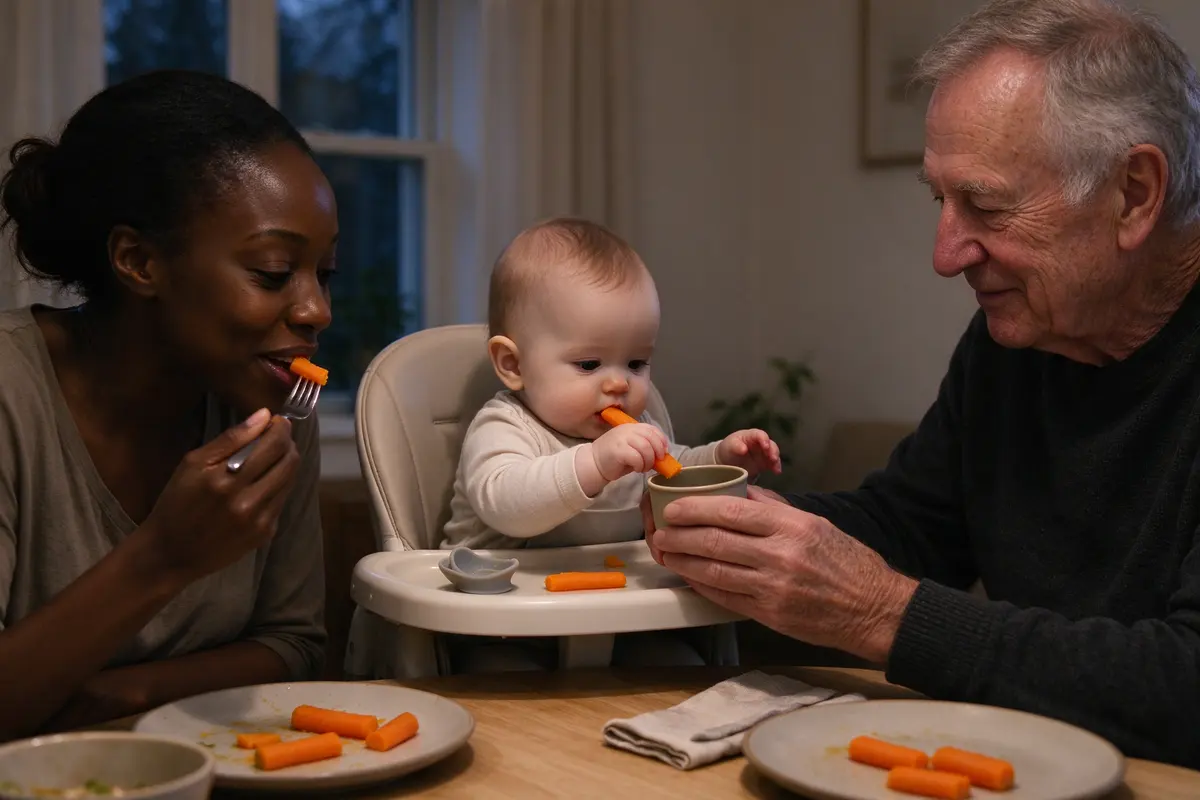
Baby at the family table
Time: One family meal today · Baby at the family table in the guide
Watch for
Normal
a baby who eats almost nothing and watches everyone; breast milk or formula is still the most important source of nutrition (CDC).
Normal
a gag on a piece of pasta, loud and brief (Children's Wisconsin).
Call 911
if your baby is choking and can't breathe, cry, or make noise, turns bluish, or goes limp, and start back blows and chest thrusts while someone calls (AAP).
Normal
a grab for your fork, your glass, and your plate; at this age, hand over a cup or a spoon and be an audience when they copy you (AAP).
Call Poison Help, 1-800-222-1222,
if a sip of something you wouldn't give a baby got in and you think it could be poisonous (AAP).
For you
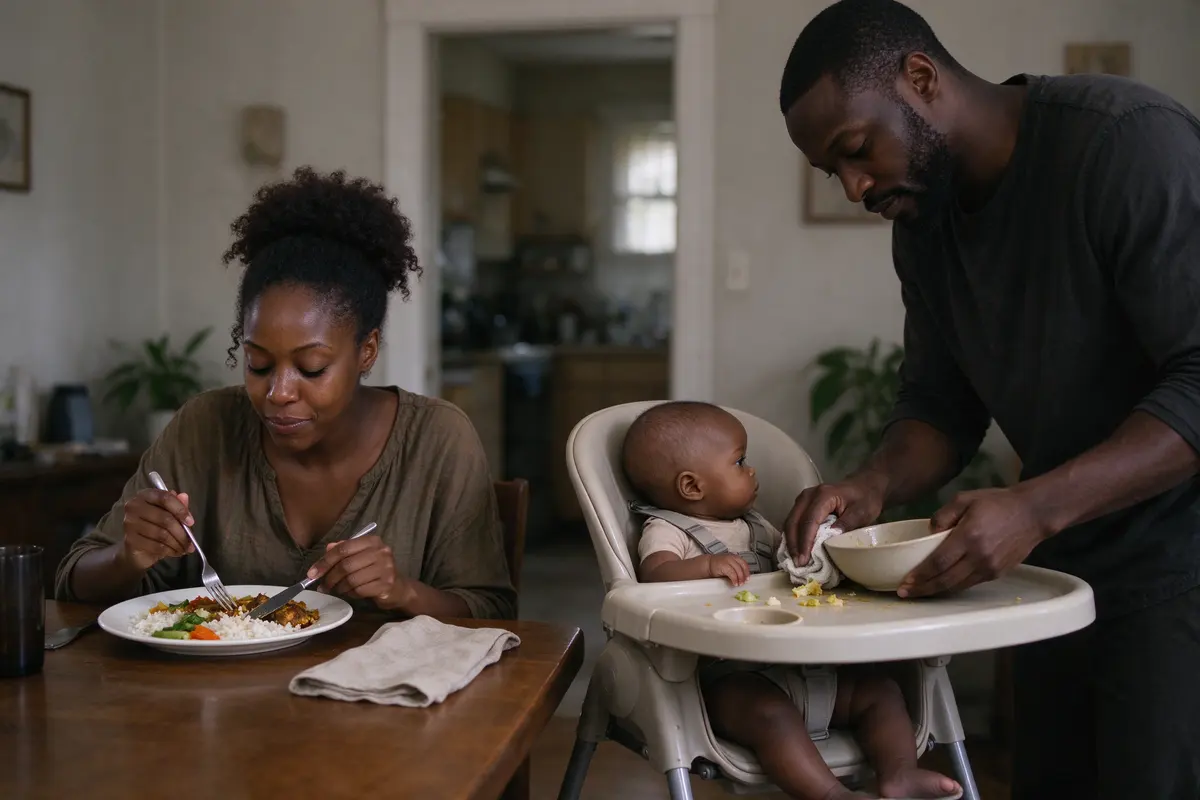
The family meal counts for you too. "Eat together" is the AAP's instruction for the baby (AAP), and it's the first piece of baby advice that requires you to sit down with a plate. Take it literally. The meal where the baby is at the table and you're at the counter cutting carrots isn't the one the AAP described.
Serve the baby's portion first, then sit. If their meal ends in four minutes, they watch you finish yours, which is also the lesson.
If you're the partner: you're on the baby's tray tonight. Cut, serve, watch, and let her eat a hot meal start to finish.
Sources
- American Academy of Pediatrics. "When Can Babies Start Solid Foods? Readiness & Feeding Tips." HealthyChildren.org, updated 2026. https://www.healthychildren.org/English/ages-stages/baby/feeding-nutrition/Pages/Starting-Solid-Foods.aspx
- Muth ND. "Recommended Drinks for Children Age 5 & Younger." HealthyChildren.org, updated 2023. https://www.healthychildren.org/English/healthy-living/nutrition/Pages/Recommended-Drinks-for-Young-Children-Ages-0-5.aspx
- Spill MK, Johns K, Callahan EH, et al. "Repeated exposure to food and food acceptability in infants and toddlers: a systematic review." American Journal of Clinical Nutrition, 2019. https://pubmed.ncbi.nlm.nih.gov/30982874/
- Forestell CA, Mennella JA. "Early determinants of fruit and vegetable acceptance." Pediatrics, 2007. https://pubmed.ncbi.nlm.nih.gov/18055673/
- Centers for Disease Control and Prevention. "Milestones by 9 Months." Learn the Signs. Act Early. program, updated 2026. https://www.cdc.gov/act-early/milestones/9-months.html
- Agbim IA, Hurtado CW. "Baby-Led Weaning: Is It Safe?" HealthyChildren.org, updated 2024. https://www.healthychildren.org/English/ages-stages/baby/feeding-nutrition/Pages/baby-led-weaning-is-it-safe.aspx
- Centers for Disease Control and Prevention. "Choking Hazards." 2026. https://www.cdc.gov/infant-toddler-nutrition/foods-and-drinks/choking-hazards.html
- Bradin S. "Choking Prevention for Babies & Children: What Every Parent Needs to Know." HealthyChildren.org, updated 2026. https://www.healthychildren.org/English/health-issues/injuries-emergencies/Pages/Choking-Prevention.aspx
- Centers for Disease Control and Prevention. "Foods and Drinks to Avoid or Limit." 2026. https://www.cdc.gov/infant-toddler-nutrition/foods-and-drinks/foods-and-drinks-to-avoid-or-limit.html
- Centers for Disease Control and Prevention. "Milestones by 6 Months." Learn the Signs. Act Early. program, updated 2026. https://www.cdc.gov/act-early/milestones/6-months.html
- National Institute of Allergy and Infectious Diseases. "Instructions for Home Feeding of Peanut Protein for Infants at Low Risk of an Allergic Reaction to Peanut" (Appendix D). 2017. https://www.niaid.nih.gov/sites/default/files/addendum_guidelines_peanut_appx_d.pdf
- Cox A, Pistiner M. "When to Introduce Egg, Peanut Butter & Other Common Food Allergens to a Baby." HealthyChildren.org, updated 2025. https://www.healthychildren.org/English/healthy-living/nutrition/Pages/when-to-introduce-egg-peanut-butter-and-other-common-food-allergens-to-your-baby-food-allergy-prevention-tips.aspx
- Lehman P. "Choking vs. gagging: What parents need to know when introducing solid foods to children." Children's Wisconsin, 2024. https://childrenswi.org/at-every-turn/stories/2024/03/choking-vs-gagging-what-parents-need-to-know-when-introducing-solid-foods-to-children
- American Academy of Pediatrics. "Cognitive Development in Infants: 8 to 12 Months." HealthyChildren.org, updated 2023. https://www.healthychildren.org/English/ages-stages/baby/Pages/Cognitive-Development-8-to-12-Months.aspx
- American Academy of Pediatrics. "Home Safety: Tips for Families With Young Children." HealthyChildren.org, updated 2022. https://www.healthychildren.org/English/safety-prevention/at-home/Pages/Home-Safety-Heres-How.aspx
This guide is general education that summarizes published research and guidance from groups like the American Academy of Pediatrics, the CDC, and the WHO. It isn’t medical advice, and every child develops on their own timeline. Your pediatrician knows your child; if something feels wrong, call them. In an emergency, call 911.
Get each day’s note the morning it applies
Add your baby to a free Chorevia household with their date of birth, and every morning for 300 days the day’s note arrives in the app and by email: what’s developing, one thing to try, what to watch for, and a word for you.
Create your household