Day 214 of 300 · Week 29
Raking
Last reviewed · 4 min read · 16 sources · Plain-text version
Raking food toward themselves with the whole hand is on the 9-month list; the thumb-and-finger pincer usually comes around 9 months. A tray of soft bits no bigger than half an inch, and a clear floor.
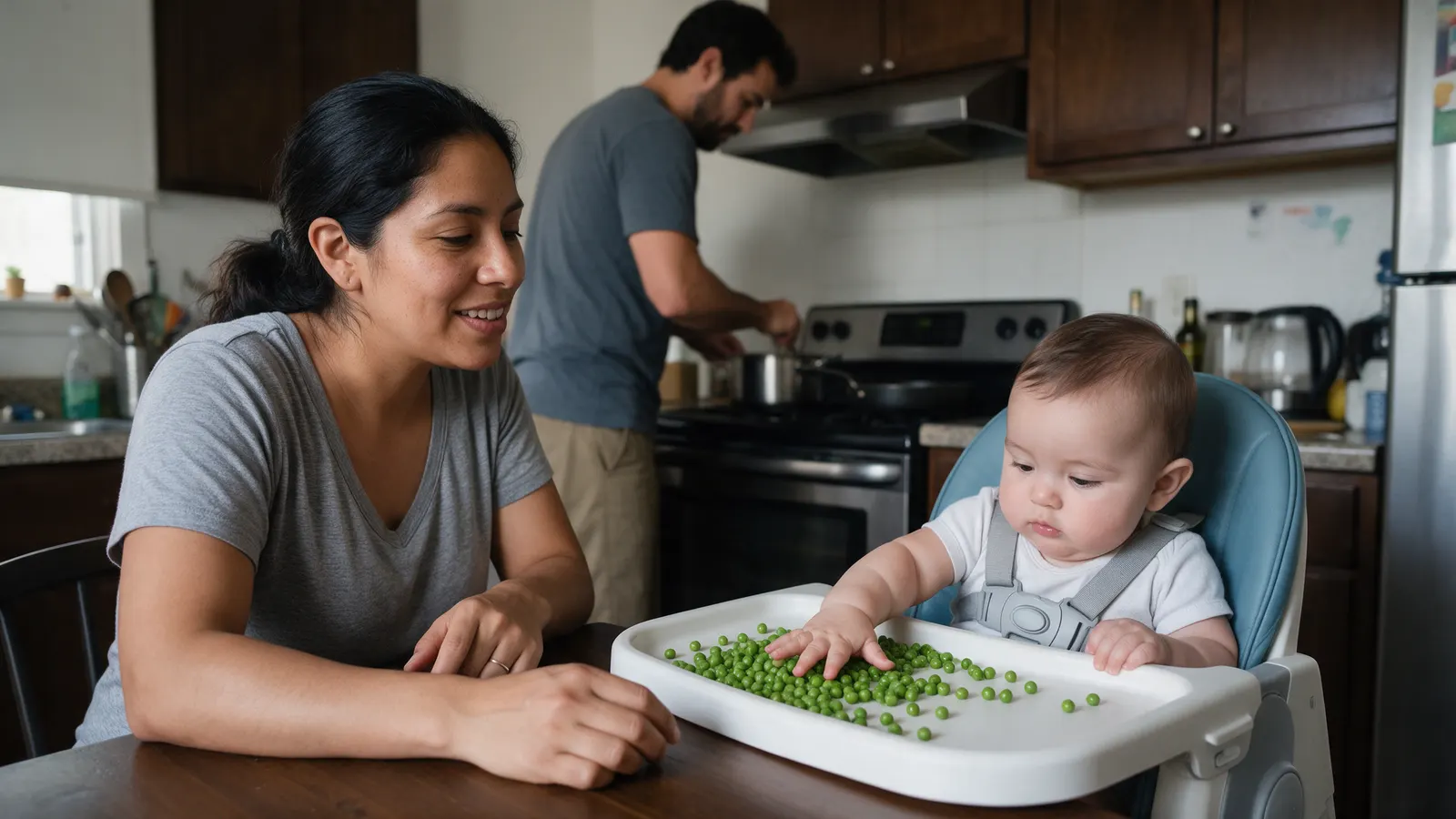
Watch the hand on the tray today. It sweeps everything toward the body in one motion, and that sweep is the skill of the week.
Heart
Early in this stage, your baby rakes things in with the whole hand. By the end of it, most pinch with thumb and finger and practice on anything small, from cereal to dust balls, and once they can let go on purpose, dropping and throwing become favorite games (AAP). Raking food toward themselves is on the 9-month list (CDC); picking up small bits between thumb and pointer finger is on the 12-month one (CDC), and the pincer usually arrives around 9 months (AAP). So the rake is this month's grip, and the fist full of peas is the right answer for now.
Head
Everything the rake catches goes to the mouth. The AAP's line is plain: everything still goes in the mouth, so check the floor often (AAP). Check floors and between cushions for coins, toy parts, and pen caps (AAP). The hand that rakes peas off a tray rakes a button off a rug just as well, and the mouth doesn't know the difference.
Body
Food is the best raking practice there is. Offer soft finger foods cut into small pieces once your baby sits up and brings things to their mouth (AAP). Good ones are soft and easy to swallow: bits of banana, scrambled eggs, well-cooked pasta, finely chopped cooked chicken, cooked potatoes or peas (AAP). Cut pieces no larger than half an inch (AAP). The setup is the one you know: upright and buckled in the high chair (AAP), your eyes on your baby at all times (CDC). CDC encourages letting babies pinch or pick up food with their fingers (CDC); the rake is how that starts.
Try today
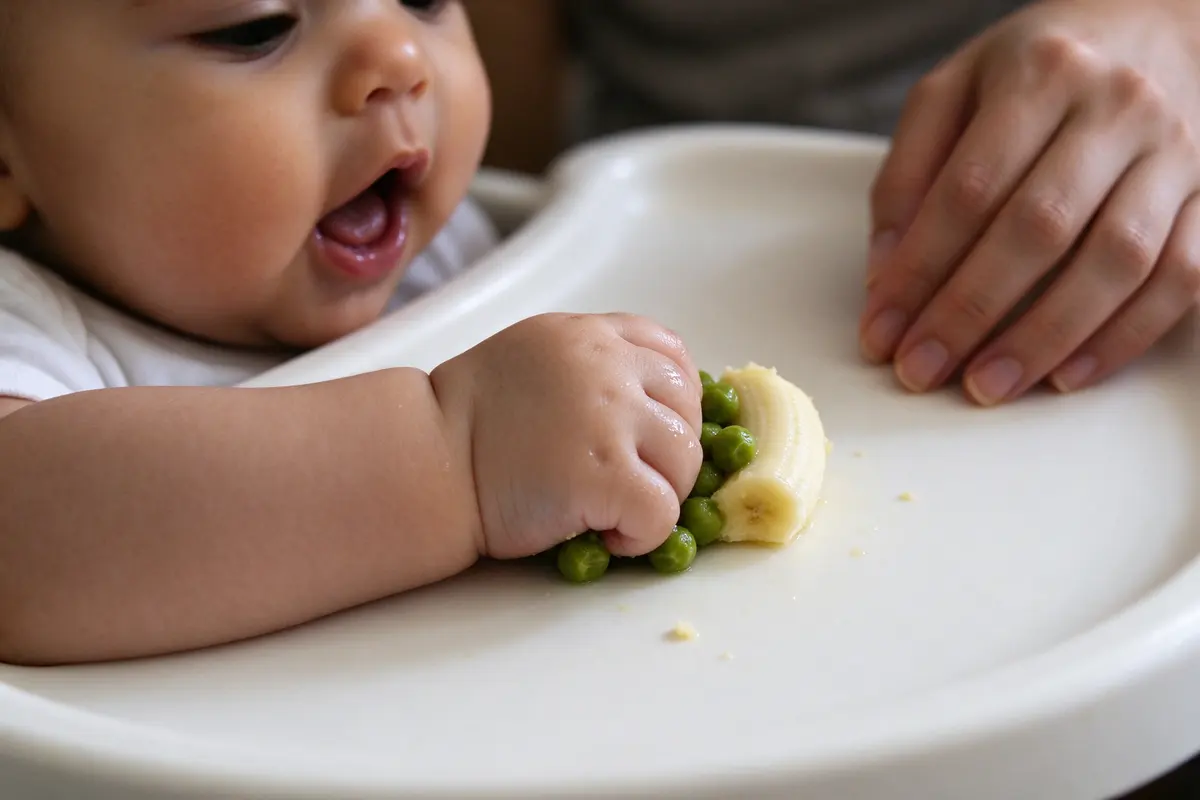
The rake-and-eat snack
Time: One snack, about 10 minutes · Pincer picking in the guide
Buckle your baby upright in the high chair and put three or four soft pieces on the tray, like cooked peas or bits of banana, none larger than half an inch (AAP).
Let the whole hand sweep them in. A fist with one pea in it is a success; don't tidy the pile toward the fingers.
Name each food as it goes in: "Pea. Banana."
When pieces land on the floor, leave them until the snack is over, then clear the floor before your baby gets down to it (AAP).
Make it work:Stay with your baby for the whole snack (AAP). Keep pieces soft enough to mash between two fingers.
Watch for
Normal
a loud gag on a bit of banana, with coughing and sputtering; the gag is noisy and protective (Children's Wisconsin).
Call 911
if your baby goes silent or squeaky, can't cry or cough, or turns pale or blue, and start back blows and chest thrusts (Red Cross).
Normal
a new food refused on the fifth try; it can take 8 to 10 or more days of tasting (Spill et al., 2019).
Normal
raking with the left hand as often as the right.
Bring it up
if your baby reaches with only one hand (AAP).
For you
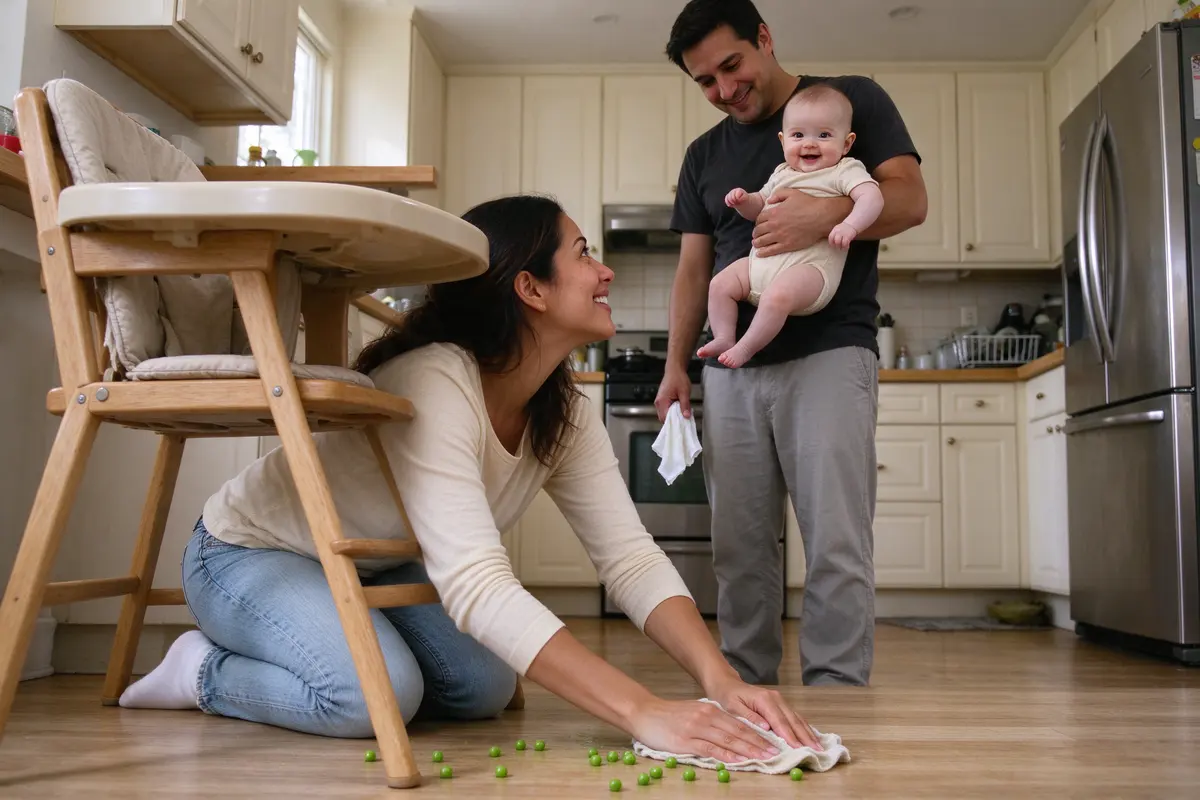
The tray is the mess you signed up for. CDC's advice is to let babies pinch or pick up food with their fingers (CDC), and there's no version of that without peas on the floor and banana in the hair. The mess is the method, not a sign you're doing it wrong. A towel under the chair, a washcloth within reach, and the floor cleared before the baby goes down on it: that's the whole system (AAP).
Save your effort for the part that matters, which is sitting there and watching. The wiping can wait ten minutes; the watching can't.
If you're the partner: the floor under the chair is yours after every snack. Not later. The baby will be down there next.
Sources
- American Academy of Pediatrics. "Hand and Finger Skills." HealthyChildren.org, updated 2009. https://www.healthychildren.org/English/ages-stages/baby/Pages/Hand-and-Finger-Skills.aspx
- Centers for Disease Control and Prevention. "Milestones by 9 Months." Learn the Signs. Act Early. program, updated 2026. https://www.cdc.gov/act-early/milestones/9-months.html
- Centers for Disease Control and Prevention. "Milestones by 1 Year." Learn the Signs. Act Early. program, updated 2026. https://www.cdc.gov/act-early/milestones/1-year.html
- American Academy of Pediatrics. "Movement Milestones: Babies 4 to 7 Months." HealthyChildren.org, updated 2021. https://www.healthychildren.org/English/ages-stages/baby/Pages/Movement-4-to-7-Months.aspx
- American Academy of Pediatrics. "Cognitive Development in Infants: 8 to 12 Months." HealthyChildren.org, updated 2023. https://www.healthychildren.org/English/ages-stages/baby/Pages/Cognitive-Development-8-to-12-Months.aspx
- Bradin S. "Choking Prevention for Babies & Children: What Every Parent Needs to Know." HealthyChildren.org, updated 2026. https://www.healthychildren.org/English/health-issues/injuries-emergencies/Pages/Choking-Prevention.aspx
- American Academy of Pediatrics. "When Can Babies Start Solid Foods? Readiness & Feeding Tips." HealthyChildren.org, updated 2026. https://www.healthychildren.org/English/ages-stages/baby/feeding-nutrition/Pages/Starting-Solid-Foods.aspx
- Agbim IA, Hurtado CW. "Baby-Led Weaning: Is It Safe?" HealthyChildren.org, updated 2024. https://www.healthychildren.org/English/ages-stages/baby/feeding-nutrition/Pages/baby-led-weaning-is-it-safe.aspx
- Centers for Disease Control and Prevention. "Choking Hazards." 2026. https://www.cdc.gov/infant-toddler-nutrition/foods-and-drinks/choking-hazards.html
- Centers for Disease Control and Prevention. "Tastes and Textures." 2026. https://www.cdc.gov/infant-toddler-nutrition/foods-and-drinks/tastes-and-textures.html
- Lehman P. "Choking vs. gagging: What parents need to know when introducing solid foods to children." Children's Wisconsin, 2024. https://childrenswi.org/at-every-turn/stories/2024/03/choking-vs-gagging-what-parents-need-to-know-when-introducing-solid-foods-to-children
- American Red Cross. "Infant Choking: How To Help." Accessed 2026. https://www.redcross.org/take-a-class/resources/learn-first-aid/infant-choking
- Spill MK, Johns K, Callahan EH, et al. "Repeated exposure to food and food acceptability in infants and toddlers: a systematic review." American Journal of Clinical Nutrition, 2019. https://pubmed.ncbi.nlm.nih.gov/30982874/
- National Institute of Allergy and Infectious Diseases. "Instructions for Home Feeding of Peanut Protein for Infants at Low Risk of an Allergic Reaction to Peanut" (Appendix D). 2017. https://www.niaid.nih.gov/sites/default/files/addendum_guidelines_peanut_appx_d.pdf
- Cox A, Pistiner M. "When to Introduce Egg, Peanut Butter & Other Common Food Allergens to a Baby." HealthyChildren.org, updated 2025. https://www.healthychildren.org/English/healthy-living/nutrition/Pages/when-to-introduce-egg-peanut-butter-and-other-common-food-allergens-to-your-baby-food-allergy-prevention-tips.aspx
- American Academy of Pediatrics. "Developmental Milestones: 7 Months." HealthyChildren.org, updated 2009. https://www.healthychildren.org/English/ages-stages/baby/Pages/Developmental-Milestones-7-Months.aspx
This guide is general education that summarizes published research and guidance from groups like the American Academy of Pediatrics, the CDC, and the WHO. It isn’t medical advice, and every child develops on their own timeline. Your pediatrician knows your child; if something feels wrong, call them. In an emergency, call 911.
Get each day’s note the morning it applies
Add your baby to a free Chorevia household with their date of birth, and every morning for 300 days the day’s note arrives in the app and by email: what’s developing, one thing to try, what to watch for, and a word for you.
Create your household