Day 220 of 300 · Week 30
Choking, this month
Last reviewed · 4 min read · 12 sources · Plain-text version
Finger foods bring the choking rules back: pieces no larger than half an inch, the not-before-1 list, a silent baby versus a noisy one, and the five-and-five. Cut tonight's food and check it.

The tray has more pieces on it than it did in week one. Today is the choking note for a baby who rakes, with a cut you can check against your own hand.
Heart
Choking is a leading cause of death for young children, and two-thirds of the children who die from choking are babies under 1 (AAP). Cut pieces no larger than half an inch (AAP). The AAP's before-age-1 list, from hot dogs and whole grapes to nuts, popcorn, and chunks of meat, cheese, or peanut butter, stays off the tray (AAP). Everything else has to pass two tests: small enough, and soft enough to mash with the gums (AAP).
Head
The difference is sound. A gagging baby is noisy, coughing and sputtering, and the gag is a protective reflex that's common in the first months of solids (Children's Wisconsin). Choking is silent: a weak or no cough, high-pitched squeaks or no sound, being unable to cry, pale or blue skin, and a panicked look (Red Cross). The 6-month guide has the full picture. The response: have someone call 911 while you hold your baby face-down along your forearm, head lower than the body, and give 5 firm back blows, then turn them face-up and give 5 chest thrusts. Repeat until the food comes out or your baby can cough or cry; start CPR if they become unresponsive (Red Cross). The 2025 AHA and AAP guidelines keep this approach and advise against abdominal thrusts for babies (AAP, 2025).
Body
Try today
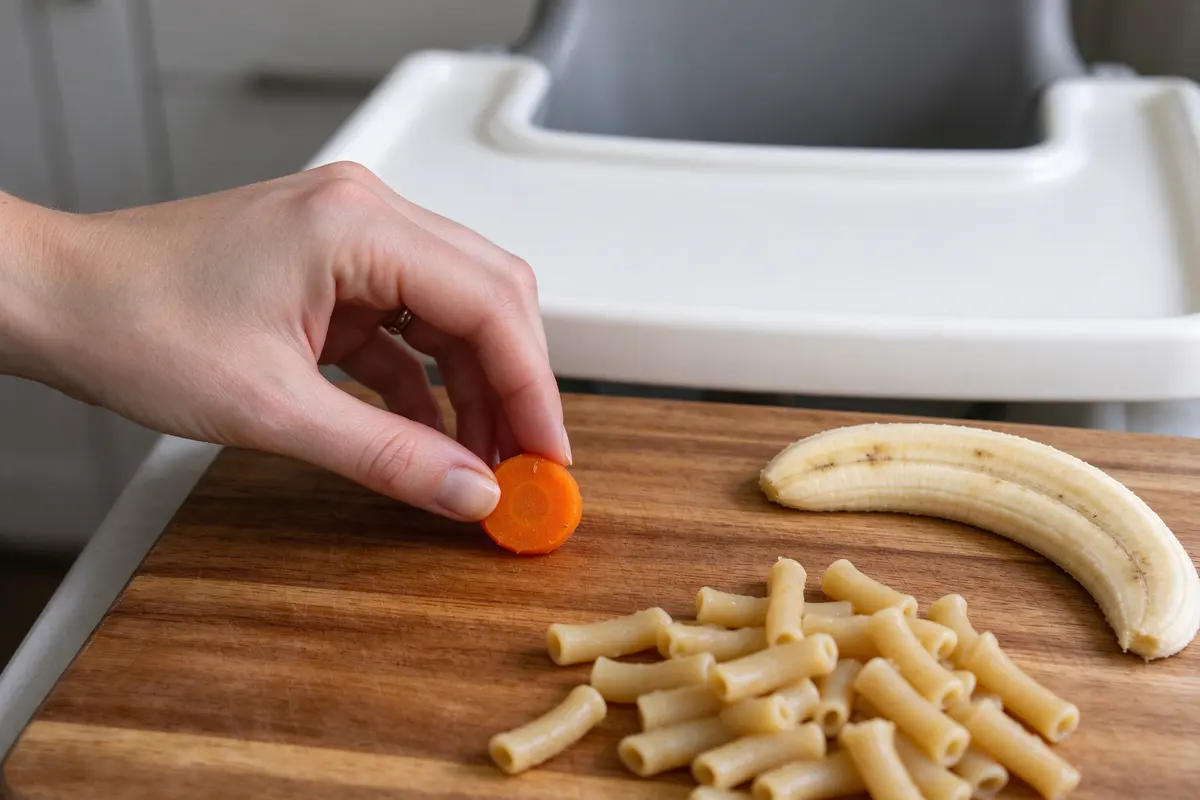
The half-inch cut
Time: 5 minutes before tonight's meal
Cut tonight's finger food, then hold the biggest piece against your little fingernail. The AAP's limit is half an inch; a piece wider than that nail is too big (AAP).
Squash one piece between your thumb and finger. It should flatten with no effort, the way it would between gums (AAP).
Check the plate against the before-age-1 list: no hot dogs, nuts, chunks of meat or cheese, whole grapes, popcorn, chunks of peanut butter, raw vegetables, raw fruit chunks, or hard or sticky candy (AAP).
Make it work:Cut round things lengthwise into strips; avoid coin-shaped slices (AAP).
Watch for
Normal
a loud gag, a cough, and the pasta back on the tray (Children's Wisconsin).
Call 911
if your baby goes silent or squeaky, can't cry or cough, or turns pale or blue, and start back blows and chest thrusts (Red Cross).
Normal
a cough that clears and a baby who reaches for the next piece.
Go to the ER now
for any trouble breathing afterward, including ribs pulling in with each breath or loud wheezing (AAP).
Normal
a dropped piece found on the floor an hour later; everything goes in the mouth, so check the floor often (AAP).
Normal
knowing this baby better than anyone alive.
Call anyway
if your baby just doesn't seem right to you. Trust your instincts; ten days into month eight, they're sharper than ever (Lurie Children's).
For you

Nobody eats in the car seat. It's the baby's rule (CDC), and it ends the habit of driving with one hand and passing a puff back with the other. The snack container stays closed until the car is parked and the baby is upright in a chair with someone's eyes on them. It costs nothing and asks only that you wait ten minutes.
And the class, if it isn't booked. The drill you've said out loud is the words; the class is the hands (AAP).
If you're the partner: the snack container rides in your bag, not in the back seat. And you're the one who books the class, this week.
Sources
- Bradin S. "Choking Prevention for Babies & Children: What Every Parent Needs to Know." HealthyChildren.org, updated 2026. https://www.healthychildren.org/English/health-issues/injuries-emergencies/Pages/Choking-Prevention.aspx
- American Academy of Pediatrics. "When Can Babies Start Solid Foods? Readiness & Feeding Tips." HealthyChildren.org, updated 2026. https://www.healthychildren.org/English/ages-stages/baby/feeding-nutrition/Pages/Starting-Solid-Foods.aspx
- Agbim IA, Hurtado CW. "Baby-Led Weaning: Is It Safe?" HealthyChildren.org, updated 2024. https://www.healthychildren.org/English/ages-stages/baby/feeding-nutrition/Pages/baby-led-weaning-is-it-safe.aspx
- Lehman P. "Choking vs. gagging: What parents need to know when introducing solid foods to children." Children's Wisconsin, 2024. https://childrenswi.org/at-every-turn/stories/2024/03/choking-vs-gagging-what-parents-need-to-know-when-introducing-solid-foods-to-children
- American Red Cross. "Infant Choking: How To Help." Accessed 2026. https://www.redcross.org/take-a-class/resources/learn-first-aid/infant-choking
- American Academy of Pediatrics. "AHA, AAP Update CPR Guidelines To Help Save Young Lives." HealthyChildren.org, 2025. https://www.healthychildren.org/English/news/Pages/AHA-and-AAP-release-update-CPR-guidelines-to-help-save-young-lives.aspx
- Centers for Disease Control and Prevention. "Choking Hazards." 2026. https://www.cdc.gov/infant-toddler-nutrition/foods-and-drinks/choking-hazards.html
- American Academy of Pediatrics. "Breathing Trouble" (symptom checker). HealthyChildren.org, accessed 2026. https://www.healthychildren.org/English/tips-tools/symptom-checker/Pages/symptomviewer.aspx?symptom=Breathing+Trouble
- American Academy of Pediatrics. "Cognitive Development in Infants: 8 to 12 Months." HealthyChildren.org, updated 2023. https://www.healthychildren.org/English/ages-stages/baby/Pages/Cognitive-Development-8-to-12-Months.aspx
- US Consumer Product Safety Commission. "Making Families Safer from Button Cell or Coin Battery Dangers; Reese's Law Leads to New Federal Mandatory Safety Standard." 2023. https://www.cpsc.gov/Newsroom/News-Releases/2023/Making-Families-Safer-from-Button-Cell-or-Coin-Battery-Dangers-Reeses-Law-Leads-to-New-Federal-Mandatory-Safety-Standard
- US Consumer Product Safety Commission. "Magnets" (Safety Education Center). Accessed 2026. https://www.cpsc.gov/Safety-Education/Safety-Education-Centers/Magnets
- Latimer T. "When to Call the Pediatrician for Your Newborn." Lurie Children's Hospital of Chicago, 2022. https://www.luriechildrens.org/en/blog/when-to-call-the-pediatrician-for-your-newborn/
This guide is general education that summarizes published research and guidance from groups like the American Academy of Pediatrics, the CDC, and the WHO. It isn’t medical advice, and every child develops on their own timeline. Your pediatrician knows your child; if something feels wrong, call them. In an emergency, call 911.
Get each day’s note the morning it applies
Add your baby to a free Chorevia household with their date of birth, and every morning for 300 days the day’s note arrives in the app and by email: what’s developing, one thing to try, what to watch for, and a word for you.
Create your household